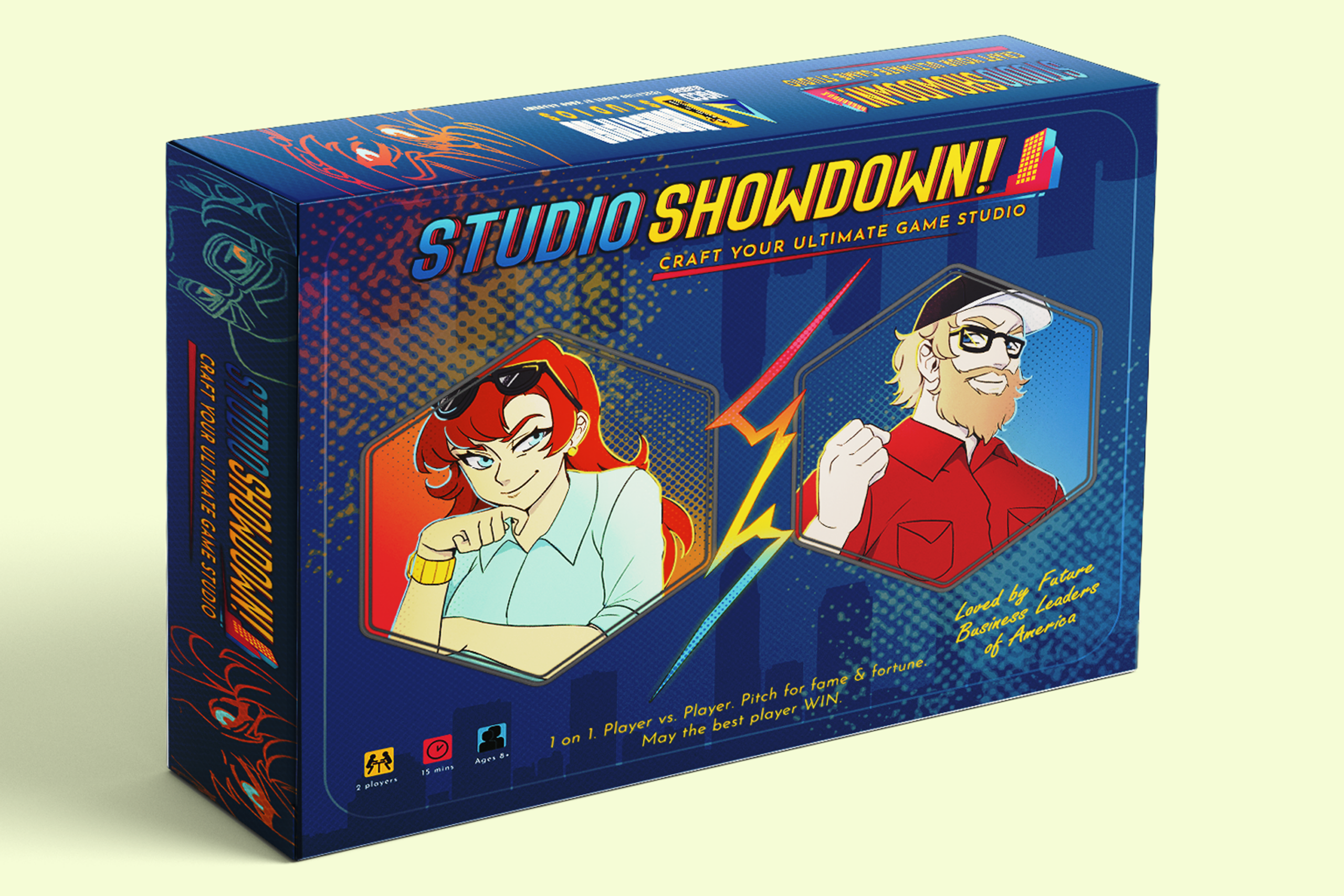
The most valuable business degree isn’t printed on cardstock. It’s won across a tabletop. Traditional textbooks fail to capture the adrenaline of a real pitch, and endless screen time leaves students drained rather than inspired. You likely feel that gap between a spreadsheet and a real-world success story. It’s time to bridge it. Real business acumen isn’t learned in a vacuum. It’s forged in the heat of a tactical showdown.
We agree that standard curriculum often lacks the pulse of the industry. That’s why we’re showing you exactly how immersive business board games for students transform passive learners into tactical entrepreneurs. You’ll learn how these simulations turn complex financial concepts into intuitive gameplay, allowing students to build professional portfolios before they even graduate. This article previews the elite simulation games for 2026, focusing on the immersive Studio Founder experience. We’ll look at how tools like Studio Showdown move beyond the visual noise to deliver high classroom engagement and authentic results. It’s time to stop reading about success and start producing it.
Key Takeaways
- Move beyond passive observation and master market dynamics through high-stakes active learning environments.
- Bridge the gap between theory and practice by building a resume-worthy portfolio through immersive gameplay.
- Evaluate the unique strengths of business board games for students to leverage tactile strategy and social cues.
- Learn a clear, two-step process for integrating professional simulations into STEM and entrepreneurship curricula.
- Discover how Studio Showdown balances creative vision with the cutthroat realities of fundraising and market dominance.
Why Business Simulation Games for Students are the Ultimate 2026 Learning Tool
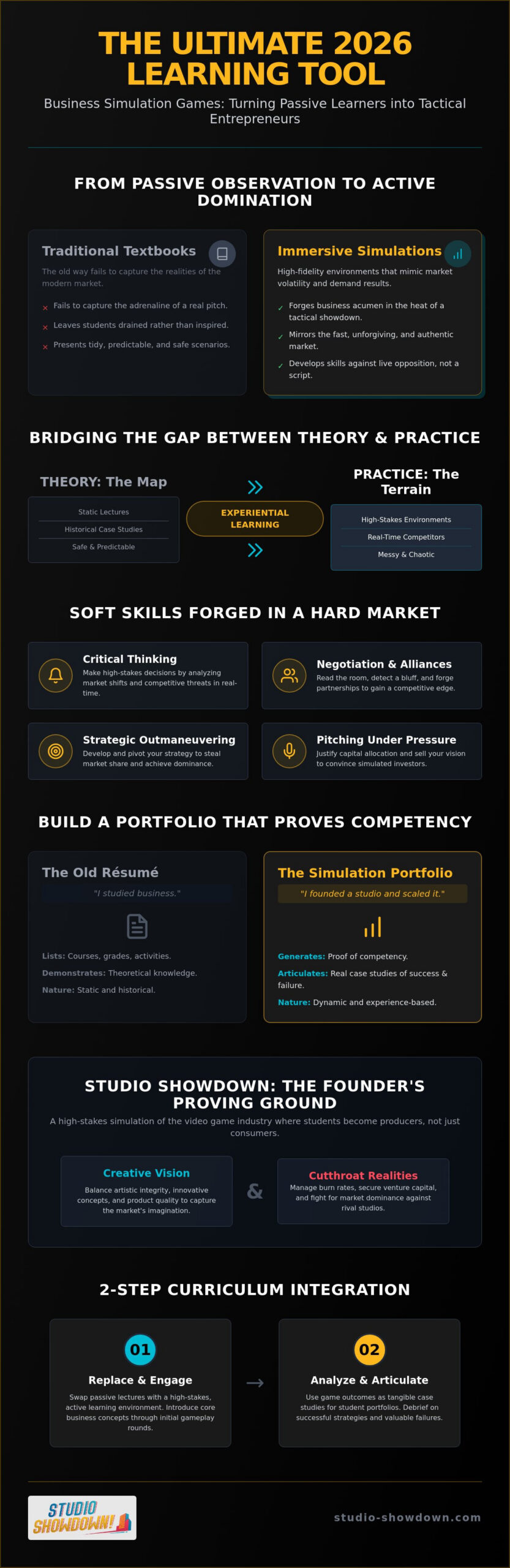
Business simulation games aren’t just entertainment. They’re high-fidelity environments that mimic market volatility and demand results. In 2026, the era of passive observation is over. Students don’t want to watch; they want to lead. This shift from reading to doing defines modern pedagogy. A simulation is a mirror of the real market. It’s fast. It’s unforgiving. It’s authentic. When students step into these roles, they aren’t just playing; they’re practicing for their first real-world venture.
The psychological impact of “skin in the game” is the secret to deep retention. When you’re the founder, every move has weight. Risk drives focus. Winning isn’t just about points; it’s about proving a strategy works against live opposition. Traditional case studies are historical artifacts. They’re tidy, predictable, and safe. Business board games for students are the opposite. They’re messy. They’re chaotic. They involve real-time competitors who don’t follow a script. This complexity prepares students for a career where the answers aren’t in the back of the book.
The Experiential Learning Revolution
Theory is a map. Practice is the terrain. Educators are increasingly turning to business board games for students to replace static lectures with high-stakes environments. Failure here isn’t a failing grade; it’s a pivot. It’s a low-risk, high-reward mechanism that allows for radical experimentation. By 2026, the classroom has become a war room where students bridge the gap between classroom theory and industry practice through pure, unadulterated experience.
Soft Skills in a Hard Market
Hard skills might get you an interview, but soft skills build empires. Critical thinking, negotiation, and strategic outmaneuvering are the core of any successful studio. In a live simulation, social interaction is the ultimate currency. Students learn to read the room, detect a bluff, and pitch under pressure. Decisions have irreversible consequences. You can’t undo a bad deal or un-spend venture capital. Learning to handle these moments in a safe space builds the professional grit required to rise above the visual noise of a crowded industry.
Beyond the Textbook: Building Real-World Professional Portfolios Through Play
Resumes are often static. They list courses, grades, and extracurricular activities that rarely demonstrate the visceral reality of making a hard decision under pressure. Simulations change the narrative. When students engage with business board games for students, they aren’t just earning points; they’re generating proof of competency. Every successful studio launch or tactical pivot becomes a case study they can articulate in a college interview or a job application. It’s about moving from “I studied business” to “I founded a studio and scaled it to market dominance.”
The video game industry serves as the perfect high-stakes business model for this generation. It’s a sector where creative vision meets cutthroat market reality. By acting as a studio founder, a teenager stops being a consumer and starts being a producer. They develop a CEO mindset by balancing artistic integrity with the cold math of burn rates and ROI. This isn’t just play. It’s professional development disguised as competition.
Mastering the Art of the Pitch
In the real world, a great idea dies without capital. Students learn this early when they have to present their vision to simulated investors. They must justify their capital allocation, defend their market projections, and convince a room of rivals that their studio is the one worth backing. Pitching is the bridge between a creative idea and a market-ready product. Mastering this skill early gives students a massive advantage in any career path, teaching them to cut through the visual noise and deliver a message that commands authority.
Game Development as a Business Strategy
Understanding the lifecycle of a product is essential for any aspiring entrepreneur. Students manage everything from the initial concept to global distribution. They don’t work in a vacuum; they respond to competitive shifts from rival studios who are trying to steal their market share. This constant pressure forces a deeper level of engagement with core financial concepts. It’s the most effective way of mastering entrepreneurship while still in the classroom.
By the time the game ends, the students have managed a full production cycle. They’ve handled setbacks, celebrated wins, and learned that success is a result of calculated risk. If you want your students to develop this level of professional grit, consider integrating a tool like the Studio Showdown Board Game into your next semester’s curriculum. It’s the difference between reading about a founder and actually becoming one.
Digital vs. Analog: Choosing the Right Simulation Format for Your Students
Digital simulations are efficient. They track data. They scale across remote environments. But they often lack the grit of a physical encounter. In 2026, the classroom needs more than just another browser tab. Business board games for students bring strategy to life in a way that code cannot replicate. They force eye contact. They demand a presence that a screen simply cannot sustain. While digital tools offer spreadsheets, analog tools offer a visceral connection to the market.
The choice between digital and analog isn’t just about technology. It’s about engagement. Educators report a growing screen-fatigue crisis that leaves students drained and disconnected. Moving the simulation to a physical tabletop changes the energy of the room. It turns a solitary task into a high-stakes social event. This is where real learning happens. It’s where theory meets the social friction of actual business.
The Case for Screen-Free Strategy
Digital fatigue is a 2026 reality. Students spend hours behind glass, leading to fragmented attention and diminished focus. Physical boards create a sanctuary of concentration. There are no notifications. There are no pop-ups. There is only the board, the pieces, and the rivals. This unplugged time is critical for mental health and peer bonding. Explore more screen-free activities for families to see how this transition impacts learning beyond the school walls. Analog games ground the experience in the present moment.
Tactical Thinking and Face-to-Face Negotiation
A screen hides the bluff. A table exposes it. Face-to-face negotiation involves reading body language, detecting hesitation, and managing social pressure. This is the “Showdown factor.” It’s where the most impactful lessons are learned. You can’t hide behind an avatar when you’re pitching for capital. The strategy of analog play is deeper than any digital clone. It forces students to handle the social reality of entrepreneurship. They learn to pivot when they see a rival’s confidence waver. They learn that business is as much about people as it is about profit.
Analog formats foster superior collaborative problem-solving. When students sit around a table, they share a physical perspective. They point to the board, move components, and debate tactics in real time. This tactile interaction grounds abstract concepts of finance and marketing. It turns business board games for students into a communal experience rather than a solitary grind. Efficiency is one thing. Impact is another. Choose the format that leaves a lasting mark on their professional development.
How to Integrate Business Simulations into STEM and Entrepreneurship Curricula
Integration isn’t a passive event; it’s a tactical deployment. To move beyond the textbook, you need a blueprint that connects gameplay to grade-level standards. Start by identifying your core learning objectives. Are you focusing on financial literacy, market psychology, or leadership? Once the target is set, select a simulation that mirrors student interests. For the 2026 cohort, the high-growth world of game design is the ultimate hook. Using business board games for students that simulate studio management ensures they stay locked in from the first turn to the final pitch.
Structure is what separates a “game day” from a professional workshop. Divide your sessions into active play and critical debriefing. The debrief is where the theory sticks. It’s where you connect a failed fundraising round in the game to a real-world market shift. Use these moments to link game outcomes to current business news. When students see their tactical errors reflected in industry headlines, the lesson becomes indelible. The Studio Showdown: Educator Edition provides the specific framework needed to facilitate these high-level connections without adding to your prep time.
Aligning with STEM Standards
Game mechanics are mathematical models in disguise. Resource management isn’t just a game feature; it’s an exercise in optimization and engineering logic. Students must calculate burn rates, project ROI, and manage complex production pipelines. This is STEM in its most practical form. By using a Classroom Bundle, you can scale this experience across multiple groups simultaneously. This turns the classroom into a competitive ecosystem where mathematical modeling determines who dominates the market and who goes bust.
The Role of the Educator as a Mentor
Step away from the podium and embrace the role of the Game Master. In this environment, you aren’t a lecturer; you’re a facilitator of a high-stakes simulation. Your job is to provoke critical thinking, challenge assumptions, and mentor students through the “messy complexity” of a startup. This proactive approach builds a culture of creative bravery. To elevate your classroom facilitation, explore our guide on mastering strategy board games. It’s time to stop teaching entrepreneurship and start hosting it.
Ready to lead the next generation of founders? Secure a Classroom Bundle and transform your curriculum into a professional-grade studio experience.
Studio Showdown: The Strategy Board Game for the Next Generation of Founders
Studio Showdown is the definitive simulation for the next wave of industry leaders. It bridges the gap between artistic vision and market dominance. While most business board games for students focus on generic corporate roles, this experience dives deep into the high-octane world of video game development. Forged through the combined expertise of VGCD Academy and DEMYSTIFIED Studios, this is professional-grade training. It’s where creativity meets capital in a high-stakes environment.
The dual focus is intentional. Creative game design is worthless without a viable business model. Conversely, a perfect business plan fails without a compelling product. Students must master both. They learn to allocate resources, manage talent, and pitch to investors who demand results. By mastering these mechanics, students build a portfolio of strategic decisions. They prove they can handle the pressure of a real-world studio launch before they even enter the workforce.
Act Like a Founder, Think Like a Pro
Launching a hit game in a crowded market requires more than luck. It requires tactical precision. Students must navigate the visual noise of the industry to find their niche. They don’t just build; they compete. Strategic outmaneuvering is the core of the experience. You outplay rival studios for market share. You pivot when a competitor steals your spotlight. Tactile components. Sharp design. High-fidelity production. Every card and board piece reinforces the feeling of being in a high-stakes production environment. This is a premium tabletop experience designed for those who refuse to settle for mediocrity.
Get Started with Studio Showdown
Finding the right fit for your classroom is straightforward. You can choose the individual Studio Showdown Board Game for small groups or the specialized Studio Showdown: Educator Edition for institutional use. The Educator Edition includes the frameworks needed to turn play into a structured, high-impact curriculum. For larger institutions, the Classroom Bundle offers the most efficient way to scale the experience across multiple departments. We also provide professional development workshops. These sessions ensure your staff can facilitate simulations with the authority of a seasoned Game Master.
The future of entrepreneurship isn’t found in a lecture hall. It’s found at the table. It’s time to stop observing and start competing. Equip your students with the tools they need to rise above the noise and dominate the market. Secure your Classroom Bundle today and witness the transformation from student to founder.
Dominate the Market: Your Studio Founder Journey Starts Now
The era of passive learning has ended. You’ve seen how immersive simulations bridge the gap between classroom theory and the cutthroat reality of the game industry. By prioritizing tactile strategy over screen fatigue, you give students the social and financial grit they need to lead. High-fidelity business board games for students aren’t just an elective; they’re a competitive advantage that builds a professional portfolio before graduation. Real business acumen isn’t gifted; it’s earned through high-stakes competition and tactical pivots.
Studio Showdown, developed by the industry experts at VGCD Academy, provides the professional-grade environment required for a 2026 curriculum. It’s an immersive strategy for screen-free learning that transforms a standard classroom into a tactical war room where decisions have weight. Schools are already using these simulations to build authentic business acumen and entrepreneurial confidence. It’s time to rise above the visual noise of traditional textbooks and start producing results. Secure your Studio Showdown Classroom Bundle today. Equip your students with the mindset of a founder and the skills of a pro. The next great studio is waiting to be built at your table.
Frequently Asked Questions
Are business simulation games effective for middle school students?
Yes, business simulation games are highly effective for middle school students. They translate abstract economic theories into tactile, competitive mechanics. At this age, students are developing critical thinking skills. Immersive gameplay keeps them engaged without the boredom of a textbook. It’s the perfect time to introduce the “Studio Founder” mindset through low-risk experimentation and active play.
How do simulation games teach financial literacy?
Simulation games teach financial literacy by forcing students to manage finite resources in a volatile market. They handle capital, calculate burn rates, and project ROI. It isn’t just math; it’s survival. When a student’s studio faces bankruptcy due to poor allocation, the lesson sticks. This hands-on approach makes business board games for students more impactful than any lecture on budget management.
Can board games really compete with digital business simulations?
Board games offer a unique social friction that digital simulations can’t replicate. While digital tools excel at data tracking, analog games focus on face-to-face negotiation and reading body language. The “Showdown” factor comes from looking a rival in the eye during a pitch. This social layer is essential for mastering real-world entrepreneurship and building professional grit in a crowded market.
What skills do students learn from game development simulations?
Students develop a comprehensive suite of leadership and tactical skills through these simulations. They master the art of the pitch, fundraising, and strategic outmaneuvering. Beyond the numbers, they learn to handle irreversible consequences in a safe environment. These simulations prepare them to navigate the visual noise of the modern market with confidence and artistic bravery.
How do I choose the right business game for my classroom?
Select a game that aligns with student interests and offers structured support for teachers. For 2026, business board games for students that focus on the video game industry are the ultimate hook. Look for options like a Classroom Bundle that includes institutional licensing. Ensure the game provides an Educator Edition to help you facilitate professional development workshops effortlessly and effectively.
Is Studio Showdown aligned with national educational standards?
Yes, Studio Showdown is designed to align with national STEM and entrepreneurship standards. It focuses on mathematical modeling, resource management, and engineering logic. Educators use it to meet core learning objectives while maintaining high classroom engagement. It moves beyond simple play to deliver a professional-grade workshop experience for aspiring developers and future leaders.
How much time is needed to complete a full business simulation session?
A full session typically requires 60 to 90 minutes for a complete production cycle. This timeframe allows for active play, tactical shifts, and a deep debriefing session. You can easily adapt the game to fit standard classroom blocks. The Educator Edition provides a blueprint for breaking the simulation into manageable segments without losing any competitive momentum or student focus.
Do students need prior knowledge of the video game industry to play?
No prior knowledge of the video game industry is required to excel in the simulation. The game is designed to teach the industry lifecycle from the ground up. It transforms students from passive consumers into proactive producers. They learn the business of game design through the mechanics of the simulation itself, making the learning curve intuitive and rewarding for everyone.