What if the most enthusiastic “I’d totally buy that” is the weakest evidence your idea has a market? It’s easy to mistake compliments for demand, especially when classmates want to support one another. Strong market validation activities for students focus on what people actually do, not just what they say. This guide shows you how to turn a business idea into specific assumptions, choose practical classroom activities to test them, and use the evidence to decide what to improve next.
Start with a clear question: Who has the problem, how do they handle it now, and what would show they’re willing to try a different solution? Then choose a test that fits your question, time, and resources. Students might observe a task, interview potential users, or test a simple offer. The goal isn’t to prove an idea is brilliant. It’s to learn what the evidence supports, identify what remains uncertain, and make a reasoned call to refine, test again, or rethink the idea.
Key Takeaways
- Separate assumptions about your audience, their problem, your solution, and their willingness to act before choosing a test.
- Choose from five adaptable market validation activities for students, matching each one to the question you need to answer and the resources you have.
- Compare activities by the evidence they produce, the effort involved, and the limits of what each result can tell you.
- Use a shared evidence log to capture your hypothesis, method, observations, limitations, and next action.
- Use Studio Showdown as a discussion supplement for entrepreneurial decisions, not as a replacement for real-world research.
What Market Validation Means for Student Business Ideas
Market validation is testing whether a specific group of people has a real problem and wants a proposed solution enough to take action. It’s not a vote on whether an idea sounds fun. It’s a focused way to gather evidence before a team invests more time building, promoting, or pitching it.
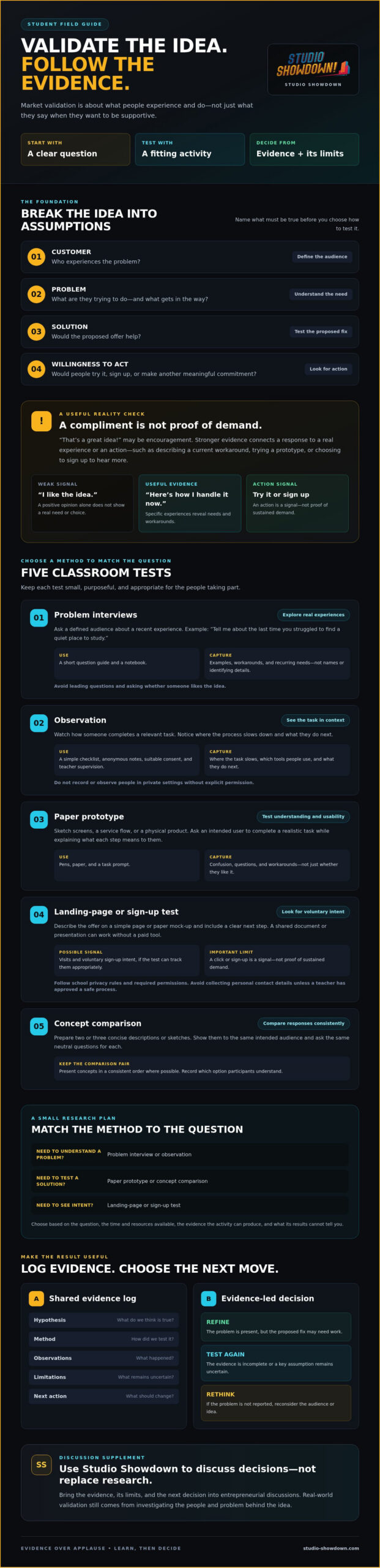
For student teams, validation starts by separating four assumptions:
- Customer: Who experiences the problem?
- Problem: What are they trying to do, and what gets in their way?
- Solution: Would the proposed offer help?
- Willingness to act: Would people try it, sign up, or make another meaningful commitment?
Each assumption needs a suitable test. The Lean Startup methodology describes validated learning as a cycle of building, measuring, and learning. In a classroom, the point isn’t to prove future success. It’s to collect relevant evidence, understand its limits, and use it to make a better next decision. The best market validation activities for students turn broad guesses into questions they can investigate.
How Is Market Validation Different From Asking for Opinions?
“That’s a great idea!” feels encouraging, but it doesn’t show that someone has the problem or would choose the solution. Stronger evidence connects a response to a specific experience or action: describing how they currently handle a problem, taking time to try a prototype, or choosing to sign up to hear more.
Friends and classmates can be useful participants, but they may not match the intended audience. Imagine a team considering a service to help commuters find secure bike parking. Before showing a polished app concept, students could ask people who regularly commute by bike where they park and what difficulties they face. This tests whether the need exists before asking for feedback on a solution.
Which Assumptions Should Students Test First?
Start narrow. Have each team name one target user and one problem before proposing a product. “Students need a better way to organize group projects” is still broad. Which students? What task causes friction? What do they do now?
Turn each guess into an investigable question, such as “How do first-year students currently divide tasks for group assignments?” Then prioritize the question whose answer could change the team’s next move. If no one reports the problem, the team may need a different audience or idea. If the problem is real but the proposed fix falls short, they can refine the solution and test again.
Five Market Validation Activities Students Can Run
These market validation activities for students use simple materials and focus on one question at a time. Harvard Business School Online also outlines practical steps to determine market validation. Keep classroom tests small, purposeful, and appropriate for the people taking part.
Which Research Activities Help Students Understand a Problem?
1. Problem interviews. Prepare a short question guide and a notebook. Ask a defined audience about a recent experience: “Tell me about the last time you struggled to find a quiet place to study.” Record examples, workarounds, and recurring needs, not names or other identifying details. Avoid leading questions or asking whether someone likes an idea.
2. Observation. With suitable consent and teacher supervision, watch how someone completes a relevant task. Use a simple checklist and take anonymous notes. Record where the task slows down, what tools people use, and what they do next. Don’t photograph, record, or observe people in private settings without explicit permission.
How Can Students Test a Proposed Solution?
3. Paper prototype. Sketch screens, a service flow, or a physical product on paper. Ask an intended user to complete a realistic task while explaining what they think each step means. Use pens, paper, and a task prompt. Note confusion, questions, and workarounds, not just whether the person says they like it.
4. Landing-page or sign-up test. Create a simple page or paper mock-up that describes the offer and includes a clear next step. A basic classroom setup can use a shared document or presentation, so no paid tool is required. Track visits and voluntary sign-up intent only if the test can do so appropriately. A click or sign-up is a signal, not proof of sustained demand. For student participants, follow school privacy rules, get required permissions, and avoid collecting personal contact details unless the teacher has approved a safe process.
5. Concept comparison. Prepare two or three concise descriptions or sketches, along with the same neutral questions for each. Show them to the same intended audience in a consistent order where possible. Record which option participants understand, choose, or want to explore, and why. This helps compare concepts, though stated preference alone doesn’t predict future behavior.
For any activity involving people outside class, have the teacher confirm permissions, supervision, and an age-appropriate approach before students begin. Keep notes focused on patterns and evidence, not personal information. After real research, educators may use the Studio Showdown board game as a hands-on supplement for discussing founder decisions, fundraising, and pitching. It supports entrepreneurship discussion; it doesn’t replace interviews, observation, or testing.
Compare Student Validation Activities by Evidence and Effort
Choose a method based on the uncertainty you need to reduce, not on which activity looks most impressive. Interviews, surveys, and observation explore a problem and current behavior. Prototypes, landing pages, and concept comparisons gather reactions to a proposed solution. Neither type proves future success, but each can help the team decide what to investigate next.
| Activity | Purpose | Time and materials | Evidence | Key limitation |
|---|---|---|---|---|
| Problem interviews | Explore experiences and workarounds | Short session; question guide, notebook | Specific past examples, recurring needs | Recall and interviewer bias can shape answers |
| Survey | Look for patterns across responses | Preparation plus response time; paper or a school-approved form | Repeated answers to consistent questions | Stated preferences don’t guarantee purchases |
| Observation | See how people handle a task | Observation session; checklist, notebook | Actions, pauses, workarounds | Requires consent and respect for personal boundaries |
| Paper prototype | Test whether a solution is understandable or usable | Prep and a short test; paper, pens, task prompt | Confusion, task completion, questions | Feedback applies to a rough model, not a finished product |
| Landing-page test | Gauge response to an offer and next step | Setup and observation; simple page or mock-up | Visits, clicks, or voluntary sign-up intent | Clicks are limited signals, not sales |
| Concept comparison | Compare reactions to possible solutions | Prep and a short session; concept cards, shared questions | Choices and reasons for those choices | Preference may not predict actual behavior |
What Can Interviews, Surveys, and Observation Each Reveal?
Interviews are strongest for detail. Ask what happened, what the person did, and what made the task difficult. Check whether the example is recent and concrete; general predictions deserve less weight. Surveys can show which responses recur, but a favorable answer is still an opinion. Observation adds a view of behavior, provided students have permission, appropriate supervision, and avoid recording identifying details.
When Should Students Use a Prototype or Landing-Page Test?
Use a prototype when the question is, “Can intended users understand how this works?” Watch the task, not just the reaction. A landing page can test whether a message prompts a click or sign-up action, but that action has limits. Don’t collect unnecessary personal information or describe interest as a purchase.
To judge feedback quality, check whether it comes from the intended audience, refers to a specific experience or action, and connects directly to the assumption. Note conflicting evidence and limitations rather than treating every positive comment as equal proof.
Takeaway: Match the activity to the assumption. Investigate problems with interviews or observation; test comprehension with a prototype; treat clicks and stated preferences as early signals, not a verdict.
Turn Student Research into a Clear Next Decision
Research only earns its place when it changes what a team does next. Use a repeatable workflow: state a hypothesis, choose an activity that can test it, gather evidence, review what happened, then decide whether to refine, test again, or reconsider the idea. This keeps market validation activities for students focused on learning, not collecting data for its own sake.
How Should Students Record and Interpret Findings?
Use one shared evidence log, in a notebook or classroom document, with a row for each test. Include the question, method, observations, limitations, and next action. Keep what participants actually said or did separate from the team’s interpretation. For example, “three participants described using a spreadsheet” is an observation; “everyone needs our app” is an interpretation the evidence may not support.
Look for repeated patterns, but don’t treat a small classroom sample as representative of a whole market. Record results that challenge the idea, unexpected comments, and weaknesses in the method alongside supportive findings. If responses conflict, investigate who gave each response and in what context. Perhaps commuters report a parking problem, while students who bike only occasionally don’t. That contrast could lead the team to narrow its intended audience or revise its assumption about how often the problem occurs.
Should a Team Persist, Pivot, or Run Another Test?
Before testing, teams should write down what result would change their minds. Then connect the decision to the original hypothesis:
- Persist with the current direction when relevant evidence supports the assumption, while noting what remains uncertain.
- Refine or pivot when the evidence points to a different user, a more specific problem, or a solution that needs reshaping.
- Run another test when results are mixed, the sample doesn’t match the intended audience, or the method couldn’t answer the question.
A teacher can prompt reflection with: Which evidence most influenced your decision? What limitations or ethical concerns should readers know about? Does your conclusion go further than the evidence allows? That final check turns findings into a reasoned next move, not a claim of certainty.
After students complete real research, a founder-role game can help them discuss how evidence informs entrepreneurial choices such as fundraising and pitching. Explore the Studio Showdown board game as a discussion supplement, not a substitute for market research.
Connect Market Validation Lessons to Studio Showdown
Research gives students evidence about real people and their needs. A business game offers a different kind of practice: considering choices from a founder’s perspective. Studio Showdown is an entrepreneurship board game, not a market-research tool. It doesn’t replace interviews, surveys, observation, or prototype testing. Educators can use it to extend the discussion after students have completed market validation activities for their business ideas.
How Can a Business Game Complement Student Research?
Students take the role of studio founders in Studio Showdown and engage with entrepreneurship skills such as fundraising and pitching. After research, invite teams to bring their evidence into a class discussion: Which customer or problem assumption did the findings support? What surprised the team? How might that evidence shape the way they explain or pitch their idea?
The distinction matters. Research gathers evidence from intended users; gameplay creates a setting for discussing entrepreneurial decisions. A team can compare what it assumed before testing with what people actually said or did, then consider how a founder might respond. Keep the claims grounded: the game can prompt discussion about decisions, fundraising, and pitching, but it doesn’t verify demand or teach a specific validation method.
Educators looking for broader context can explore this business board game guide. For a wider look at strategic play and decision-making, see the strategy board games guide.
Where Can Educators Explore Related Learning Ideas?
Use the activity as a bridge from evidence to reflection. Before gameplay, ask teams to identify one finding they trust and one uncertainty they still need to investigate. Afterward, ask what they would communicate in a pitch and which conclusions remain tentative. This keeps classroom discussion connected to student research without treating a game scenario as proof about a real market.
To bring founder-style decision-making into the conversation, explore Studio Showdown as a classroom discussion supplement. Let the research lead, then use the game to open a conversation about choices, evidence, and how teams present an idea.
Make Your Next Business Idea Testable
Strong market validation activities for students start with a clear assumption and a focused test. Interviews and observation can reveal how people experience a problem; prototypes and simple concept tests can show how they respond to a possible solution. Record what people actually do, recognize the limits of the evidence, and let the findings guide the next decision.
That decision might be to refine the idea, test a different audience, or gather more evidence. No classroom activity can guarantee future success, but each thoughtful test can help students make their reasoning clearer and their next steps more deliberate.
Once students have gathered real-world evidence, educators can extend the conversation with Studio Showdown, a strategy board game about video game development and entrepreneurship. Developed by VGCD Academy and DEMYSTIFIED Studios, it puts players in the role of studio founders and offers a setting to discuss founder decisions. It complements validation; it doesn’t replace it.
Explore Studio Showdown as an entrepreneurship learning experience to bring founder-style thinking into the classroom. Start with one useful research question, then use the game to continue the conversation about entrepreneurial decisions.
Frequently Asked Questions
What is market validation for students?
Market validation for students is a structured way to investigate whether a defined audience experiences a problem and responds to a proposed solution. Students test assumptions through interviews, observation, prototypes, or other suitable activities. Findings should guide a next decision, not serve as proof that a business will succeed. In their project report, students should describe who they asked, how they gathered evidence, and what their method could not establish.
What are simple market validation activities for students?
Simple market validation activities for students include interviewing people about a recent experience, observing an appropriate task with permission, comparing concept sketches, and asking intended users to try a paper prototype. A small survey can reveal response patterns, but it can’t establish whether people will buy. Choose the activity that fits the assumption being tested, then record the method, evidence, limitations, and the decision the team makes from the findings.
How can students validate a business idea at school?
Start by defining a target audience, a problem, and one assumption that could change the idea. Choose a classroom-appropriate test, prepare neutral questions, and collect only the information needed. Teams can review patterns together, note conflicting evidence, and decide whether to refine the idea or test again. Before research begins, check school guidance on consent and privacy, especially if students plan to speak with or observe people outside class.
Are student surveys enough to validate a product idea?
A survey can contribute useful evidence, but it’s rarely enough on its own. Responses show what people say in a particular context; they don’t reliably predict what those people will do. Ask neutral questions about real experiences, avoid wording that nudges respondents toward approval, and report who answered. If appropriate, pair survey patterns with interviews, observation, or a prototype test to understand the experiences and behavior behind the responses.
How many people should students interview for market validation?
There’s no universal interview count that makes student research conclusive. The right scope depends on the assignment, available time, access to the intended audience, and the question being tested. Students should describe their sample honestly, look for recurring themes, and avoid generalizing beyond the people they spoke with. A teacher can set a manageable target for the project, but the target shouldn’t be presented as a guarantee of reliable results.
What should students do after a market validation activity?
Organize the observations, separate direct evidence from interpretation, and note the test’s limitations. Then decide whether to continue with the current idea, revise the audience or solution, or run another test. Ask each team to explain which finding influenced its decision and what new evidence could change its mind. This reflection turns a list of responses into a reasoned next step, rather than ending the activity with a tally of positive comments.