Traditional textbooks are the graveyard of student engagement in game business modules. Your students want to build worlds, not study spreadsheets. They see marketing as a boring hurdle rather than a creative weapon. It’s a common struggle. The industry moves at a breakneck pace while curriculum often feels stuck in the past. Learning how to teach video game marketing effectively requires a shift from passive theory to active, competitive simulation.
This guide delivers a clear framework to turn your classroom into a high-stakes arena where students master modern industry strategies through hands-on play. You’ll learn to navigate the 2026 environment, from managing $28,000 macro-influencer campaigns to surviving the market dominance of the GTA VI launch. We’ll explore how the Studio Showdown: Educator Edition bridges the gap between creative design and the brutal reality of the market. It’s time to stop lecturing and start simulating the real-world developer showdown. Let’s elevate your business modules into a premium, engaging experience that prepares students for the ultimate industry win.
Key Takeaways
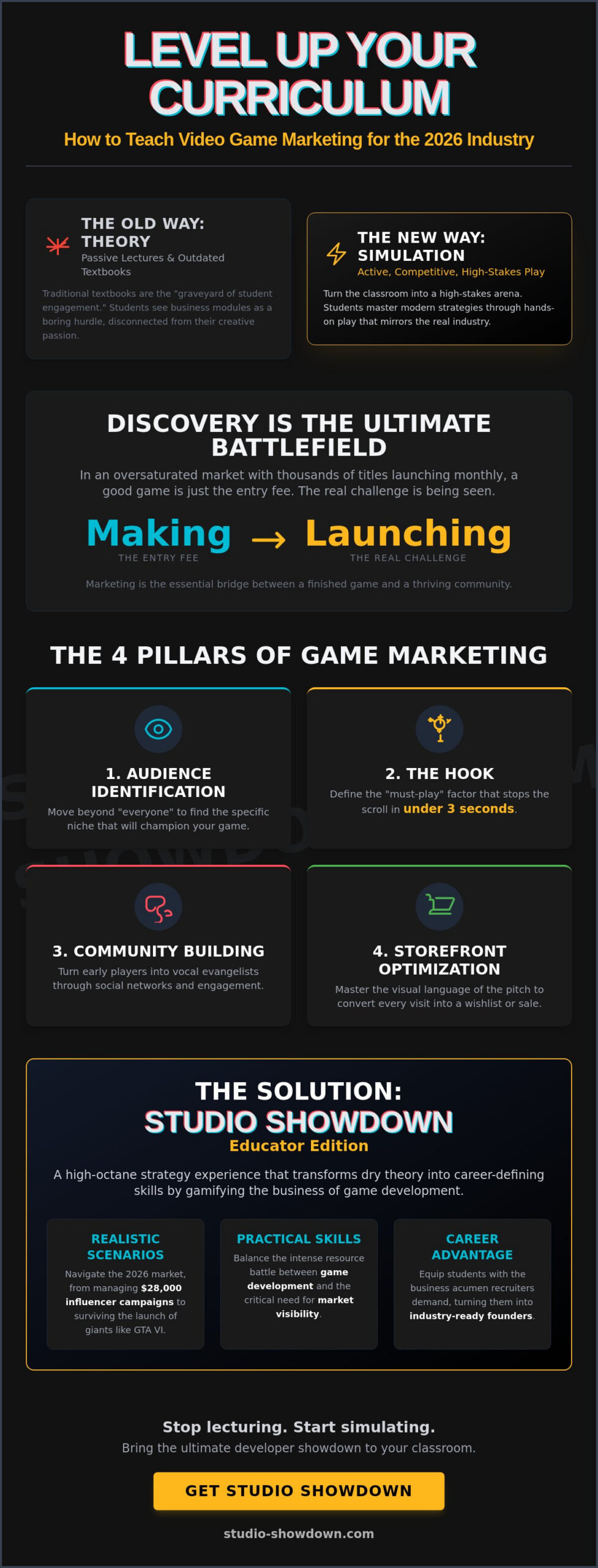
- Discovery is the ultimate battlefield. Learn how marketing acts as the essential bridge between a finished game and a thriving community in an oversaturated market.
- Stop the lecture fatigue. Master how to teach video game marketing through high-stakes simulations that mirror the fast-paced 2026 industry.
- Nail the hook. Discover the four pillars of game business, from precise audience identification to capturing player attention in under three seconds.
- Balance the budget. Guide students through the intense resource battle between game development and market visibility using practical workshop steps.
- Bring the showdown to the classroom. The Studio Showdown: Educator Edition transforms dry theory into a high-octane strategy experience for future founders.
Why Video Game Marketing is a Critical Skill for Future Developers
Marketing isn’t a bureaucratic chore. It’s a creative showdown. In the current landscape, the bridge between a brilliant game and a thriving community is built on strategic visibility. If a game launches in a vacuum, it effectively doesn’t exist. Many students view business modules as a distraction from their “real” work in design or code. This perspective is a liability. Learning how to teach video game marketing effectively starts with reframing the entire discipline. It’s not about selling out; it’s about ensuring the art finds its audience. In 2026, discovery is the only currency that matters. Recruiters are no longer looking for solo specialists. They want developers who understand the stakes of the market, the cost of player acquisition, and the psychology of a hook.
Teaching business acumen creates a massive advantage for student portfolios. A developer who can explain their target demographic, their unique selling proposition, and their community growth strategy is a professional ready for the industry. It proves they can think beyond the screen. It shows they understand the competitive reality of a studio. We must shift the narrative. Marketing is a creative battleground. It requires the same level of intuition, experimentation, and precision as game mechanics. It’s the difference between a forgotten prototype and a commercial victory.
The Shift from ‘Making’ to ‘Launching’
The “Indiepocalypse” is a constant threat. Great games fail every day because they lacked a launch plan. In a market where thousands of titles hit digital storefronts every month, discovery is the primary hurdle. Students must realize that a “good game” is just the entry fee. The real challenge is the launch. Modern developers must be community managers, brand architects, and PR specialists. Discovery is a limited resource. You can’t wait for the final build to start the conversation. Marketing begins at the first line of code. It involves building a wishlist, nurturing a Discord, and creating assets that cut through the visual noise long before the player hits “buy.”
Building Business Acumen in the Classroom
Business lessons are survival training. When students analyze market data, they develop critical thinking skills that apply to every stage of production. Understanding monetization models, including the complexities of in-game advertising, adds a layer of professional depth to any student project. These topics connect directly to STEM and entrepreneurship standards. They prepare students for the brutal pressure of fundraising, pitching to publishers, and managing a studio budget. Mastering how to teach video game marketing transforms a standard curriculum into a career-defining experience. It turns students into founders who can navigate the industry with confidence and strategic intent.
The Four Pillars of Game Marketing Every Student Should Know
Foundational knowledge is the only thing that survives a platform shift. While Steam algorithms or TikTok trends fluctuate, the psychological drivers of a purchase remain constant. Effective educators don’t just teach tools. They teach principles. When figuring out how to teach video game marketing, you must ground your curriculum in four non-negotiable pillars. These pillars transform a student’s project from a hidden gem into a market contender. They provide a checklist for success in an industry that rarely offers second chances.
- Audience Identification: Moving beyond “everyone” to find the specific niche that will champion the game.
- The Hook: Defining the “must-play” factor that stops the scroll in under three seconds.
- Community Building: Leveraging the influence of social networks to turn early players into vocal evangelists.
- Storefront Optimization: Mastering the visual language of the pitch to ensure every visit ends in a wishlist or sale.
To bring these concepts to life, students need more than a lecture. They need a simulation. Using the Studio Showdown: Educator Edition allows them to test these pillars in a competitive, low-risk environment before they face the actual 2026 market.
Identifying the Target Player Persona
Students often make the mistake of targeting too broadly. “Gamers” is not a demographic. It’s a crowd. Teach your students to look for the “Player Avatar.” Why do they play? What other titles are in their library? By distinguishing between demographics like age and psychographics like the desire for “creative expression” or “intense competition,” students can tailor their messaging. This precision ensures their marketing budget isn’t wasted on people who would never buy the game anyway.
Crafting the High-Concept Hook
Nail the hook or lose the player. In 2026, attention is the most expensive resource. We use the “Elevator Pitch” exercise to force students to describe their game in 12 words or less. If they can’t do it, they don’t have a hook. Visual storytelling is equally vital. The first screenshot is the most important asset on any storefront. Students must analyze successful indie trailers to see how the “hook” is delivered within the first few seconds. It’s about showing, not telling, the core fantasy of the game immediately.
Theory vs. Practice: Why Traditional Lectures Fail in Game Education
Passive learning is where creativity goes to die. In high-energy US classrooms, the traditional lecture model acts as a massive bottleneck. Students enter these courses to build, iterate, and compete. When they’re met with static slides about business theory, they disengage. This “boredom barrier” is the primary reason business modules often have the lowest retention rates in creative programs. Learning how to teach video game marketing effectively requires a total departure from the textbook. You can’t lecture someone on how to survive a market showdown. They have to live it.
Marketing is essentially a high-stakes strategy game. Success depends on resource management, timing, and outmaneuvering rivals. Therefore, strategy board games are the perfect teaching tool for this environment. They provide immediate feedback loops that a lecture simply cannot replicate. When a student loses market share in a simulation because they neglected their community building, the lesson sticks. It’s no longer an abstract concept. It’s a tactical error they’ll work to fix in the next round. Game-based learning (GBL) isn’t a gimmick. It’s a professional necessity for the 2026 classroom.
The Limits of the Textbook Method
The industry moves too fast for paper. A case study from 2020 is a historical artifact in the 2026 market. Traditional materials can’t keep up with shifting gamer spending habits or the sudden dominance of new creator-led platforms. There’s a massive disconnect between learning terms and executing a strategy. Knowing the definition of “CPM” doesn’t help a student decide whether to pivot their budget toward a TikTok creator or a Twitch sponsorship during a launch week. Textbooks teach the “what,” but they fail to teach the “when” and the “why.”
Active Simulation: The Gold Standard
Active simulation puts the student in the hot seat as a Studio Founder. They need to feel the genuine pressure of a dwindling budget and a competing studio launching on the same day. This competitive edge fosters a deeper understanding of market dynamics than any essay ever could. In a simulated environment, failure is a teacher, not a catastrophe. If a student’s marketing campaign flops, they can analyze the data and try again. This iterative process mirrors the real-world developer experience. It builds the entrepreneurial mindset required to navigate the visual noise of the modern storefront. By simulating the struggle, you prepare them for the win.
Designing Your Marketing Workshop: A Step-by-Step Lesson Plan
Execution is the ultimate filter. You’ve taught the pillars. You’ve discussed the theory. Now, your students must face the market. A structured workshop transforms abstract business concepts into a high-octane creative challenge. This isn’t about filling out worksheets. It’s about surviving a launch. To maximize the impact of these sessions, integrate them into a business board game session. This provides the mechanical structure for competition and immediate consequences for every strategic choice. Here is how to teach video game marketing through a battle-tested workshop framework.
Phase 1: The Pitch and the Hook
Every project starts with the Unique Selling Point (USP). In this phase, students must pitch a game idea to the class. We use a “Shark Tank” style presentation where the goal isn’t just to sound “fun.” The goal is market viability. Students must answer one question: why would a player choose this over the 84,000 other mobile games advertised monthly? Evaluate these pitches based on their niche appeal and the clarity of their three-second hook. If the hook is buried, the project is dead on arrival.
Phase 2: Managing the Marketing Mix
Marketing is an investment, not a cost. In Phase 2, students receive a mock budget. They must allocate resources across the 4 Ps: Product, Price, Place, and Promotion. This is where they calculate ROI on simulated campaigns. They must decide: do they spend $180 on a nano-influencer for a niche post, or do they gamble their entire budget on a $28,000 macro-influencer video? This phase teaches them to break through the visual noise. They learn that every dollar spent on marketing is a dollar taken from development. It’s a brutal balancing act.
- Step 1: The Concept Phase. Pitching a niche game idea with a clear USP.
- Step 2: The Resource Battle. Allocating budgets between dev and promotion.
- Step 3: The Market Launch. Simulating a showdown against rival student projects.
- Step 4: Post-Mortem. Analyzing data to see what worked and what failed.
The showdown is the climax. Students launch their mock campaigns simultaneously. They see whose hook captured the most “wishlists” and whose budget ran dry. The final post-mortem is vital. They analyze the results, compare their ROI, and identify the tactical errors that led to their “failure.” This iterative loop builds the professional resilience required for the real industry. Ready to bring this level of engagement to your classroom? Secure your Classroom Bundle today and start the simulation.
Studio Showdown: Gamifying the Business of Game Development
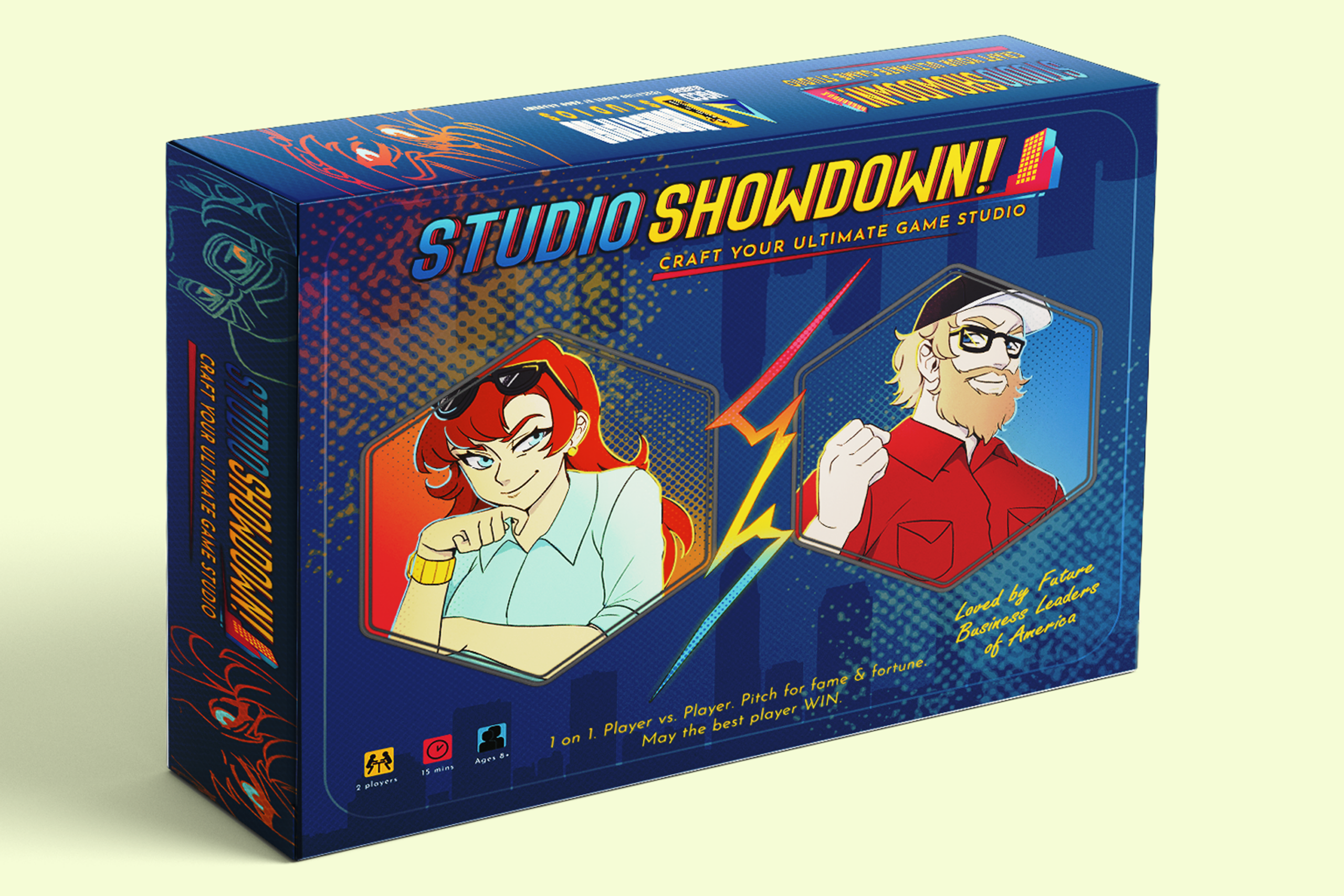
Tactile strategy. Real stakes. Zero screen fatigue. Studio Showdown is the antidote to dry business lectures. It is a hands-on strategy game engineered specifically for the classroom. Students don’t just read about marketing. They live it. By stepping into the shoes of studio founders, players navigate the cutthroat world of fundraising, pitching, and market rivalry. It’s a bridge between artistic design and brutal entrepreneurship. This is the gold standard for building real-world business acumen. Mastering how to teach video game marketing requires a tool that keeps up with the pulse of the industry. Studio Showdown delivers that pulse through high-octane, competitive play.
The game transforms abstract concepts into physical choices. Every card played and every resource allocated has an immediate impact on the board. Students quickly learn that a great game is worthless if no one knows it exists. They must balance development speed with market visibility. They must decide when to pivot and when to double down. This isn’t just a game. It’s a laboratory for discovery. It prepares students for the ultimate industry win by simulating the noble struggle of a startup.
A Tactile Approach to Game Marketing
Studio Showdown mechanics mirror real-world studio challenges with surgical precision. The “Showdown” element forces students to outmaneuver rivals for market dominance. They learn to fight for player attention in a crowded space. Beyond the strategy, the physical nature of the game is a massive benefit. Professionals know that screen-free activities are vital for developer mental health and focus. It gives their eyes a break from the IDE while keeping their strategic brains in high gear. It fosters better communication, clearer collaboration, and more intense engagement than any digital simulation could provide.
Implementing Studio Showdown in Your Curriculum
The Studio Showdown: Educator Edition is built for the modern syllabus. It’s not a distraction. It’s a structured teaching tool. Use it to anchor your business modules. Start with a single game session to introduce core concepts. Then, facilitate a post-game discussion on marketing strategy. Why did the RPG campaign fail? Why did the casual game dominate the market share? You can easily scale this from a one-off workshop to a semester-long project. Students can track their studio’s progress over multiple rounds, refining their tactics as the competition intensifies. This is how to teach video game marketing in a way that creates lasting professional intuition. Equip your classroom with the Classroom Bundle and turn your students into the industry leaders of 2026.
Elevate Your Classroom into a Creative Powerhouse
The days of passive learning are over. Your students deserve a curriculum that mirrors the intensity of the actual industry. By focusing on discovery, high-concept hooks, and the influence of social networks, you prepare them for more than just a grade. You prepare them for a career. Mastering how to teach video game marketing means embracing the chaos of the market and turning it into a structured, competitive workshop. It’s about shifting the perspective from “selling out” to “finding a community.”
Developed by VGCD Academy and DEMYSTIFIED Studios, our tools provide hands-on learning for fundraising and pitching. It’s time to bridge the gap between artistic vision and commercial reality. Empower your students with the Studio Showdown: Educator Edition. With classroom bundles available for national shipping, you can transform your next module into a high-stakes simulation that students will actually remember. Stop lecturing and start winning. Your students are ready for the challenge. Let’s help them rise above the noise.
Frequently Asked Questions
What is the best age to start teaching video game marketing?
Start as early as middle school, typically ages 11 to 14. At this stage, students are already heavy consumers of gaming content and can grasp basic concepts like audience personas and “the hook.” Early exposure demystifies the business side of their favorite hobby. It turns them from passive players into critical thinkers who understand why certain games dominate the cultural conversation while others vanish.
Can I teach game marketing if I’ve never worked in the industry?
You can effectively teach these concepts by focusing on universal business principles and using structured simulations. You don’t need a background at a AAA studio to explain ROI or target demographics. Using the right tools, like the Educator Edition, provides the framework you need. Your role is to facilitate the strategic showdown and guide the analysis, not to provide anecdotal industry stories.
How do I explain ‘Steam algorithms’ to a middle school student?
Compare the algorithm to a popular librarian who only recommends books that people actually finish and talk about. If a game gets lots of wishlists and early reviews, the librarian puts it on the front display. It’s about momentum. Explain that the computer isn’t picking favorites; it’s just following the crowd. This makes how to teach video game marketing accessible without getting lost in technical jargon.
Are there any free resources for teaching game business?
Platforms like GDC Vault offer some free talks, and industry blogs provide current trends. However, free resources often lack the structured pedagogy needed for a classroom setting. They provide the “what” but not the “how.” For a comprehensive lesson plan, look for tools that offer a clear, repeatable framework rather than scattered articles or outdated case studies that no longer reflect the 2026 market.
How does a board game help teach digital marketing skills?
A board game strips away technical complexity and focuses purely on high level strategy. It forces players to manage limited resources and anticipate rival moves in real time. These are the exact skills needed for digital campaigns. By removing the screen, students can’t hide behind pretty visuals. They have to rely on their strategic intuition and resource management to win the market and survive the competition.
What are the most common marketing mistakes students make in simulations?
Most students either target “everyone” or wait until the game is finished to start promoting it. They often blow their entire budget on one massive influencer without checking if that audience actually fits their game. Learning how to teach video game marketing involves pointing out these tactical errors during the post mortem phase. Failure in a simulation is the best way to prevent expensive mistakes in the real market.
How can I assess student progress in a game-based marketing workshop?
Assess them on their strategic justification and their ability to pivot based on results. Don’t just grade the win. Look at their pitch clarity, their ROI calculations, and their post game analysis. A student who loses the simulation but can explain exactly why they failed has learned more than a student who won by luck. Use their post mortem reports as your primary grading metric for the module.
Why is ‘The Hook’ more important than the actual game code in marketing?
The hook gets the player to click; the code is what keeps them there. In a market with 240 million monthly Twitch users, you won’t get the chance to show off your code if your hook doesn’t stop the scroll. Marketing is a battle for attention. If the first three seconds don’t land, the technical brilliance of the game effectively doesn’t exist because the player has already moved on.