SWOT analysis isn’t a static list of bullet points; it’s a high-stakes battle plan that only makes sense when there’s a winner and a loser. You’ve seen the glazed eyes when those four dry quadrants hit the screen. Traditional theory fails to translate because it lacks the adrenaline of real-world risk. Learning how to teach swot analysis with a game transforms a boring lecture into a visual victory that students actually remember.
Data from 2025 proves that challenge-based gamification improves student performance by 89.45% compared to traditional lectures. With the game-based learning market hitting $34.90 billion in 2026, static teaching is officially obsolete. You want high student engagement and a practical understanding of business risks. This guide explores how to master strategic planning through narrative-driven gameplay that sticks. We’ll provide a repeatable framework to turn abstract business risks into a creative showdown where students don’t just learn; they compete to win.
Key Takeaways
- Stop using static lists and start building battle plans. Learn how competitive dynamics cement business concepts better than any dry lecture.
- Master the mechanics of how to teach swot analysis with a game by quantifying risks and introducing the “Rival Factor” to simulate real-world chaos.
- Differentiate between quick classroom fillers and deep-dive simulations to ensure your strategy session hits the right learning objectives every time.
- Follow a proven tournament structure to facilitate high-energy sessions where students identify strengths and pivot against threats in real-time.
- Elevate your curriculum with the Educator Edition, turning your classroom into a production house for future founders and strategic thinkers.
Beyond the Quadrant: Why Games Are the Ultimate SWOT Teacher
A standard SWOT analysis is often treated like a grocery list. Students write down internal factors. They list external variables. Then, they stop. There’s no conflict. There’s no consequence. In the real world, strategy is a contact sport. Lists fail because they don’t capture the pulse of a shifting market. Games succeed because they force players to use their data to survive. This is the difference between reading a map and actually driving the car through a storm.
Think of it through a production lens. In a game context, Strengths aren’t just traits; they’re your primary assets. Weaknesses become critical vulnerabilities that rivals will exploit. Opportunities represent lucrative market gaps waiting for a first mover. Threats are the aggressive moves your opponents make to shut you down. Game-based SWOT serves as a predictive tool for navigating competitive environments by transforming static data into actionable battle intelligence.
The Limitations of Traditional SWOT Activities
Sticky note workshops are the graveyard of creativity. They lack stakes. When there’s no “lose” condition, students disengage instantly. A 2025 meta-analysis of 43 studies concluded that passive learning leads to a massive drop in knowledge retention. Traditional classroom exercises don’t simulate the stress of a ticking clock or a competitor stealing your market share. It’s safe. It’s boring. It’s ineffective. Without a “Showdown” moment, the theory never leaves the paper.
The Benefits of Game-Based Learning (GBL) in Business
Game-based learning changes the score. Data from 2025 shows that challenge-based gamification improves student performance by 89.45% compared to traditional lectures. It builds more than just knowledge. It develops soft skills. Negotiation. Critical thinking. Tactical adjustment. By 2026, immersive technologies will account for 30% of the educational market because they deliver results that stick.
The psychology of play cements long-term memory. When a student loses a round because they ignored a “Threat” card, that lesson stays with them longer than any slide deck. Games create a safe space for failure. Students can lose, analyze why, and pivot their strategy immediately. This is how to teach swot analysis with a game effectively: you make the theory inseparable from the action. You turn the classroom into a high-stakes arena where the best strategy wins.
The Showdown Method: Turning SWOT into a Strategic Battle
Strategy is a duel. Precision meets chaos. While standard SWOT analysis procedures provide a baseline, a game adds the missing ingredient: pressure. To understand how to teach swot analysis with a game, you must move beyond listing attributes and start quantifying them. Assign numeric values to every element. A “High-End Render Farm” isn’t just a Strength; it’s a +5 bonus to production speed. A “Limited Marketing Budget” isn’t just a Weakness; it’s a -3 penalty to market reach. This shift turns a static chart into a functional engine.
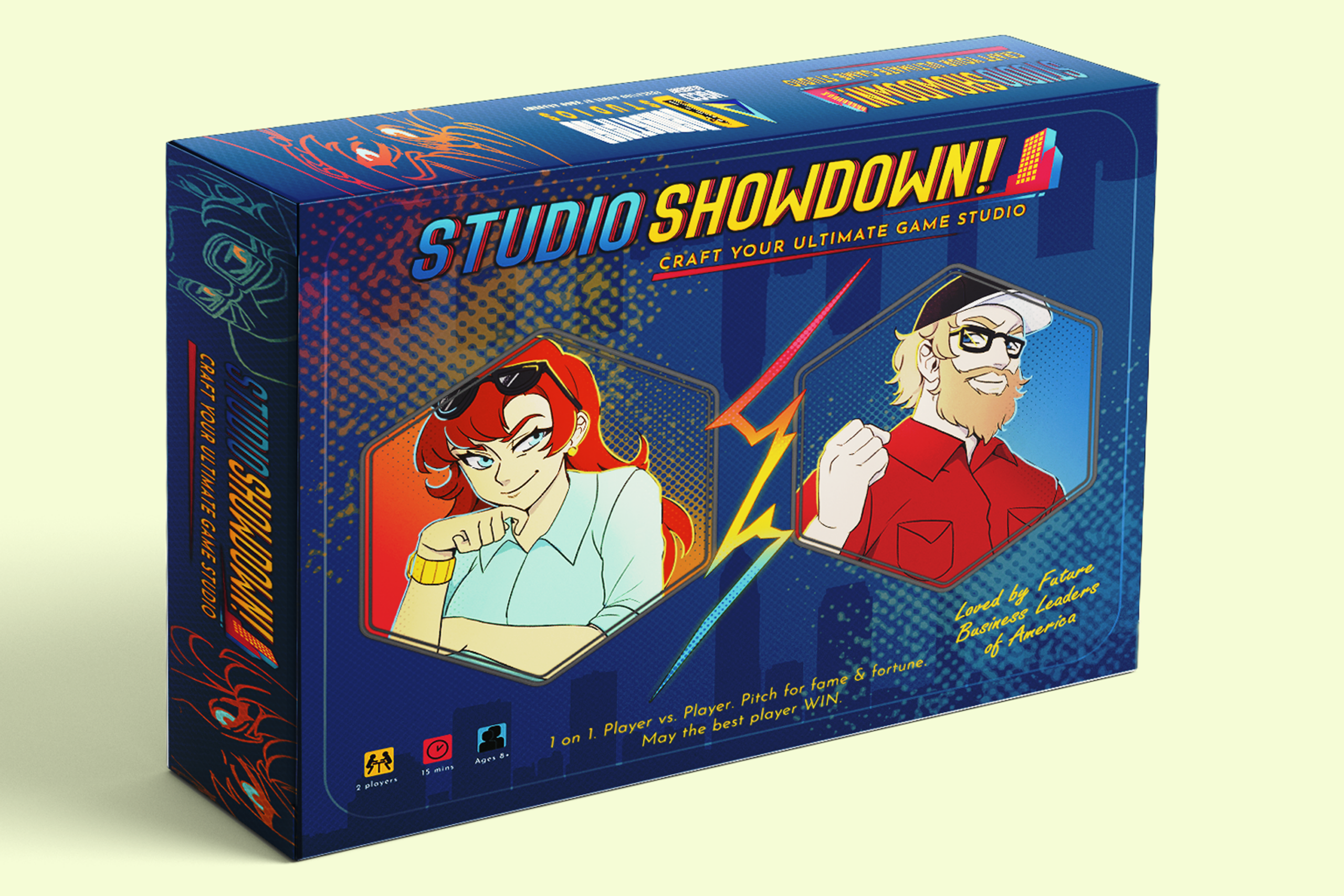
The “Rival Factor” is what separates a simulation from a simple exercise. In a true showdown, Threats aren’t just abstract economic shifts. They’re calculated moves from other players. When a rival studio launches a competing product, your “Opportunity” to dominate a market niche can vanish in a single turn. Studio Showdown uses these competitive mechanics to simulate a real-world game studio launch, forcing players to pivot or perish. If you want a pre-built arena for this, the Studio Showdown board game provides the perfect framework for these high-stakes decisions.
Internal Factors: Mastering Strengths and Weaknesses
Internal assets are your fuel. Funding, talent, and technology define your starting position. In a gameplay environment, Weaknesses function as bottlenecks. They’re the friction that slows your progress. Rivals will watch for these gaps. If your team lacks “Cybersecurity Expertise,” an opponent might play a “Data Breach” card. You must balance resources to shore up these defenses before you even think about a product launch. Success depends on using your Strengths to mitigate these vulnerabilities through tactical investment.
External Factors: Navigating Opportunities and Threats
The market is a moving target. How to teach swot analysis with a game effectively involves making the external environment unpredictable. Market trends appear as Opportunities. They’re temporary windows for growth, like a sudden surge in “Retro-Style RPGs.” However, every Opportunity comes with a shadow. Rival actions and economic shifts create constant Threats. Strategic pivoting is the ultimate skill. You must know when to abandon a risky Opportunity to avoid a devastating Threat. It’s about survival, timing, and the courage to change course when the data shifts.

Activity vs. Simulation: Choosing the Right Game for Your Students
Choosing the right tool depends on your objective. Are you introducing a concept or building a career? If you’re looking for how to teach swot analysis with a game, you must decide between a quick warm-up and a full-scale simulation. Conducting a SWOT analysis is a high-level professional skill. It requires more than just filling out a worksheet. It requires immersion. You need to match the complexity to your audience. A high school intro class has different needs than an MBA workshop or a corporate strategy session.
Level 1: The Quick Classroom SWOT Game
A 15-minute exercise is perfect for breaking the ice. Use global titans like Nintendo or Apple as case studies. Ask your students to identify Strengths and Weaknesses in real-time. Most will identify “brand loyalty” or “proprietary technology” instantly. It’s fast. It’s low-fidelity. It works for introducing the basic four-square concept to beginners. However, these “fillers” lack teeth. There are no stakes. No one loses capital. No one gets outmaneuvered by a rival. These activities are entry-level glimpses, not strategic mastery. They provide the “what” but completely ignore the “how.”
Level 2: The Full Strategic Simulation
True mastery happens in the trenches. Multi-hour simulations build professional acumen by forcing players into resource management and high-pressure pitching. This is where strategy board games enthusiasts find their edge. Research shows that 88% of teachers who use games report increased student engagement. In a deep simulation, SWOT isn’t a list; it’s a dashboard. You monitor your vulnerabilities while looking for a gap to exploit. You don’t just learn about threats; you survive them.
Narrative is the secret sauce. Students don’t care about a “generic widget factory.” They care about their studio. They care about their vision. When they’re building a creative empire, every threat feels personal. This emotional buy-in is why The Ultimate Business Board Game outperforms traditional methods. It transforms a dry academic requirement into a visual victory. You aren’t just teaching a framework; you’re facilitating a production. This is the premium experience modern education demands. You want students to feel the heat of the showdown, not just read about it in a textbook.
Step-by-Step: Facilitating a SWOT-Based Classroom Tournament
Victory isn’t accidental. It’s engineered. Mastering how to teach swot analysis with a game requires a structured arena where theory meets immediate consequence. You aren’t just running a lesson; you’re directing a production. Statistics from 2026 show that 74% of teachers now use games for instruction, but a tournament format takes this further by adding a layer of healthy competition. This four-phase framework turns your classroom into a high-stakes market where only the most strategic survive.
- Phase 1: The Briefing. Establish the core SWOT terminology. Explain that Strengths are weapons, Weaknesses are armor gaps, and the market is the battlefield.
- Phase 2: The Build. Students identify their starting internal factors. They must choose which Strengths to prioritize based on limited initial resources.
- Phase 3: The Market. Introduce unpredictable external factors. Use a deck of “Market Event” cards to simulate Threats like economic shifts or Opportunities like viral trends.
- Phase 4: The Showdown. Studios go head-to-head. They pitch their strategies and use their accumulated Strengths to mitigate rival Threats.
Setting the Stage for Competition
Divide your class into rival “studios.” Each group needs a name, a vision, and a goal. Establish clear victory conditions early. Is the winner the studio with the highest revenue, the best portfolio quality, or the most market share? You need a physical or digital game environment that tracks these metrics in real-time. If you’re ready to launch your first tournament, the Studio Showdown: Educator Edition provides all the lesson plans and workshop support you need to start today.
The Post-Game Debrief: Connecting Play to Theory
The real learning happens when the game ends. While 88% of teachers who use these methods report massive increases in student engagement, that energy must be channeled into business acumen. Ask the “Why.” Why did a specific Threat destroy a project? Why was an Opportunity missed during the heat of play? This is where you connect the adrenaline of the showdown to professional strategy.
A 2025 meta-analysis confirmed that game-based learning significantly boosts knowledge retention by making concepts experiential. During the debrief, force students to articulate their tactical adjustments. Transition from game victory to real-world application by analyzing how these same dynamics play out in the 2026 global market. You’re not just playing; you’re building founders. This is how to teach swot analysis with a game so it actually sticks.
Studio Showdown: The Professional Portfolio Builder for Aspiring Founders
Engagement follows interest. Most business curricula fail because they use outdated examples like heavy manufacturing or legacy retail. Studio Showdown flips the script by targeting the high-growth game development niche. Students don’t just study a business; they build a creative empire. This narrative hook is how to teach swot analysis with a game while keeping students locked into the process. When they’re deciding whether to invest in “Motion Capture Tech” (a Strength) or risk a “Global Server Outage” (a Threat), the theory becomes a survival tool. It’s about vision, production, and the drive to win.
The Educator Edition is built for the modern classroom. It includes comprehensive lesson plans, bulk licensing for departments, and dedicated workshop support. You aren’t just buying a box; you’re adopting a premium creative concept. The game integrates fundraising and pitching mechanics that mirror real-world venture capital rounds. Students must use their SWOT data to defend their studio’s valuation. This builds professional acumen that translates directly to STEM and entrepreneurship tracks. By May 2026, over 74% of educators reported that these immersive simulations are the only way to keep Gen Alpha engaged with complex strategic theory.
From Board Game to Business Portfolio
Success in the game is a resume builder. Playing forces students to articulate strategic decisions under pressure. In a job interview, “I won a simulation by pivoting my studio’s tech stack to avoid a market crash” sounds much better than “I understand SWOT.” These outcomes provide a baseline for deep business case studies. It’s a transition from play to professional practice. If you’re looking for high-impact, screen-free activities for gamers, this provides the perfect balance of entertainment and education. It’s about taking the pörge of the industry and putting it on the table.
Getting Started with the Classroom Bundle
Scaling this experience is simple. Multi-unit Classroom Bundles are designed for schools and libraries, ensuring every student has a seat at the table. These bundles come with access to professional development workshops for educators to master the “Showdown” facilitation style. You’ll learn how to turn every round into a teachable moment. This is the ultimate tool for any teacher who refuses to settle for mediocre results. Equip your classroom with the Studio Showdown Educator Edition today. Don’t just teach the theory. Launch the studio. Win the market.
Master the Strategic Showdown Today
The era of the static sticky note is over. You now have the blueprint for transforming dry theory into a high-stakes strategic battle. By using the Showdown Method, you turn internal factors into tangible assets and external threats into calculated risks. Master how to teach swot analysis with a game by prioritizing narrative-driven mechanics that mirror real-world game development.
Developed by VGCD Academy and DEMYSTIFIED Studios, our framework is already a staple in STEM and entrepreneurship programs nationwide. It’s about building professional acumen through fundraising and pitching mechanics that actually stick with your students. Don’t settle for classroom disengagement when you can deliver a visual victory. Bring the Showdown to your classroom with our Educator Edition and watch your students step into their roles as future founders. The 2026 market is waiting for their next move. Let’s make it a winning one.
Frequently Asked Questions
What is the best age to start teaching SWOT analysis with a game?
Students aged 12 and up are the ideal audience for this strategic depth. While 74% of K-8 teachers use games for instruction, the complex logic of balancing internal assets against external market shifts peaks in middle and high school. This is when students possess the cognitive maturity to handle high-stakes decision making and competitive rivalry effectively.
Can I teach SWOT analysis without a physical board game?
Yes, but you lose the tactile tension of a true showdown. While online collaborative tools like Miro or Creately offer digital alternatives, physical games provide a premium, screen-free experience that cements long-term memory. A 2025 meta-analysis of 43 studies confirmed that game-based learning significantly boosts academic achievement and knowledge retention compared to static digital worksheets.
How long does a typical SWOT simulation game take to play?
A full strategic simulation usually requires 45 to 90 minutes. Quick 15-minute activities work for introducing how to teach swot analysis with a game basics, but deep simulations need time for the “Showdown” and the critical post-game debrief. This duration ensures students can move through the build, market, and assessment phases without rushing the strategic process.
Do I need a business degree to facilitate these games for my students?
No specialized degree is required to lead a successful session. The Educator Edition provides comprehensive lesson plans and workshop support to guide you through the mechanics. Your role is to act as a production lead, facilitating the competition and helping students connect their gameplay wins or losses to real-world business acumen and strategic theory.
How do games help students understand the “Threats” section of SWOT?
Games transform abstract “Threats” into immediate, rival actions. Instead of reading about theoretical market risks, students face a rival studio launching a competing product or a sudden “Economic Shift” card. This makes the threat personal and unavoidable. It forces an immediate tactical pivot, which is the most effective way to understand external business risks in a 2026 market.
Are there digital versions of SWOT games for remote learning?
We focus exclusively on the premium physical experience to maximize engagement. For remote learning, educators often use a hybrid model where the facilitator manages the physical board via camera while students collaborate through digital whiteboards. This maintains the “Showdown” energy without requiring digital game downloads, which often lack the social pressure of a physical tabletop environment.
What happens if a student “loses” the game? How do I handle that?
Losing is a critical data point for the post-game debrief. In a safe simulation, a “loss” is simply a failed strategy that requires analysis. Challenge-based gamification has been shown to improve student performance by 89.45% precisely because it allows for iterative failure. Use the loss to ask why their defenses failed and how they can pivot their next production.
How does SWOT analysis relate to game design principles?
SWOT is the foundation of game balance. In design, Strengths are player abilities, Weaknesses are cooldowns or vulnerabilities, Opportunities are power-ups, and Threats are enemy mechanics. Understanding how to teach swot analysis with a game is natural for students because they already navigate these systems in their favorite titles. You’re simply giving their existing intuition a professional, strategic vocabulary.