A polished pitch can’t guarantee funding, but practice can make the thinking behind one less intimidating. If you’re exploring how to teach pitching and fundraising skills, give learners a chance to build, deliver, test, and revise a pitch instead of leaving the ideas on the page.
Fundraising can feel abstract to beginners, especially when lessons explain persuasive communication without letting students try it. A pitch is also not a promise of investment. Learners need to understand the difference between making a clear case and controlling someone else’s decision.
This article offers a practical sequence for moving from an idea to a specific funding ask, responding to questions, using feedback, and reflecting on choices. It also outlines ways to assess communication and decision-making through practice, not just a polished presentation. A simulation such as the Studio Showdown board game can give learners a structured setting to explore founder decisions and discuss how they communicate. The goal is real-world readiness, not a guaranteed yes.
Key Takeaways
- Teach pitching as a learnable sequence: identify a problem, present an idea, support it, explain the resources needed, and make a clear ask.
- Use role-play to practise presenting, asking questions, observing communication, and giving useful feedback.
- Build a repeatable lesson that moves from scenario and draft to pitch, questions, feedback, and revision.
- Adapt the challenge to learners’ age and experience, and check relevant school or program requirements before planning activities.
- Explore how to teach pitching and fundraising skills through simulations, including Studio Showdown, while checking verified game rules before connecting gameplay to specific pitch practice.
Why Teach Pitching and Fundraising Skills as Learnable Practices?
A promising idea doesn’t speak for itself. Learners need to explain who it helps, why it matters, and what support could move it forward. A pitch is a concise explanation of a problem, a proposed solution, its value, and a specific request. An elevator pitch is a useful model for introducing an idea clearly and quickly, but classroom learning should go beyond delivering a polished speech.
Fundraising practice develops communication and judgment. It cannot guarantee investment, donations, or business success. A listener may ask for more evidence, raise a concern, or decline. Learners can’t control that decision, but they can prepare, explain their reasoning, listen carefully, and adapt their message.
Make progress observable. After practice, learners should be able to explain an idea to a particular audience, justify what they’re asking for, answer questions with relevant information, and revise their pitch based on feedback. These outcomes give educators something concrete to assess beyond confidence or charisma.
What pitching and fundraising skills should learners develop?
Teach a connected set of skills rather than a script to memorize. Learners should identify what their audience cares about, tell a clear story, choose evidence that supports their case, and deliver the message concisely. They should also name the resources they need, such as time, materials, or funding, and explain how those resources relate to the next step.
Listening is part of pitching, as are answering questions honestly and revising when feedback reveals a gap. These skills help learners distinguish a persuasive explanation from an unsupported claim.
How can educators make fundraising feel less intimidating?
Begin with a low-stakes exercise. Ask learners to describe a familiar creative project, such as a school event or a student-designed game concept, and identify what support it would need. Have them explain the idea to a partner before introducing a formal pitch or simulated funder conversation.
Set the expectation that first drafts are starting points. Feedback is information, not a verdict on talent, and hesitation is normal when practising. Once learners can explain a familiar project, connect the same thinking to entrepreneurship: identify an audience, show the value, and make a reasoned ask.
That progression is central to how to teach pitching and fundraising skills to beginners. Start with an idea they understand, then help them make the communication choices that clarify its case.
How to Teach the Core Parts of a Persuasive Pitch
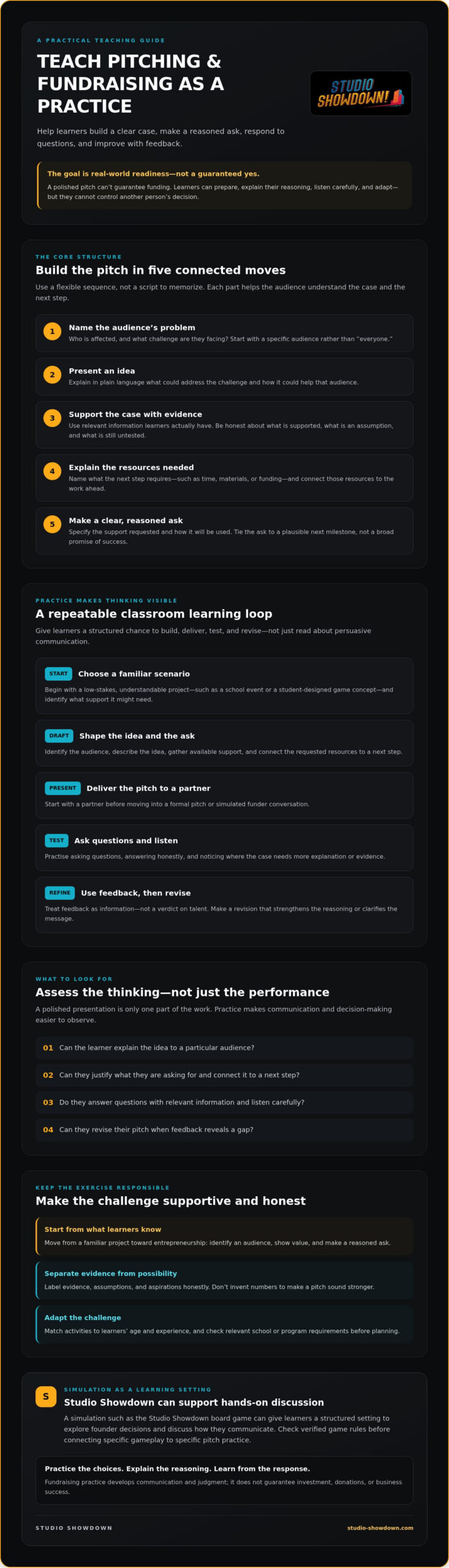
Give learners a flexible structure, not a script to recite. Build a concise case in sequence: identify the audience’s problem, present an idea, offer relevant evidence, explain the resources needed, and make a clear ask.
- Audience problem: Who is affected, and what challenge are they facing?
- Proposed idea: What could address that challenge?
- Evidence: What supports the idea, and what remains untested?
- Resources: What does the next step require?
- Clear ask: What specific support is the learner requesting?
This structure works for a game-development venture without requiring students to build a game. For example, learners might pitch a concept for a game that helps new students learn their school’s layout. They can describe the intended audience and need, show a simple sketch or storyboard, and explain how they might test the concept. Visuals should clarify the idea, not hide gaps in its case. Use evidence learners actually have, such as feedback they collected, and label assumptions and aspirations honestly. Don’t invent numbers to make a pitch sound stronger.
How should learners explain the idea and its value?
Ask learners to name a specific audience before describing the solution. “A game for everyone” is difficult to assess. “A short exploration game for students new to our school” gives listeners a clearer frame. Next, have learners explain the idea in plain language and connect its features to value for that audience. They can sort statements into three groups: evidence they can support, assumptions to test, and aspirations they hope to achieve.
How can learners make a clear, responsible funding ask?
A useful request names the resources sought and explains how they’ll be used. Learners might ask for materials, time to test a prototype, or funding for a defined next step. Tie the ask to a plausible milestone, such as gathering feedback on a concept, rather than a broad promise of success. Encourage direct language: “We’re asking for support to test this idea with students.” Then name what remains uncertain. Resources can help a project move forward, but they can’t guarantee it will work.
For educators who want a physical entrepreneurship simulation to prompt discussion, the Studio Showdown board game offers a game-development context. Check the rules and educator materials before connecting specific gameplay to pitch activities.
How to Practise Pitching, Questions, and Feedback Without Real Investors
A lecture can introduce pitch structure, but it can’t show whether learners can use it in conversation. Role-play and simulation give students a chance to make a case, hear questions, and respond. That creates visible opportunities to practise and receive feedback. Keep the distinction clear: practice develops communication skills, but it can’t predict a real funding outcome.
Set up rotating roles so every learner experiences the exchange from more than one perspective:
- Presenter: explains the idea and makes a clear request.
- Prospective funder: listens from an assigned perspective and asks relevant questions.
- Observer: tracks whether the case is clear, supported, and responsive.
After each round, rotate roles. Learners get to practise both making and evaluating a case, without treating a classmate’s response as a prediction of what a real investor or donor would decide.
What does a useful pitch role-play look like?
Give the presenter a short preparation window and a defined audience perspective, such as a community partner interested in youth learning. Ask the listener to probe the need, supporting evidence, requested resources, and intended next step. The observer can use a simple checklist: Was the idea clear? Did the presenter support key claims? Did they listen to the question and answer it directly? Keep prompts consistent enough to compare rounds, while allowing the conversation to feel natural.
For broader context on using simulations to explore entrepreneurship, educators can read this guide to business board game entrepreneurship. A simulation can give learners a shared scenario to discuss. Check specific game rules or teaching materials before linking an activity to particular game mechanics.
How should students give feedback and revise a pitch?
Make feedback specific and safe. Ask each listener to name one element that made the case convincing and one question that remains unanswered. Keep comments focused on the message, its evidence, and how it addressed the audience. Don’t judge personality, confidence, or presentation style as measures of whether someone is suited to fundraising.
Then ask presenters to revise one part, such as clarifying the audience’s need or making the request more precise. Have them explain what they changed and why. That explanation shows whether the learner understood the feedback and made a deliberate choice, rather than simply editing to please the group.
This cycle adds an assessment layer to how to teach pitching and fundraising skills. Educators can note clarity, use of support, listening, and purposeful revision, then ask students where those communication choices might matter outside the simulation.
How to Build a Classroom Lesson for Pitching and Fundraising Skills
A repeatable lesson turns pitching from a one-off performance into a skill learners can practise and improve. Keep the structure consistent, then adjust the scenario and level of support to suit the group. Before planning a classroom funding activity, check relevant school or program requirements, especially if the scenario involves real money or outside participants.
What are the steps in a beginner-friendly pitch lesson?
Start with a short sample pitch. Ask learners to identify its audience, central claim, evidence, and request. Then give them a planning template with the same prompts so they can organize their thinking before drafting or speaking. For younger or newer learners, offer a familiar creative-project scenario and sentence starters. More experienced groups can shape their own venture and decide what evidence they need.
Move through the lesson in a clear cycle:
- Introduce the scenario: Explain the audience and the decision the pitch should support.
- Draft: Learners use the planning template to shape their case and request.
- Pitch and question: One learner presents while listeners ask relevant questions.
- Give feedback: Peers identify a clear strength and an unanswered question.
- Revise and try again: Learners adjust one part and explain their choice.
Protect time for questions, feedback, and a second attempt. If the lesson ends after the first pitch, learners miss the chance to apply what they heard. To teach pitching and fundraising skills effectively, make revision part of the task, not an optional extra.
How can educators assess pitch and fundraising learning?
Use a simple rubric tied to observable actions: clarity of the message, fit for the intended audience, relevant supporting evidence, and a specific ask. Assess listening and thoughtful responses separately from presentation style. Charisma, volume, and confidence aren’t reliable measures of whether a learner can make a sound case. Nor should a simulated pitch be graded on whether it would receive funding.
Close with a brief reflection. Ask each learner to name an assumption they reconsidered after feedback, what prompted the change, and what they’d test next. Clear asks, relevant evidence, attentive listening, and reflection are teachable outcomes educators can observe and assess.
For a hands-on entrepreneurship context, explore the Studio Showdown board game and verify its educator materials before connecting specific gameplay to lesson objectives.
How Studio Showdown Can Support Hands-On Pitch and Fundraising Practice
Studio Showdown is a strategy board game about video game development and entrepreneurship. Players take the role of studio founders and navigate business challenges, creating a shared scenario educators can use to prompt discussion. It’s one option for bringing simulated founder decisions into a lesson, not a requirement for teaching pitching and fundraising.
How can a business board game prompt pitch discussions?
Start with the verified rules and educator materials. When the game presents a relevant venture choice or resource decision, pause afterward and ask learners to explain their reasoning: What were they trying to achieve? Who might benefit? What support or resources did they need, and why? Connect their answers to the pitch skills practised earlier, including audience awareness, evidence, trade-offs, and a clear request.
Keep the discussion grounded in what actually happened during play. Don’t imply that a game decision is itself a pitch or that a particular choice guarantees success. Instead, ask learners to turn a supported decision into a concise explanation, then consider what evidence would strengthen the case. For broader context on entrepreneurship through tabletop play, review this business board game guide.
How can educators explore Studio Showdown for a learning setting?
Consider the learning goal first. If a class needs a structured entrepreneurship scenario, review the game’s rules and materials to see whether its activities suit the lesson, learner experience, and program requirements. The Educator Edition and Classroom Bundle are options to explore for classroom use. Neither is essential to the lesson sequence.
Keep how to teach pitching and fundraising skills focused on learner practice, whether an educator uses a commercial game or creates a scenario independently. If a pitch or fundraising activity depends on game mechanics, verify that connection before building it into instruction.
To assess classroom fit, educators can explore Studio Showdown, review the available product and educator information, and decide whether the game supports their teaching goals.
Turn Pitch Practice Into a Repeatable Skill
Strong pitch lessons don’t depend on a naturally confident speaker or a real funding decision. They give learners a clear sequence: shape the idea, explain the evidence, make a specific ask, listen to questions, and revise. Assess what students can demonstrate, not whether a simulated audience says yes.
That’s the heart of how to teach pitching and fundraising skills: make practice active, feedback constructive, and reflection part of the process. A classroom simulation can help learners explore entrepreneurship decisions, while a simple role-play can build the same communication habits without a commercial tool.
Studio Showdown is a strategy board game centered on video game development and entrepreneurship. Educators can review the rules and learning materials, then consider whether the game fits their goals. The Educator Edition and Classroom Bundle are options to explore, not required ingredients for a strong lesson.
Explore Studio Showdown as a hands-on entrepreneurship resource and see whether it suits your learning setting. Start with one scenario, give learners room to test their thinking, and let each round make the next pitch clearer.
Frequently Asked Questions
How do you teach students to make a persuasive pitch?
Teach students to build a clear case for a specific audience, then practise delivering and revising it. Have them explain the audience’s problem, present an idea, support it with relevant evidence, and make a specific request. For educators considering how to teach pitching and fundraising skills, short role-plays followed by targeted feedback help turn each part into a skill students can demonstrate, rather than a script they simply memorize.
What should a beginner include in a fundraising pitch?
A beginner’s pitch should identify who the idea serves, the need it addresses, the proposed solution, and the evidence available so far. It should also state what resources are requested and how they’ll support a realistic next step. Encourage learners to distinguish confirmed information from assumptions and hopes. A responsible pitch makes a case for support without suggesting that funding guarantees success.
How can students practise pitching without real investors?
Use a classroom role-play with rotating presenters, prospective funders, and observers. Give the listener a clear perspective and prompts about the need, evidence, resource request, and next step. Observers can track clarity, support, listening, and responses. After each round, invite specific feedback and a revision. This gives students a realistic communication challenge without treating a classmate’s reaction as a prediction of actual funding.
What activities teach fundraising skills in the classroom?
Try short pitch drafts, peer interviews about an idea’s audience, simulated funding conversations, and feedback-and-revision rounds. Students can also examine a creative project and identify the resources needed to reach its next milestone. These activities teach learners to connect an idea to a clear request. A business board game can provide a shared entrepreneurship scenario, provided educators verify the rules before linking gameplay to specific fundraising practice.
How do you assess students’ pitching skills fairly?
Use a rubric for observable skills, such as message clarity, audience fit, relevant evidence, and a specific ask. Assess listening and thoughtful answers separately from presentation style. Don’t grade learners on charisma, confidence, or whether a simulated pitch would receive funding. A short reflection can add useful evidence: ask students what feedback they considered, what assumption they revised, and why they chose to make that change.
Can a board game teach entrepreneurship and fundraising?
A board game can introduce entrepreneurship through shared scenarios and simulated decisions, then give learners material to discuss and reflect on. Studio Showdown is a strategy board game centered on video game development and entrepreneurship, with players taking the role of studio founders. Before using particular gameplay to teach pitching or fundraising mechanics, educators should check the game rules and educator materials to confirm that connection.
How can students respond to questions after a pitch?
Teach students to pause, listen to the full question, and answer the point being raised with relevant information. If a question is unclear, they can ask for clarification. If they don’t know the answer, they should say so rather than inventing evidence, then explain how they would investigate it. Practising these responses helps learners treat questions as part of the conversation and identify where their pitch may need revision.