In 2026, the greatest threat to your game studio isn’t a bug in your code; it’s a blind spot in your bank account. You’ve spent years honing your craft, yet the leap from developer to founder often feels like entering a high-stakes boss fight without a weapon. It’s a common struggle. Most creators excel at building worlds but stumble when it’s time to build a company. This is where a professional game development business simulation changes the rules. It transforms the complexity of venture capital and market volatility into a manageable, low-risk practice ground.
You deserve to see your creative vision succeed without the fear of financial collapse. This guide will teach you the essential business mechanics required to lead a studio. We’ll master the art of the investor pitch, decode current fundraising trends, and build a strategy that puts you ahead of the competition. From understanding critical financial metrics and optimizing profit margins for growth to capturing a slice of the $213 billion global market, you’re about to get a clear operational roadmap. It’s time to stop guessing. Start executing with the precision of a seasoned producer.
Key Takeaways
- Transition from a creative artist to a strategic founder by prioritizing your studio’s commercial viability over purely artistic impulses.
- Master financial survival by calculating your burn rate and selecting the right funding path, whether it is bootstrapping or venture capital.
- Outmanoeuvre rivals in the 2026 market by using a professional game development business simulation to pressure-test your strategy before spending a single dollar.
- Build a predictable production pipeline using Agile or Scrum to balance artistic polish with the harsh reality of market deadlines.
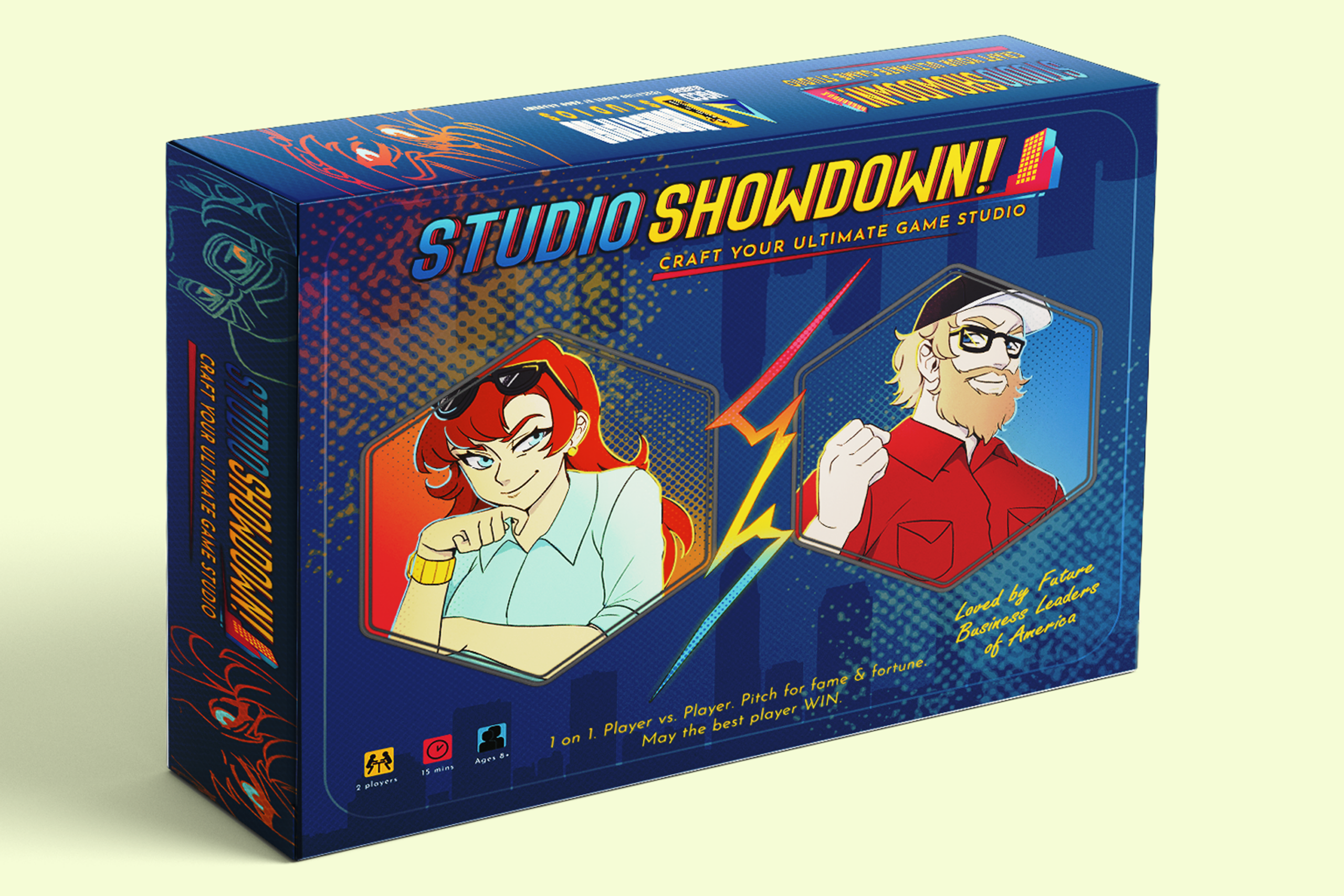
- Accelerate your leadership skills with Studio Showdown, the ultimate flight simulator for mastering high-stakes pitching and fundraising.
The Foundation: Shifting from Developer to Studio Founder
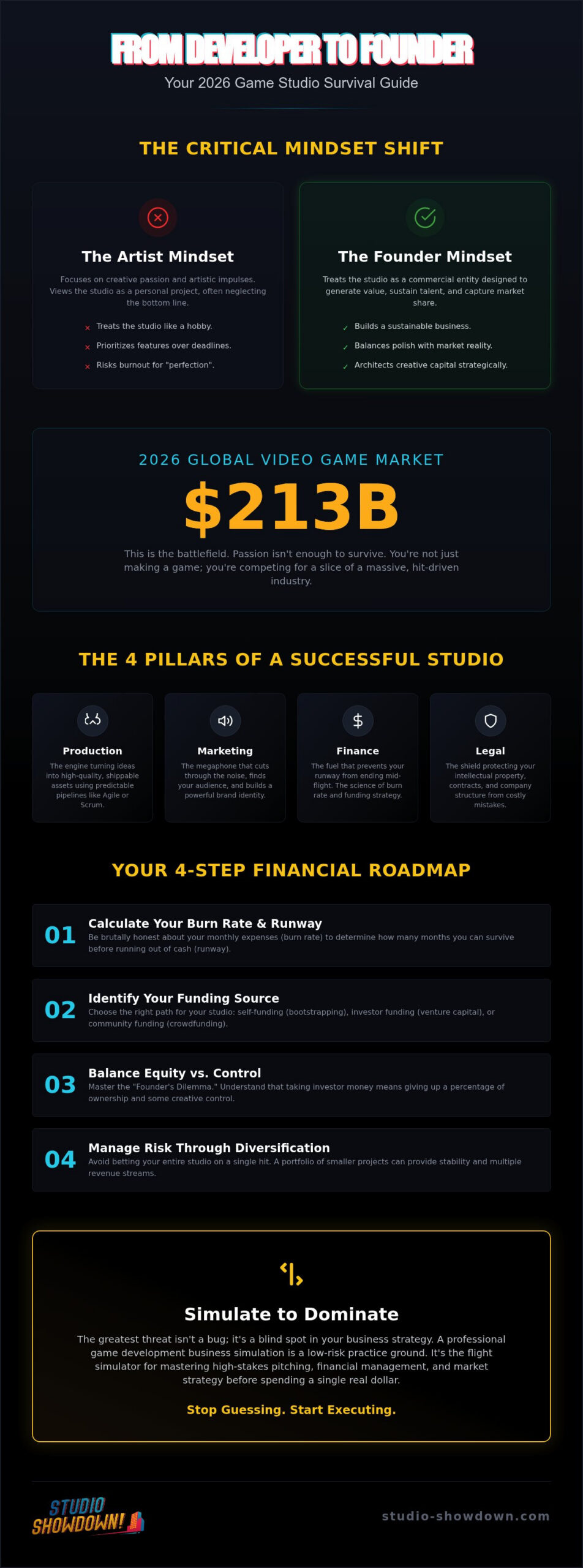
Your code is elegant. Your art is breathtaking. But if you treat your studio like a hobby, the market will treat you like an amateur. In 2026, the global video game industry is a $213 billion battlefield where passion alone isn’t enough to survive. You must stop viewing your studio as a creative project. It is a commercial entity. It is a machine designed to generate value, sustain talent, and dominate market share.
Most indie developers hit a wall because they refuse to shed their “Artist” skin. Your creative identity is your soul, but as a founder, it can become your bottleneck. You can’t just be the person who fixes the shaders; you must be the person who understands why those shaders affect the bottom line. A Studio Founder is a strategic architect of creative capital.
A successful studio rests on four pillars that must work in perfect synchronization:
- Production: The engine that turns raw ideas into high-quality, shippable assets.
- Marketing: The megaphone that cuts through the visual noise to find your audience.
- Finance: The fuel that prevents your runway from ending mid-flight.
- Legal: The shield that protects your intellectual property and contracts.
Using a professional game development business simulation allows you to test these roles without risking your life savings. It’s the difference between guessing and knowing. It provides a safe environment to fail, learn, and pivot before the stakes become real.
The Business of Games vs. The Art of Games
Great games fail every day. They fail because they lack a market strategy. The 2026 industry is brutally hit-driven; you either stand out or disappear. You aren’t just selling a game; you’re building a brand. Players don’t just buy a title; they invest in a studio’s vision. If you don’t define your commercial path, the algorithm will define it for you. This requires a shift from making what you love to making what the market demands, then finding the artistic soul within that demand.
Setting Your Studio’s Core Mission
The global market is saturated. To survive, you need a niche. You need a sustainable development culture that doesn’t burn out your team by the first milestone. Decide your scale now. Are you a lean solo-dev, a nimble indie team, or a hungry AA aspirant? Your mission dictates your moves. A professional game development business simulation helps you visualize these paths, showing you the consequences of your choices before you hire your first employee. This is about building a legacy, not just a product.
Fundraising and Financial Management: Fueling the Engine
Cash isn’t just a resource; it’s oxygen. Without it, your creative engine stalls before the first milestone. Before you open an IDE, you must calculate your burn rate. This is the amount of money you spend each month to keep the lights on. Your runway is the countdown clock; it’s how many months you can survive before the bank account hits zero. Engaging with a game development business simulation early on helps you visualize these numbers before they become a crisis.
To secure your studio’s future, you need a disciplined financial roadmap. Follow these four critical steps:
- Step 1: Calculate your burn rate and runway with brutal honesty.
- Step 2: Identify your funding source, whether it’s bootstrapping, venture capital, or crowdfunding.
- Step 3: Master the Founder’s Dilemma by balancing equity distribution against creative control.
- Step 4: Manage risk through a diversified project portfolio to avoid total reliance on a single hit.
Funding is a strategic move. In 2026, you aren’t limited to one path. Bootstrapping offers total freedom but slow growth. Venture capital provides speed but demands equity. Understanding the video game industry economic impact helps you realize that you’re competing for a slice of a $213.9 billion market. You aren’t just making a game; you’re managing a high-growth asset. Don’t bet everything on one title. Spread your risk across smaller projects or different genres to stay agile.
The 2026 Fundraising Landscape
Venture capital has shifted. Investors no longer chase vague ideas; they chase hard metrics like retention and community engagement. Government grants and educational subsidies have become vital lifelines, especially in regions focusing on digital innovation. Crowdfunding in 2026 is less about the “dream” and more about pre-sales and brand loyalty. If you can’t prove a market exists through data, you won’t get funded.
Budgeting for More Than Just Assets
Beginners budget for art and code. Professionals budget for the friction of doing business. You must account for the 30% Steam revenue share and the potential 5% Unreal Engine royalty after your first million. If your studio is in the UK, remember that corporation tax hits 25% for profits over £250,000. Legal fees for IP protection and PR agencies are non-negotiable. Community management is an ongoing expense, not an afterthought.
Making these choices under pressure is difficult. This is why strategy board games are the best way to practice financial trade-offs. A professional game development business simulation allows you to experience the crushing weight of a low runway without actually going bankrupt. It’s the ultimate stress test for your financial intuition. To see how these mechanics play out in a competitive setting, you can explore the Studio Showdown system and start building your legacy.
Market Dominance: Outmanoeuvring Rival Studios
In 2026, with the number of gamers worldwide forecasted to reach 3.7 billion, “getting noticed” is no longer a viable strategy. You must dominate. Success begins with your Unique Value Proposition (UVP). This isn’t just a marketing buzzword; it’s your studio’s reason for existing in a crowded market. What do you provide that no one else can? Perhaps it’s a specific artistic vision, a proprietary technology, or a deep connection to a niche community. If your UVP is weak, your studio is invisible.
Stop fighting in the “Red Ocean” where every developer mimics the same trending mechanics. Instead, use a “Blue Ocean” strategy to find where competitors aren’t playing. This requires rigorous competitive analysis. Monitor rival studios to understand their release windows, pricing strategies, and community sentiment. Don’t copy them; learn from their mistakes. Your goal is to identify a gap in the global market and fill it with such precision that competition becomes irrelevant.
Collaboration is often a more powerful weapon than pure competition. Strategic partnerships with platform holders, middleware providers, or even non-competing studios can amplify your reach. Knowing when to collaborate and when to compete is a high-level skill. A professional game development business simulation provides the perfect environment to test these diplomatic moves. You can experiment with aggressive market expansion or cautious alliances without risking your real-world reputation.
The Art of the Pitch
Your pitch deck is your battle plan. In 2026, the requirements have evolved. Publishers look for data-backed certainty; they want to see your retention metrics and community growth. Private investors look for scalable Intellectual Property. Tailor your message to the audience. A publisher wants to know you can hit a milestone; an investor wants to know how you’ll dominate a category. Practice these business “Showdowns” until your delivery is sharp, confident, and undeniable.
Growth and Scaling Strategies
Scaling too fast is a death sentence for most indie studios. Identify your critical talent gaps before you post a single job opening. Don’t just hire for the sake of growth; hire to add a specific capability that moves the needle. Your marketing efforts must scale in lockstep with your development cycle. If your community isn’t growing while your game is being built, you’re launching into a vacuum. You can see how business board games teach these scaling skills in a high-pressure, competitive format. Mastering the balance between team size and burn rate is the hallmark of a true founder.
Operational Excellence: Avoiding the Indie Trap
Operational excellence separates the survivors from the statistics. Many indie developers fall into the trap of perpetual polishing without a clear production pipeline. This is a death spiral. To avoid it, you must establish a predictable workflow using Agile or Scrum methodologies. These frameworks ensure that every sprint moves the needle toward a shippable product. In 2026, the market doesn’t reward perfection; it rewards presence and consistency.
The Release vs. Polish debate is a founder’s ultimate test. You must know when your game is market-ready. Over-polishing kills runways. Under-polishing kills reputations. Finding the sweet spot requires data, not just intuition. Playtesting serves as a primary business risk-mitigation tool by identifying friction points before they reach the paying public. Simultaneously, you must manage your PR and community from day one. Waiting until month twelve to build an audience is a recipe for a silent launch. Engage your players early. Build the hype while you build the code.
Mastering these rhythms is difficult in a vacuum. A professional game development business simulation provides the tactical pressure needed to sharpen your operational instincts. It forces you to make hard choices about team allocation and feature creep before real money is on the line. You learn to balance the creative soul of your project with the cold reality of a delivery schedule.
Building a Professional Portfolio
Running a studio builds real-world business acumen that looks impressive on a CV. It shows you can manage people, budgets, and timelines under pressure. Documenting your processes for future investors or employers proves you aren’t just an artist; you’re a professional. Educational tools play a vital role here. They allow you to simulate the lifecycle of a studio, giving you the experience needed to lead a team with confidence. Your portfolio should reflect your ability to ship, not just your ability to dream.
Legal and Intellectual Property (IP) Basics
Securing your IP is your studio’s first line of defense. You must handle trademarks, copyrights, and contracts with absolute precision. Managing work-for-hire agreements and revenue share models requires a long-term vision that protects your studio’s future. You’ll quickly see why strategy wins over ‘easy money’ in long-term IP management. Don’t trade your future for a quick check. Build a fortress around your ideas and ensure every contract serves your ultimate goal.
Ready to build your operational roadmap? Get the Studio Showdown board game and master the mechanics of a winning studio.
Simulating Success: Training Future Founders
Watching a video is passive. Reading a textbook is theoretical. To lead a studio, you need to feel the pressure of a dwindling runway and the adrenaline of a successful pitch. This is why a physical board game acts as the ultimate flight simulator for studio management. It strips away the digital noise. It forces you to look your rivals in the eye. By using a game development business simulation, you internalize the consequences of your decisions without risking your actual capital. You learn to fail fast, pivot quickly, and win decisively.
Studio Showdown provides a hands-on experience in the brutal reality of fundraising and pitching. You aren’t just playing; you’re training. Screen-free learning is essential for mastering these complex business concepts. It removes the distractions of software and focuses your mind on pure strategy. Educators now use these game-based tools to teach financial literacy, helping students understand the $213 billion industry through active participation rather than dry lectures. It’s about building a portfolio of decisions before you build a portfolio of code.
Mastering Studio Mechanics via Studio Showdown
In the Studio Showdown Board Game, you navigate high-stakes launches and rival studio manoeuvres in a tabletop format. You’ll learn to balance the four pillars of production, marketing, finance, and legal in a fast-paced environment. This isn’t about luck. It’s about building real-world business acumen through strategic gameplay. When you transition these skills from the board to your digital studio, you do so with the confidence of someone who has already survived a hundred market crashes. You’ve seen the traps. You know the moves. You’re ready to lead.
Next Steps for Aspiring Founders
Don’t build in isolation. Join a community of developers and entrepreneurs who prioritize business strategy as much as creative vision. Integrate a game development business simulation into your daily learning routine to keep your instincts sharp. You can also explore other screen-free activities that build professional skills and foster creative collaboration. These moments away from the monitor often provide the greatest clarity for your business strategy.
Whether you’re a solo developer or looking to scale a team, the goal remains the same. You must become the architect of your own success. Use tools like the Studio Showdown: Educator Edition or the Classroom Bundle to bridge the gap between concept and launch. The market is waiting for your vision. Make sure you have the business foundation to deliver it with authority.
Forge Your Legacy in the 2026 Games Market
The transition from indie creator to studio founder is the ultimate challenge. It requires more than just technical skill; it demands a strategic architect’s vision. You’ve learned how to calculate your runway, outmanoeuvre rivals, and secure your intellectual property. Now, it’s time to put those theories into practice without risking your studio’s survival. Success in this industry belongs to those who prepare for the battle before the first line of code is written.
A professional game development business simulation is your secret weapon. Developed by industry experts at VGCD Academy, Studio Showdown is already used in classrooms to teach entrepreneurship to the next generation of leaders. It reduces the risk of learning through real-world failure by providing a safe, high-stakes environment to master fundraising and pitching. You don’t have to guess your way to the top. You can simulate your way there.
Your vision deserves a foundation that won’t crumble under market pressure. Take control of your production pipeline, dominate your niche, and lead with confidence. The future of gaming is waiting for your leadership. Go build it.
Ready to lead your studio to victory? Get Studio Showdown today!
Frequently Asked Questions
What is the first step to legally starting a game studio?
The first step is selecting a legal structure, such as an LLC or C-Corp, to separate your personal assets from the business. This foundation allows you to sign contracts, protect intellectual property, and open a corporate bank account. Without this legal shield, you risk personal liability for studio debts or legal disputes. Once incorporated, you can focus on establishing your production pipeline and securing the necessary licenses for your chosen game engine.
How much money do I actually need to run a small indie studio?
Your budget depends entirely on your burn rate and the length of your development cycle. For a small indie team in 2026, you must account for salaries, software licenses, and a 30% revenue share for platforms like Steam. Many successful founders aim for at least 12 to 18 months of runway before launching. It’s vital to include hidden costs like legal fees and marketing expenses to avoid running out of cash mid-production.
Can I run a game studio without knowing how to code?
You absolutely can. Many successful founders act as strategic architects who focus on marketing, fundraising, and team management rather than writing code. While understanding the technical process helps, your primary role is to ensure the studio remains a viable commercial entity. By hiring specialized talent for programming and art, you can dedicate your energy to high-level strategy, investor relations, and navigating the competitive landscape of the global games market.
What are the most common mistakes new game studio founders make?
The most frequent error is ignoring the business side in favor of pure creativity. Founders often fail to calculate their burn rate accurately or wait too long to start community management. Over-polishing a game without a clear market strategy is another common pitfall. Many studios collapse because they didn’t have a plan for the 25% corporation tax or didn’t realize how quickly a small team can exhaust its initial funding.
How do I find investors for my first game project?
Finding investors requires a data-driven pitch deck and active networking within the industry. In 2026, investors prioritize retention metrics and community growth over vague concepts. You can seek out venture capital firms specializing in interactive media or explore private angel investors. Building a professional portfolio through a game development business simulation can also give you the confidence and vocabulary needed to handle high-stakes pitches and negotiate equity effectively.
Is a business degree necessary to run a successful game studio?
A formal degree isn’t mandatory, but mastering business mechanics is essential for survival. You need to understand financial management, legal protection, and market strategy to keep your studio afloat. Many founders acquire these skills through hands-on experience, mentorship, or specialized educational tools. Practical knowledge of how to manage a project’s runway and navigate the “Hit-Driven” nature of the industry is far more valuable than a traditional diploma in today’s fast-paced market.
How does Studio Showdown help in learning game studio management?
Studio Showdown acts as a flight simulator for aspiring entrepreneurs. This game development business simulation immerses you in the competitive world of fundraising, pitching, and market dominance. By acting as a studio founder in a tabletop format, you learn to make critical decisions under pressure without risking real capital. It’s a hands-on way to build professional acumen, used by educators at VGCD Academy to help students understand the complexities of the games industry.
What is the ‘Artist’s Trap’ in game development?
The Artist’s Trap occurs when a creator prioritizes their aesthetic vision at the expense of commercial viability. This mindset often leads to infinite development cycles, feature creep, and eventual financial failure. To escape this trap, you must shift your identity from Artist to Founder. This means making hard choices about which features are market-ready and ensuring that every creative decision serves the long-term sustainability of the studio.