Your creative vision is just noise until someone writes a check. In a global games market projected to exceed $200 billion this year, brilliance alone won’t save you. Mastering how to pitch a game idea is the only way to cut through the static. You’ve felt the anxiety. The fear of stolen concepts, the technical jargon, the crushing silence from investors who don’t see the business behind the art. It’s a high-stakes struggle where strategy is your primary weapon.
We’re here to change the rules of engagement. You’ll learn to think like a seasoned studio founder, transforming raw mechanics into a professional investment opportunity. We’re stripping away the jargon, building your business vocabulary, giving you the confidence to stand before any stakeholder. This guide delivers a professional pitch deck structure, a roadmap to funding, the strategic mindset needed to dominate the industry. From your first slide to your final studio contract, you’ll turn your concept into a funded reality. The battle for funding starts now.
Key Takeaways
- Shift from creative dreamer to business founder by prioritizing execution-led strategies over raw mechanics.
- Master how to pitch a game idea by building a high-impact deck that captures the “fun factor” in under 30 seconds.
- Crack the code of cold outreach and elevator pitches to bypass industry gatekeepers and land high-stakes meetings.
- Navigate the 2026 funding landscape by choosing between the transparency of crowdfunding and the strategic stability of publisher contracts.
- Sharpen your competitive edge and practice fundraising strategies in a risk-free environment with the Studio Showdown board game.
The Pitch Mindset: Moving Beyond the “Good Idea”
In 2026, the global games market is a crowded arena. Everyone has a “revolutionary” concept. Investors don’t buy concepts; they buy execution. Understanding how to pitch a game idea requires a total psychological reset. You aren’t selling a story. You’re selling a return on investment. The 2026 funding landscape has shifted. Capital now flows toward founders who prove they can deliver, not just dream. Ideas are the starting line. Execution is the finish.
Many creators fall into the Artist Trap. They obsess over frame-perfect mechanics or deep lore. While these matter, they don’t prove financial viability. Your pitch fails when it’s a feature list instead of a business plan. You must bridge the gap between creative spark and commercial fire. This means moving beyond the mechanics. It means identifying your “Blue Ocean,” those underserved player niches where your project can breathe without being suffocated by AAA clones.
Defining Your Studio’s Unique Value Proposition
Steam and the Epic Games Store are saturated. Standing out is a battle. To win, you need a Unique Value Proposition (UVP). This is your mission statement to the world. It tells investors exactly why your studio exists and why it will dominate. You’ll inevitably face the Founder Dilemma, which is the constant, grinding tension between maintaining artistic integrity and meeting the cold necessity of profit. Solving this tension is the mark of a true CEO. Your UVP must reflect this balance. It should signal that you’re a partner, not just a dreamer.
Market Research for 2026 Trends
Use data, not feelings. Modern tools now identify genre gaps with surgical precision. If you’re building another soulslike, you need a data-backed reason why. Business literacy is your new language. You need to talk about player retention and market trends as fluently as you talk about shaders. Mastering how to pitch a game idea means showing you understand the landscape better than the competition.
In the initial phase, your network is worth more than a grey-box prototype. Build bridges before you build levels. While a comprehensive Game Design Document (GDD) is essential for production, your initial pitch is about the team and the opportunity. Investors want to see that you’ve done the legwork. They want to see a founder who understands the industry’s pulse.
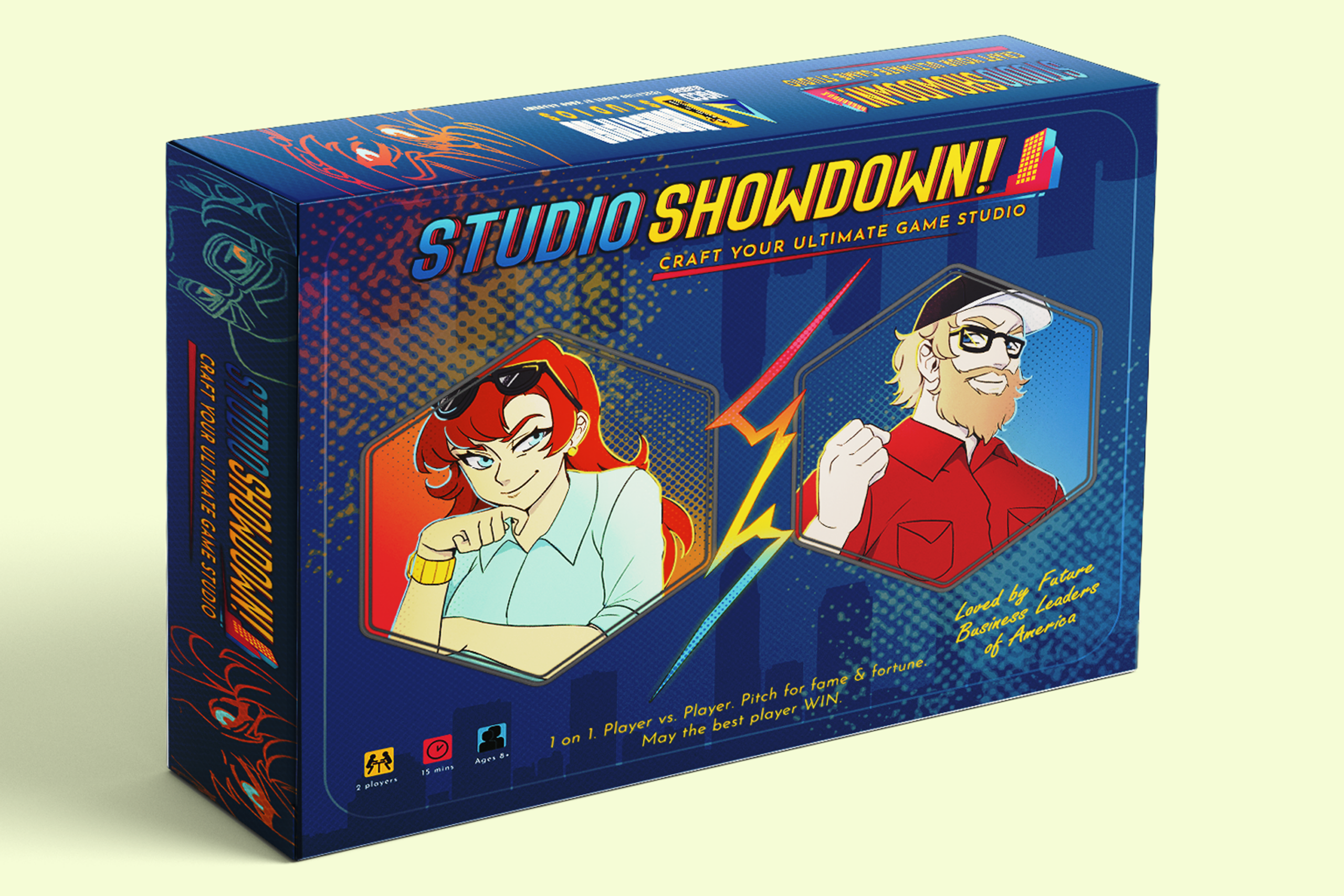
This strategic shift is difficult. It’s why we created the Studio Showdown board game. It simulates these high-stakes decisions in a risk-free environment. It forces you to manage resources, outmaneuver rivals, and practice the art of the pitch. It turns the Founder Dilemma into a winnable scenario. Practice here. Win out there.
The 2026 Pitch Deck: Essential Slides Every Founder Needs
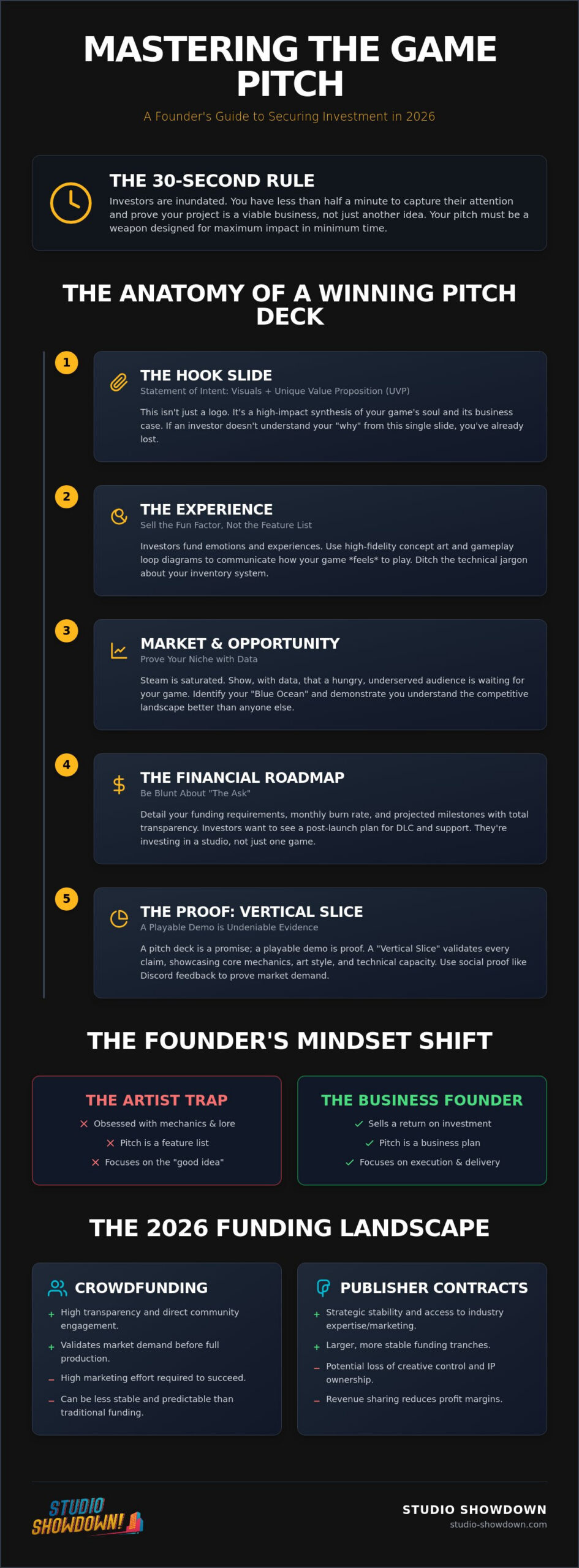
Your deck is a weapon. In the 2026 funding arena, it’s either sharp enough to pierce the noise or it’s dead weight. Investors are inundated with content. You have exactly 30 seconds to hook them before they move to the next PDF. Mastering how to pitch a game idea starts with the Hook slide. This isn’t just a logo. It’s a statement of intent that combines a striking visual with your studio’s unique value proposition. If they don’t understand the “why” in half a minute, they won’t care about the “how.”
Stop selling mechanics. Start selling the experience. Investors don’t care about your inventory system; they care about how it feels to survive a night in your world. Show the fun factor through high-fidelity concept art and gameplay loops that emphasize player emotion. This focus on experiential design is a cornerstone of any professional university course on game design. It bridges the gap between technical specs and commercial appeal. Finally, be blunt about the “Ask.” Detail your funding requirements and monthly burn rates with total transparency. In 2026, financial literacy is just as important as your tech stack.
The Anatomy of a Winning Slide
Every slide must serve the narrative of success. Use visual storytelling to sell the mood and scope. Your concept art should suggest a world much larger than your budget. The Market Slide is where you prove your niche. Use specific data from platforms like Steam to show a hungry, underserved audience. Your Financial Roadmap must project beyond the launch. Investors want to see milestones, DLC plans, and post-launch support. They’re investing in a studio, not just a single release.
The “Vertical Slice” Strategy
A deck is a promise. A playable demo is proof. A vertical slice validates every claim in your presentation. It shows you have the technical capacity to deliver. In 2026, social proof is king. Use community feedback from Discord or playtest metrics to prove market demand before you even sign a contract. However, protect your assets. Ensure your Intellectual Property (IP) is legally secured and your builds are watermarked before sharing the deck with external parties.
Refining these high-stakes presentations takes practice. You can build the necessary strategic thinking and learn to manage investor expectations by playing the Studio Showdown board game, which simulates the pressure of the modern gaming industry. Developing a professional mindset here ensures you don’t stumble when the real money is on the line.
Delivering the Presentation: From Cold Emails to Boardrooms
The deck is your blueprint, but the delivery is your construction. In the 2026 funding cycle, investors don’t just back games; they back people who can lead. Learning how to pitch a game idea is as much about psychological warfare as it is about creative vision. You need to walk into every meeting, whether digital or physical, with the absolute conviction that your project is the inevitable next success. It starts with the elevator pitch. You have 60 seconds to distill years of work into a power statement that leaves them wanting more. If you can’t explain why your game matters in the time it takes to brew a coffee, you’ve already lost the room.
Getting into the room is the first hurdle. Cold outreach in 2026 requires surgical precision. Generic emails are deleted instantly. You must bypass gatekeepers by offering value before asking for it. Research the specific portfolio of the publisher. Show them exactly where your title fits in their lineup. Once you land the meeting, prepare for the Q&A battle. This isn’t a conversation; it’s a stress test of your business model. Anticipate objections regarding your burn rate, your tech stack, and your target demographic. For a deeper dive into the tactical nuances of this process, consult this ultimate guide to pitching. Finally, remember post-pitch etiquette. A concise, professional follow-up within 48 hours shows discipline. Persistence is a virtue, but desperation is a red flag.
Mastering Verbal Communication
Confidence is a skill you practice. Maintain steady eye contact and control your breathing under high-pressure scrutiny. You must also learn to speak two languages. Angels want to hear about the long-term studio vision and exit strategies. Publishers want to hear about market fit and launch windows. Shifting your vocabulary based on the stakeholder is essential for success. Adopting a strategy board game mindset can help you sharpen this real-time decision-making. It teaches you to read the “board” of the boardroom and adjust your tactics before the opponent even moves.
Building the “Launch Blitz” Mentality
Your pitch shouldn’t exist in a vacuum. Synchronize your outreach with major industry milestones like Steam Festivals or digital showcases. This creates a “Launch Blitz” effect that makes your studio feel omnipresent. Leverage early influencer interest to create a sense of FOMO among investors. If they see that players are already clamoring for a demo, the perceived risk of the investment drops significantly. To ensure your digital presence and video pitches look and sound professional, you can learn more about Podcast Zurich. Use project management tools to track every interaction. Know exactly who you spoke to, what they feared, and when you need to strike again. Every “no” is just data for the next “yes.”
The 2026 Funding Landscape: Crowdfunding vs. Publishers
Choosing your capital source is a strategic pivot that defines your studio’s DNA. In 2026, the divide between community-led funding and corporate partnerships has never been sharper. Understanding how to pitch a game idea to these different audiences is the difference between creative freedom and a predatory contract. You aren’t just looking for a check. You’re looking for an ally who understands the brutal reality of the 2026 market. Equity is your most expensive currency. Spend it wisely.
Crowdfunding remains a powerful, though volatile, weapon. Kickstarter dominates with a 5% platform fee plus 3-5% in payment processing. Indiegogo offers similar terms but requires a different marketing engine. These platforms demand a “crowd-first” mentality. You need a community before you launch the campaign. If you prefer the publisher route, expect advances between $50,000 and $500,000 for indie titles. Revenue splits typically sit between 70/30 and 50/50. Remember that publishers recoup their entire advance before you see a single cent of profit. This is the “Long Tail” risk that kills unprepared studios.
Venture capital and Angel investors offer a different path. Firms like BITKRAFT Ventures now see average seed rounds of $3 million. They aren’t just funding a game; they’re funding a studio. This requires a pitch focused on scalability and long-term tech stacks. Regardless of your choice, watch your burn rate. Steam takes a 30% cut on your first $10 million in revenue. Epic Games Store takes 12%. Payout delays can last months. If you don’t have a six-month financial buffer post-launch, your studio won’t survive its own success.
Navigating Legal and Financial Hurdles
Structure your studio before you sign anything. Choosing between an LLC and a C-Corp depends on your exit strategy. VCs almost always demand a C-Corp structure. Obtain your EIN and register your name immediately to secure your brand. Use Founder Agreements to define equity splits early. Disputes over “who owns what” can derail a funding round faster than a bad demo. Clear legal boundaries protect your art from business chaos.
The Reality of Rejection
Rejection is a data point, not a defeat. A “No” is often a “Not Yet.” Use investor feedback to iterate your pitch deck and refine your market projections. Watch for red flags in contracts, such as “perpetual IP rights” or “right of first refusal” on future titles. These are studio killers. Walk away from bad deals with your head high. Maintaining morale during the long hunt for a lead investor is your hardest job as a founder. Stay aggressive. Stay focused.
Mastering these high-stakes financial maneuvers takes more than reading. You need to feel the pressure of the boardroom. Practice outmaneuvering rivals and managing your burn rate by playing the Studio Showdown Board Game. It is the ultimate simulation for founders who want to win the funding war before it even begins.
Simulating Success: Mastering the Pitch with Studio Showdown
Theory is a ghost. You can read every guide on how to pitch a game idea, but until you’re staring down a rival studio, it’s just words. Real-world stakes are unforgiving. One bad contract can sink years of development. Simulation is the ultimate teacher. It provides a laboratory for failure where the only cost is a lost turn, not your life’s savings. You need a space to test your aggression before you step into a publisher’s boardroom.
Studio Showdown mimics the high-stakes world of fundraising and market dominance with surgical precision. It’s more than a pastime; it’s a professional development tool used by aspiring founders to build real-world business acumen. This experience bridges the gap between a business board game and a real-world startup. You aren’t just moving pieces on a map. You’re training your brain to recognize opportunities in a crowded, competitive market. Every round is a lesson in survival.
A Flight Simulator for Studio Founders
Think of this as a flight simulator for your career. You’ll learn to navigate the “Founder Dilemma” through competitive tabletop play. Every decision counts. Practice outmaneuvering rivals for market share without risking real capital. It forces you to develop the strategic thinking required to lead a successful dev team. You’ll learn when to pivot, when to push, and when to walk away. These are the same instincts that will save your studio during a difficult 2026 launch window.
Mastering the Fundraising Arc
The game pushes you into simulated pitching sessions that sharpen your persuasive skills under pressure. You’ll understand the brutal mechanics of burn rates and revenue shares through hands-on play. It’s one thing to see these numbers on a spreadsheet. It’s another to watch your resources dwindle as you hunt for the next funding round. This hands-on experience is the most effective way to internalize how to pitch a game idea that actually wins. You’ll walk into your real pitch meetings with the confidence of someone who has already won the battle a hundred times over.
Ready to lead your own studio? Master the business of games with Studio Showdown.
Dominate the Boardroom and Build Your Studio
The transition from developer to founder is a trial by fire. You’ve learned that a winning pitch isn’t just about mechanics; it’s about proving execution and financial literacy. By mastering how to pitch a game idea, you’ve moved beyond the Artist Trap and into the mindset of a Studio CEO. You now have the roadmap to navigate the complex 2026 funding landscape, from crowdfunding platform fees to publisher revenue shares. The battle for funding is won through strategy, not just luck.
Ready to sharpen your instincts? Start your studio journey with the Studio Showdown Board Game. It is an analog strategy tool built for educators and aspiring founders to master fundraising and pitching skills. Practice your digital success in a high-stakes, risk-free environment. Your studio’s future is waiting for you to claim it. Go win.
Frequently Asked Questions
How much money do I need to start an indie game studio in 2026?
A solo developer can create a commercially viable indie game for between $10,000 and $50,000. Small teams of 2 to 5 people typically require a budget of $50,000 to $250,000. If you are scaling a mid-sized indie studio with 5 to 15 employees, you generally need between $250,000 and $1 million. These figures cover development, basic marketing, and legal registration costs.
Can I pitch a game idea if I don’t know how to code?
You can pitch without coding skills, but you must have a team that can execute the vision. Investors fund studios and execution, not just solo dreamers. If you lack technical skills, your pitch must emphasize your role as a creative director or business lead. Partnering with a technical co-founder is essential to prove the project won’t stall during production.
How do I protect my game idea from being stolen during a pitch?
Protect your Intellectual Property by registering your studio name and watermarking every build you share. While NDAs are often rejected by venture capital firms, having a paper trail of your development process and a clear copyright on your concept art provides a legal shield. Focus on building a reputation that makes your execution impossible to replicate. Execution is your best defense.
What is the best legal structure for a new indie game studio?
The best structure depends on your ultimate funding goal. An LLC is ideal for small teams seeking simplicity and tax flexibility. If you plan to seek venture capital, a C-Corp is often required by investors for easier equity distribution. Consult a legal professional to ensure your choice aligns with your long-term studio roadmap and potential exit strategy.
How long should a professional game pitch deck be?
A professional pitch deck should be between 10 and 15 slides. It’s about high-impact visuals and concise data, not exhaustive detail. Your goal is to spark interest and secure a second meeting. Mastering how to pitch a game idea means knowing what to leave out to keep the presentation lean, focused, and punchy for busy investors.
Is it better to self-publish or find a publisher for a first game?
Self-publishing offers total creative freedom but leaves you responsible for the 30% Steam commission and all marketing costs. Publishers provide advances between $50,000 and $500,000 and handle global distribution. For a first game, the publisher route often mitigates the high risk of the modern market by providing professional marketing support and industry connections.
How do I find a co-founder for my game studio?
Find co-founders at industry hubs like GDC, local game jams, or specialized Discord communities. Look for individuals whose skills complement yours. If you’re a creative lead, find a technical director or a business strategist. A balanced team is one of the most attractive assets to any potential investor. Networking is a long game; start building bridges early.
What are the most common reasons game pitches get rejected?
Rejection usually stems from a lack of market fit or poor financial planning. Investors walk away if they don’t see a clear target audience or if your burn rate is unsustainable. Learning how to pitch a game idea involves proving that you understand the business of games as well as the mechanics of play. If the math doesn’t work, the art won’t matter.