The most expensive business degree in 2026 isn’t found in a prestige lecture hall. It’s the time you waste reading dry textbooks that never teach you how to actually win. You’ve likely felt the burnout of endless video modules and theoretical jargon that lacks real-world bite. If you’re looking for how to learn business management at home, you need a strategy that mirrors the high-stakes pulse of a professional production. It’s time to stop consuming. It’s time to start competing.
We know the frustration of screen fatigue and the hollow feeling of theory without practice. This guide reveals how to transform your living room into a command center where you master financial literacy and entrepreneurial grit. We’ll explore the 2026 landscape of AI-enabled solutions and the latest ‘Food Freedom’ regulations that allow home-based startups to thrive without revenue caps in many states. You’ll gain a portfolio-ready understanding of business that cuts through the noise and delivers results. From mastering ERP software to developing a competitive mindset through tactical play, your path to management starts here.
Key Takeaways
- Trade static textbooks for a dynamic home-based laboratory that simulates the high-pressure reality of 2026 entrepreneurship.
- Master how to learn business management at home by blending real-time digital updates with analog strategy to build a competitive edge.
- Decode the core pillars of financial literacy and strategic planning through active application rather than passive observation.
- Embrace the “fail fast” philosophy in a safe, simulated environment to develop the grit and decision-making skills required for a real boardroom.
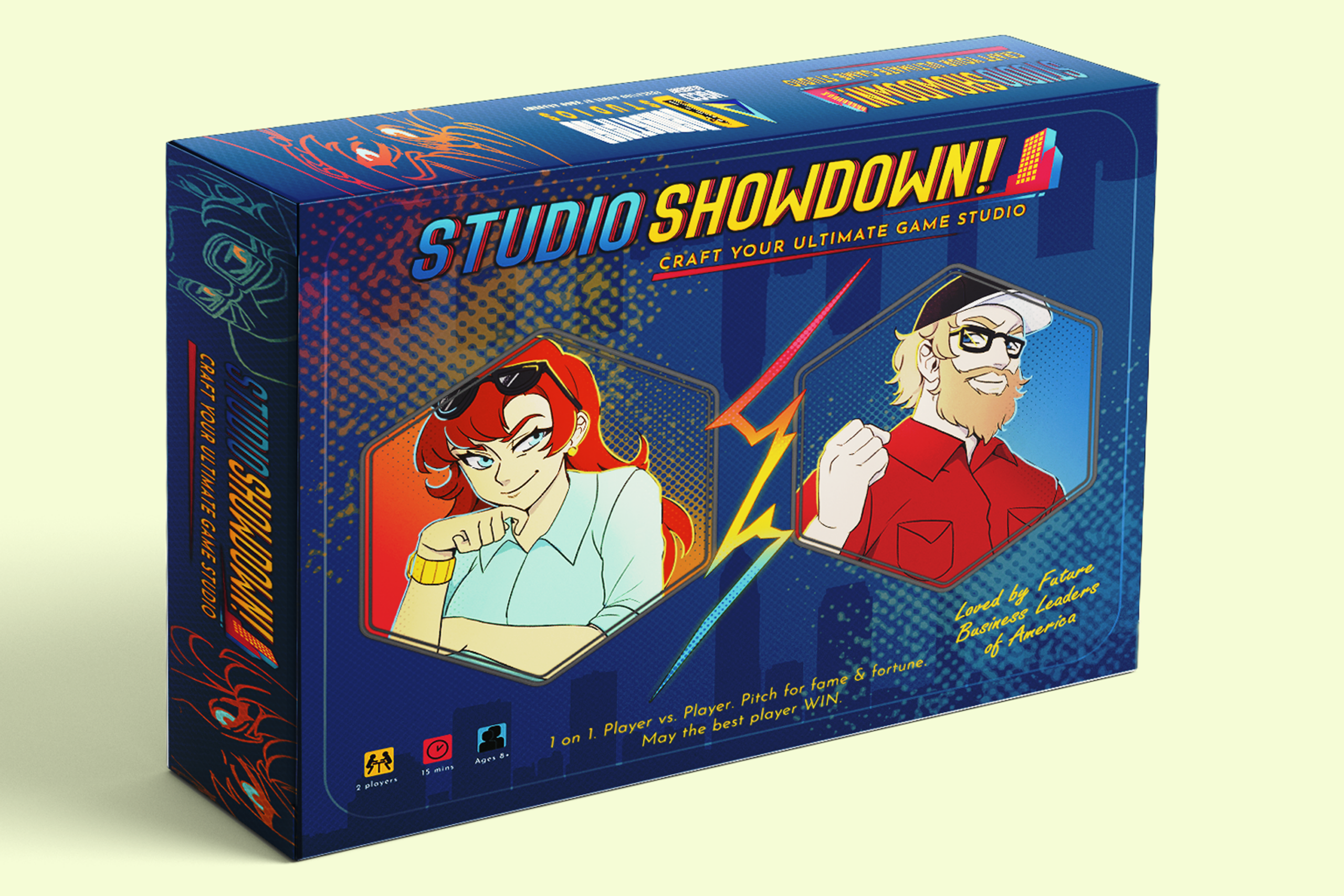
- Discover how immersive tools like Studio Showdown transform your living room into a high-stakes studio management training ground.
The Home-Based Business School: Why Traditional Learning Isn’t Enough
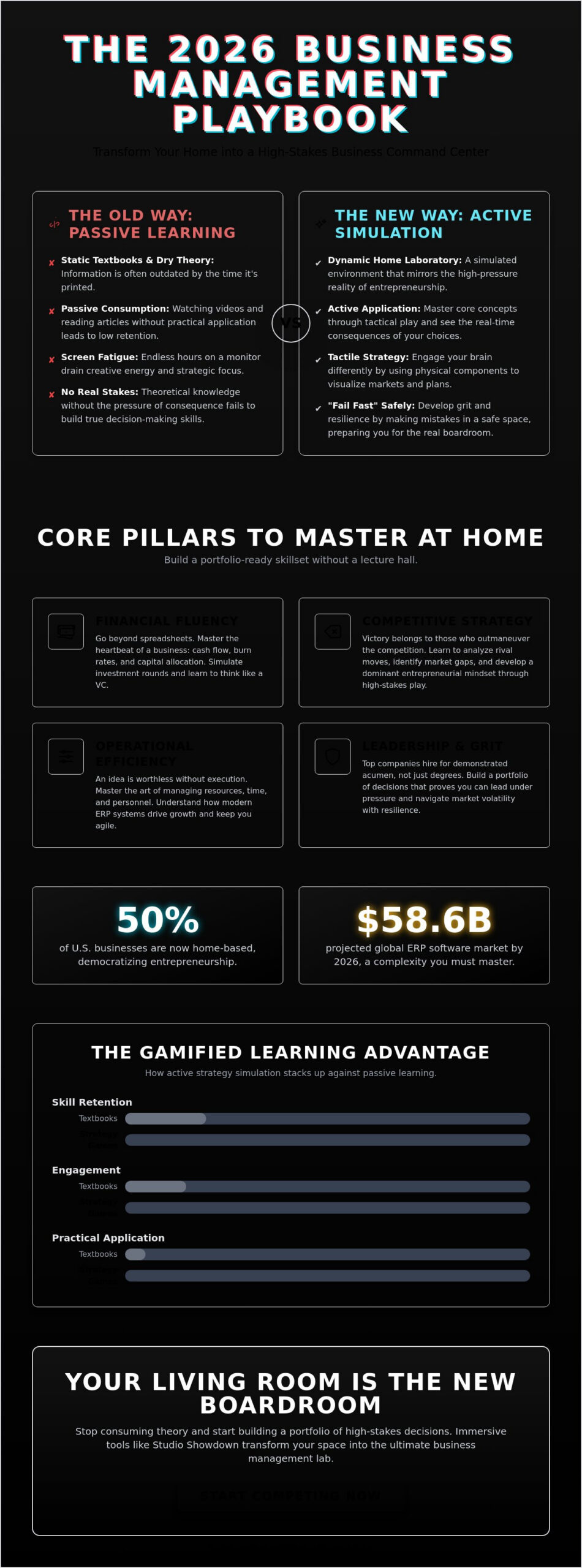
The traditional lecture hall is a relic. It’s a sterile environment that promises expertise but delivers only observation. In the fast-paced production of a real business, there’s no pause button. You don’t need a syllabus; you need a strategy. If you want to know how to learn business management at home, you have to stop acting like a student and start acting like a founder. Approximately half of U.S. businesses are already home-based. They aren’t waiting for permission. Textbooks fail because they describe the weather while you’re trying to survive a storm. They offer static solutions to a world where the global ERP market is projected to reach US$58.63 billion by 2026. You can’t manage that complexity with yesterday’s theories.
Many fall into the “Passive Learning Trap.” You watch a three-hour masterclass. You take notes. You feel productive. But watching a video on studio management isn’t the same as making a high-stakes decision under pressure. Spectating is not skill-building. Real growth happens when you move from consumption to high-fidelity simulation. You need to feel the weight of the choice. You need to see the consequences of a bad pivot in real-time. The 2026 approach demands a blend of theory and active, tactical play.
The Rise of the Self-Taught Manager
The gig economy and modern digital tools have democratised the boardroom. The gatekeepers are gone. Today, understanding the fundamentals of business management is just the baseline. Top-tier companies and creative agencies no longer hunt for degrees. They hunt for demonstrated acumen. They want to see your portfolio of decisions. A self-made manager who has navigated real market volatility is worth more than a graduate with a pristine transcript but zero scars. Your home is the laboratory where this acumen is forged. It’s about building a body of work that proves you can lead, not just follow instructions.
Breaking the Screen-Time Cycle
Learning exclusively through a monitor has a hidden cost. It’s called screen fatigue. It drains your creative battery and blurs your strategic vision. To truly understand how to learn business management at home, you must incorporate tactile, analog experiences. Physical interaction with data and strategy improves long-term memory retention. It grounds your thinking. Turn your living room into a command center. Use physical boards, cards, and maps to visualize your market. This isn’t just about escaping the blue light. It’s about engaging your brain in a way that a cursor never can. Focused, strategic thinking requires a space that demands your full presence.
Core Pillars of Business Management You Can Master at Home
Mastering the core pillars of industry is the first step in understanding how to learn business management at home. You don’t need a corner office to understand market dynamics. You need a mindset that treats every resource as a tactical asset. Management isn’t a checklist. It’s a symphony of finance, strategy, operations, and persuasion. While many online business management courses provide the raw data, few provide the arena to test your instincts. You must build your own battleground.
Financial Fluency Without the Spreadsheet
Financial literacy is often buried under mountain-high spreadsheets. Break that cycle. Focus on the heartbeat of a business: cash flow and burn rates. Burn rate is the speed at which a new company spends its available capital before reaching positive cash flow. If you can’t manage the burn, you can’t survive the launch. Practice simulating investment rounds. Treat your home budget like a venture capital fund. Allocate. Pivot. Scale. This is how you develop a portfolio-ready understanding of capital without drowning in dry theory.
If you’re ready to apply these management principles to tangible assets in the 2026 market, you can learn more about Multifamily Schooled to see how these financial strategies translate to the apartment and commercial real estate sectors.
Competitive Strategy and Market Dominance
Victory belongs to those who outmanoeuvre. Analyzing competitor moves isn’t just about reading reports. It’s about identifying the gaps they’ve left behind. This is where Mastering the Board: The 2026 Guide to Strategy Board Games becomes your playbook. High-fidelity competition sharpens your reflexes. It teaches you to capture market share while others are still reading the instructions. You learn to see the board, not just the pieces. Developing a competitive entrepreneurial mindset requires this kind of active, high-stakes engagement.
Operational efficiency is the engine. You must manage resources with surgical precision. Even at home, you can ‘hire’ digital tools and ‘fire’ inefficient processes. Then comes the art of the pitch. Communicating value to stakeholders is a high-stakes performance. It requires clarity, authority, and creative courage. Finally, master risk management. Know when to double down on a winning hand and when to pivot your entire strategy. It’s better to fail fast in a simulation than to bleed out in the real market. To truly sharpen these instincts, consider adding a tactical management lab to your daily routine.
Digital vs. Analog: Choosing Your Learning Medium
The 2026 manager doesn’t choose between digital and analog. They master the hybrid model. Think of your business education as a high-end production. Digital tools are your data feed. Analog tools are your creative direction. If you want to know how to learn business management at home, you must understand where each medium excels. Screens are perfect for raw speed and compliance. Physical boards are for deep strategy and human connection. You don’t just need information; you need a cognitive edge that your rivals lack. Relying exclusively on one medium is a tactical error that leads to burnout and narrow vision.
When to Go Digital
Digital platforms are your command center for logistics. You need them for the “hard” facts of how to learn business management at home. Use the Small Business Administration (SBA) portal to track federal and state licensing requirements. In 2026, legal landscapes shift fast. Michigan’s HB 4122 recently raised cottage food revenue caps to $75,000, while Texas’s SB 541 now indexes caps to inflation. You won’t find these updates in a textbook. Digital is also where you harness the power of AI. By 2027, 62% of cloud ERP spending will go to AI-enabled solutions. Use these tools for market research and data analysis. They handle the “what,” allowing you to focus on the “why.”
The Power of the Physical Board
Analog is the arena for “soft” power. Negotiation, social EQ, and complex decision-making are best forged away from the screen. Physical pieces and face-to-face play force you to read the room, not just the data. This is where Game Theory becomes a lived experience rather than a mathematical concept. When you engage in Screen-Free Activities for Teens and Families: The 2026 Strategy Guide, you’re training your brain for the boardroom. Negotiation requires eye contact. Strategy requires a bird’s-eye view of the board. Physical interaction grounds your memory. It turns abstract management concepts into tactile reflexes.
The “Passive Learning Trap” mentioned earlier is a digital disease. It makes you feel like an expert while your practical skills atrophy. A hybrid approach solves this. You use online courses for the theory, but you use games and physical simulations for the practice. This isn’t just about escaping blue light. It’s about building a versatile entrepreneurial mindset. You learn to pivot between the high-speed data of the monitor and the deep, strategic silence of the board. That versatility is what defines a leader in 2026.
Gamified Learning: Why Strategy Games Outperform Textbooks
Textbooks are a graveyard of dead ideas. They present business as a series of solved problems. In reality, entrepreneurship is a sequence of unfolding crises. If you want to know how to learn business management at home, you must embrace the ‘Fail Fast’ philosophy. Games provide a high-stakes arena where the cost of a mistake is a reset button, not a bankruptcy filing. This safe environment allows you to take the kind of creative risks that lead to breakthroughs. You build muscle memory for complex financial decisions. You learn to read the market’s pulse. While traditional courses offer quizzes to test your memory, strategy games test your ability to react under pressure.
Simulation vs. Theory
Reading about a cash flow crunch is a passive exercise. Navigating one in a simulation is a visceral lesson. Game-based learning increases engagement and retention because it activates the brain’s reward systems. It’s not just about facts. It’s about patterns. Simulation builds real-world business acumen by forcing you to live through the consequences of your strategic choices in a compressed timeframe. You don’t just learn about the global US$66 billion ERP market; you learn why managing that data matters for your survival. It turns abstract concepts into instinctive reactions.
The Competitive Edge
Business is a struggle for dominance. Rivalry is the best teacher. In a gamified setting, ‘rival studios’ mimic the predatory nature of real-world competition. They force you to outwit, outmanoeuvre, and outpace live opponents. This develops a true Founder Mindset. You stop thinking like an employee and start thinking like a predator. This is the core of The Ultimate Business Board Game: Master Entrepreneurship in 2026. It’s about more than just winning a game. It’s about mastering the social EQ required for high-level negotiation. You learn to spot a bluff. You learn to pitch under fire. You learn to win.
The social element is often the first casualty of digital learning. Video modules can’t teach you how to negotiate a deal with a stubborn partner. They can’t simulate the tension of a boardroom showdown. Strategy games bring that human element back to your living room. They turn how to learn business management at home into a collaborative, competitive experience. You aren’t just studying management. You are practicing it. Ready to step into the arena? Explore the Studio Showdown collection and start your training today.
Studio Showdown: The Ultimate Home Business Management Lab
Theory is the map. Practice is the terrain. You’ve explored the pillars of finance and the hybrid learning model. Now, you need the arena where these elements collide. Studio Showdown isn’t just a board game. It’s a high-fidelity simulator built by industry veterans for the next generation of founders. If you’re serious about how to learn business management at home, you need a tool that mirrors the volatility of the real market. This is the logical culmination of your curriculum. It moves you past the screen and into the heat of the boardroom. You aren’t just reading about leadership. You’re living it.
Mastering the World of Game Development
The creative industry is the perfect laboratory for management. Launching a hit game requires more than just a good idea. It demands surgical resource management and tactical foresight. In Studio Showdown, you navigate the specific challenges of a high-pressure production. You’ll deal with talent acquisition, budget crunches, and shifting market trends. Strategically outmanoeuvring rival studios becomes your primary objective. You learn to spot market gaps before they close. You master the skills of fundraising and pitching in a competitive arena where every move has a consequence. This is where you build the “demonstrated acumen” that 2026 employers value over any degree.
Start Your Showdown Today
The transition from the living room to the boardroom is shorter than you think. Educators and proactive parents are already using Studio Showdown as a cornerstone for real-world preparation. It’s a bridge between home-based study and professional execution. The Studio Showdown: Educator Edition is specifically designed to facilitate this transition, making it an essential part of any modern classroom-style home learning setup. It turns abstract concepts into a shared, competitive experience that sticks. You don’t just memorize the language of money. You use it to win. This is the most effective way to understand how to learn business management at home without the burnout of traditional methods.
Your journey from student to founder requires the right equipment. Don’t settle for passive consumption when you can engage in high-stakes strategy play. Build your portfolio of decisions. Sharpen your competitive edge. Outwit your rivals. The boardroom is waiting, and your training starts at the table. It’s time to elevate your strategy and claim your place in the market. Bring the ultimate business challenge home with Studio Showdown and start your first session today.
Step Into the Arena: Your Management Legacy Starts Now
The lecture hall is empty. The screen is dark. The only thing left is your move. You’ve discovered that the secret to how to learn business management at home isn’t found in a textbook; it’s forged in the heat of tactical play. By balancing real-time digital compliance with the deep strategic weight of analog simulation, you’ve built a foundation that rivals traditional degrees. You’ve moved beyond the passive learning trap and stepped into a world where every decision carries weight. It’s time to stop studying and start leading.
Now, you must validate that acumen. Developed by the experts at VGCD Academy and DEMYSTIFIED Studios, Studio Showdown provides the hands-on laboratory you need to master real-world entrepreneurship. It’s the reason educators use this system to help aspiring developers build professional portfolios that actually mean something in the 2026 market. You have the strategy. You have the mindset. Now, you need the arena.
Master Entrepreneurship with the Studio Showdown Board Game
Your studio is waiting. Your rivals are already playing. The board is set; it’s time to win.
Frequently Asked Questions
Can I really learn business management without a degree?
Yes, you can. Mastery comes through proactivity and tactical play. Top firms in 2026 prioritize demonstrated acumen over paper credentials. Since approximately half of U.S. businesses are home-based, the path for how to learn business management at home is already well-trodden. Success depends on your ability to build a portfolio of strategic wins rather than just collecting certificates.
What are the best free resources for learning business at home?
Use the SBA platform for compliance and edX for foundational theory. AI tools like specialized market research software are essential for data analysis. These digital resources handle the raw information. This allows you to focus your energy on the “why” behind every strategic move you make during your home curriculum. Combine these with free CRM trials to practice operational efficiency.
How do board games help with professional development?
Board games build social EQ and negotiation skills through face-to-face interaction. They simulate high-pressure boardroom scenarios where every choice has a visible consequence. This tactile experience grounds your memory more effectively than any digital quiz. You learn to read opponents and pivot your strategy in real-time. It turns abstract management concepts into a lived experience that textbooks can’t replicate.
What business skills are most important for teens to learn?
Financial literacy and the art of the pitch are the most critical skills. Teens need to understand burn rates and cash flow to survive the chaos of real-world entrepreneurship. Mastering the ability to communicate value to stakeholders early on builds a competitive edge that lasts a lifetime. It turns complex management concepts into professional instincts before they even enter the workforce.
Is gamified learning as effective as traditional courses?
Gamified learning is often more effective than traditional courses because it avoids the passive learning trap. It requires active participation and offers immediate feedback. This method builds muscle memory for complex decisions. It’s a high-fidelity simulation that prepares you for real market volatility better than a static textbook. You aren’t just memorizing facts; you’re developing the reflexes of a founder.
How much time should I spend learning business each day?
Aim for 30 to 60 minutes of deliberate practice or study each day. Consistency is the secret to how to learn business management at home effectively. Short, punchy sessions prevent screen fatigue and keep your strategic reflexes sharp. It’s about building a sustainable habit that integrates into your daily production cycle rather than burning out on long, dry lectures.
What is the difference between an ‘easy money game’ and a strategy board game?
Easy money games rely on luck and simple accumulation. Strategy board games require complex decision-making, resource management, and outmanoeuvring rivals. In a strategy game, your agency determines the outcome. You aren’t just rolling dice; you’re managing a studio, negotiating deals, and capturing market share through superior intellect. These games provide a legitimate laboratory for testing your professional instincts.
How does Studio Showdown teach fundraising and pitching?
Studio Showdown puts you in the hot seat of a game development studio. You must manage limited capital while convincing investors and rivals of your project’s value. It turns the abstract concept of fundraising into a tactical struggle for resources. You learn to pitch under fire and secure the backing needed to launch a hit. It’s a high-stakes simulation of the modern creative industry.