Teachers shouldn’t have to bankroll every classroom idea themselves. A RAND survey in early 2026 found that public school teachers spent an average of $665 of their own money on classroom supplies. If you’re asking how to get funding for innovative teaching tools, start with the learning goal, not the shopping list. A strong proposal explains what students need, how the tool supports that outcome, and how you’ll use it.
Finding the right funding route takes planning. Eligibility, deadlines, and application requirements vary, and a compelling idea still needs a clear educational rationale. Rather than relying on one grant, compare potential sources, match your project to their priorities, and keep a practical backup plan.
This guide will help you compare funding paths, build an evidence-led request, and plan your next step if a grant isn’t available or your application doesn’t succeed. You’ll also see how to assess a hands-on teaching tool such as Studio Showdown against learning objectives, including entrepreneurship and pitching. The goal is simple: define the learning outcome, then choose a tool and funding route that fit.
Key Takeaways
- Start with a specific learning need and intended outcomes, then choose a teaching tool that supports them.
- Compare school budgets, grants, foundations, community giving, and crowdfunding by eligibility, timing, restrictions, and reporting requirements.
- A tool’s format alone doesn’t determine funding eligibility. The funder’s rules and your educational rationale matter.
- Build a focused proposal around implementation, a realistic budget, evaluation, and sustainability. Cite evidence with its source and limitations.
- Learn how to get funding for innovative teaching tools by shortlisting potential routes, verifying requirements, and tracking decisions. Have a revision plan if funding falls through.
How to Get Funding for Innovative Teaching Tools: Start With the Learning Need
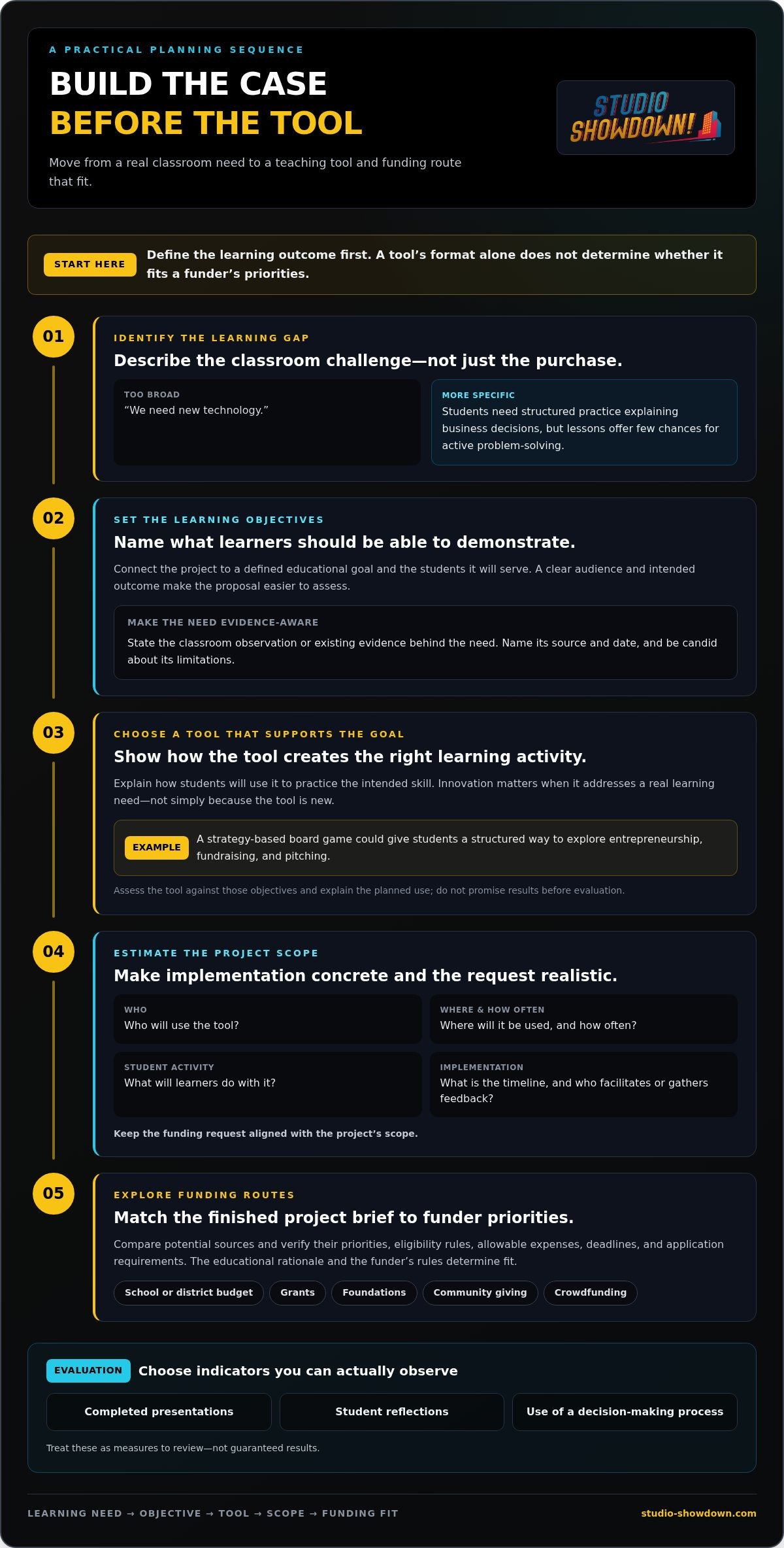
A strong funding search begins with a classroom challenge, not a grant database. First, define the learning gap and the experience students need. Then work through the project in order: identify the need, set learning objectives, choose a suitable tool, estimate the project’s scope, and explore funding routes.
This sequence makes your case more specific. “We need new technology” is a broad purchase request. “Students need structured practice explaining business decisions, but current lessons offer few opportunities for active problem-solving” describes an instructional challenge. Funders can better assess a defined need, audience, activity, and intended outcome than a tool selected simply because it’s new.
What makes a teaching tool fundable?
There’s no universal test. Fit depends on each funder’s priorities, eligibility rules, and allowable expenses. Connect the proposed tool to a specific instructional goal, the learners it will serve, and the activity it will support. The tool’s format alone doesn’t determine whether it fits.
Innovation matters when it addresses a real learning need, not just when it looks different. For example, a strategy-based board game could give students a structured way to explore entrepreneurship, fundraising, and pitching. Educators can assess Studio Showdown against those objectives and explain how they plan to use it, without promising results before evaluation. For a related look at strategy-based learning, explore this business board game guide. To set broader context, Wikipedia’s overview of what is educational technology connects tools with learning theory and practice.
Turn a classroom challenge into a clear project brief
Write the need in one evidence-aware sentence. For example: “Students in [course or program] need more guided practice presenting and defending business ideas, based on [specific classroom observation or existing evidence].” Name the source and date of any evidence, and be candid about its limits. Don’t turn a limited observation into a sweeping claim.
Next, make the project concrete. State who will use the tool, where it will be used, how often, and what students will do with it. Add a realistic timeline and identify staff responsibilities, such as facilitating activities or gathering feedback. Keep the funding request aligned with that scope.
- Need: What learning challenge are you addressing?
- Outcome: What should learners be able to demonstrate?
- Activity: How will the tool support practice?
- Indicator: What evidence will help you assess progress?
Choose indicators you can actually observe, such as completed presentations, student reflections, or demonstrated use of a decision-making process. Treat them as measures to review, not guaranteed results. This project brief is the starting point for how to get funding for innovative teaching tools: connect a learning goal to a tool, then look for funding that fits the project.
Compare Funding Sources for Innovative Teaching Tools
A grant is one possible route, not the only route. The best fit depends on your project goals, how soon the funding is needed, who can approve the expense, and what follow-up the source requires. Compare options before investing time in an application.
| Funding route | Decision-maker | Likely fit | Timing, restrictions, and reporting |
|---|---|---|---|
| School or district budget | School leaders, department heads, or district staff | A tool tied to an approved instructional priority | Budget cycles and approval steps vary. Follow purchasing rules and internal documentation requirements. |
| Grants | Government agencies or other grantmakers | A defined project aligned with a specific funding opportunity | Applications have set deadlines, eligibility rules, and allowable expenses. Reporting and matching requirements may apply. |
| Foundations | Foundation staff or review committees | Projects that closely reflect the foundation’s stated mission | Cycles and award terms differ. Check who may apply, which expenses qualify, and what updates are expected. |
| Community giving | PTAs, community groups, or local donors | A clear classroom need people can understand and support | Approval and fundraising policies may apply. Agree on how contributions will be handled and reported. |
| Crowdfunding | Individual contributors, often through a platform | A focused project with a specific purpose and an understandable case | Plan around platform terms, school fundraising rules, campaign timing, and transparent updates to supporters. |
When could a grant or foundation support fit?
Consider a grant when the project’s intended outcomes align with a funder’s published priorities. Before drafting, verify applicant eligibility, permitted expenses, deadlines, matching requirements, and reporting duties in the current funding materials. Federal education resources and the National Science Foundation can be useful starting points for exploring education-related opportunities. Treat them as leads, not assurances: current program details determine fit.
When are budgets, community giving, or crowdfunding practical?
A school or district budget may suit a tool that supports an approved instructional priority and fits the purchasing process. PTA support, community giving, or crowdfunding can be alternatives when the purpose is specific and stewardship is clear. Before launching, review applicable approvals, fundraising policies, platform terms, and how you’ll communicate the use of funds. For example, an educator could explain how Studio Showdown’s strategy-based learning supports a planned classroom activity, without implying that a particular funding source will cover it.
To decide how to get funding for innovative teaching tools, shortlist more than one plausible route. Compare each source’s rules and timeline with your project scope, and verify requirements before applying or raising funds. Eligibility and allowable purchases depend on the current terms.
Can Hands-On Teaching Tools Qualify? Match the Tool to Funder Priorities
A hands-on tool may fit some funding opportunities, but its format alone doesn’t establish eligibility or rule it out. The funder’s written rules and the strength of your educational rationale matter most. Explain why the tool suits the learning objective, who will use it, and how it will be incorporated into instruction.
Compare formats against the project’s practical needs. A digital tool may depend on devices, connectivity, accounts, or technical support. A hands-on resource may support collaborative practice without the same digital setup, but still needs a plan for access, classroom use, storage, and maintenance. Neither format is automatically more effective or more fundable. The case depends on the match between the activity, learners, implementation plan, and funder priorities.
Show educational value without overclaiming
Make the connection visible: link a tool feature to a student activity, then to a learning objective. For example, students using Studio Showdown could practice making strategic choices and presenting or pitching ideas. Those activities may support entrepreneurship learning, but they don’t prove achievement gains on their own.
Explain how you’ll observe progress with suitable indicators, such as participation, completed work, student reflections, or presentations. Describe these as evidence you plan to review, not results you can promise in advance. If you have relevant baseline information, identify its source and limitations.
Check the rules before treating a tool as eligible
Read the current funding notice or policy closely. Look for definitions and restrictions covering equipment, instructional materials, vendors, and allowable expenses. Confirm whether funds may support the purchase itself, implementation, professional development, or evaluation. These categories vary, so don’t assume that a general education focus means every classroom tool or related expense qualifies.
Eligibility is only one part of a credible plan. Address practical questions that affect whether the project can run as proposed:
- Access: How will intended learners participate, including those who may need accommodations?
- Use: Where and how often will the tool be used, and who will facilitate the activity?
- Logistics: What storage, maintenance, or setup does classroom use require?
- Evaluation: What work, observations, or reflections will help you assess the intended learning?
Clear answers help funders see a planned instructional project, not a novelty purchase. That’s the core of how to get funding for innovative teaching tools: show a relevant learning purpose, a workable plan, and a funding fit supported by the rules.
How to Build a Strong Funding Proposal for a Teaching Tool
A persuasive proposal reads like a plan for learning, not a product pitch. Make the logic easy to follow: need, objectives, tool fit, implementation, budget, evaluation, and sustainability. Each part should connect. When reviewers can see why learners need the project, how it will work, and how you’ll assess it, the request is more focused and credible.
Write a concise case for the tool
State the instructional need, intended participants, and why the tool’s format suits the planned activity. Explain how staff will introduce and facilitate it, and how it fits into existing learning. Use observable objectives, such as explaining a decision or presenting an idea. Don’t guarantee achievement gains. Describe what you intend to support and what you’ll evaluate.
For instance, Studio Showdown can give students a hands-on way to explore strategy, entrepreneurship, fundraising, and pitching. Focus the rationale on the specific learning objective and classroom activity, not simply on the appeal of a game-based resource.
This concise structure can help keep your rationale focused:
- Need: [Describe the instructional challenge and cite the evidence.]
- Objective: [State what learners will practice or demonstrate.]
- Tool and activity: [Explain why this format supports the objective and how students will use it.]
- Evaluation: [Name the evidence you’ll review without predicting the result.]
Plan implementation, evaluation, and sustainability
Name the staff responsible, preparation required, implementation timeline, and how learners will access the tool. Choose practical indicators, such as completed activities, student reflections, or educator observations. For school or program evidence, record the source and date, explain what it measures, and note its limitations. Don’t present a small sample or informal observation as proof of a broad outcome.
Build the budget around the funding notice, not assumptions. List only costs the funder allows, describe the purpose of each item, and use documented estimates where required. Separate the tool from related preparation, implementation, or evaluation expenses so reviewers can see what each cost supports. Confirm eligible categories before submitting.
Sustainability explains what happens after the funded period. Describe plans for continued use, storage, staff onboarding, maintenance, and future costs where applicable. Keep the plan realistic and connected to available resources.
Studio Showdown: Educator Edition is designed for educational settings. Educators can also use Studio Showdown’s professional development and workshops to support classroom implementation. A clear case can help you approach how to get funding for innovative teaching tools with a learning-centered proposal, transparent budget, and practical plan. Explore Studio Showdown: Educator Edition.
From Funding Plan to Classroom Use: Choose a Practical Next Step
A funding plan moves forward when someone owns the next action. Turn your research into a short checklist, set a date to review progress, and keep a second route in view. A missed deadline or declined request doesn’t have to end a promising classroom idea.
A funding-readiness checklist for educators
- Clarify the project: State the need, intended learners, and learning objectives in plain language.
- Shortlist routes: Compare a few plausible funding sources instead of depending on one opportunity.
- Verify requirements: Check current eligibility, deadlines, allowable expenses, matching rules, and approval steps with the funder or relevant school office.
- Prepare documents: Gather the project rationale, supporting evidence, budget, and required approvals.
- Plan delivery: Identify responsible staff, implementation steps, and feasible ways to review progress.
- Track decisions: Record submission dates, follow-up needs, results, and future deadlines.
Before a full rollout, consider a small, manageable pilot if school policies and funding terms permit it. Define what the pilot will test, who will take part, and what evidence you’ll review. Keep the scope practical. A pilot can help educators assess fit and implementation needs, but it shouldn’t be presented as proof of results beyond what the evidence supports.
How to evaluate Studio Showdown as a classroom option
Studio Showdown is a hands-on strategy game centered on video game development and entrepreneurship. Its fundraising and pitching elements can connect with course objectives when students are expected to explore those topics. Compare the activity with your curriculum, learner needs, and implementation plan rather than treating novelty as the goal. For another perspective on hands-on formats, see this strategy board games guide.
If a request is declined, review the decision and use any feedback the funder provides. Then revise the proposal’s alignment, strengthen the evidence or implementation plan, or consider another funding route. A “no” can clarify what to improve for the next opportunity.
Learning how to get funding for innovative teaching tools is a process, not a single application. Keep the learning purpose at the center, follow the applicable rules, and choose a next step your team can realistically carry out. To explore classroom options, take a look at Studio Showdown: Educator Edition and Classroom Bundle.
Turn a Clear Learning Goal Into Your Next Move
The strongest funding request starts with a learning need, not a product pitch. Define the outcome, compare funding routes, and verify each funder’s current rules, deadlines, and eligible expenses. A focused implementation and evaluation plan can make your case clearer, while a backup route helps keep progress moving if an application is declined.
That’s the practical foundation for how to get funding for innovative teaching tools: connect the tool to a specific classroom activity, explain how you’ll assess it, and keep claims grounded in evidence. Studio Showdown is a hands-on strategy board game centered on video game development and entrepreneurship, with fundraising and pitching as learning themes when they align with your curriculum.
Ready to consider a game-based option for your learning goals? Explore Studio Showdown for educators, including Studio Showdown: Educator Edition and Classroom Bundle. Start with the need, build a thoughtful plan, and take the next step.
Frequently Asked Questions
How do I find grants for innovative teaching tools?
Start by matching your learning goal to funders’ published priorities, then search federal, state, district, foundation, and education-organization opportunities. Narrow the field by checking who can apply, which expenses are allowed, deadlines, matching requirements, and reporting duties. Confirm those details in the current funding notice or with the funder. A focused shortlist helps you learn how to get funding for innovative teaching tools without relying on one opportunity.
Can a school use grant funding to buy board games or other hands-on teaching tools?
Possibly, if the grant’s rules allow the purchase and the proposal connects the tool to an eligible educational purpose. A board game’s physical format neither guarantees eligibility nor rules it out. Explain who will use it, what classroom activity it supports, and how that activity connects to learning objectives. Before including it in a budget, verify the funder’s rules for instructional materials, equipment, vendors, and related expenses.
What should a funding proposal for a teaching tool include?
Include a clear instructional need, intended learners, measurable objectives, and an explanation of how the tool supports planned activities. Describe implementation responsibilities, timeline, eligible costs, evaluation indicators, and plans for continued use. Support the need with relevant school or program evidence, naming its source and date and noting limitations. Keep the budget transparent and avoid promising results that haven’t been evaluated. Follow the funder’s required format and document checklist.
Can teachers apply for education grants, or must a school apply?
It depends on the specific grant. Some opportunities accept individual teachers or educator teams, while others require an eligible school, district, nonprofit, or other organization to apply. Check applicant rules before preparing a request, and find out whether school or district approval is needed even when individual applications are allowed. Confirm who would receive and manage funds, since that can affect purchasing, documentation, and reporting.
What if my teaching tool is not digital?
A non-digital tool can still support a fundable learning project if the funding rules permit it and the educational rationale is clear. Describe the activity, intended learners, learning objective, access considerations, and how the tool will be used in instruction. Include practical details such as storage and classroom implementation when relevant. Focus on the fit between the tool and the learning need, not on whether the resource uses a screen.
What can I do if my funding application is rejected?
Review the decision and request feedback if the funder offers it. Use any comments to identify whether the issue involved eligibility, alignment with priorities, evidence, budget, or project scope. Then revise the request or consider a different funding route whose rules better fit the project. Track future deadlines and reuse proposal materials that remain accurate. A rejection is a decision on one application, not necessarily the end of the project.
How can I demonstrate that an innovative teaching tool is worth funding?
Show a direct line from the learning need to the tool, planned activity, and intended outcome. Explain how educators will observe progress through appropriate evidence, such as student work, reflections, participation, or educator observations. Cite the source and date of existing evidence and describe its limitations. Distinguish goals from proven results. For example, a hands-on strategy game may support entrepreneurship or pitching practice when those objectives fit the curriculum, without guaranteeing achievement gains.