Most indie games don’t die because of bad code. They bleed out because the founder forgot to value their own heartbeat. With over 1,200 titles hitting Steam every month, your project isn’t just a passion piece; it’s a high-stakes tactical operation. You’ve likely felt that cold sweat, fearing your bank account will hit zero before your beta even launches. Mastering how to budget for an indie game is the difference between a visual masterpiece and a forgotten folder on a hard drive.
We know the struggle. Valuing your time as a solo dev feels impossible; hidden costs like localization or the $2,000 Xbox devkits can wreck a fragile spreadsheet. This guide provides the financial roadmap you need to survive the 2026 market. We’ll dismantle the burn rate concept, reveal why marketing now demands up to 50% of your budget, and show you how to pitch for the resources you deserve. It’s time to stop guessing and start building with professional precision. Let’s secure your studio’s victory.
Key Takeaways
- Define your production tier early to align your creative vision with realistic 2026 financial constraints and market expectations.
- Master how to budget for an indie game by prioritizing labor costs, which typically consume 70-80% of your total development runway.
- Protect your studio’s survival by calculating an accurate burn rate and identifying the silent, cash-draining threat of scope creep.
- Ensure global reach by accounting for localization and platform-specific hardware costs like devkits in your initial financial strategy.
- Bridge the gap between theory and execution by using Studio Showdown to simulate the high-stakes world of fundraising and project management.
The Indie Reality Check: Defining Your 2026 Budget
Budgeting is a tactical strike. It isn’t just about spreadsheets; it’s about survival in a market that releases 1,200 games a month. Most indie budgets fail within the first six months because founders mistake “passion” for “capital.” They ignore the friction of reality. If you want to understand how to budget for an indie game, you must first define the size of your battlefield. Precision matters. Vision is expensive. Without a clear scope, your project is just a slow-motion crash.
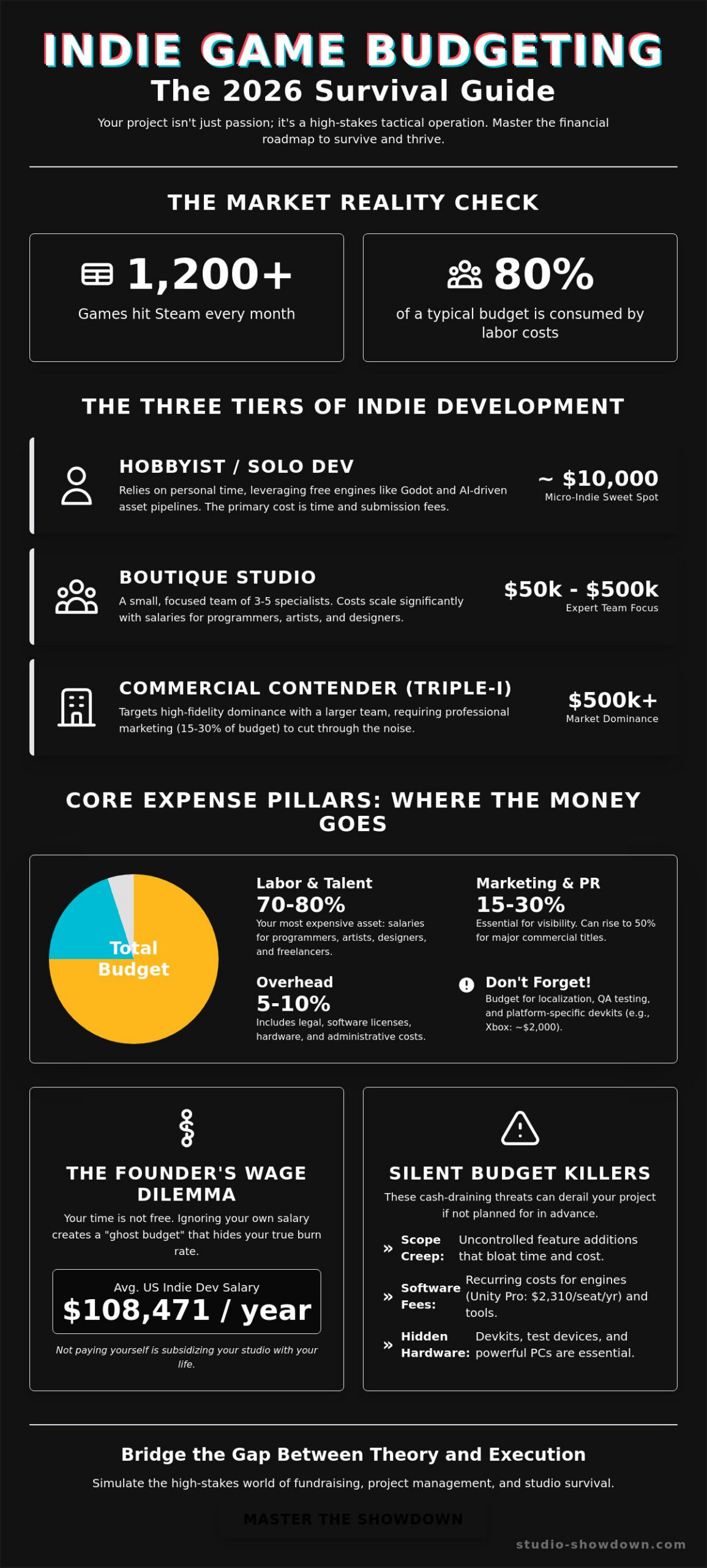
The 2026 landscape offers a unique $10,000 threshold. For a solo developer, this is the “micro-indie” sweet spot. By leveraging free engines like Godot and integrating AI-driven asset pipelines, a single creator can produce a vertical slice that looks like a million dollars. But visual fidelity is only half the fight. The other half is the cold, hard math of your own existence. Time is currency. Every hour spent debugging is an hour of “founder’s debt” you’re accruing against your future success.
The Three Tiers of Indie Development
Indie game development spans a massive spectrum. The Hobbyist/Solo track relies on personal time and free tools. Your budget here is lean, mostly covering Steam submission fees and minor asset packs. The Boutique Studio manages 3-5 specialists. Here, costs explode. You aren’t just buying code; you’re buying the collective focus of experts. Finally, the Commercial Contender, or Triple-I, targets high-fidelity dominance. These projects require professional marketing budgets, often ranging from 15% to 30% of total development costs, just to break through the visual noise of 2026.
The “Founder’s Wage” Dilemma
Your time is not free. It’s your most expensive currency. Many founders ignore their own salary, creating a “ghost budget” that looks sustainable until the rent is due. You must calculate a theoretical salary. In the US, the average indie developer earns roughly $108,471 annually. If you aren’t paying yourself, you’re effectively subsidizing your studio with your life savings. Track your deliverables, not just your hours. If a task takes forty hours but adds zero market value, you’ve just burned cash you didn’t know you had. Balancing a day job with studio leadership is a grueling marathon. Don’t let it become a death march by ignoring the opportunity cost of your labor. Success requires a professional mindset, not just a creative one.
Core Expense Pillars: Where the Money Actually Goes
Every dollar in your budget is a soldier. If you don’t deploy them with precision, you’ll lose the war before launch. When you’re determining how to budget for an indie game, your focus must shift from what you can build to what you can afford to sustain. Labor is the undisputed heavyweight, typically consuming 70-80% of your total capital. Whether you’re paying a lead programmer or outsourcing character rigging, people are your most expensive asset. Marketing follows closely. For studios with budgets between $50,000 and $500,000, experts recommend allocating 15-30% of your total development cost to promotion just to survive the noise of 1,200 monthly Steam releases.
Understanding fundamental game budget principles ensures you don’t treat legal and administrative needs as an afterthought. You’ll need to set aside $1,000 to $10,000 for LLC formation, trademarks, and ironclad contracts. It’s the price of professionalism. These pillars aren’t suggestions. They’re the structural supports that keep your studio from collapsing under the weight of its own ambition.
Talent Acquisition and Outsourcing
Choosing between full-time hires and project-based freelancers is a high-stakes balancing act. Full-time talent provides stability, but freelancers offer the flexibility to scale costs during lean months. High-quality sound design and music licensing are often underestimated, yet they define the premium feel of your title. Team synergy is the invisible variable here. Mastering the dynamics of a small studio is difficult. Exploring strategy board games can help founders understand how to optimize limited resources and manage team friction. Testing these leadership skills with the Studio Showdown Board Game is a smart way to prepare for real-world production hurdles.
Software and Hardware Requirements
The tech stack for 2026 is powerful but carries recurring costs. While Godot is free, Unity Pro is set to cost $2,310 per seat annually for larger studios starting January 12, 2026. Don’t forget industry standards like Adobe or Maya, which add hundreds in monthly subscription fees. Hardware is another hurdle. Xbox Developer Kits now cost $2,000, a significant jump from previous years. You also need to budget for cloud storage and version control through GitHub or Perforce. These tools ensure your team’s work is safe and synchronized. Hardware depreciates, and testing devices for mobile or console ports are non-negotiable expenses for any serious commercial release.
Fundraising and Managing the Burn Rate
A budget is not a static document. It is a ticking clock. If you want to master how to budget for an indie game, you must understand that capital is simply time in a different form. Your burn rate is the speed at which your studio consumes that time. Whether you are self-funding or managing a million-dollar seed round, ignoring this velocity is the fastest way to a project’s graveyard. In 2026, 60% of indie creators still choose to self-fund. This bootstrapping approach offers total creative freedom but places the entire financial risk on your shoulders. External investment, while harder to secure, provides the nitro boost needed to scale your production before the market shifts.
Crowdfunding has evolved into a community-led financial engine. It is no longer just about the money. It’s about proof of concept. A successful campaign in 2026 serves as a loud, data-driven signal to publishers and platform holders that your game has a hungry audience. Your community is your biggest financial asset. They aren’t just backers; they are the vanguard of your marketing effort. Treat their investment with the same professional rigor you would a venture capitalist’s check. Stop guessing. Start calculating.
The Strategic Pitch Deck
Investors don’t fund dreams; they fund calculated risks. Your pitch deck must move beyond concept art and lore. It needs to showcase a clear Return on Investment (ROI). Use competitive analysis to prove market dominance in your specific niche. Be cold. Be objective. Show them you know exactly where your game fits in the Steam ecosystem. Most importantly, you must define your runway with absolute clarity. Runway is the lifeblood of your studio, representing the exact number of months you can survive before your bank account hits zero. If you can’t explain how you’ll reach the finish line with the requested funds, the meeting is over.
Alternative Funding Sources
Don’t limit your search to big-name publishers. Government grants and regional tax incentives for digital media are often overlooked gold mines. Many regions offer significant rebates on labor costs, which we’ve already identified as your largest expense. Publisher advances are another route. You might trade 30% to 50% of your revenue for their marketing muscle and stability. It’s a trade-off between equity and security. Angel investors and Venture Capital firms are also increasingly active in the gaming space, looking for studios that combine technical prowess with a sharp business mind. Success here requires more than just a good game; it requires a founder who understands the mechanics of the industry.
Budget Killers: Avoiding Scope Creep and Hidden Costs
Scope creep is the silent assassin of the indie world. It starts with a small feature request. It ends with a bankrupt studio. Every “cool idea” added mid-development extends your burn rate and pushes your launch date into the unknown. Mastering how to budget for an indie game requires the discipline of a surgeon. You must be willing to cut features to save the project’s life. If you don’t control the scope, the scope will eventually control your bank account.
Quality Assurance (QA) and post-launch support are the most common “forgotten” costs. Bug hunting isn’t a hobby; it’s a professional necessity. Experts recommend allocating 10-20% of your initial budget for post-launch patches, server maintenance, and community management. If your game launches broken, every dollar spent on marketing is wasted. A polished, smaller game will always outperform a massive, buggy mess. Protect your reputation by budgeting for the “bug hunt” phase early.
The Minimum Viable Product (MVP) Strategy
Focus on the core loop. Cut everything else. Iterative development is about finding the fun fast. It is about testing your business board game mechanics early to ensure the foundation is solid before you build the penthouse. Prioritize “Must-Haves” over “Nice-to-Haves.” If a feature doesn’t directly contribute to the primary hook of your game, it is a luxury you likely cannot afford. Shipping an MVP allows you to generate revenue and player feedback while you still have the resources to pivot.
Localization and Rating Fees
You cannot afford to ignore the global market. Localization is one of the highest ROI investments you can make. While translating for EFIGS (English, French, Italian, German, Spanish) is standard, don’t overlook the massive potential in China and Japan. However, translation isn’t the only cost. If you’re targeting a console release, you must factor in ESRB and PEGI rating fees. These costs are fixed and non-negotiable. Combine this with regional marketing and influencer outreach to ensure your game resonates across borders. Global success requires a global strategy.
Don’t let hidden costs sink your vision. Prepare for the reality of production by sharpening your decision-making skills with the Studio Showdown Board Game, the ultimate training ground for aspiring founders.
Mastering the Showdown: Education Before Execution
Knowledge is a tactical advantage, but only if you know how to deploy it. You can memorize every statistic about how to budget for an indie game, but until you’re forced to choose between a localization push and a critical server fix, it’s all just theory. Real-world development is a high-speed collision of art and finance. Simulation is the only way to build the muscle memory required for this struggle. It lets you test high-stakes strategies in a vacuum before you risk your life savings in the crowded 2026 market. Failure in a simulation is a lesson; failure in the market is a bankruptcy.
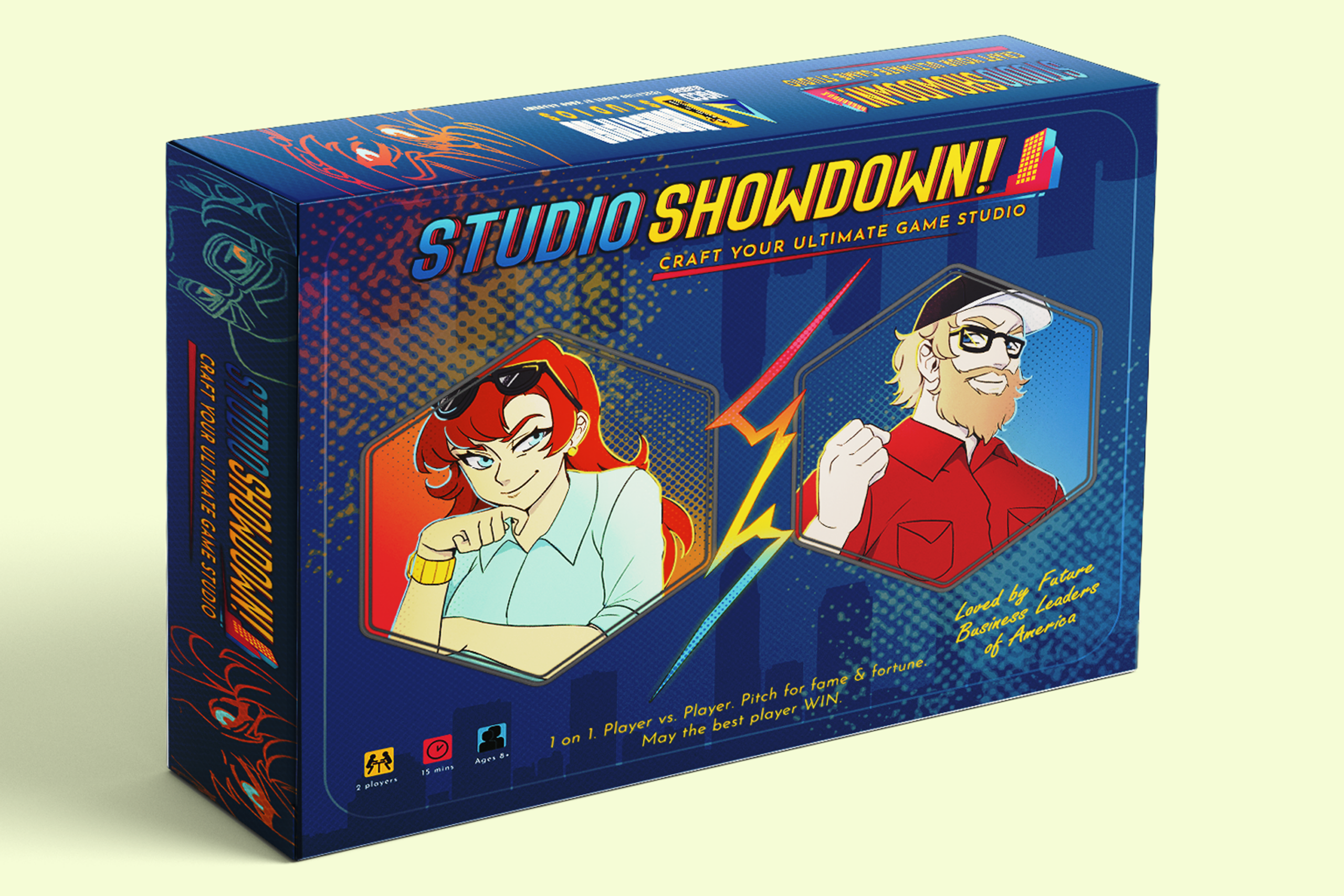
Studio Showdown acts as a hands-on lab for the “business of games” education that most tutorials ignore. It bridges the gap between being a talented artist and a viable CEO. You’ll learn to manage the friction of team dynamics and the crushing weight of hidden costs we’ve discussed in previous sections. This isn’t just about survival. It’s about building a professional portfolio of decisions. When you finally pitch to an investor, you won’t be guessing. You’ll be speaking from a place of simulated experience, proving you have the grit to lead a team through the entire production lifecycle.
Risk-Free Entrepreneurship
Studio Showdown isn’t just a board game. It’s a high-fidelity stress test. It forces you to manage the same variables that sink real studios: fluctuating burn rates, aggressive rivals, and limited capital. You’ll learn to outmaneuver competitors for market share without losing your shirt. This isn’t about luck. It’s about developing a “Founder’s Instinct.” You’ll practice resource allocation until it becomes second nature. By the time you sit down to draft your actual studio plan, you’ve already survived dozens of digital “showdowns.” You’ve seen how scope creep kills. You’ve felt the sting of a failed marketing campaign. Now, you’re ready to win.
The Path to Market Dominance
Success in the 2026 gaming landscape requires more than just technical skill. It requires financial literacy. This is why Studio Showdown is becoming the standard for classrooms and workshops. It strips away the jargon and replaces it with actionable experience. You’ll learn how to budget for an indie game by living the process, from the first hire to the final launch. Transitioning from the board game to a real studio isn’t a leap; it’s a step. You aren’t just a developer anymore. You’re a founder ready to dominate the visual noise. Experience the struggle for dominance with Studio Showdown and secure your studio’s future today.
Secure Your Studio’s Victory
Success in the 2026 indie market isn’t a roll of the dice. It’s the result of a calculated, high-fidelity strategy. You’ve learned that labor isn’t just an expense; it’s your primary engine. You’ve seen how marketing is the vital bridge between a finished project and a commercial hit. Understanding how to budget for an indie game means respecting your burn rate while ruthlessly cutting scope creep before it drains your runway. Precision is your greatest weapon.
Don’t wait for a real-world bankruptcy to teach you these critical lessons. Developed by VGCD Academy experts and utilized in professional development workshops, Studio Showdown offers an immersive entrepreneurship simulation that tests your grit. It’s the ultimate training ground for founders who refuse to settle for mediocrity. It’s time to elevate your leadership and master the mechanics of the industry before the first line of code is even written. Master the business of games with Studio Showdown. Stop guessing. Start winning. Your studio’s future is yours to build.
Frequently Asked Questions
How much does it cost to make a 2D indie game in 2026?
Costs range from $10,000 for solo micro-projects to over $500,000 for boutique studio productions. Your final price tag depends on the level of polish and the size of your team. While 2D art can be more affordable than high-fidelity 3D assets, you must still account for significant labor costs and a competitive marketing spend to stand out.
What is the biggest expense in indie game development?
Labor is the undisputed heavyweight, typically consuming 70-80% of your total capital. This includes salaries for specialists, freelancer fees, and the “founder’s wage” required to cover your own living expenses. If you don’t calculate the cost of human hours, you aren’t truly managing a studio; you’re just running an expensive hobby.
Can I make an indie game with a $0 budget?
Technically yes, but your time is never free. You can leverage free engines like Godot and open-source asset libraries to eliminate upfront software fees. However, you must still account for the opportunity cost of the months or years you spend in development. A $0 cash budget usually requires a massive investment of personal “sweat equity” that carries its own financial risk.
How much should I budget for marketing an indie game?
Experts recommend allocating 25-50% of your total project spending to marketing and promotion. With over 1,200 titles hitting Steam every month, discoverability is a paid battle for market share. Even solo developers with budgets under $50,000 should set aside at least $1,000 to $10,000 to ensure their title doesn’t launch into total silence.
What percentage of the budget should go to art and sound?
Art and sound typically require 20-30% of your total resources. These elements define your game’s visual success and premium feel. When learning how to budget for an indie game, you must ensure these departments have enough capital to create high-impact assets that can cut through the noise of the 2026 market.
What is scope creep and how do I prevent it?
Scope creep is the uncontrolled growth of features that pushes your launch date and drains your burn rate. It is the silent killer of indie projects. You can prevent it by defining a strict Minimum Viable Product (MVP) and sticking to it. Every new feature request must be weighed against its impact on your remaining runway before it’s approved.
Should I quit my job to work on my indie game full-time?
Only quit if you have at least 12 months of living expenses saved as a safety net. The average US indie developer salary is approximately $108,471, and your project may take longer than expected to generate revenue. Protecting your financial health allows you to make better creative decisions without the crushing pressure of immediate bankruptcy.
How do I find investors for my indie game studio?
Investors look for a polished vertical slice and a data-driven pitch deck that proves a clear Return on Investment (ROI). Focus on showcasing your market niche and competitive advantage. You can practice the high-stakes negotiation and resource management required for these meetings by using the Studio Showdown Board Game to simulate real-world fundraising scenarios.