The traditional lemonade stand model is dead, and your students have already tuned out the funeral. You see the disengagement every time classroom activities for entrepreneurship feel like a history lecture instead of a high-stakes board meeting. It’s difficult to bridge the gap between textbook definitions and the brutal reality of a 2026 market where the federal corporate tax rate sits at 21% and the prime rate holds at 6.75%. Students deserve more than theory; they need the adrenaline of a real launch.
We’re here to change the game. This guide provides the blueprint to transform your students into founders and your classroom into a high-growth startup hub. You’ll learn to replace dry theory with simulated survival, competitive fundraising, and professional portfolio building. We’re moving past the basics to master the $5 million Regulation Crowdfunding limits and the high-energy mechanics of the Studio Showdown: Educator Edition. Prepare to watch your students move from passive learners to aggressive innovators as we dive into the industry-focused strategies that define modern business success.
Key Takeaways
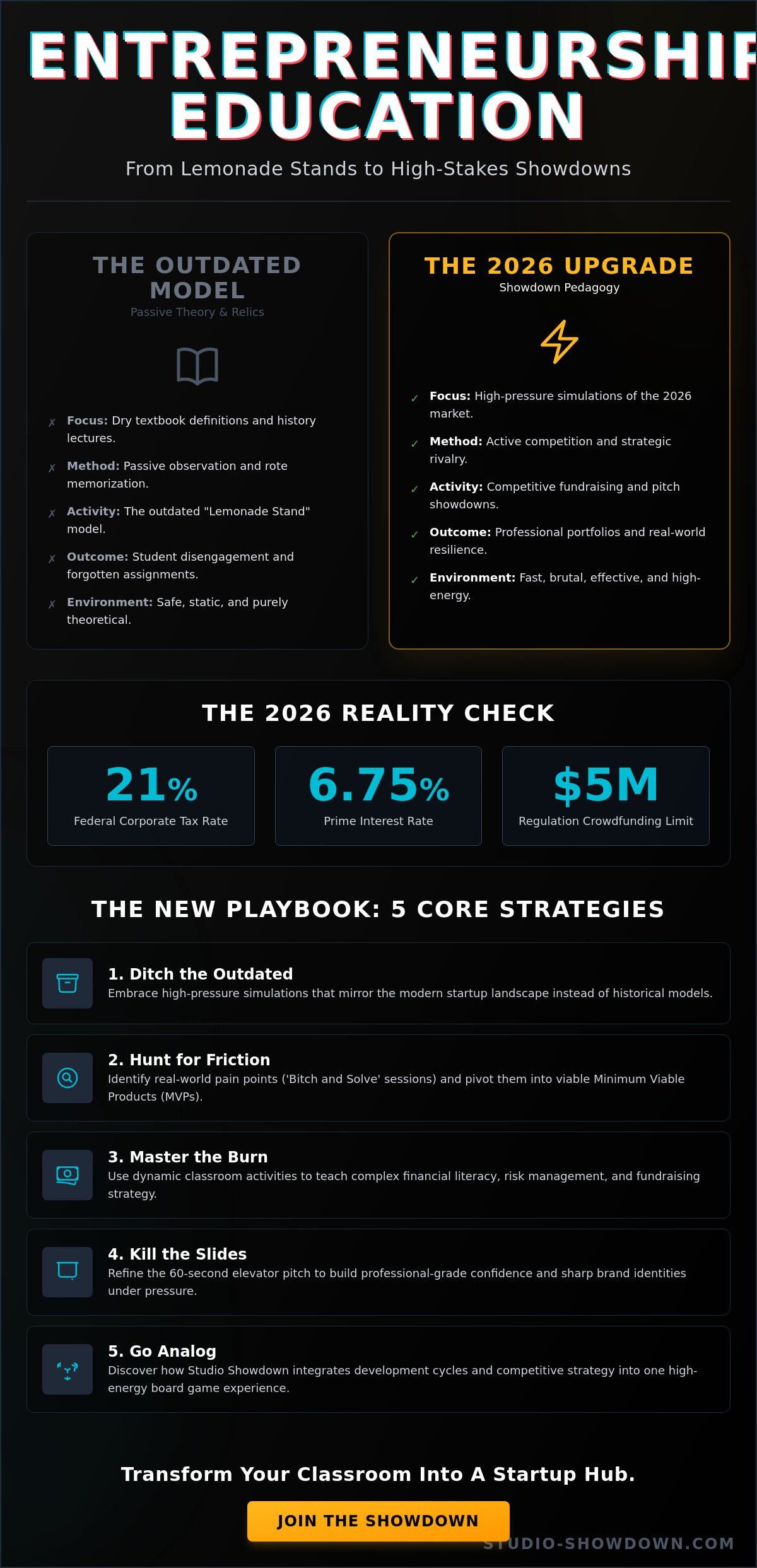
- Ditch the outdated lemonade stand. Embrace high-pressure simulations that mirror the 2026 startup landscape.
- Hunt for friction. Learn to identify real-world pain points and pivot them into viable Minimum Viable Products.
- Master the burn. Use dynamic classroom activities for entrepreneurship to teach complex financial literacy and fundraising strategy.
- Kill the slides. Refine the 60-second elevator pitch to build professional-grade confidence and sharp brand identities.
- Go analog. Discover how the Studio Showdown: Educator Edition integrates development cycles and competitive strategy into one high-energy experience.
Why Classroom Activities for Entrepreneurship Need a 2026 Upgrade
The lecture hall is silent. The students are gone. Even if they’re physically present, their minds are miles away, scrolling through market trends and creator economy updates. Traditional entrepreneurship education has hit a wall. Theoretical models are static. The market is liquid. To capture attention, we must replace passive observation with active simulation. We don’t just teach business; we stage it. The goal is to move from the safety of the textbook to the heat of the arena.
The “Lemonade Stand” model is a relic. It fails tech-native students who understand global scaling before they can drive. They don’t want to sell juice on a corner. They build studios. They launch platforms. They disrupt industries. Modern classroom activities for entrepreneurship must reflect this ambition. We call this “Showdown Pedagogy.” It’s a method where competition serves as the ultimate catalyst for critical thinking. It’s fast. It’s brutal. It’s effective. This approach ensures that every project becomes a portfolio piece rather than a forgotten assignment.
The Psychology of Competitive Learning
Gamification isn’t a buzzword; it’s a biological hack. When students enter a competitive arena, dopamine levels rise. Retention follows. We’re shifting the focus from simple cooperation to strategic rivalry. This isn’t about being mean. It’s about being sharp. Students learn to read the room, anticipate moves, and counter-punch with better data. This environment builds a specific kind of resilience. In a simulation, failure is a data point, not a disaster. It’s the only way to teach a student how to survive a market downturn or a failed funding round without losing their nerve.
Bridging the Gap Between Theory and The Boardroom
The 2026 job market has no room for rote memorization. Employers demand business acumen. They want to see a portfolio of decisions, not a transcript of grades. High-energy classroom activities for entrepreneurship allow students to live the Founder’s Journey in real time. We focus on industry-specific contexts, particularly tech and gaming, where the stakes are high and the pace is relentless. These simulations force students to grapple with real numbers. They manage risk. They pitch to skeptics. They learn that the boardroom doesn’t care what you know; it cares what you can do under pressure. This is how we prepare them for the high-growth reality of the modern economy.
Ideation and Market Research: The ‘Pain Point’ Hunt
Stop chasing “cool” ideas. They’re often useless. Real entrepreneurship begins with a problem that hurts. In the 2026 classroom, we start with the ‘Bitch and Solve’ session. Students list every annoyance, friction point, and failure in their daily lives. This is raw data. It’s the foundation for high-impact classroom activities for entrepreneurship. We don’t want a bakery; we want a solution to a logistical nightmare. Once the pain is identified, we move to the Minimum Viable Product (MVP). It’s the leanest version of a solution that still delivers value.
Validation is the next battle. We simulate customer interviews. Students must grill their peers, but they can’t pitch. They listen. They look for the “why” behind the behavior. To ground this process, educators often use the CFPB’s Guide to Exploring Entrepreneurship to structure these early brainstorming phases. After validation, we launch the ‘Competitor Shadowing’ exercise. Students analyze a rival’s failure. They don’t just copy success; they study the wreckage of those who came before them. It’s about finding the gap the giants missed.
Rapid Prototyping Without a Lab
Speed is the only currency that matters here. We use paper prototyping for digital products. It’s fast. It’s cheap. It’s honest. If you can’t explain the user flow with a stack of index cards, a million-dollar dev budget won’t save you. Mid-session, we drop the ’10-Minute Pivot.’ We tell the teams their primary market just vanished. They must adapt their model instantly. This forces them into the ‘Brutal Honesty’ peer review. It’s a high-energy feedback loop where fluff is stripped away. Only the strongest logic survives.
Market Analysis in the Digital Age
Finding a market isn’t about broad demographics anymore. It’s about the ‘Niche Down’ challenge. We push students to find the smallest viable market. If they can’t dominate a room, they can’t dominate a city. We simulate digital market trends and sudden consumer shifts to keep the pressure high. Visualizing market share is often the hardest part for non-business students. Using board game mechanics like those found in the Classroom Bundle makes these abstract concepts tangible. It turns market share into a physical territory to be defended. This is how classroom activities for entrepreneurship become more than just talk. They become a fight for survival.
Managing the Burn: Financial Literacy and Risk
Finance is the graveyard of good ideas. Most educators avoid it because it feels like a math test. It isn’t. It’s a pulse check. Effective classroom activities for entrepreneurship must strip away the spreadsheets and focus on the burn. If a student doesn’t understand cash flow, they don’t have a business; they have a hobby. We make financial literacy a game of survival. The biggest objection we hear is that finance is too boring for non-business students. That’s only true if you’re using a calculator instead of a clock. When you add a ticking timer and a depleting bank account, finance becomes the most exciting part of the room.
The ‘Burn Rate’ Challenge is Activity 2 in our guide. It forces teams to manage a fixed budget through 12 simulated months. We introduce real 2026 variables to ground the experience. Every C-corp pays a 21% federal corporate income tax. Self-employed founders face a 15.3% tax rate. We drop “Hidden Cost” cards like equipment failure or sudden legal fees. This turns boring accounting into a high-stakes rescue mission. Students don’t just learn numbers; they learn how to keep the lights on when the market turns cold.
Demystifying fundraising is the next step. We simulate the choice between bootstrapping and Venture Capital. Students decide: do they keep 100% of a small pie or 10% of a massive one? We introduce the $5 million limit for Regulation Crowdfunding (Reg CF). They learn that raising money isn’t a win; it’s a debt or a dilution. We teach ROI through high-risk investment scenarios where the wrong move ends the game instantly. It’s about teaching them that every dollar has a job to do.
The Founder’s Dilemma Simulation
Negotiation is the core of this exercise. Students trade equity for resources in a classroom negotiation game. We simulate the “Scaling Too Fast” trap. If they hire too many people before their MVP is validated, they hit zero in month four. It’s a brutal lesson in timing. We also use a ‘Hidden Cost’ lottery to simulate unexpected business expenses. It builds the resilience needed to handle the volatility of a real startup.
Resource Management Under Pressure
We use ‘Talent Points’ to represent human capital. Teams must decide: do we dump points into R&D to build a better product, or into Marketing to find customers? There’s no right answer, only trade-offs. This is the ‘Opportunity Cost’ exercise in action. Visualizing cash flow with physical tokens or board game currency makes the loss of cash feel real. It’s no longer just a number on a screen. It’s a physical resource they just lost to the market. This is how classroom activities for entrepreneurship create lasting business acumen.
The Art of the Pitch: Competitive Strategy Showdowns
Pitching is a contact sport. It isn’t a presentation; it’s a battle for resources. If you can’t hook an investor in the time it takes to ride an elevator, you’ve already lost. We use the 60-Second Elevator Showdown to force this reality. No slides. No safety net. Just the founder and their vision. This is one of the most vital classroom activities for entrepreneurship because it strips away the fluff. It demands clarity, confidence, and a razor-sharp hook. It’s about learning to command the room before you ever open a laptop.
Developing a “Studio Identity” comes next. Branding isn’t just a logo; it’s a positioning statement. We teach students to build an identity that cuts through the visual noise. They must define their competitive edge. Why should the market care? To test this, we introduce the ‘Rival Sabotage’ exercise. Markets are aggressive, and we simulate that hostility. Teams must defend their market share against hostile takeovers and aggressive pricing from their peers. This is where long-term tactical thinking becomes a survival skill. We often use strategy board games to simulate these multi-turn power plays and complex market shifts.
Mastering the Pitch Deck
Clarity is king. We enforce a strict 5-slide limit. If you can’t explain your revenue model, scalability, and exit strategy in five frames, you don’t understand your business. The Q&A session is student-led. We cast them as VCs with a mandate to be difficult. They learn the ‘Hook, Line, and Sinker’ technique: grab attention with a problem, present the data-driven solution, and close with a clear ask. This pressure cooker environment ensures that when they finally face a real investor, they’re ready for the heat.
Competitive Outmaneuvering
Students must choose their battlefield. We teach them to identify ‘Blue Ocean’ opportunities versus ‘Red Ocean’ bloodbaths. They grapple with the ‘First-Mover Advantage’ versus the ‘Fast-Follower’ strategy through live simulations. We encourage tactical alliances. Sometimes, the best way to win is to merge. This isn’t just business theory; it’s a tactical struggle for dominance. To bring this level of intensity to your curriculum, the Studio Showdown: Educator Edition provides the perfect framework for these high-stakes encounters.
Studio Showdown: The Ultimate Entrepreneurship Simulation
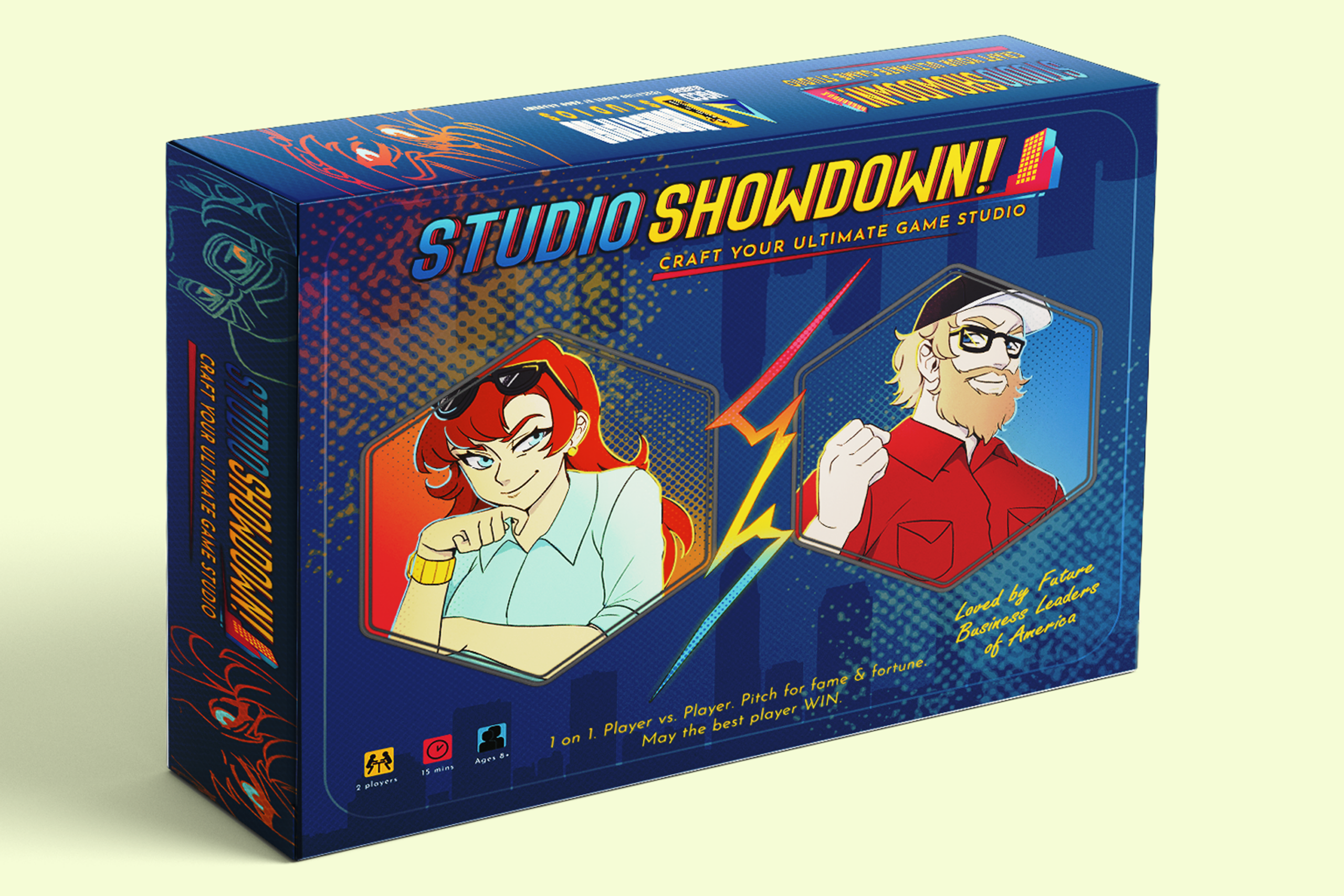
Theory only takes a founder so far. To truly master the market, students must enter the arena. Studio Showdown isn’t just a game; it’s a comprehensive engine for classroom activities for entrepreneurship. It pulls every thread we’ve discussed—ideation, burn rates, and high-pressure pitching—into a single, high-octane simulation. Instead of disconnected assignments, students manage a living business entity. They experience the friction of a development cycle while simultaneously hunting for investors. It’s an all-in-one laboratory for the next generation of creators.
In a world of digital noise, the analog nature of this simulation is a tactical advantage. It forces teens to disconnect from screens and engage in raw, face-to-face negotiation. There’s no algorithm to hide behind. They must read their rivals’ body language and adjust their strategy in real time. This focus leads to deeper learning. Every session becomes a story. We encourage educators to have students document these games as ‘Business Case Studies.’ This transforms a class period into a professional portfolio piece that proves they can handle the volatility of the 2026 market. Implementing a business board game as a semester-long capstone project provides a clear, competitive goal. It gives the curriculum a ‘Big Game’ feel that keeps engagement high until the final bell.
From Players to Founders
The mechanics are built to mirror the specific challenges of a video game studio. Students aren’t just moving pieces; they’re managing talent and capital. They must master the ‘Dev Cycle.’ This means balancing the holy trinity of project management: quality, time, and budget. If they spend too long in R&D, their burn rate kills the studio. If they rush to market, the product fails. They learn to navigate the $5 million Regulation Crowdfunding limits while fighting for market share. The ‘Showdown’ moment is the final test of their strategy. It’s where superior tactical positioning beats raw luck every time.
Getting Started in Your Classroom
Setting up your first tournament is simple. The Educator Edition is designed to slot directly into existing CTE or business curricula without a massive overhaul. It provides the structure; the students provide the energy. You aren’t just a teacher anymore; you’re a board chairman overseeing a fleet of startups. It’s time to elevate the standard of business education. Order your Classroom Bundle today and transform your teaching from a lecture into a launchpad. Give your students the tools to win before they even step into the real boardroom.
Forge the Next Generation of Industry Leaders
The era of static business plans is over. Your students need the grit that only comes from high-stakes simulation and tactical rivalry. By shifting from theoretical models to Showdown Pedagogy, you provide a launchpad for real innovation. These classroom activities for entrepreneurship don’t just teach business; they build the resilience needed to survive a 21% corporate tax rate and the pressure of a 60-second pitch. You’ve seen how identifying pain points and managing the burn can transform a dry lecture into a competitive arena.
It’s time to stop prepping and start producing. Developed by VGCD Academy experts and trusted by leading CTE programs nationwide, our tools are built for results. You’ll reduce your lesson prep time while watching student engagement skyrocket. Bring the heat to your classroom with the Studio Showdown Educator Bundle and turn your students from players into founders. The market is waiting. Let’s make sure they’re ready to dominate it.
Frequently Asked Questions
What are the most effective entrepreneurship activities for middle schoolers?
Focus on tangible problem-solving and rapid ideation to capture their energy. The ‘Bitch and Solve’ session is a perfect entry point; it teaches students to identify real friction in their daily lives and pivot those frustrations into product solutions. Middle schoolers thrive on immediate feedback, so use paper prototyping to visualize their ideas before they get bogged down in technical details. It’s about building the habit of seeing gaps in the market.
How do I teach financial literacy without making it boring for students?
Stop using spreadsheets and start using a clock. Gamifying the ‘Burn Rate’ challenge turns accounting into a survival mission. Integrate real 2026 data like the 21% federal corporate income tax rate and the 15.3% self-employment tax to ground the simulation. When students see their physical tokens or board game currency disappearing every ‘month’ due to overhead, the math becomes a tactical necessity rather than a dry chore.
Can board games really teach real-world business skills?
Analog simulations force a level of face-to-face negotiation and tactical thinking that digital platforms can’t replicate. A well-designed business board game like Studio Showdown mirrors the complexity of a real development cycle. Students must balance quality, time, and budget while managing talent. These games move business education from passive observation to active struggle, which is where true leadership is forged.
How do I facilitate a classroom pitch competition?
Keep the pressure high and the time limits short. Run a 60-Second Elevator Showdown where slides are banned and only the core value proposition matters. To increase the stakes, cast the rest of the class as Venture Capitalists with the power to ‘fund’ projects based on the clarity of the pitch and the realism of the ‘ask.’ This environment forces students to master their hook and handle aggressive Q&A sessions with confidence.
What is the ‘Envelope Exercise’ in entrepreneurship education?
This activity provides teams with a sealed envelope containing a small amount of seed capital and a strict deadline to generate the highest return possible. It’s a classic lesson in resourcefulness and immediate ROI. Students learn that the most valuable asset isn’t the money in the envelope; it’s their ability to identify a high-demand service they can perform within the time limit. It’s a masterclass in the ‘First-Mover Advantage.’
How can I integrate entrepreneurship into a STEM or CTE curriculum?
Bridge the gap between technical skill and market viability by treating every lab project as a potential startup. In CTE programs, use industry-specific classroom activities for entrepreneurship that focus on the ‘Founder’s Journey’ within that field. For example, a coding student isn’t just writing a script; they’re developing an MVP for a studio. This context adds professional purpose to every technical lesson.
What are some low-prep classroom activities for entrepreneurship?
The ‘Pain Point Hunt’ and the ’10-Minute Pivot’ require almost zero setup but deliver massive engagement. You can challenge students to identify three market gaps in the room or force them to change their entire business model mid-discussion. These activities prioritize mental agility over materials. They’re perfect for filling a short block of time while keeping the competitive spirit of the classroom alive.
How do I assess student performance in a business simulation?
Evaluate the logic behind their decisions rather than just their final bank balance. Use the ‘Business Case Study’ model where students must document their strategy, their failures, and how they adapted to market shifts. Performance in the Studio Showdown: Educator Edition is best measured through their ability to manage the ‘Dev Cycle’ and defend their market share. A student who loses their capital but can explain exactly why is often learning more than one who got lucky.