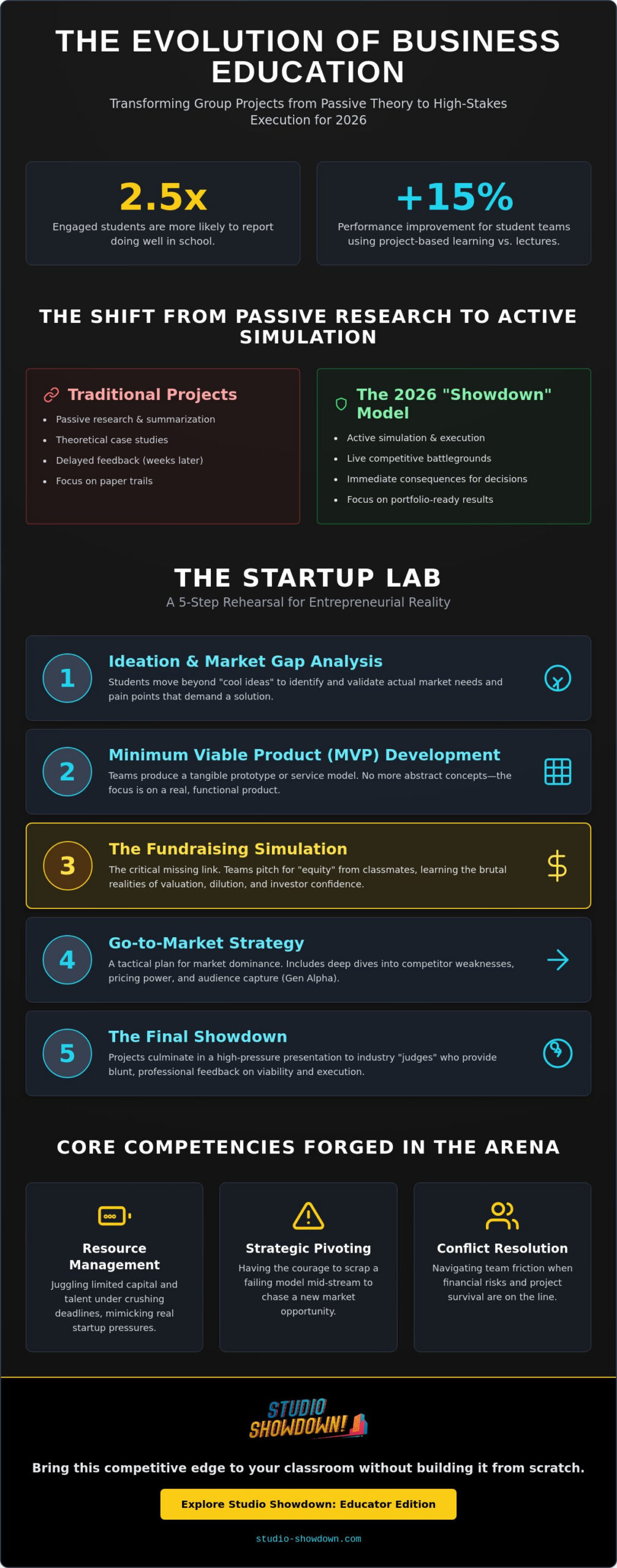
The traditional business lecture is dead. In 2026, students don’t want to hear about strategy; they want to execute it. Research indicates that engaged students are 2.5 times more likely to report doing well in school, yet most group projects for business students still feel like academic busywork. It’s time to trade passive research for high-stakes simulations that mirror the grit of the real market.
You’ve seen the disengagement. You’ve felt the frustration of grading projects that lack professional depth. We agree that a syllabus should be an arena, not a script. This guide promises to move you beyond theory. You’ll discover how to build entrepreneurship and leadership skills through projects that produce portfolio-ready results instead of just paper trails.
We’ll dive into the latest 2026 AACSB Global Standards for Business Education and explore how to simulate high-stakes risks without leaving the classroom. From finance-driven challenges to strategic showdowns, it’s time to elevate your teaching and give your students a competitive edge.
Key Takeaways
- Shift from theory to high-stakes execution by designing group projects for business students that mirror the intensity of 2026’s market demands.
- Execute the five-step Startup Lab to transform student ideas into tangible MVPs and market-ready prototypes.
- Turn case studies into competitive battlegrounds where teams rebrand failing products to capture emerging Gen Alpha audiences.
- Leverage analog board game simulations to foster deeper social learning and authentic leadership under financial pressure.
- Integrate professional-grade tools like the Studio Showdown: Educator Edition to master the arts of fundraising, pitching, and industry dominance.
The Evolution of Group Projects for Business Students in 2026
Gen Z and Gen Alpha students have zero patience for busywork. They’ve grown up in a world of instant feedback and high-velocity content. Static assignments feel like a waste of their digital-native potential. Traditional group projects for business students often collapse under the weight of passive research. These students don’t want to summarize a CEO’s memoirs; they want to be the CEO. They want skin in the game. They want a challenge that reflects the grit of the modern market.
High-impact learning in 2026 is defined by one word: execution. It’s the move from the library to the arena. We’re seeing a massive shift in how Business education prepares the next generation. It’s no longer enough to understand a concept. You have to defend it against a competitor. Competition is the ultimate engine of retention. It turns a boring credit requirement into a high-stakes mission. Students who compete don’t just pass. They retain. They adapt. They win. This isn’t just theory; a 2018 study showed that student teams using project-based learning had a 15% improvement in performance scores compared to lecture-only groups.
Modern curricula now prioritize the “un-teachable” skills. Negotiation isn’t learned from a slide deck. Adaptability isn’t found in a glossary. These are forged in the heat of a project where the variables change every hour. It’s about moving beyond the “consultancy” models of the past that require massive administrative overhead. We’re building creators, not just advisors.
The Shift from Passive Research to Active Simulation
Case studies are post-mortems of someone else’s victory. They’re secondary to live business simulations. Why? Because simulations offer immediate feedback. In a traditional project, a student makes a mistake and finds out three weeks later through a grade. In a “Showdown” style project, that mistake costs them market share instantly. This mimics real-world market volatility. It forces teams to think on their feet. It creates a pulsing classroom environment where every decision has a visible consequence. It’s production-level learning that cuts through the noise.
Core Competencies Developed Through Group Collaboration
Effective collaboration isn’t just about getting along. It’s about managing a “founder” environment where the stakes are high. Students must master specific, measurable skills that look great in a portfolio:
- Resource Management: Juggling limited capital and talent under crushing deadlines.
- Strategic Pivoting: Having the courage to scrap a failing model mid-stream to chase a new market gap.
- Conflict Resolution: Navigating team friction when financial risks and project survival are on the line.
This isn’t just a grade. It’s a rehearsal for the industry. When group projects for business students are designed as tactical challenges, the result isn’t just a better GPA. It’s a student body that’s ready to dominate the 2026 economy from day one.
The Startup Lab: A 5-Step Entrepreneurial Project
The Startup Lab isn’t a simulation. It’s a rehearsal for reality. While generic assignments focus on filing reports, this framework forces students to build, break, and defend a business idea in five distinct stages. Most group projects for business students fall short because they lack a structured financial risk. We’re changing that. Educators are constantly looking for ways of making group work a better experience, and the Startup Lab is the definitive answer for 2026.
- Step 1: Ideation and Identifying Market Gaps. Students move past “cool ideas” to find actual market wounds that need healing.
- Step 2: Developing a Minimum Viable Product (MVP). Teams produce a tangible prototype or service model. No more abstract concepts.
- Step 3: The Fundraising Simulation. This is the missing link. Teams pitch for “equity” from classmates, learning the brutal reality of dilution and valuation.
- Step 4: Go-to-Market Strategy. A tactical plan for market dominance. It includes a deep dive into competitor weaknesses and pricing power.
- Step 5: The Final Showdown. The project culminates in a high-pressure presentation to industry “judges” who provide blunt, professional feedback.
If you want to bring this competitive edge to your classroom without building it from scratch, the Studio Showdown: Educator Edition provides the perfect framework for these high-stakes decisions.
Phase 1: Ideation and Market Validation
Most students start with a product. We teach them to start with a problem. In 2026, precision is everything. Teams must use digital sentiment analysis to prove their target audience actually exists. They don’t just guess; they validate. This stage ensures that group projects for business students are rooted in data, not just imagination. By defining a niche with surgical precision, students learn that a broad market is often a weak market.
Phase 2: The Art of the Pitch
A great idea dies in a boring deck. Phase 2 is about visual storytelling and financial grit. Students must explain ROI and burn rates in terms that an investor can’t ignore. It’s about the narrative. We push them to treat their presentation as a production. The data must be rock solid, but the delivery must be cinematic. Students can look to industry examples like Zoney to see how flexible digital signage is used to create professional-grade visual narratives in the real world. This builds the “soft skills” of persuasion and presence that are 2.5 times more likely to lead to long-term career success according to 2026 engagement research. They aren’t just presenting; they’re selling a vision.
Market Analysis and Advertising “Showdowns”
Don’t just read the quarterly reports. Hunt for the mistakes. In 2026, market analysis is a contact sport. We’re moving beyond the dry summaries of the past. These group projects for business students focus on the winners and losers of the current fiscal year. Students dissect the failures of major brands. They identify the exact moment a campaign lost its rhythm. It’s about developing an eye for the visual noise that kills a brand’s momentum. You aren’t just looking at numbers. You’re looking at the story the numbers failed to tell.
The “Ad War” simulation takes this further. We pit groups against each other for the same target audience. It’s a zero-sum game. If one team wins the demographic, the other loses. We measure success through simulated engagement metrics that mirror real-world platform algorithms. This isn’t a hypothetical exercise. It’s a fight for market dominance. Students learn that in 2026, attention is the most expensive currency. They must create, test, and pivot in real-time to survive the showdown.
Competitive Intelligence Gathering
A SWOT analysis shouldn’t be a list. It should be a blueprint for an attack. We teach students to track rival “studios” or companies in a classroom setting. They aren’t just looking at their own strengths. They’re looking for the gaps in the competition’s armor. This is how you find “blue ocean” opportunities. In a crowded 2026 market, you don’t compete on price. You compete on uniqueness. You find the space where the noise is quietest and you own it. This requires a level of detail that goes beyond the textbook.
The Rebranding Challenge
Every year, a legacy industry falls out of touch. The challenge is simple: take a failing product and make it viral for Gen Alpha. This requires applying strategy board games principles to marketing. You think three moves ahead. You anticipate the pivot. You manage your resources like a grandmaster. Students present multi-channel campaigns that don’t just look good; they work. They use visual storytelling to bridge the gap between a boring utility and a premium experience. It’s about production value. It’s about the showdown. By the end, they don’t just have a grade. They have a campaign that belongs in a professional portfolio.
Strategy Simulations: Bridging Theory and Real-World Risk
Digital simulations are often a black box. Students plug numbers into a spreadsheet, an AI algorithm processes the data, and a result appears without context. This isn’t learning; it’s data entry. In 2026, the most effective group projects for business students are moving back to the table. We’re trading sterile screens for the high-stakes grit of analog strategy. When students can see their competitors’ movements in real-time, the psychological pressure changes. The “Founder Experience” isn’t about clicking buttons. It’s about managing team morale when a financial risk doesn’t pay off. It’s about the social friction of a board room.
Modern business simulation games teach rapid decision-making better than any lecture. They force teams to live with their choices. In these arenas, we track wins and losses as a primary metric for grading. This mirrors the 2026 AACSB standards that emphasize demonstrated impact and clear outcomes. If a team goes bankrupt in the simulation, they don’t just lose points. They perform a post-mortem to understand why. This turns a “loss” into a masterclass in resilience and strategic pivoting.
Bring the showdown to your classroom today with the Studio Showdown Board Game.
Analog vs. Digital: Which Simulation Wins?
The screen-free advantage is real. Tactile engagement helps students retain complex systems. Moving a physical resource piece across a board aids memory retention in a way a cursor never will. Beyond the mechanics, analog play demands face-to-face negotiation. You can’t hide behind an avatar when you’re pitching a merger or defending a hostile takeover. This builds the “soft skills” of presence and persuasion that digital platforms lack. In a hyper-digital world, the board provides a rare, focused environment where the only noise is the competition.
Risk Management and Resource Allocation
We teach students the true cost of a bad hire. In our simulations, every resource spent has a ripple effect. Teams must balance long-term growth with short-term survival. If they over-leverage for a flashy product launch, they might not have the capital to survive a market shift. The “Showdown” moment occurs when an unexpected event card changes the board state. Suddenly, the “perfect” plan is obsolete. This forces group projects for business students to move beyond static planning. It’s about agility. It’s about knowing when to double down and when to cut your losses before the next turn.
Implementing Studio Showdown in Your Business Curriculum
The creative economy is the new frontier. In 2026, the video game industry represents a high-stakes arena for entrepreneurship. It’s a world where artistic vision meets brutal financial reality. By acting as studio founders, students engage in group projects for business students that demand more than just participation. They demand mastery. They must navigate the complexities of fundraising, the pressure of a live pitch, and the relentless pursuit of market dominance. This isn’t just a simulation. It’s a production. Every milestone achieved on the board translates into a portfolio-ready deliverable that proves their readiness for the industry.
Integrating professional-grade tools into your syllabus changes the classroom dynamic. We don’t just teach strategy. We build it. You can incorporate screen-free activities into a professional development plan that values human connection over digital noise. This approach ensures that your students are developing the face-to-face negotiation skills required for the 2026 market. It’s about presence. It’s about the social grit that a screen simply cannot replicate.
The Business of Game Development
Why video games? It’s the perfect case study for the modern age. It requires balancing creative talent against strict financial constraints. Students learn the true cost of a “hit” and the danger of a “flop.” They manage burn rates. They analyze market gaps. Launching a product in a crowded marketplace is a battle of narratives. In this environment, the “founder” mindset isn’t an option. It’s a survival requirement. They aren’t just playing; they’re managing the risks and rewards of a global industry in real-time.
Classroom Integration and Educator Support
Implementation is seamless. The Studio Showdown: Educator Edition provides a structured framework for grading based on performance and strategic depth. You don’t have to guess who the leaders are. The board shows you. Setting up a “Classroom League” encourages a healthy, competitive energy that keeps engagement levels at an all-time high. Every turn is a lesson. Every loss is a pivot. We provide the professional development workshops needed to turn your classroom into a production studio. Stop lecturing about the economy. Start building the people who will lead it. This is the new standard for group projects for business students. It’s time for the showdown.
Dominating the 2026 Business Arena
The era of the passive syllabus is over. Modern education demands the grit of a startup lab and the strategic depth of a market showdown. By shifting from research to execution, you turn your classroom into a production studio. You’ve seen how analog simulations bridge the gap between theory and real-world risk. These tactics ensure that group projects for business students result in measurable skill development and portfolio-ready deliverables.
Success in the creative economy requires more than knowledge. It requires presence, persuasion, and the ability to pivot under pressure. Developed by VGCD Academy and DEMYSTIFIED Studios, our framework focuses on the essential arts of fundraising and pitching. It’s time to move beyond the visual noise and give your students a genuine competitive edge.
Bring the Showdown to your classroom with the Studio Showdown Educator Edition. It’s designed specifically for maximum student engagement and elite portfolio building. Your students are ready for a challenge. Give them the arena they deserve.
Strategy and Execution: Frequently Asked Questions
What are the best group projects for high school business students?
High-impact group projects for business students at the high school level focus on tangible outcomes like the Startup Lab or rebranding challenges. These projects allow students to identify market gaps and develop physical prototypes. They move beyond theory by forcing students to present a viable business case to their peers. It’s about building a foundation of entrepreneurship through active execution.
How do you grade a business simulation group project fairly?
Fair grading in a business simulation requires a mix of objective performance metrics and process-based evaluation. Track wins and losses within the game while also assessing the quality of strategic reflections. Use peer reviews to ensure team accountability. This ensures that the final grade reflects both market success and individual contribution without penalizing students for calculated risks.
Can board games really teach professional business skills?
Board games provide a high-pressure environment for face-to-face negotiation and resource management that digital platforms often lack. They force players to read the room and adapt to human unpredictability. Games like Studio Showdown simulate industry volatility with precision. This builds the social grit and presence required for actual high-stakes business meetings in the 2026 economy.
What is the “Startup Lab” project format?
The Startup Lab is a five-step entrepreneurial framework designed for rapid execution within group projects for business students. It starts with ideation and market validation before moving to MVP development and a fundraising simulation. The process culminates in a Final Showdown pitch. This structure ensures every team member has a specific, measurable role in the survival of the venture.
How do group projects help students build a professional portfolio?
Why is the video game industry a good focus for business projects?
The video game industry is the ultimate case study for the modern creative economy. It sits at the intersection of artistic innovation and brutal financial constraints. Students must manage burn rates while launching products in a crowded market. This industry provides a relatable yet high-stakes backdrop for mastering complex business concepts like ROI and market dominance.
How can I reduce screen time while still teaching digital-age business skills?
Use analog strategy simulations to teach the logic of digital markets without the need for a screen. These games mirror the mechanics of platform algorithms and venture capital in a tactile format. By removing the digital interface, students focus on the human elements of strategy. It creates a deep, focused learning environment that cuts through the visual noise of the classroom.
What is the difference between a case study and a business simulation?
Case studies are retrospective post-mortems of events that have already happened. Simulations are active arenas where students make real-time decisions with immediate consequences. While a case study teaches you what someone else did, a simulation teaches you what you’re capable of doing. It’s the difference between reading a script and entering the showdown yourself.