A lecture on venture capital isn’t a lesson; it’s a sleep aid. You’ve seen the glazed eyes. You’ve felt the screen fatigue. Teaching abstract market risks through a slide deck feels like explaining a color to someone who can’t see it. It’s frustrating. It’s inefficient. It’s failing the next generation of founders. You likely agree that students deserve more than a passive seat in a digital-only classroom. They need the heat of the arena. They need to feel the pressure of a real pitch. They need to own their decisions.
This is how gamified business education changes the narrative. We’re moving beyond simple points and badges to a world where students learn by doing, failing, and pivoting in high-stakes environments. This guide explores the transition from student to studio founder. We’ll show you how to turn dry theory into real-world entrepreneurship skills through strategic play. You’ll discover how to drive 150% more engagement while helping students build tangible portfolios. It’s time to replace the lecture hall with a strategy room. We’re going to master the market, outmaneuver rivals, and turn business failure into a blueprint for success.
Key Takeaways
- Stop lecturing and start simulating; learn why gamified business education is the definitive shift from passive listening to high-stakes market mastery.
- Develop elite business acumen by managing complex resources and navigating financial feedback loops in real-time.
- Combat screen fatigue with the “Analog Advantage,” using face-to-face tabletop interaction to forge stronger, more collaborative leaders.
- Identify and integrate the right strategic formats to meet specific learning goals like fundraising, pitching, and market risk.
- Bridge the gap between the classroom and the industry by transforming students into studio founders through immersive, industry-specific play.
What is Gamified Business Education in 2026?
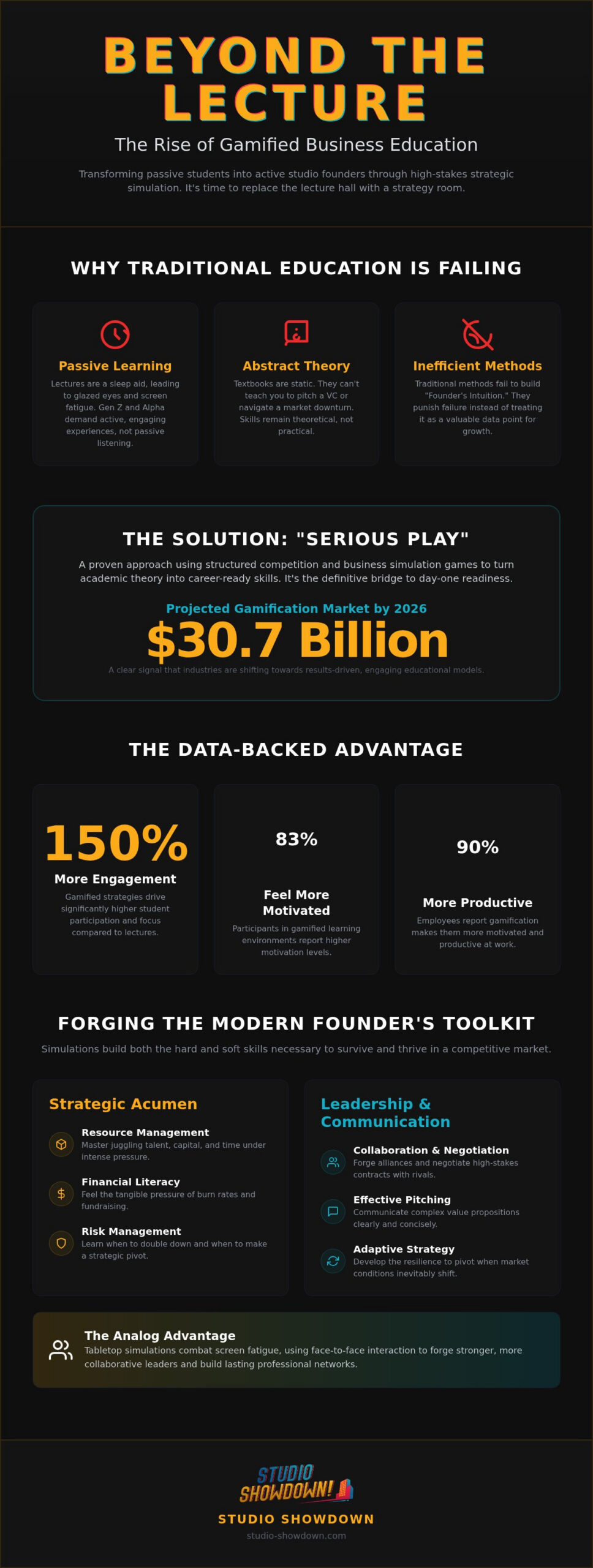
The era of passive listening is dead. In 2026, gamified business education isn’t a luxury; it’s a survival tool. It is a pedagogical approach that uses game design to simulate market dynamics. The “Easy Money” educational era has vanished. High interest rates have ended the era of cheap capital. Investors want proof of execution. With the gamification market projected to reach $30.7 billion by 2026, the industry is moving toward results, not just participation. Students need to practice high-stakes decision-making before they ever step into a boardroom.
This isn’t about digital stickers. It’s about business simulation games that force players to adapt. We call this “Serious Play.” It’s the process of using structured competition to build a professional portfolio. It proves you can handle the heat. It proves you can win. It proves you can:
- Manage limited resources under intense pressure.
- Negotiate high-stakes contracts with rivals.
- Pivot strategies when market conditions shift.
- Communicate complex value propositions clearly.
From Theory to ‘Serious Play’
Textbooks are static. The world is fluid. Simulations bridge the gap between academic theory and real-world execution. You can’t learn to pitch a VC by reading a PDF. You learn by facing a rival across a table. You learn by losing a deal. Pitch. Pivot. Prevail. This immersive approach turns abstract concepts into muscle memory.
Failure is a data point. In a game, you can blow a budget and restart. This psychological safety encourages bold moves and artistic bravery. Each round builds a sharper instinct. Gamified business education is the definitive bridge between academic theory and day-one career readiness.
Why Traditional Methods are Failing Gen Z and Gen Alpha
Gen Z and Gen Alpha don’t want to be talked at. They’ve grown up with instant feedback and high-fidelity visuals. The lecture hall is a relic. They demand visual, social, and competitive experiences. They want to see results. This shift requires a new production mindset that values engagement as much as information.
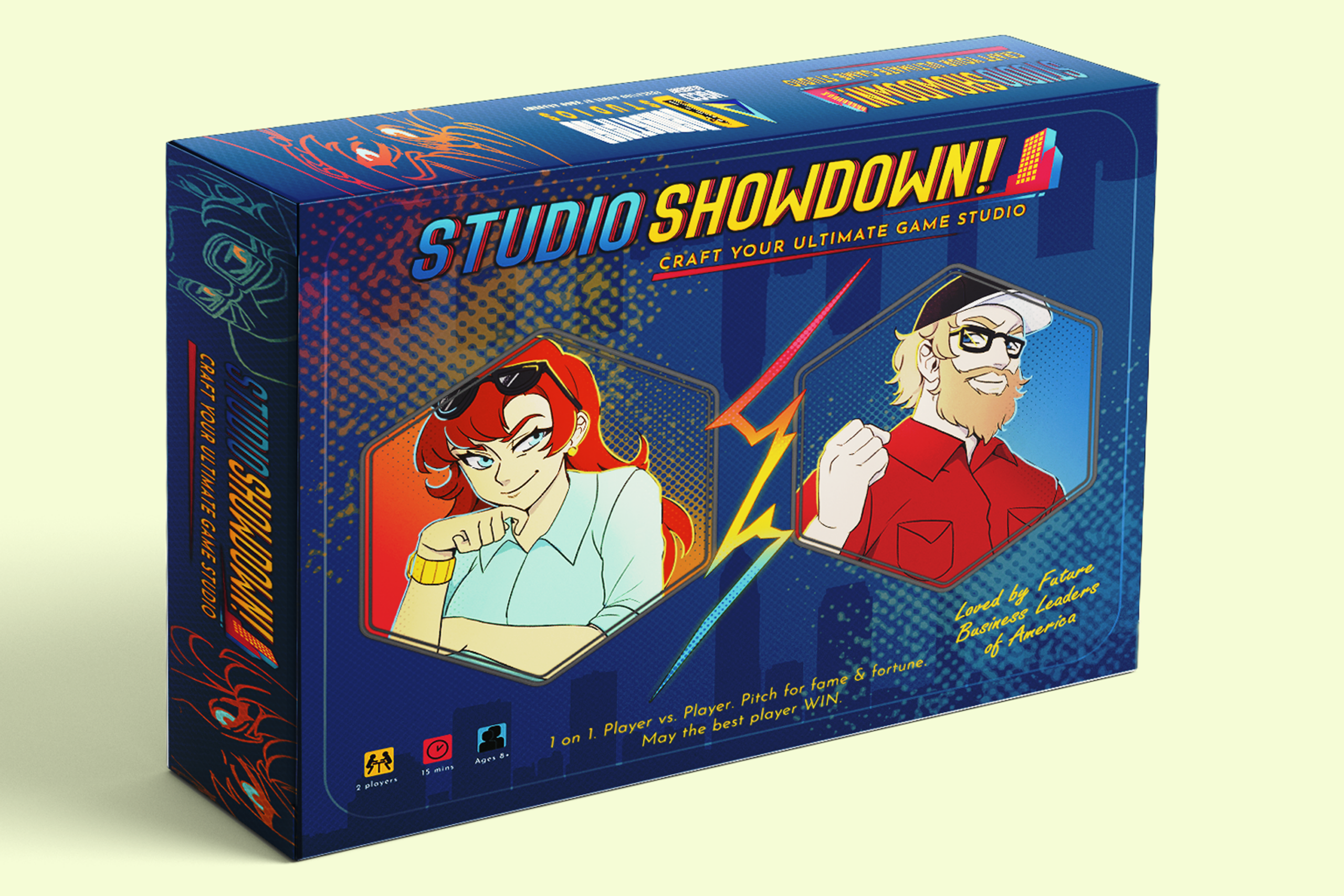
Tools like the Studio Showdown Board Game, developed by VGCD Academy and DEMYSTIFIED Studios, are leading this charge. It moves beyond the abstract. It transforms a student into a studio founder. Fundraising. Pitching. Studio management. They don’t just study management; they live it. They build business acumen through competitive studio management. This is how you rise above the noise and build a career that lasts.
The Science of Strategy: How Games Build Business Acumen
Managing a startup is a cognitive marathon. You’re juggling talent, capital, and time while the market shifts beneath your feet. Traditional methods ignore this complexity. They offer isolated facts. Gamified business education offers the whole storm. By managing multiple resources simultaneously, students build a mental map of how a studio actually functions. It isn’t just about reading a balance sheet; it’s about surviving it. This immersive approach builds “Founder’s Intuition” through repeated game cycles. You recognize the signs of a failing project before it’s too late. You know when to double down on a marketing push. This visceral understanding separates a student from a CEO.
Retention isn’t about memorization. It’s about experience. When you lose a deal in a simulation, the lesson sticks. You don’t forget the burn rate that killed your project. Research highlights the massive impact of gamification in corporate learning, noting that 83% of participants feel more motivated than those in traditional settings. Additionally, 90% of employees report that gamification makes them more motivated at work. This drive translates directly into long-term skill retention. You aren’t just learning for an exam. You’re training for the industry.
Risk Management and Financial Literacy
Financial literacy isn’t just about math. It’s about stakes. In a game environment, fundraising and burn rates become tangible. You feel the pressure of a dwindling bank account. You learn to pivot when market conditions shift. Teaching the financial risks of game development through simulation allows students to see the “why” behind the numbers. They learn to survive the lean months before they reach the launch phase. They practice the art of the pivot. If a market segment dries up, they don’t give up. They adapt. This is financial literacy with consequences.
Soft Skills: Pitching, Negotiating, and Outmaneuvering
Communication is the ultimate business weapon. Games are the training ground for professional persuasion. Whether you’re pitching a publisher or negotiating a co-development deal, the stakes are high. You learn to read the room. You learn to outmaneuver rivals for market dominance. Negotiation in a tabletop setting is raw. You see the body language. You hear the hesitation in a rival’s voice. This face-to-face friction builds a level of professional communication that digital-only platforms can’t touch. It’s about more than just the deal; it’s about the relationship.
This is where leaders are forged. To see how these mechanics work in a real-world setting, you can explore The Ultimate Business Board Game Pillar. It’s time to stop studying and start winning. Analyze your rivals. Secure your funding. Build your empire.
Analog vs. Digital: The Case for Tabletop Business Games
The Metaverse promised a revolution. High-end VR simulations claim to be the ultimate immersion. They’re wrong. In 2026, the real frontier of gamified business education is the tabletop. While digital tools offer scale, they often trade social friction for automation. True entrepreneurship isn’t about clicking buttons; it’s about reading people. The “Analog Advantage” lies in the raw, unscripted interaction that only happens when rivals sit across from one another. You don’t just see a data point; you see the sweat on a competitor’s brow when you raise the stakes.
Tactile learning provides a psychological weight that pixels can’t replicate. Holding physical game pieces creates a stronger neural connection to the resources they represent. When you physically hand over “capital” to another player, the loss feels real. This visceral experience is backed by academic research. A study on Gamification in Entrepreneurship Courses highlights how these immersive environments develop critical thinking and problem-solving skills that static digital platforms often overlook. Beyond the cognitive benefits, board games are a masterclass in cost-effectiveness. You don’t need a $20,000 VR lab to teach market dynamics. You need a box, a table, and a group of ambitious minds.
The Power of Face-to-Face Negotiation
Algorithms don’t have tells. Humans do. In a competitive tabletop setting, students learn to decode body language and social cues. They practice the art of the “soft sell” and the “hard pivot” in real-time. This environment builds genuine collaboration. Team-based studio founders must communicate clearly to survive. Analog games foster a level of critical thinking that automated sims can’t match because every move is a response to a human choice, not a pre-programmed script. It’s about outthinking the person, not the software.
Screen-Free Activities for Modern Classrooms
Screen fatigue is the silent killer of engagement in 2026. Students spend their lives behind glass. Digital-heavy STEM curricula are beginning to pivot toward physical products to restore balance. There’s a growing movement toward integrating screen-free activities to keep students sharp and present. Physical games provide a necessary break from the blue-light glow while maintaining high educational standards. For educators looking to balance their digital offerings, this Screen-Free Activities Strategy Guide offers a blueprint for reclaiming the classroom. It’s time to close the laptops and open the board game. The most important business lessons happen in the real world.
Integration isn’t a passive event. It’s a strategic deployment. To make gamified business education stick in middle and high school classrooms, you need a clear blueprint. Start with the “why.” Are you teaching the slow grind of daily operations or the high-stakes adrenaline of a venture capital pitch? Define the target. Once the objective is locked, choose the arena. Team-based studio competition is almost always the superior choice. It forces collaboration. It creates healthy conflict. It mirrors the high-pressure environment of a real startup. Individual play has its place for teaching basic mechanics, but the boardroom is a social space. You want your students arguing over resource allocation, not just clicking through a menu.
Don’t just play and walk away. The real growth happens in the debrief. This is where theory meets reality. Students analyze their failures. They justify their pivots. They build a narrative for their professional portfolios. This process transforms a simple classroom activity into a career-defining milestone. You’re not just grading an assignment; you’re reviewing a business strategy. This approach ensures that the lessons of the market are etched into their professional DNA.
Setting Learning Objectives for Business Games
Map the game mechanics to what actually matters in the industry. If you’re following national education standards, look for modules on resource allocation, market research, or financial risk. Use the simulation to illustrate the “Founder’s Dilemma.” Should they hire more talent or save capital for a market downturn? These aren’t just game choices. They’re the same high-stakes decisions made by CEOs every day. Focus on specific skills. Pitching. Negotiating. Resource management. Burn rates. When the stakes are high, the learning is deep. It turns abstract concepts into tangible survival skills.
Assessing Performance Beyond the Scoreboard
The winner isn’t always the one who learned the most. Assessment in gamified business education must evolve beyond the final score. Look for the pivot. Did a student recognize a market shift and change course? That’s the real win. Encourage students to document their strategic logic. Ask for a post-game analysis where they explain their failures. This documentation becomes a part of their tangible portfolio, proving they have the intuition to survive the market.
If you’re using tools like the Studio Showdown: Educator Edition, you can track classroom progress with precision. You see who is taking risks and who is playing it safe. It’s about the journey from student to studio founder. Ready to elevate your curriculum? Explore the Classroom Bundle and start building the next generation of founders today.
Studio Showdown: The Ultimate Business Strategy Experience
Studio Showdown isn’t just a board game. It’s a high-stakes simulation of the world’s most dynamic creative industry. It is the only tabletop experience specifically engineered to replicate the complex ecosystem of the video game market. Developed by VGCD Academy and DEMYSTIFIED Studios, this tool brings a professional production pedigree directly to the classroom. It moves beyond abstract theory. It places students in the hot seat of a studio founder. This is the pinnacle of gamified business education. It challenges advanced students to think like executives while maintaining the artistic bravery of an indie developer. No safety nets. No fluff. Just the market.
The strategic depth of Studio Showdown challenges even the most seasoned business students. It doesn’t offer easy answers; it offers meaningful choices. Should you invest in high-end tech or focus on aggressive marketing? Do you pitch to a publisher early or wait for a better deal? These decisions have immediate consequences. The game forces players to handle the “Founder’s Dilemma” in real-time. This is where academic theory ends and professional instinct is born. You learn to recognize the visual noise of the market and rise above it. You learn to win.
Inside the Box: From Fundraising to Hit Games
Inside the box, players find the entire lifecycle of a production studio. Fundraising. Pitching. Talent management. Launching hit games. Each mechanic is designed to force strategic friction. You don’t just play; you outmaneuver rivals for market dominance. The depth of play ensures that no two sessions are identical. You must adapt your tactics to the shifting demands of the industry. For those looking to sharpen their competitive edge, our Mastering Strategy Board Games Guide provides the tactical insights needed to dominate the table. Analyze the board. Secure your capital. Build your empire.
Educator Edition and Classroom Bundles
Scaling this experience for schools and libraries requires the right tools. The Studio Showdown: Educator Edition is built for the modern classroom. It includes professional development resources that help educators implement the game with confidence. You don’t need to be a game designer to teach like one. We provide the blueprint for success. The Classroom Bundle represents the best institutional value for schools looking to transform their entrepreneurship curriculum. It provides everything needed to turn a classroom into a competitive studio floor. This isn’t just an educational purchase; it’s an investment in the future of the industry. It’s time to stop talking about business and start building it.
Forge the Future of Entrepreneurship
The landscape of business education has shifted. Passive lectures and blue-light fatigue are relics of the past. By embracing gamified business education, you’re giving students more than just a grade. You’re giving them the muscle memory of the market. They’ve learned to manage burn rates, outmaneuver rivals, and pitch with the confidence of an industry veteran. They aren’t just students anymore. They’re founders in training. This transition from theory to serious play is what defines the leaders of 2026.
Studio Showdown bridges the gap between the classroom and the boardroom. Developed by industry experts at VGCD Academy, this tool is specifically designed for entrepreneurship curricula. It features durable physical components for repeated classroom use, ensuring it remains a staple in your strategy room for years. It’s time to stop explaining risk and start simulating it. You have the power to turn dry theory into high-stakes success through strategic, tactile play.
Secure your Studio Showdown Classroom Bundle today and turn your classroom into a powerhouse of innovation. The market is waiting for the next great studio. Let’s build it together.
Frequently Asked Questions
What is the difference between gamification and game-based learning?
Gamification adds game-like elements such as points or leaderboards to traditional tasks to increase motivation. Game-based learning uses an actual game as the core educational vehicle to teach a specific curriculum. In the context of gamified business education, we prioritize game-based learning because it forces students to live the consequences of their strategic choices rather than just chasing a high score.
Can board games really teach complex financial concepts like fundraising?
Board games make abstract financial concepts tangible by attaching them to physical resources and high-stakes consequences. When a student manages a dwindling pile of capital tokens, the concept of a burn rate becomes a survival instinct. They learn the nuances of fundraising by negotiating deals with rivals and publishers in a safe but competitive environment. This visceral experience anchors financial literacy more effectively than any spreadsheet.
What age group is best suited for gamified business education?
Middle school and high school students, typically ages 12 to 18, see the most significant engagement gains from these tools. The mechanics are intuitive enough for younger learners to grasp basic resource management while offering enough strategic depth for university-level entrepreneurship courses. It scales with the ambition and intellect of the players, making it a versatile asset for any business curriculum.
How do I fit a business board game into a 60-minute class period?
You can manage tight schedules by using modular play sessions or setting specific turn limits for each class. A standard 60-minute block allows for a 10-minute strategic setup, 40 minutes of active play, and a 10-minute debrief to solidify the day’s lessons. The Studio Showdown: Educator Edition provides specific timing guides to help teachers maintain a high-tempo learning environment without rushing the experience.
Does Studio Showdown require prior knowledge of video game coding?
No technical coding knowledge is required to master the game. Studio Showdown focuses exclusively on the entrepreneurial side of the industry, such as studio management, market positioning, and investor pitching. It’s about the business of creativity, not the technical script behind it. This ensures that students from all backgrounds can compete on a level playing field based on their strategic acumen.
Are there specific business games for middle school vs. high school?
Many gamified business education tools are designed to be adaptable across different grade levels. While high schoolers might focus on the complexities of venture capital and market pivots, middle schoolers can use the same game to learn about teamwork and basic resource allocation. The Educator Edition allows teachers to adjust the complexity of the simulation to match the specific learning objectives of their classroom.
How can I justify the cost of a classroom bundle to school administration?
Focus on the long-term ROI and the durability of the physical components. A single Classroom Bundle serves multiple classes per year and lasts for several years, unlike disposable workbooks or expensive digital subscriptions. Highlight the tangible portfolio-building skills students develop, such as negotiation and financial risk management. You’re investing in a professional-grade simulation that prepares students for the high-stakes reality of the modern economy.
What are the benefits of analog business games over digital simulations?
Analog games prioritize human psychology and face-to-face negotiation. You can’t read a rival’s body language or detect a bluff through a computer screen. Tabletop play builds elite communication skills and fosters genuine collaboration among team members. Additionally, physical games eliminate screen fatigue, keeping students present and focused on the social friction that defines real-world business leadership.