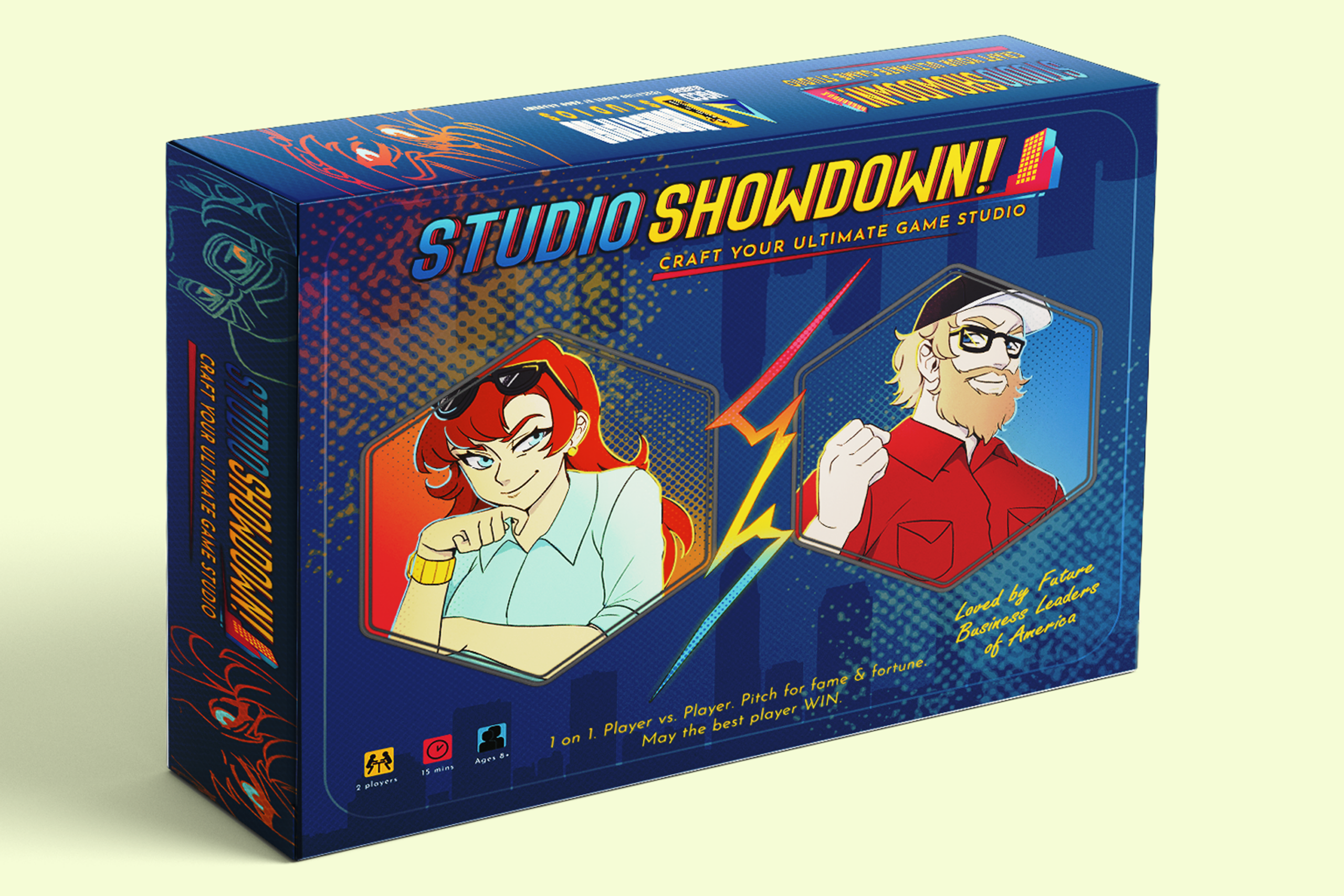
The most effective boardroom training doesn’t happen in a seminar. It happens over a map and a deck of cards. Traditional business education is often a sterile, theoretical slog that fails to capture the raw tension of a real deal. Textbooks can’t teach you how to read a room or when to walk away from the table. You’re likely tired of screen fatigue and the dry delivery of soft skills through a monitor. This is where strategic games that teach negotiation skills change the narrative. They offer a hands-on, analog arena where every choice carries weight and every alliance is a calculated risk.
We’ll show you how to transform tabletop play into professional mastery. You’ll learn to identify simulations that mirror the intense pressure of venture capital fundraising and market competition. We provide a clear framework for evaluating your tactics and building a portfolio that proves your strategic worth. From the 42nd Anniversary Edition of Cosmic Encounter to the industry-focused Studio Showdown, we’re diving into the tools that turn players into power brokers. It’s time to stop reading about the art of the deal and start playing it.
Key Takeaways
- Replace theory with action. Build the muscle memory of persuasion through immersive, high-stakes simulations.
- Master BATNA and reciprocity. Learn how resource scarcity and calculated alliances drive successful professional outcomes.
- Identify the top games that teach negotiation skills. Compare economic simulations and social deduction to find your strategic edge.
- Bridge the gap from tabletop to boardroom. Use our selection framework to map game mechanics to real-world business challenges.
- Experience the ultimate negotiation lab with Studio Showdown. Master the art of the pitch and fundraising in a competitive, analog environment.
The Invisible Skill: Why Negotiation Games Are the Future of Business Education
Negotiation isn’t a soft skill. It’s a strategic discipline. In the high-pressure markets of 2026, the ability to close a deal is the difference between a project that scales and one that stalls. Traditional business education often misses the mark. It relies on static textbooks and dry lectures. These methods fail because they can’t simulate the pulse of a real deal. True mastery requires a dynamic environment. It requires games that teach negotiation skills by forcing players to manage conflicting interests in real-time. These games are ecosystems. They are arenas where every choice carries weight and every alliance is a calculated risk.
Passive learning is dead. You can’t build the muscle memory of persuasion by reading about it. You need to feel the sweat. You need to experience the stutter of a failed pitch. Modern strategy games move beyond the old “zero-sum” mindset where one person’s gain is another’s loss. Instead, they focus on value creation. They teach you how to expand the pie before you slice it. This is the concept of the negotiation lab. It’s a safe space where the cost of failure is zero real-world capital but the educational value is immense. You lose a cardboard token today so you don’t lose your studio tomorrow. This transition from passive knowledge to active skill is vital in many disciplines; for example, Amidon Spanish helps professionals who understand Spanish but struggle to speak it to finally bridge that communication gap through one-on-one practice.
The Shift Toward Game-Based Learning
The classroom is changing. In 2026, experiential education is the gold standard. Students and professionals crave interactivity. They want to be in the driver’s seat. Games lower the barrier to entry for complex topics like venture capital, IP rights, and equity splits. They turn abstract legal concepts into tangible mechanics. There is also an emotional component that only a game can capture. The tension of a ticking clock or the betrayal of a trusted partner provides a level of immersion that a PowerPoint simply cannot match. It transforms learning from a chore into a high-stakes challenge.
Soft Skills vs. Strategic Acumen
Great negotiators don’t just talk. They calculate. Modern games force you to look at the data. You must manage resources, track trade-offs, and assess the long-term cost of a bad deal. It’s about strategic outmaneuvering. Classic titles like the Diplomacy board game demonstrate this perfectly; they strip away luck to focus entirely on the human element of the deal. Success requires more than just a silver tongue. It requires:
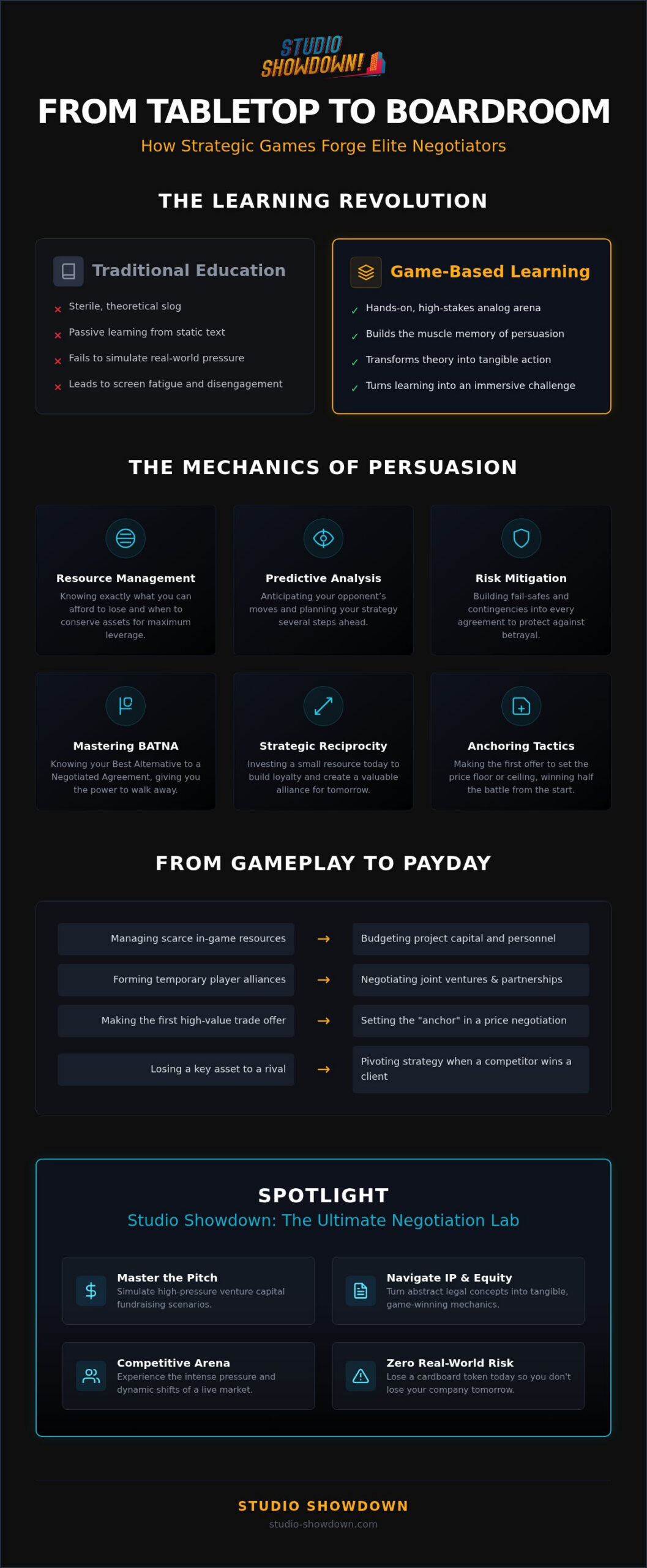
- Resource Management: Knowing exactly what you can afford to lose.
- Predictive Analysis: Anticipating your opponent’s next three moves.
- Risk Mitigation: Building fail-safes into every agreement.
Luck is irrelevant. In these simulations, your result is a direct reflection of your strategic intuition and your ability to read the room.
The Mechanics of Persuasion: Core Skills Modern Games Develop
Games aren’t just entertainment; they are mechanical engines for behavior. When you engage with games that teach negotiation skills, you aren’t just playing. You’re calculating. Every card drafted and every resource traded is a lesson in strategic leverage. These games strip away the fluff of traditional lectures and force you to confront the cold reality of the deal. They turn abstract concepts into tangible wins and losses. You learn because you have to, not because you’re told to.
The most critical concept in any deal is your BATNA, or the Best Alternative to a Negotiated Agreement. Modern strategy games teach this through resource scarcity. If you’re drafting cards and the one you need is snatched by a rival, what’s your pivot? Your BATNA is your safety net. It’s the difference between a desperate “yes” and a confident “no.” By playing through these scenarios, you build the mental agility to recognize your backup options before you even sit down at the real-world table.
Psychology is baked into the mechanics. Take “anchoring,” for example. The first offer made in a game session often sets the price floor or ceiling for every subsequent trade. If you open high and hold your ground, you’ve already won half the battle. This isn’t just theory; it’s a proven tactic studied by the Program on Negotiation at Harvard Law School. Games also weaponize reciprocity. Giving up a small resource today isn’t a loss; it’s an investment in a future alliance. You’re buying loyalty when it’s cheap so you can cash it in when the stakes are at their peak.
Understanding Resource Scarcity and Leverage
In the high-stakes arena of a startup, you’re always hunting for capital. Games simulate this “hustle” perfectly. You start with nothing and must trade your way to the top. Leverage is the heartbeat of this process. It isn’t about having the most resources; it’s about having the right one at the right time. Leverage is the strategic advantage gained by controlling a unique resource or position that dictates the tempo and options of every other player at the table. If you hold the only “blue wood” in the game and everyone needs it to finish their turn, you own the room.
The Art of the Pitch: Communication Under Pressure
Negotiation is a performance. Games force you to articulate value quickly and clearly while the clock is ticking. You can’t just have a good deal; you have to sell it. This is where you learn to read “the table.” You watch for the subtle shift in a rival’s posture or the hesitation in their voice. Reading body language and player intent becomes second nature. Pitching is the ultimate test of your confidence. It’s about holding eye contact when your hand is weak. If you want to sharpen this edge, you might want to explore a competitive strategy board game that mirrors these exact industry pressures. It turns the “soft skill” of talking into a hard weapon of strategic outmaneuvering.
Beyond Monopoly: A Comparison of Negotiation Game Genres
Not all games that teach negotiation skills are created equal. Some focus on the poker face. Others demand a calculator. To master the art of the deal in 2026, you must understand the architecture of the game you’re playing. We can categorize these tools into two primary camps: Social Deduction and Economic Simulation. One tests your ability to read a person; the other tests your ability to read a market. For a deeper dive into how these systems function, check out Mastering the Board: The 2026 Guide to Strategy Board Games.
Social Deduction: The Psychology of Bluffing
In social deduction games, information is the currency. Negotiation is purely verbal. You aren’t trading wood for sheep; you’re trading trust for survival. These games build exceptional “lie detection” and empathy. You learn to spot the micro-expression of a bluff. You learn to craft a narrative that shifts blame. However, social deduction has limits in a professional context. Business isn’t usually about unmasking a traitor. It’s about aligning interests. While these games sharpen your “people sense,” they often lack the technical depth of a real-world contract negotiation.
Economic Engines: Trading and Market Dynamics
Economic engines are different. Here, players must trade resources to build a functioning system. These games simulate supply chain management and the brutal reality of trade-offs. You learn the difference between friendly trading and predatory negotiation. In a friendly trade, both players grow. In a predatory one, you exploit a rival’s immediate need for your long-term gain. This mirrors the “hustle” mentioned earlier. You aren’t just talking; you’re managing a balance sheet in real-time.
Choosing the right tool depends on your specific learning objectives. We can rank these by Negotiation Intensity to help you select the best fit:
- Low Intensity (Bartering): Catan 6th Edition. Simple resource swaps. Excellent for introducing basic trade-offs.
- Medium Intensity (Bidding/Bribery): Sheriff of Nottingham 2nd Edition. Blends bluffing with financial incentives.
- High Intensity (Pure Negotiation): Diplomacy. No luck. No dice. Only alliances, betrayal, and raw persuasion.
- Professional Simulator: Studio Showdown. High-stakes pitching and fundraising for aspiring entrepreneurs.
Different mechanics impact skill development in unique ways. Bidding teaches you to value assets under pressure. Trading teaches you to find win-win scenarios. Bluffing teaches you to control the narrative. By selecting the right genre, you ensure the training matches the challenge.
From the Tabletop to the Boardroom: Implementing Games in Curricula
Integration is where the magic happens. It’s not enough to just open a box and hope for the best. You need a blueprint. Using games that teach negotiation skills requires a tactical approach to ensure the lessons stick. In 2026, the most successful corporate trainers and educators treat the tabletop as a high-fidelity simulator. They move beyond the “fun factor” to focus on measurable growth. This isn’t just play; it’s a structured path to professional mastery. To ensure these simulations are delivered with professional impact at your next gathering, learn more about Debut Media and their specialized event production services.
The implementation process follows five critical steps:
- Step 1: Define the learning objective. Start with the end in mind. Are you teaching seed-round fundraising, vendor management, or internal conflict resolution?
- Step 2: Select the game. Match the complexity of the simulation to the real-world scenario. Don’t use a bartering game to teach complex equity splits.
- Step 3: Facilitate a debrief. This is the most vital phase. Connect every game-winning move back to a core business principle.
- Step 4: Establish a recurring lab. Mastery requires repetition. Use the game as a safe space to test different negotiation personas without real-world risk.
- Step 5: Document the portfolio. Encourage players to record their strategic decisions. A win at the table is a case study in the making.
By following this cycle, you turn a single session into a long-term development tool.
The Educator’s Role as Game Master
The best teachers don’t micromanage the deal. They set the stage and step back. Your job is to observe the dynamics and identify the “teachable moments” as they happen. Tools like the Studio Showdown: Educator Edition are designed for this exact purpose. They provide the structure needed for classroom play while allowing students the freedom to fail and pivot. Assessing performance shouldn’t be about who won the most tokens. It should be about who demonstrated the best strategic outmaneuvering and resource management under pressure.
Building a Professional Portfolio Through Play
A victory in a high-stakes simulation isn’t just a game win. It’s evidence of a “Founder’s Mindset.” In 2026, savvy professionals are listing these experiences on their resumes to demonstrate their grasp of complex market dynamics. You’re showing that you can handle the “hustle” and the heat of a real pitch. To see how this works in practice, explore The Ultimate Business Board Game: Master Entrepreneurship in 2026. It provides the perfect platform to build a portfolio of strategic wins that translate directly to the boardroom. Equip your team with a Classroom Bundle to turn abstract theory into tangible professional acumen.
Studio Showdown: The Ultimate High-Stakes Negotiation Lab
Studio Showdown is the final boss of business simulations. It’s the premier choice for game developers and entrepreneurs who want to test their mettle in a high-fidelity environment. Developed by VGCD Academy and DEMYSTIFIED Studios, this game fills the gap that generic business simulators leave behind. It isn’t just about moving pieces on a board. It’s about building a legacy. As one of the most sophisticated games that teach negotiation skills in 2026, it places you at the helm of a rising game studio. You aren’t just playing; you’re surviving the industry’s most brutal cycles.
The mechanical heart of the game is the “Fundraising and Pitching” phase. This is the core negotiation engine. Here, the abstract theories of BATNA and anchoring become a fight for capital. You must convince rivals and investors that your project is the next market leader. Every pitch is a high-stakes gamble where your communication clarity determines your studio’s runway. You’ll learn to outmaneuver rivals while managing the crushing risks of a global game launch. It’s a pressure cooker designed to forge professional acumen through fire.
For institutions looking to modernize their approach, the Classroom Bundle is the perfect entry point. It provides the tools for structured, peer-to-peer learning that textbooks simply can’t replicate. Educators can step into the role of a facilitator, watching as students navigate complex trade-offs and equity splits. This is the ultimate “negotiation lab” where the lessons are permanent but the financial risks are simulated.
Navigating the Video Game Development Industry
The game simulates the visceral reality of a studio founder. You’ll face the constant tension of balancing production costs with the need for market dominance. It’s a strategic dance. Spend too much on development, and you’ll run out of cash before the pitch. Spend too little, and your product will be lost in the visual noise. The Studio Showdown Board Game offers a screen-free, analog experience that demands total presence. You have to look your partners in the eye. You have to feel the weight of the deal as you trade resources for a shot at the top of the charts.
Winning the Showdown: Strategy Over Luck
Luck is dead in the Showdown. There are no random dice rolls to save a bad deal. Winning requires calculated negotiation and a deep understanding of leverage. You must secure the best terms for your studio while keeping aggressive rivals at bay. It’s about strategic outmaneuvering in its purest form. You’ll build a “Founder’s Mindset” by repeatedly navigating these competitive waters. Every session is a new opportunity to refine your persona and sharpen your edge. Don’t leave your professional growth to chance. Order your Studio Showdown Board Game and start mastering the deal today!
Step Into the Arena: Your Strategic Edge Starts at the Table
Negotiation isn’t a lecture. It’s a battle won through repetition and tactical intuition. By shifting from passive textbooks to immersive simulations, you bridge the gap between abstract theory and real-world results. You’ve seen how mechanics like BATNA and anchoring transform simple play into a professional portfolio. Modern games that teach negotiation skills provide the only arena where you can fail safely and learn quickly. It’s time to move beyond the screen and master the art of the deal in a tangible, high-stakes environment.
Studio Showdown is the definitive tool for this transformation. Developed by industry experts at VGCD Academy, it offers an immersive entrepreneurship and game design simulation that demands creative courage. This is analog, screen-free learning for the modern age; a place where every alliance is a calculated risk and every pitch is a test of confidence. Don’t let your team’s potential stay theoretical.
Elevate your classroom with the Studio Showdown Classroom Bundle. Stop reading about the hustle and start leading the market. The next deal is yours to close.
Frequently Asked Questions
How do board games actually teach negotiation skills better than books?
Board games provide a dynamic “negotiation lab” where you face immediate, tangible consequences for your decisions. Books offer static theory; games offer visceral practice. You build muscle memory by reading body language, managing real-time trade-offs, and pivoting when a deal collapses. This experiential loop is far more effective for developing persuasion than memorizing tactics from a textbook.
What are the best games to teach negotiation to teenagers?
High-engagement titles like the 2nd Edition of Sheriff of Nottingham or Catan 6th Edition are excellent for younger players. They have clear rules but allow for creative bluffing and trading. These games that teach negotiation skills keep teenagers focused because the social interaction is constant and the win-state is always within reach through a well-timed alliance.
Can playing Studio Showdown help me with real-world fundraising?
Yes. Studio Showdown was specifically designed to mirror the “Fundraising and Pitching” phase of a startup. It was developed by industry experts at VGCD Academy and DEMYSTIFIED Studios to simulate the pressure of securing capital. You’ll practice articulating value, managing equity splits, and outmaneuvering rivals in a safe, analog environment.
Is the Studio Showdown: Educator Edition different from the standard game?
The Educator Edition includes the complete game plus specialized resources for facilitators. You get structured lesson plans, debriefing guides, and assessment frameworks. It’s designed to help teachers guide students through strategic outmaneuvering without micromanaging every deal, making it a professional-grade teaching tool.
How many players are needed for an effective negotiation game session?
Most effective sessions require at least three players to allow for shifting alliances and multi-party dynamics. Four to six players is the “sweet spot” for high-stakes negotiation. This number creates a complex web of conflicting interests where leverage is constantly moving between different participants, forcing you to stay sharp.
Do these games work for corporate team building as well as classrooms?
They are highly effective for corporate environments. These simulations expose team communication styles and conflict resolution tactics in a safe, competitive setting. It’s a powerful way to build strategic alignment among managers while breaking the monotony of traditional seminars with a premium, analog experience.
What is the Classroom Bundle and who is it for?
The Classroom Bundle is a bulk package designed for schools, universities, and large training institutions. It includes multiple copies of the game to support large-scale learning sessions. It’s for any educator who wants to replace theoretical lectures with a high-fidelity entrepreneurship and game design simulation.
Are there any screen-free activities that teach game design alongside negotiation?
Studio Showdown is a prime example of an analog activity that bridges both disciplines. It forces you to balance production costs and market dominance while negotiating with rivals for resources. It’s a screen-free way to master the core loops of game design and the “hustle” of entrepreneurship simultaneously.