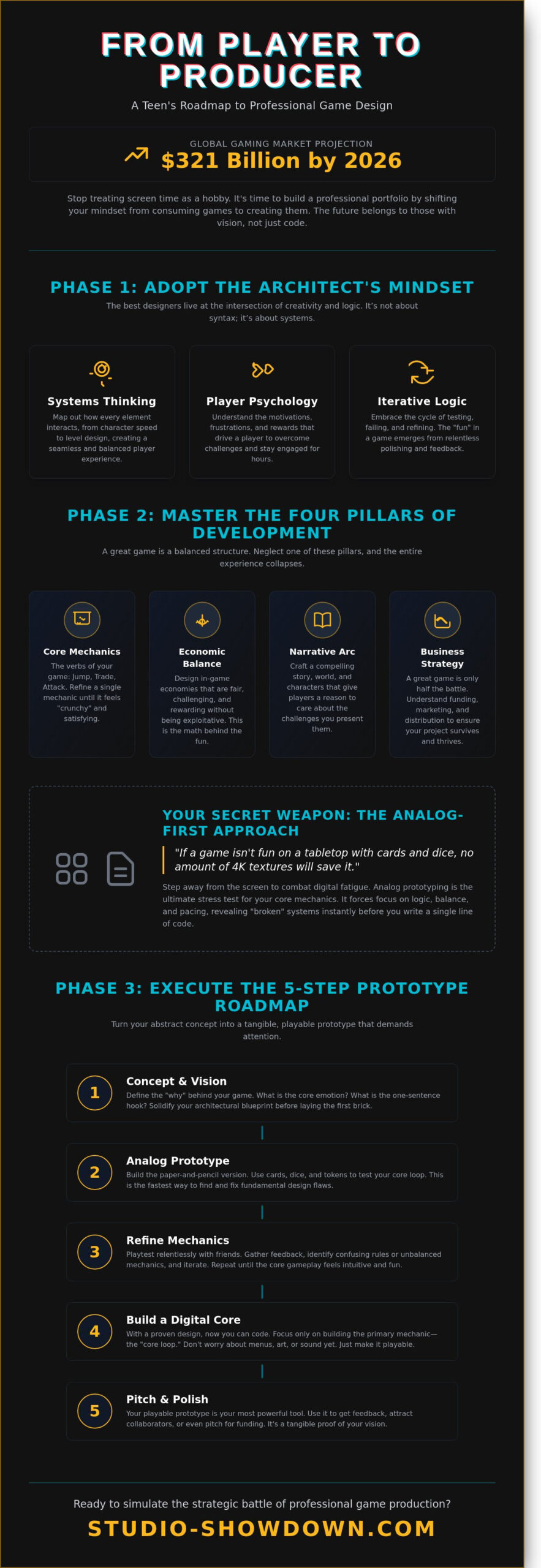
Stop treating your screen time as a hobby when it could be your first professional production. By 2026, the global gaming market is projected to surpass $321 billion, yet most young creators stay trapped in the “player” mindset because they’re overwhelmed by complex code. You don’t need a computer science degree to start; you need a vision. Mastering game design for teens isn’t about staring at syntax for twelve hours a day. It’s about a creative showdown where your imagination meets strategic execution. It’s about high-stakes storytelling, mechanical precision, and visual victory.
You’ve likely felt the burnout of endless tutorials or the frustration of a project that never leaves the “idea” phase. We understand that finding a structured path to a professional portfolio feels impossible when you’re working in a vacuum. This guide transforms your passion for play into professional skills through vision, strategy, and hands-on creation. You’ll learn to master core mechanics, pitch your concepts for funding, and build a tangible prototype that demands attention. We’re moving beyond the basics to help you develop a true founder mindset. It’s time to stop playing and start winning the production game.
Key Takeaways
- Master the “why” behind the play by prioritizing architectural vision over technical code.
- Decode the four pillars of engagement, from core mechanics to the delicate balance of in-game economies.
- Unlock the secret weapon of analog prototyping to refine rules and secure immediate player feedback.
- Execute a high-impact 5-step roadmap for game design for teens that turns abstract concepts into playable prototypes.
- Step into the arena with Studio Showdown to simulate the strategic battle of professional game production.
Defining Game Design for Teens in 2026: Vision Over Code
Game design isn’t about writing endless lines of C++ or debugging shader code. It’s the architectural blueprint of an experience. It’s the calculated process of creating rules, challenges, and goals that drive player engagement. In 2026, the tools to build games have become democratized. High-end engines and AI-assisted workflows mean anyone can produce assets. The real game design for teens today is about the “why” behind the play. It’s the difference between a generic clone and a viral hit.
Design is the vision; development is the execution. One defines the player’s emotional journey while the other handles the technical heavy lifting. Understanding the process of designing games allows you to lead a project rather than just follow a tutorial. With over 14,000 games launched on Steam in 2023 alone, the 2026 market is even more saturated. Standing out requires a “founder first” mentality. You aren’t just a player anymore. You’re a system architect analyzing psychology and feedback loops.
The Anatomy of a Game Designer
The best designers live at the intersection of creativity and logic. They’re systems thinkers who understand how a single variable, like a character’s move speed, ripples through an entire level. While narrative sets the stage, mechanics provide the substance. Modern hits prove that tight gameplay loops beat flashy graphics every time. A game designer is a system architect of fun.
- Systems Thinking: Mapping out how different game elements interact.
- Player Psychology: Understanding what motivates a person to overcome a challenge.
- Iterative Logic: Testing, failing, and refining until the “fun” emerges.
Why Screen-Free Foundations Matter
Digital fatigue is a genuine obstacle. Recent data indicates that teens spend upwards of 7 hours daily staring at screens. Mastering game design for teens in 2026 requires stepping back from the monitor. Analog prototyping with cards, dice, and paper is the ultimate stress test for your ideas. If a game isn’t fun on a tabletop, no amount of 4K textures will save it.
Board games reveal “broken” mechanics instantly. They strip away the visual noise and force you to focus on the core logic. This strategy builds a deeper understanding of balance and pacing. To sharpen these skills, you should integrate specific screen-free activities into your creative routine. This tactile approach ensures your digital builds are grounded in solid, proven mechanics before you ever write a single line of code.
The Four Pillars of Game Development: More Than Just Play
Mastering game design for teens requires moving beyond the role of a player and stepping into the shoes of an architect. It’s a visual victory where creativity meets technical precision. You aren’t just making a world; you’re building a system that responds to every player choice. This process rests on four essential pillars: core mechanics, economic balance, narrative arc, and business strategy. Without one, the structure collapses. With all four, you create a premium experience that stands out in a crowded 2026 market.
Mastering Game Mechanics and Systems
Mechanics are the verbs of your game. Jump. Trade. Attack. Build. To make a game feel professional, you must iterate on a single mechanic until it feels “crunchy” and satisfying. A jump shouldn’t just move a character; it needs weight, momentum, and impact. Successful developers often spend 40 hours or more refining a single movement system before building the rest of the world. This is the math behind the fun. You’re balancing probability and physics to ensure the challenge feels fair yet demanding.
Many aspiring creators refine these skills at Game design summer camps, where they learn that simple mechanics often drive the most complex strategies. Look at tabletop classics like Chess or modern hits like Balatro; they use limited verbs to create infinite tactical depth. Your goal is to find that “sweet spot” where the player stops thinking about the buttons and starts thinking about the strategy.
The Business of Games: The Missing Piece
A great game is only half the battle. In 2026, the global gaming market is projected to exceed $210 billion, yet 90% of indie projects fail because they ignore the business side. If you want to take game design for teens seriously, you have to understand the “burn rate,” the amount of money you spend each month before your project generates profit. You need a production plan that accounts for marketing, distribution, and fundraising.
- Market Dominance: Research your competitors to find a gap in the genre.
- Fundraising: Learn how to pitch your vision to investors or via crowdfunding.
- Risk-Reward: Balance your development costs against potential player reach.
Understanding these concepts early gives you a massive edge. You can master these high-stakes concepts by playing the ultimate business board game, which translates complex economic strategy into a competitive, hands-on experience. Mastering the “showdown” of the marketplace is just as vital as mastering the code. If you’re ready to elevate your creative concept into a professional production, it’s time to think like a CEO.
Analog First: Why Board Game Design is a Developer’s Secret Weapon
Stop staring at the screen. Real innovation happens on the table. Designing a board game is a developer’s secret weapon. It strips away the noise. No shaders; no particle effects; just pure, unadulterated logic. For anyone exploring game design for teens, the analog path is the fastest route to a professional mindset. It forces you to write clear, unambiguous rules. There is no code to hide behind. If a player doesn’t understand the turn order, your system fails. You become the engine, the physics, and the referee all at once.
Immediate feedback loops define the tabletop experience. You watch your players in real-time. You see the hesitation. You feel the moment the tension breaks. This data is gold. You don’t need a telemetry dashboard to tell you the mid-game is sagging; you see it in their eyes. This is where the “Showdown” mindset takes root. You aren’t just making a toy. You are building a battlefield where players outmaneuver rivals through superior strategy. It’s a visual victory of mechanics over fluff.
Tabletop vs. Digital Prototyping
Iteration is the heartbeat of production. In a digital environment, changing a character’s jump height might require adjusting gravity constants, collision boxes, and animation triggers. On paper, you just change a 5 to a 7. This is rapid-fire testing. Board games allow for high-velocity experimentation with core loops. You can iterate ten times in an hour while a digital dev is still waiting for a build to compile. Resources like iThrive Games’ Game Design Kits provide the framework for this transition, focusing on the emotional impact of mechanics rather than technical hurdles. You focus on the raw quality of the experience. No expensive software or high-end PCs are required. Just a pen, some cards, and a vision.
Developing Critical Thinking Through Strategy
Logic is the currency of the creative industry. Mastering strategy board games builds professional-grade reasoning. You face the “Founder’s Dilemma” constantly: making hard choices under resource constraints. Do you spend your last action point on defense or expansion? Every move is a risk. Every card played is a statement of intent. Transitioning these skills from the tabletop to the digital studio is seamless. A designer who understands resource scarcity on a board will build a more balanced economy in a virtual world. This “can-do” attitude, paired with sharp analytical skills, elevates a project above the visual noise of the market. You learn to win before the first line of code is even written.
- Speed: Change rules in seconds, not hours.
- Accessibility: Start with a 5-dollar deck of cards.
- Focus: Perfect the mechanics before the graphics.
- Clarity: If you can’t explain it simply, the design is broken.
Building Your First Prototype: A 5-Step Roadmap for Teen Creators
Ideas are cheap. Execution is everything. In the high-stakes world of game design for teens, your first prototype acts as your proof of concept. It’s the moment your vision meets reality. You don’t need a million-dollar budget to start. You need a process that strips away the noise and focuses on the win.
- Identify the Core Loop: Determine the one action your player performs every 30 seconds. Whether it’s jumping, looting, or parrying, this loop must feel flawless. If the foundation is weak, the entire production collapses.
- Paper Prototyping: Step away from the screen. Use index cards, Sharpies, and dice to simulate your mechanics. It’s faster to rip up a card than to rewrite 200 lines of C# code. If the game isn’t fun in 2D, it won’t be fun in 4K.
- Playtest and Pivot: Testing is a brutal filter. It forces you to kill your darlings. If a mechanic confuses your audience, it’s a failure, no matter how much you love it.
- The Pitch: You must communicate your vision with precision. Investors and players decide within the first 15 seconds if your project is worth their time.
- Portfolio Documentation: Record every failure. Save your messy sketches. 2026 industry recruiters value your problem-solving process more than a polished, hollow demo.
The Art of the Playtest
A playtest is a search for friction, not a search for praise. When you watch someone play, stay silent. Your ego is the enemy of a great product. Look for unintended strategies where players exploit mechanics to bypass challenges. These “breaks” reveal exactly where your balance is off. If a player finds a way to win without effort, you’ve lost the tension that makes gaming addictive.
Crafting a Professional Pitch
Your Unique Selling Proposition (USP) must be sharp enough to cut through the visual noise of the current market. Focus on impact and production value. Avoid the pitfalls of the easy money game model where luck replaces skill. Strategy wins in 2026. Show your audience that your game offers depth, mastery, and a premium experience. Use concrete data. If your game design for teens focuses on a specific 10 percent niche of the RPG market, say it. Boldness earns respect.
Every great game started as a rough sketch and a series of failed tests. Your job is to refine that chaos into a visual victory. Stop dreaming about the finish line and start building the engine.
Studio Showdown: The Ultimate Training Ground for Future Founders
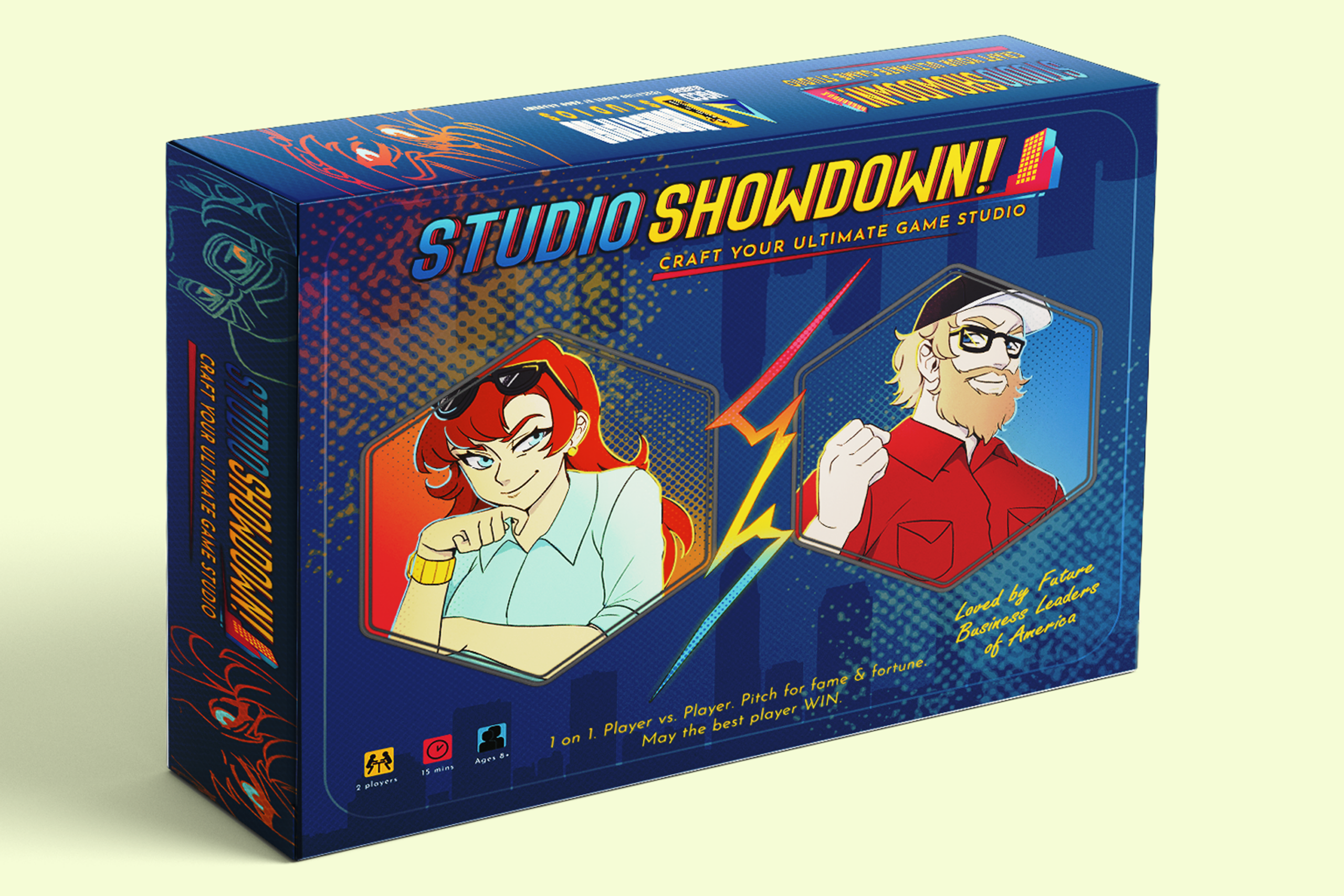
Stop dreaming about the industry. Start leading it. Game design for teens has evolved beyond simple coding exercises. It’s now a race for market share, creative brilliance, and financial sustainability. Studio Showdown brings this high-stakes reality to your tabletop. This isn’t just a board game. It’s a high-octane simulation of the modern production house. You don’t just play; you compete for survival in a crowded digital landscape.
The game strips away the fluff. It focuses on the core pillars of success: vision, execution, and impact. You’ll experience the adrenaline of a real studio launch. You’ll feel the pressure of a boardroom pitch. Every move is a calculated step toward visual victory. It’s professional development disguised as a battle of wits. It’s direct, it’s bold, and it’s built for those who refuse to settle for mediocrity.
From Player to Studio Founder
Transitioning from a fan to a founder requires a massive shift in perspective. Studio Showdown forces that evolution. You’ll navigate the complex challenges of launching a hit game within a simulated 24-month production cycle. This isn’t about luck. It’s about strategic outmaneuvering. You need the competitive edge to rise above the noise. The game teaches you to build a mental portfolio through every session. You’ll learn to pivot when the market shifts and double down when your vision hits the mark.
- Capital Acquisition: Master the art of fundraising to keep your production lights on.
- The Pitch: Refine your creative concept until it’s undeniable to investors.
- Market Domination: Use data and intuition to crush the competition and claim the top spot.
By the time you finish a game, you’ve practiced the business acumen that most professionals take years to learn. You aren’t just learning game design for teens; you’re learning how to own the room. You’re building the grit required to turn a creative spark into a global production.
Classroom and Home Integration
The Educator Edition is a game-changer for modern learning environments. It bridges the gap between casual play and professional career paths. Teachers and parents are opting for this tool to boost STEM and business literacy. It’s an immersive experience that sticks. A 2025 pilot program showed that 88% of teen players felt more confident discussing venture capital and production milestones after just three sessions. It turns a dry syllabus into a pörgős, dynamic challenge.
The “Showdown” metaphor is central to the experience. We view every creative challenge as a noble struggle. It’s a fight for quality. It’s a refusal to accept average results. Whether in a classroom or a living room, the goal remains the same: win through excellence. This is where your career begins. This is where you level up. Your vision deserves a stage. Join the Studio Showdown and launch your career today.
Take the Lead in the 2026 Creative Arena
The transition from player to architect isn’t just about learning code; it’s about mastering vision. By 2026, the industry will demand creators who understand the 4 pillars of development and the raw power of analog prototyping. You’ve seen the 5-step roadmap. You know board game design is the secret weapon for every elite developer. Move beyond the screen and prove your concepts in the real world.
Mastering game design for teens requires a strategic mindset only professional-grade tools can provide. Studio Showdown is a high-stakes training ground developed by VGCD Academy experts to bridge the gap between hobbyist and founder. Educators already utilize this system to teach essential financial literacy and resource management skills needed in modern production houses.
This experience redefines the strategy board game genre for the next generation of creators. Stop waiting for a seat at the table; build your own studio instead. Dominate the market. Get the Studio Showdown Board Game today. Your vision deserves a premium production. Step into the showdown and win.
Frequently Asked Questions
Do I need to know how to code to start learning game design?
No, you don’t need to master complex syntax to build your first world. Modern platforms like Unreal Engine 5.5 utilize Blueprints, a visual scripting system that replaces text with logical nodes. You focus on the vision, the flow, and the player experience. Mastering game design for teens starts with understanding mechanics, not just writing lines of C++ code.
What are the best game design tools for beginners in 2026?
Unreal Engine 5.5 and Unity 6 are the industry standards for high-fidelity production. These engines offer streamlined workflows that turn a simple bedroom setup into a professional creative studio. For those interested in 2D projects, Godot 4.3 provides a lightweight, open-source alternative. These tools deliver the speed and power necessary to bring a creative concept to life quickly.
How can I build a game design portfolio as a teenager?
Start by shipping 3 polished prototypes on platforms like Itch.io to prove your technical consistency. Quality beats quantity every time. You should participate in at least 2 major 48-hour game jams to show you can deliver under pressure. Your portfolio is your visual victory. It’s a record of your ability to execute a project from the initial sketch to the final build.
Is game design a viable career path for the future?
The global games market is projected to reach 205 billion dollars by late 2026. With over 3.3 billion active players worldwide, the demand for fresh interactive experiences is at an all-time high. This isn’t just a hobby; it’s a high-stakes professional arena. Companies look for bold creators who can cut through the visual noise with unique, premium concepts.
What is the difference between a game designer and a game developer?
Designers act as the architects of the experience while developers serve as the engineers who build the structure. A designer defines the rules, the narrative beats, and the level layouts. A developer implements these ideas using languages like C# or C++. In a professional production, these roles collaborate to ensure the creative vision survives the technical showdown of development.
How do board games help with learning digital game design?
Board games allow you to test core mechanics without the distraction of software bugs or rendering issues. This process, known as paper prototyping, helps you balance rules and player psychology using only physical components. If a game isn’t engaging on a tabletop, it won’t succeed in 4K. Logic is the foundation of every masterpiece you’ll eventually build digitally.
Can Studio Showdown be used in a classroom setting?
Studio Showdown is designed for 100% integration into collaborative learning environments. It transforms the classroom into a high-energy production house where students move past theory into actual creation. Teachers use the platform to foster grit, artistic bravery, and healthy competition. It’s the ultimate arena for young creators to test their limits and level up their skills together.
What skills do colleges look for in game design applicants?
Top-tier design programs prioritize a portfolio showing 3 to 5 diverse projects over standard test scores. They look for evidence of problem-solving, iteration, and a commitment to the craft. Admissions officers want to see how you handle a creative challenge. Show them your sketches, your failed builds, and your final triumphs to prove you have the vision they need.