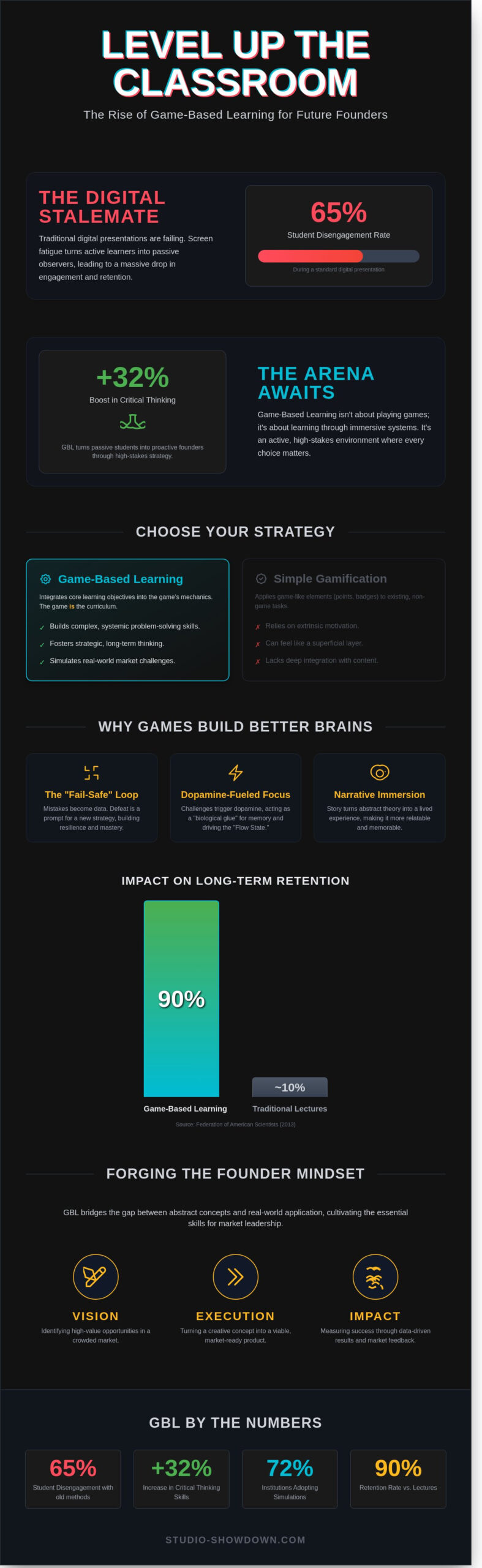
The lecture hall is no longer a place for passive listening; it’s a high-stakes arena for the mind. What if the next generation of founders didn’t graduate from a library, but from a simulation? By 2026, the global market for game based learning is set to outpace traditional ed-tech, proving that play is the most serious work there is. You’ve felt the frustration of watching 65% of your students drift away during a standard digital presentation. You know that screen fatigue is real, turning bright minds into static observers. It’s a visual stalemate that ends today.
We agree that teaching abstract financial concepts through a textbook feels like explaining a film without the visuals. It’s time for a creative showdown. This article reveals how game based learning transforms passive students into proactive founders through high-stakes strategy and immersive simulation. You’ll discover the roadmap to boosting critical thinking by 32% while building a bridge to career readiness. We’re moving beyond the noise. Vision. Strategy. Impact. Let’s level up the classroom.
Key Takeaways
- Master the “Fail Safe” loop to turn strategic setbacks into the fastest route toward high-impact mastery and long-term retention.
- Learn why systems-based game based learning outperforms simple gamification in building elite, future-ready founders.
- Align your learning objectives by selecting immersive mechanics that mirror real-world challenges like fundraising and market dominance.
- Enter the arena with the “Showdown” metaphor, transforming passive education into a high-stakes creative battle for market leadership.
The Evolution of Game Based Learning in 2026
Education isn’t a spectator sport anymore. It’s a high-stakes arena where the goal is mastery, not just attendance. In 2026, the definition of game-based learning has evolved into the intentional integration of game mechanics into core educational outcomes. This isn’t about adding a leaderboard to a quiz. It’s about designing a curriculum that functions like a high-performance engine. We’ve moved past the era of passive consumption. Modern classrooms now demand active, high-stakes participation where every choice creates a ripple effect in the learning environment.
The demand for this shift is driven by a global economy that prizes agility over rote memorization. By mid-2026, data from the EdTech Innovation Report suggests that 72% of secondary institutions have adopted some form of immersive simulation to replace traditional testing. There’s a critical distinction to make here: there’s a world of difference between “playing a game” and “learning through a system.” Playing is a pastime. Learning through a system is an architectural deep dive into logic, feedback loops, and strategic iteration. It’s the difference between watching a film and directing the production. We don’t just want students to finish the level; we want them to master the mechanics that govern it.
From Theory to Practice: Why GBL Works Now
Sociocultural learning theories have long argued that knowledge is built through social interaction and cultural tools. GBL finally brings this theory to life. It bridges the gap between abstract concepts and real-world application with surgical precision. This is “Gameful Pedagogy.” It’s a design philosophy that treats the syllabus like a premium user experience. It transforms the classroom into a dynamic studio where failure is just another data point. In this environment, students develop the resilience to pivot, the courage to experiment, and the drive to win.
The Demand for Real-World Business Acumen
Textbooks are static. They can’t keep up with the volatility of the 2026 market. Today’s students need more than definitions; they need entrepreneurship, financial literacy, and a “Founder Mindset.” Traditional materials fail to capture the high-pressure reality of modern startups. GBL fills this void by placing students in the driver’s seat of complex business simulations. They manage resources. They navigate market crashes. They handle the pressure of venture capital pitches. This is how we prepare them for the competitive showdown of the professional world.
- Vision: Identifying opportunities in a crowded visual noise.
- Execution: Turning a creative concept into a viable product.
- Impact: Measuring success through data-driven results.
By simulating these high-stakes environments, we ensure students aren’t just ready for the test; they’re ready for the victory.
The Psychology of Play: Why Games Build Better Brains
Traditional education penalizes mistakes. Game based learning weaponizes them. This is the fail-safe loop. You lose, you learn, you iterate. It’s a high-speed feedback cycle that mirrors professional production workflows. Defeat isn’t a dead end; it’s a data point. This shift in perspective transforms the classroom into a laboratory where the cost of failure is zero, but the value of the lesson is absolute.
The neurobiology of play is a powerhouse for memory. A 2013 study by the Federation of American Scientists revealed that game-based environments can increase retention rates by 90% compared to traditional lectures. When students engage with a challenge, the brain releases dopamine. This chemical surge doesn’t just feel good; it acts as a biological glue for long-term potentiation. Information isn’t just heard; it’s experienced and encoded.
Narrative framing is the secret sauce that turns dry data into a compelling production. Instead of memorizing 2024 supply chain logistics, students become commanders of a galactic trade fleet. Relatability drives engagement. When content is wrapped in a story, the brain processes it as a lived experience rather than abstract theory. This immersion leads directly to the “Flow State,” a psychological phenomenon identified by Mihaly Csikszentmihalyi where focus becomes effortless. In this state, distractions vanish. The student is fully present, driven by a perfect balance of challenge and skill.
Risk and Reward: The Mechanics of Decision Making
GBL forces students to weigh consequences in real-time. Every click is a choice. Every choice has a result. This immediate feedback loop is essential for mastering complex systems. Unlike a midterm exam that returns results weeks later, games provide instant clarity. Students learn to pivot. They build tactical resilience by treating every setback as a prompt for a new strategy. It’s about cultivating a “can-do” attitude that translates directly to the professional arena. Level up your brand’s vision with premium creative production that captures this same level of engagement.
Cognitive Load and Scaffolding
Games are masterclasses in scaffolding. They introduce complex concepts through gradual mechanical layering. You don’t start with the final boss; you start with the basic controls. This manages cognitive load, preventing the brain from hitting a wall. This is the power of “Stealth Learning.” Students master intricate finance models or engineering principles without realizing they’re studying. They’re simply trying to win.
“In a well-designed game, the curriculum is the win condition.”
By the time the difficulty spikes, the student has already internalized the core mechanics. The learning happens in the background, driven by the desire to conquer the next level. This method ensures that 100% of the audience remains locked in, moving from basic comprehension to total mastery without the friction of traditional rote memorization.
Game Based Learning vs. Gamification: Choosing the Right Strategy
Most managers mistake a leaderboard for a revolution. It isn’t. Slapping a digital badge onto a dull training manual is gamification. It’s a veneer. It’s a cosmetic layer designed to trigger quick hits of dopamine without changing the underlying content. Real game based learning operates on a different frequency. It doesn’t just reward the player for finishing a task. It makes the task the game itself.
Choosing the wrong strategy leads to “chocolate-covered broccoli.” Employees see the game, but they still taste the chore. To achieve a visual victory in your training production, you must understand where points end and principles begin.
Points vs. Principles: The Depth of Integration
Gamification relies on extrinsic motivation. It uses points, levels, and trophies to push users through a linear path. It stays on the surface. If you remove the points, the engagement vanishes. Game based learning demands a systems-based approach where the core mechanics are the subject matter. You don’t earn a star for reading about market volatility. You survive the game by navigating market volatility.
This deep integration is why GBL offers superior skill transfer. When the mechanics mirror real-world challenges, the brain treats the experience as a lived event rather than a memorized fact. This is the exact philosophy behind The Ultimate Business Board Game. It strips away the visual noise of traditional corporate training. It replaces it with a premium, tactile experience where entrepreneurship is mastered through play, not just points.
Why Mechanics Matter More Than Badges
The true power of a learning tool lies in the Showdown. Competitive mechanics drive critical thinking because the stakes feel real within the game’s universe. A 2022 study by the Entertainment Software Association found that 65% of players feel more connected when the experience involves social interaction. This is the “Analog Advantage.” Board games provide a level of transparency that digital code hides.
- Transparency: In a board game, every player sees the math. You track the resources. You witness the cause and effect in real-time.
- Social Dynamics: Tabletop GBL forces negotiation, eye contact, and collective problem-solving. These are the soft skills digital apps struggle to replicate.
- Retention: Active participation in a systems-based game yields a 20% higher retention rate compared to isolated digital modules.
Don’t settle for mediocre solutions. Identify a true game based learning strategy that delivers genuine, lasting educational impact.
Designing for Impact: Implementing GBL in Your Curriculum
Implementing game based learning isn’t a gamble; it’s a high-stakes production. To move your curriculum from a standard lecture to a premium experience, you need a blueprint. It’s about precision. It’s about vision. Use these four steps to ensure your educational showdown delivers maximum impact.
- Step 1: Define clear learning objectives. Start with the end result. Are you teaching fundraising tactics or market disruption? Your win state must align with your academic goals.
- Step 2: Select a game with mirrored mechanics. The game’s internal logic must reflect real-world systems. If the mechanics don’t mirror the objectives, the lesson loses its edge.
- Step 3: Facilitate the De-brief. This is the climax of the process. According to a 2019 report by the Federation of American Scientists, learners retain 90% of information through simulation when followed by a structured review. This is where the real learning solidifies.
- Step 4: Assess through strategic reflection. Move beyond the red pen. Use portfolio building and post-game analysis to track how students pivot under pressure.
The Role of the Educator as Game Master
The era of the “Sage on the Stage” is over. Teachers are now directors. They’re guides on the side, managing the competitive energy of the room. It’s a shift in power. You aren’t just delivering facts; you’re orchestrating a creative clash. Encourage collaborative competition. Imagine rival studios working toward a shared market goal. It’s about pushing each other to achieve visual and strategic victory. You manage the heat to ensure the outcome is always professional and productive.
Measuring Growth Beyond the Test
Grades are legacy technology. In a game based learning environment, we use real-time performance metrics. We track business acumen and critical thinking as they happen. Students don’t just finish a course; they build a professional portfolio of their strategic wins. This data provides a clearer picture of a student’s readiness for the industry. You can see exactly how they handle a crisis or manage resources. For a deeper look at this evolution, explore How Business Simulation Games Teach Real-World Skills to see how these mechanics translate to the boardroom.
Ready to elevate your training into a visual victory? Start your production with Studio Showdown and transform your curriculum today.
Studio Showdown: The Ultimate GBL Experience for Future Founders
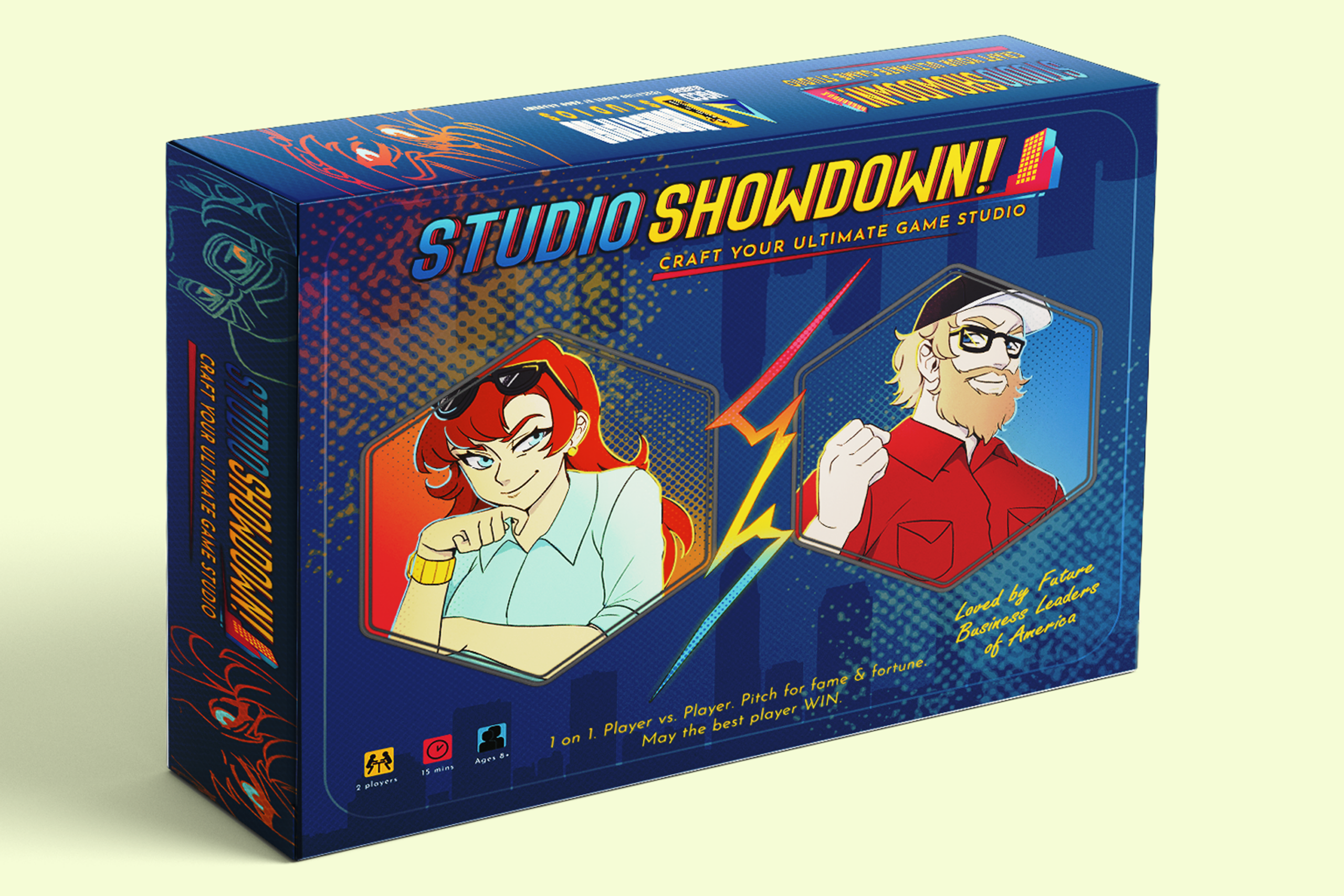
Studio Showdown isn’t just a tabletop game. It’s a high-stakes arena where creativity meets commerce. Developed through a powerhouse collaboration between VGCD Academy and DEMYSTIFIED Studios, this analog tool redefines game based learning for the next generation of creators. It’s built for those who don’t just want to play; they want to build, lead, and win. The “Showdown” metaphor isn’t a gimmick. It represents a relentless creative battle for market dominance where students transform into studio heads. They must pitch, pivot, and produce or get left behind in the visual noise of the industry.
Mastering Entrepreneurship Through Strategy
Success in the modern market requires more than just artistic talent. It demands a “can-do” attitude and razor-sharp tactical thinking. Players navigate the complex lifecycle of a production house. They manage fundraising rounds. They refine their pitching skills under pressure. They handle studio management challenges that mirror real-world obstacles. This physical, tactile experience provides a necessary break from digital fatigue. It’s the premier screen-free alternative for students in 2024. By removing the monitor, Studio Showdown forces face-to-face negotiation and authentic collaboration. To see how these high-performance teamwork skills translate to the technology sector, discover Symphony 100. For more ways to engage students offline, explore our guide on Screen-Free Activities for Teens.
- Fundraising: Learn to secure capital and manage resources effectively.
- Pitching: Master the art of the sell in a competitive environment.
- Studio Management: Balance creative vision with operational reality.
- Market Dominance: Outmaneuver rivals to become the industry leader.
Join the Showdown: Institutional Solutions
We’ve engineered the Educator Edition to deliver maximum institutional impact. This isn’t a one-off activity; it’s a comprehensive pedagogical shift. Our Classroom Bundles are designed for scale, supporting groups of 30 or more students simultaneously. We don’t just provide the box; we provide the expertise. Our professional development workshops empower teachers to facilitate high-intensity game based learning sessions with confidence. We give you the framework to turn your classroom into a thriving production hub. Stop teaching theory and start building legacies. The competition is already moving. Don’t let your students miss the cut. Bring Studio Showdown to your classroom today and witness the evolution of your future founders.
Master the Future of Classroom Engagement
By 2026, the divide between academic theory and professional execution will vanish. We’ve decoded how game based learning rewires the brain for critical thinking, moving beyond surface-level rewards to create true cognitive impact. Research shows that immersive simulations prepare students for high-pressure environments better than any traditional textbook. It’s a shift from being a spectator to becoming a protagonist in a digital arena. You aren’t just delivering a curriculum; you’re launching a production where every student has a stake in the outcome.
This isn’t about mindless clicking; it’s about professional mastery. Developed by VGCD Academy experts, this strategy reduces passive screen time while boosting professional acumen through intentional, strategic play. Leading schools already leverage these tools to help students build portfolios that command attention from recruiters and investors alike. You don’t have to settle for mediocrity when you can provide a premium experience that delivers measurable results. Stop competing with distractions and start dominating the educational landscape with a vision that sticks.
Elevate your classroom with the Studio Showdown Educator Edition
Step into the arena and claim your victory. The next generation of founders is waiting for a challenge worthy of their talent. Let’s give it to them.
Frequently Asked Questions
What is the primary difference between game based learning and gamification?
Game based learning uses the game itself as the primary vehicle for reaching learning objectives, while gamification simply adds mechanics like points or badges to existing tasks. In GBL, the gameplay is the lesson. You aren’t just earning rewards. You’re mastering mechanics that mirror real-world systems. It’s the difference between a leaderboard for reading and playing a simulation to understand market economics. It’s about immersion, not just incentives.
Is game based learning effective for high school students or just younger kids?
High school students benefit immensely from game based learning because it bridges the gap between abstract theory and practical application. Leading educational research suggests that simulation games can increase retention by 9 percent compared to traditional methods. For older students, the challenge shifts from basic literacy to complex decision-making. They engage with systems, manage resources, and face consequences. It’s not child’s play. It’s high-stakes strategy.
How do I assess student progress when using a board game in the classroom?
You assess student progress through structured observation rubrics and post-game debriefing sessions that map actions to learning goals. Track specific behaviors like negotiation tactics or resource management during a standard 45 minute session. Ask students to justify their strategic choices in a short reflection paper. This data provides a clear picture of their analytical skills. It’s a live performance review, not a boring multiple-choice test.
Can game based learning replace traditional textbooks for teaching business?
Game based learning acts as a powerful catalyst that can replace traditional business case studies with active, lived experiences. While textbooks provide the theoretical foundation, games like Studio Showdown force students to apply those theories in a simulated market. You don’t just read about production cycles. You manage them. It transforms passive reading into a 100 percent active creative production. It’s about building a vision, not just memorizing a glossary.
What skills do students actually learn from playing a game development board game?
Students master project management, resource allocation, and creative problem-solving through the lens of a production house. They learn to balance 3 distinct variables: time, budget, and creative quality. The game forces them to make tough calls under pressure. These are the same skills used by 85 percent of project managers in the creative industry. It’s about vision, execution, and winning the final showdown. It’s professional training disguised as play.
How much time does it take to implement a GBL strategy in a standard curriculum?
Integrating a GBL strategy typically requires 15 to 20 hours of planning to align game mechanics with your existing curriculum standards. You can start with a single 60 minute pilot session to test the waters. Most educators find that a 4 week module allows for deep immersion without disrupting the primary syllabus. It’s a high-speed sprint toward a long-term victory in student engagement. Efficiency is the key to this creative transition.
Are analog board games better than digital games for classroom learning?
Analog board games often outperform digital versions in fostering face-to-face negotiation and immediate social feedback. Physical components demand tactile engagement and 100 percent focus on the players at the table. Digital games offer scale, but analog games build the interpersonal soft skills that 92 percent of employers value. There’s no screen to hide behind. It’s pure, unadulterated creative confrontation. You see the impact of your decisions in real time.
Is Studio Showdown suitable for students with no prior game design knowledge?
Studio Showdown is built for anyone with a creative spark, requiring zero prior knowledge of game design or professional production. The mechanics are intuitive, fast, and designed to guide you through the creative process from day one. You don’t need a degree. You just need the drive to create something impactful. It’s an entry point into a world where your vision takes center stage. We provide the tools. You provide the talent.