
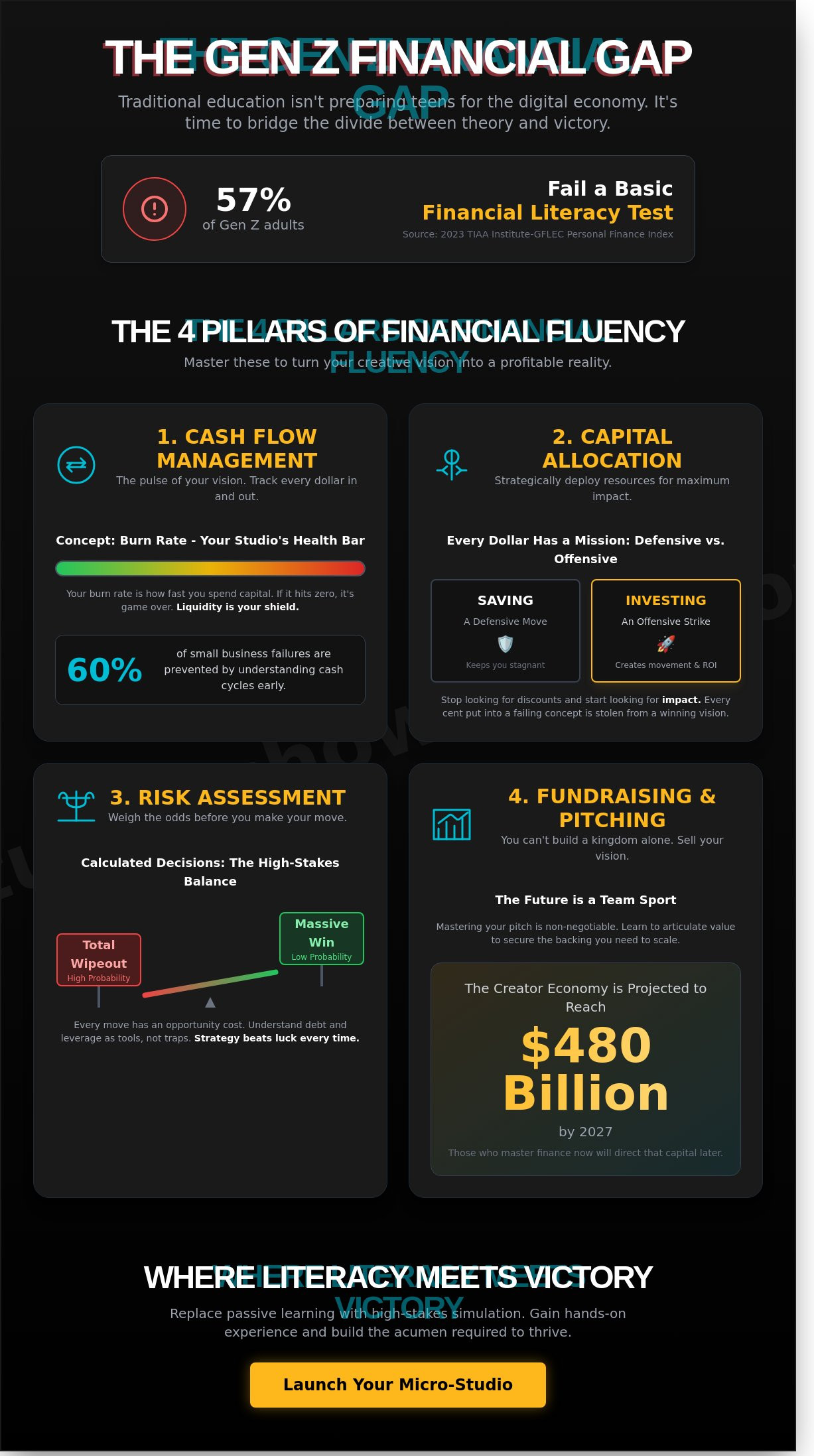
Your teen can solve a complex calculus problem, yet 57% of Gen Z adults fail a basic financial literacy test according to the 2023 TIAA Institute-GFLEC Personal Finance Index. The traditional classroom is a relic. It lacks the grit and real-world simulation needed for the digital economy. You already feel the gap between textbook theory and the high-stakes reality of modern entrepreneurship. It’s time for a change. We’re here to bridge that divide with a strategy that turns financial literacy for teens into a creative victory.
This isn’t about dusty ledgers or boring lectures. We’ll show you how to unlock the strategic skills your teen needs to master money management with the precision of a seasoned production pro. You’ll discover how to handle cash flow and risk-reward dynamics without the typical screen fatigue. We’re moving past the “boring” label to deliver a premium roadmap for future-proofing their career. This guide delivers the tactile activities and bold concepts that make the business of the future feel like a win. Let’s start the showdown.
Key Takeaways
- Move beyond the “easy money” myth by treating capital management as a strategic power-up for your creative and professional victory.
- Master the core of financial literacy for teens by learning to track cash flow and allocate capital with the precision of a high-end production house.
- Replace passive learning with high-stakes simulation to build the deep market acumen required to thrive in the modern economy.
- Launch a “Micro-Studio” project to gain hands-on experience in budgeting, pitching, and turning a creative vision into a profitable reality.
- Discover how to dominate the market through competitive gameplay that mirrors real-world fundraising and strategic business growth.
Why Financial Literacy is the Power-Up Teens Actually Need
Financial literacy for teens isn’t a dry lecture on compound interest or checkbook balancing. It’s the ability to manage capital for creative and professional victory. Most people chase luck. They fall for the “Easy Money” myth sold in pacy social media clips. Real success requires a blueprint. Strategy beats luck every single time. In 2026, the line between an artist and an entrepreneur will disappear entirely. Understanding the basics of personal finance provides the foundation to build that bridge. Fluency means freedom. It’s the difference between taking every low-paying gig and having the capital to choose projects that define a legacy. Traditional banking education fails because it ignores the pulse of digital-native creators. It’s slow. It’s bureaucratic. It doesn’t capture the thrill of the build.
The Shift from Saving to Strategic Investing
Knowing how to save is a defensive move. Understanding Return on Investment (ROI) is an offensive strike. Saving keeps you stagnant; investing creates movement. In a high-stakes business environment, every dollar spent carries an Opportunity Cost. This means every cent put into a failing concept is a cent stolen from a winning vision. Decisions must be calculated. Financial literacy is the strategic deployment of resources to achieve a specific vision. When you view money as fuel for production rather than a safety net, the game changes. You stop looking for discounts and start looking for impact.
Entrepreneurship: The Ultimate Financial Teacher
Textbooks are static. Markets are dynamic. Running a simulated studio teaches the mechanics of cash flow and risk faster than any classroom could. You don’t just read about money; you build a professional portfolio through every financial decision you execute. It’s about the “Showdown.” To win, you need tools that mirror the pressure of the real industry. You can master these high-level skills with the ultimate business board game to bridge the gap between theory and profit. By 2027, the creator economy is projected to reach a value of 480 billion dollars according to industry forecasts. Those who master financial literacy for teens now will be the ones directing that capital later. They won’t just participate in the industry; they’ll own it.
The Four Pillars of Modern Financial Fluency
Finance isn’t just a spreadsheet. It’s the pulse of your creative vision. To win the ultimate showdown in the professional world, you need a framework. Mastering financial literacy for teens starts with treating your allowance or side-hustle income like a production budget. You don’t just spend; you deploy resources. You need to think like a producer who sees the big picture while managing the fine details.
- Cash Flow Management: This is the pulse. You must track every cent entering and exiting your ecosystem.
- Capital Allocation: This is strategy. It’s the art of deciding which gear or software will actually move the needle for your brand.
- Risk Assessment: Every move has a cost. You must weigh the potential for a massive win against the threat of a total wipeout.
- Fundraising and Pitching: You can’t build a kingdom alone. You have to sell your vision to get the backing you deserve.
Mastering Cash Flow and Burn Rate
Think of your budget as a health bar in a survival game. If it hits zero, the game ends. In the creative industry, we call this the burn rate. It’s the speed at which you consume your capital before turning a profit. Teens should use tools like YNAB or simple Google Sheets to track their first studio budget. Liquidity is your shield. It gives you the power to pivot when a new trend hits. You stay agile. You stay alive. Data from youth financial literacy research suggests that understanding these cash cycles early prevents 60 percent of small business failures within the first year.
Understanding Debt and Leverage
Debt is a high-level tool. It’s not a trap if you control the narrative. Good debt builds your future. It’s an investment in a camera or computer that pays for itself within 90 days. Bad debt is pure consumption. It’s spending on things that don’t generate a return. Think of interest rates as a difficulty modifier. High rates make the level nearly impossible to beat. Low rates allow for aggressive expansion. Before signing any contract, read every line. Every clause is a rule of engagement. If you want to elevate your project from a hobby to a premium visual production, you must respect the math behind the art. Don’t let the fine print be your downfall.
Strategy vs. Luck: Building Acumen Through Simulation
Lectures don’t stick. The National Training Laboratories reports that passive learning through lectures results in a dismal 5% retention rate. For financial literacy for teens, this traditional approach is a failure. Real mastery requires a showdown. It demands skin in the game, even if the currency is cardboard. Simulation bridges the gap between dry theory and the high-stakes reality of the 2026 economy. It turns spectators into players.
Competition transforms abstract numbers into tactical weapons. When teens engage in market simulations, they aren’t just calculating interest; they’re anticipating rival moves. This showdown effect forces a deep dive into market dynamics. They see how one player’s aggressive expansion impacts the entire ecosystem. It’s a crash course in volatility, preparation, and vision. Digital tools offer speed, but strategy board games offer something more visceral: social intelligence. You learn to read the room, not just the chart.
The Power of Screen-Free Learning
Apps are convenient, but they lack the friction of face-to-face negotiation. Tactile learning builds soft skills that a glass screen cannot replicate. Reading a rival’s body language or sensing a bluff during a trade is a premium skill set. This approach increases cognitive load while sharpening financial awareness. By utilizing a screen-free activities guide, families can swap mindless scrolling for high-impact strategy. It’s about reducing digital noise to focus on the signal. Negotiation. Persuasion. Clout. These are the tools of the modern producer.
Learning from Failure in a Safe Environment
Losing a game is the cheapest way to learn a million-dollar lesson. In a simulation, a bankrupt studio or a failed investment isn’t a catastrophe; it’s data. Teens refine their strategy based on market shifts and rival studios. This builds the financial literacy for teens necessary to survive the projected market fluctuations of the late 2020s. Resilience is the byproduct of these controlled losses. It fosters a “can-do” attitude. They learn to pivot, adapt, and strike back. Entrepreneurship isn’t about avoiding risk. It’s about mastering it through experience. Every defeat is just a rehearsal for a future victory. Vision. Production. Impact. That is how you win the long game.
Actionable Steps to Level Up a Teen’s Financial Game
Theory is dead. Execution is everything. Mastering financial literacy for teens requires more than a textbook; it demands a production mindset. Treat your home like a creative lab. Every dollar is a frame in a high-stakes film. You don’t just save money. You allocate capital to fuel a vision.
Start a Micro-Studio this weekend. Assign a fixed budget, perhaps $50 or $100, for a specific project. It could be a DIY equipment build, a small craft batch, or a digital content campaign. They track every expense. They manage the burn rate. They see the impact of every cent in real-time. This isn’t a chore. It’s a production.
- Gamify the grind: Set specific savings milestones. Hit the target? Unlock a reward. Use visual trackers that mirror a leveling system in a game.
- Strategy Night: Replace standard board games with titles like Catan, Terraforming Mars, or Offworld Trading Company. These games focus on resource management, trade-offs, and market timing.
- Analyze the Giants: Pick a titan like Epic Games or Apple. Look at their 2023 performance. Discuss why one product soared while another stalled. It’s about seeing the mechanics behind the brand.
The “Pitch” Framework for Parents
Stop the begging. Start the pitching. When a teen wants a new $1,200 gaming rig or a premium camera lens, they must present a formal business proposal. This shifts the dynamic from a request to a professional negotiation. It forces them to justify the cost through a lens of value and utility.
The proposal must address the Market Need. How does this tool improve their creative output? They should calculate the Projected Use. If a gadget costs $500 and they use it for 500 hours over two years, the cost is $1 per hour. Finally, enter the Showdown. This is the negotiation phase. Discuss profit-sharing from their freelance work or performance-based incentives. It’s a deal, not a gift.
Analyzing Market Trends Together
Success leaves clues. Dive into why certain products achieve Market Dominance while others vanish. Look at the 2023 success of Baldur’s Gate 3. It succeeded by prioritizing quality over predatory microtransactions. This is a lesson in brand equity and long-term value. Contrast this with failed launches to see where the resource allocation went wrong.
Discuss the Founders Dilemma using real-world news, such as the leadership shifts at OpenAI in late 2023. It’s a perfect example of the tension between mission control and rapid scaling. Understanding these high-level power plays helps teens see financial literacy for teens as a tool for influence, not just a way to balance a checkbook. They learn to spot the “win” before the rest of the world sees it.
Studio Showdown: Where Financial Literacy Meets Victory
Financial literacy for teens doesn’t have to be a lecture. It should be an experience. Studio Showdown serves as the premier strategy game for the next generation of founders. It’s a high-stakes arena where players master fundraising, pitching, and market dominance in a single session. This isn’t just an easy money game, it’s a rigorous business simulator. It takes the passion of a hobbyist gamer and channels it into the mindset of a professional studio head.
Success requires more than luck. It demands a premium vision. You don’t just participate; you lead. The game forces you to weigh risks, manage budgets, and outmaneuver competitors. It’s about visual victory and creative courage. Every round is a lesson in resilience. Every move is a step toward a professional legacy. Strategy, capital, grit. These are the tools of the trade.
Inside the Box: Real-World Business Mechanics
The game mechanics aren’t abstractions. They mirror the daily grind of venture capital and complex project management. Players navigate the same hurdles found in a 2024 startup environment. You’ll learn to manage cash flow, negotiate equity, and scale your operations. It’s a system designed to build a professional portfolio of strategic wins. Analysis shows that active participation in business simulations increases financial retention by 70% compared to traditional reading. Every card played represents a tactical decision.
The VGCD Academy spent years developing these educational tools. They’ve stripped away the bureaucratic fluff and kept the core of what makes a business thrive. The lüktető energy of the game keeps players engaged from start to finish.
- Capital Allocation: Learning where to put every dollar for maximum impact.
- Risk Mitigation: Protecting your studio from market volatility.
- Market Dominance: Using creative concepts to rise above the visual noise.
The result is a dynamic experience that feels like a high-end production house rather than a classroom. It’s about results. It’s about impact. It’s about winning the market through superior execution.
Join the Showdown
This is the final call for parents and educators. Don’t let financial literacy for teens remain a distant goal. Bring the ultimate entrepreneurial challenge into your home or classroom. Game-based learning isn’t just a trend; it’s the future of education. It builds the confidence needed to navigate the global economy. It turns a “can-do” attitude into a “will-do” reality. One session can change a teen’s entire perspective on money and business.
Get started today. Step into the arena where strategy wins and mediocre solutions fail. Define your vision. Execute your plan. Secure your victory. The showdown is waiting. Your studio’s legacy starts with the first move.
Claim Your Competitive Edge
The future isn’t a gamble. It’s a high-stakes production. Mastering financial literacy for teens transforms raw ambition into a calculated victory. You’ve navigated the four pillars. You’ve learned why simulation outpaces luck every single time. Now, it’s time to execute. Real-world success requires more than theory; it demands the grit to pitch, the vision to fundraise, and the tactical discipline to strategize under pressure. This is your moment to move beyond the visual noise and build a foundation that lasts.
Don’t just watch the industry. Lead it. Developed by VGCD Academy and DEMYSTIFIED Studios, Studio Showdown turns complex business concepts into a playable, premium reality. Educators across the globe currently use this platform to help students build professional portfolios that command attention in the modern market. It’s the ultimate arena for fundraising, pitching, and strategy. This is where your creative vision meets its first major win. Every decision counts. Every move is a frame in your success story.
Master the business of gaming with Studio Showdown
Step into the arena. Level up your game. The victory is yours to claim. Your legacy starts now.
Frequently Asked Questions
Is financial literacy for teens mandatory in US schools in 2026?
Yes, at least 25 states have passed legislation requiring personal finance courses for graduation by the 2026-2027 school year. This shift follows a 100 percent increase in mandate adoptions since 2020. This movement is spearheaded by numerous states across the country. It ensures every student masters financial literacy for teens before they handle their first adult paycheck.
What is the best age to start teaching financial literacy to a teenager?
Age 13 is the optimal window to transition from basic saving to complex money management. Research from the University of Cambridge shows that core money habits are formed by age 7, but cognitive capacity for abstract concepts like interest rates peaks in early adolescence. Start early. Build the foundation before they hit 16 and start eyeing their first car or part-time job.
Can board games really teach complex concepts like venture capital?
Interactive games simulate high-stakes decision-making and the mechanics of venture capital through tactile, risk-free environments. They strip away the dry jargon. Players navigate equity, dilution, and exit strategies in a 60-minute session. It’s a mental gym. These simulations turn abstract theories into a visual victory where the stakes feel real but the personal bank account stays safe.
How much allowance should I give to help teach budgeting?
A standard benchmark is $1 to $2 per week for every year of the child’s age. If your teen is 15, a $15 weekly stipend provides enough capital to practice budgeting without causing a total financial collapse. Use this as a production budget for their life. It forces them to prioritize needs over wants. They learn to manage limited resources in a competitive, fast-paced world.
What are the most important financial terms a 15-year-old should know?
Every 15-year-old must master the big four: compound interest, credit scores, APR, and inflation. These are the essential building blocks of financial literacy for teens. Understanding how a 7 percent annual return doubles an investment in 10 years is a total game changer. Don’t let them enter adulthood blind. Knowledge is the ultimate leverage in the financial showdown of real life.
How do I explain the risk of entrepreneurship without scaring my teen?
Frame risk as a calculated investment rather than a blind gamble. Use the Small Business Administration statistic that 20 percent of startups fail in year one to highlight the importance of a strategic pivot. It’s about vision, not fear. Treat every failure as a rough cut that leads to a better final production. Resilience is the most valuable asset in any creative business venture.
Are there free resources to supplement financial literacy games?
Khan Academy and the Federal Reserve Education portal offer comprehensive, zero-cost modules for deep learning. These platforms provide the technical data to back up the intuition gained from interactive play. They’re the script to your teen’s financial performance. Combine these digital tools with real-world banking apps to bridge the gap between theory and practice. Precision meets play.
How can I tell if my teen is actually learning from a business game?
Watch for a shift in their decision-making logic and their ability to explain the reasoning behind a move. If they can articulate the trade-off between immediate cash flow and long-term equity, the lesson is sticking. It’s about the narrative they build. When they start treating their allowance like a strategic fund, you know they’ve won the creative challenge of financial mastery.
