Most aspiring developers think a computer science degree is the only golden ticket, but the industry’s next titans are being forged in the hours after the final bell rings. Choosing the right extracurriculars for aspiring game developers is no longer about just learning to code; it’s about building a brand before you even have a diploma. You’ve likely felt the weight of technical barriers and the crushing silence of a crowded market. It’s exhausting to have the vision without the business roadmap to back it up. You aren’t just looking for a job. You’re looking to build a legacy.
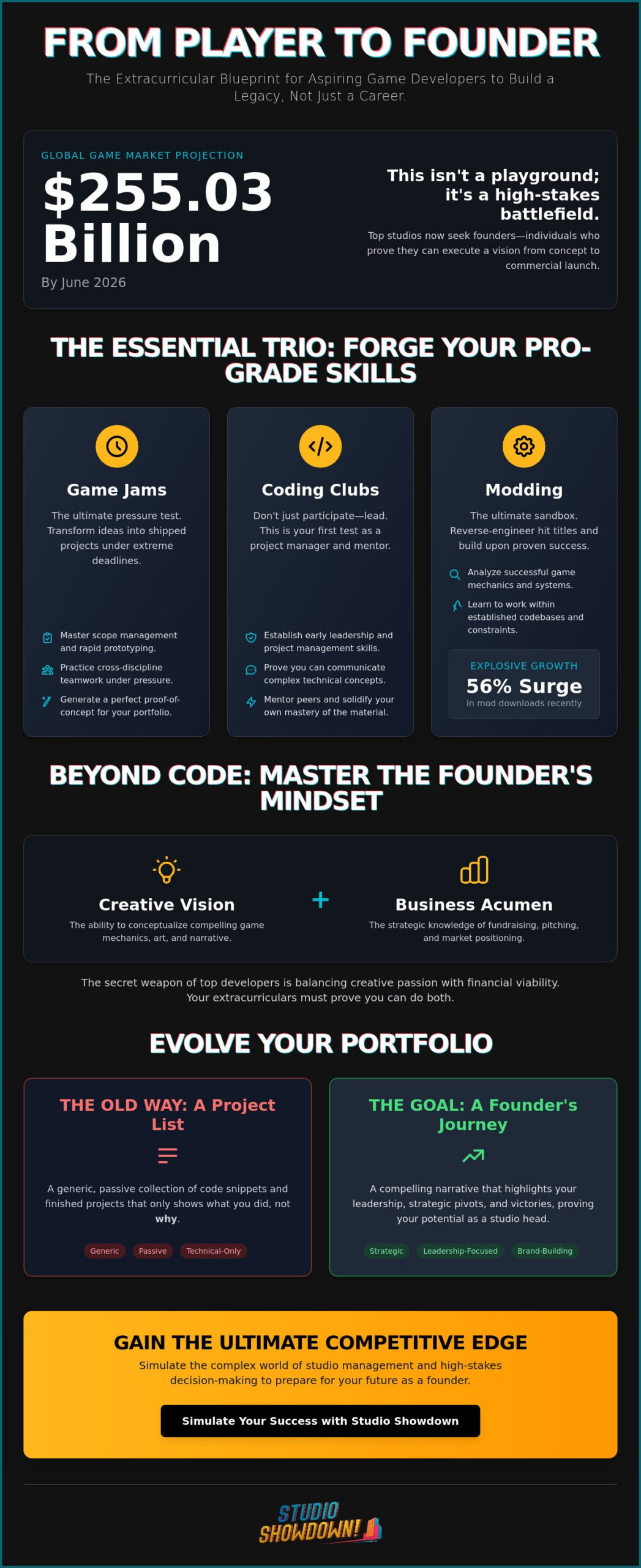
We’re here to change that narrative. This guide reveals the high-impact activities that transform you from a passive player into a professional studio founder. You’ll discover how to build a professional-grade portfolio and gain the real-world business acumen necessary to rise above the visual noise. We’ll explore everything from the 2026 Global Game Jam to the modding communities that saw a 56 percent surge in downloads recently. It’s time to stop chasing the industry. It’s time to start leading it.
Key Takeaways
- Move beyond the screen to master the high-stakes battle for market dominance by proving you can execute a vision from concept to completion.
- Explore why high-impact extracurriculars for aspiring game developers, like rapid-prototype game jams and leading coding clubs, are the ultimate pressure tests for future studio heads.
- Unlock the “secret weapon” of top developers by learning to balance creative vision with the financial viability of fundraising and pitching.
- Transform your portfolio from a simple list of projects into a compelling “Founder’s Journey” that highlights your victories and strategic pivots.
- Gain a competitive edge by simulating the complex world of studio management and high-stakes decision-making through Studio Showdown.
Beyond the Screen: Why Extracurriculars Define Your Game Dev Career
The era of the “bedroom coder” who just loves games is over. By June 2026, the global video game market is projected to hit approximately $255.03 billion. This isn’t a playground; it’s a high-stakes battlefield for market dominance. Technical proficiency is now the baseline. To actually rise above the noise, you must prove you can manage the process of creating a video game from the first concept to the final pitch. High-impact extracurriculars for aspiring game developers are no longer optional. They are the manifesto of your ability to execute.
Top-tier studios in 2026 have shifted their gaze. They aren’t just looking for raw syntax knowledge or someone who can recite C++ libraries. They’re hunting for founders. They want individuals who understand that a game is a commercial product requiring strategic positioning. Engaging in out-of-class activities bridges the gap between being a fan and becoming a professional. It signals that you don’t just consume media; you command it. You understand the grit required to ship a project when the initial excitement fades.
The Shift from Player to Creator
Stop playing for fun. Start playing for intelligence. The first step in your evolution is analyzing game mechanics in the wild. Why did that indie studio’s launch succeed while others failed? Successful founders look for the “why” behind the loop. They see creative combat where others see entertainment. By joining game jams or modding communities, you move from passive consumption to active production. You begin to see every mechanic as a strategic choice. This mindset shift is what separates the hobbyist from the future studio lead.
Building Your Professional Identity Early
Recruiters can smell a generic portfolio from a mile away. You need a signature style that cuts through the visual clutter. Extracurriculars signal self-taught mastery and the hunger to innovate. Whether you’re leading a coding club or contributing to a massive mod project, you’re building a brand. Consider these benefits of early networking:
- Direct Peer Access: Connect with future collaborators before they’re famous.
- Soft Skill Mastery: Practice pitching and fundraising in low-stakes environments.
- Proven Grit: Show that you can handle the “boring” parts of development, like bug testing and documentation.
In a field with over 250,000 jobs in the U.S. alone, standing out requires more than a degree. It requires a legacy of action. Your extracurricular choices today determine whether you’ll be a cog in the machine or the person who owns the machine tomorrow.
The Essential Trio: Game Jams, Coding Clubs, and Modding
Building a studio legacy doesn’t happen in a vacuum. It happens in the trenches of rapid production. When selecting the right extracurriculars for aspiring game developers, three pillars stand taller than the rest: game jams, coding clubs, and modding communities. These aren’t just hobbies. They’re the forge where raw talent becomes professional-grade execution. They provide the technical foundation you need to survive the competitive landscape of 2026.
Coding clubs offer a unique opportunity to establish leadership early. Don’t just show up to write lines of code. Take the lead. Managing a project or teaching a peer a complex algorithm proves you’ve mastered the material. This type of peer-to-peer mentorship is highly valued by organizations like the International Game Developers Association. It shows you can communicate technical concepts clearly, a skill every studio founder must possess to lead a diverse team of artists and engineers.
Mastering the Game Jam Sprint
The 48-hour constraint of a game jam is the best teacher for scope management. Events like the Global Game Jam 2026, scheduled for January 26 to February 1, force you to kill your darlings. You learn to prioritize core mechanics over fluff. These sprints are the ultimate pressure test for teamwork. You’ll collaborate across disciplines, syncing with sound designers and artists under a ticking clock. To maintain focus and dominate these intense development blocks, you can check out Spark Membership for free interval timer apps that help you manage your sprint cycles with precision. A successful jam entry serves as a perfect proof of concept. It demonstrates to recruiters that you can ship a working build on a deadline.
The Power of Modding and Level Design
Modding is the ultimate sandbox for reverse-engineering hit titles. In 2025, the modding community saw explosive growth, with Mod.io seeing a 56 percent increase in downloads to 920 million. This isn’t just about changing textures. It’s about understanding player psychology within established frameworks. You’re creating content for a fanbase that will give you immediate, often brutal, feedback. Use community bug reports to document your iteration process. If you want to practice these high-stakes decisions without the 48-hour burnout, you might explore how tabletop simulations can sharpen your studio instincts before you write a single line of code.
By leveraging these activities, you build a portfolio that tells a story of technical agility. You aren’t just a developer who knows syntax. You’re a creator who understands market appeal and the necessity of rapid prototyping.
Mastering the Business of Games: Entrepreneurship and Leadership
Technical skill creates the product. Business acumen creates the studio. Most extracurriculars for aspiring game developers focus exclusively on the screen, leaving a massive gap in professional readiness. Game development entrepreneurship is the high-stakes art of balancing artistic vision with financial viability. It’s about knowing when to push a creative boundary and when to protect the bottom line. Understanding fundraising and pitching isn’t just a bonus skill. It’s the secret weapon of developers who actually ship their dreams and dominate the market.
Innovation thrives on competition. In an industry where the U.S. video game economic impact is projected to hit $95.8 billion by 2026, the stakes couldn’t be higher. Leading a studio requires more than just knowing how to build a game; it requires knowing how to build a business. By simulating the studio environment early, you learn the nuances of resource allocation and market timing. You aren’t just a coder. You’re a founder in training who understands that every creative choice is also a strategic business decision.
From Developer to Studio Founder
You must learn to manage a budget before you ever see a million-dollar investment. Start by treating your personal projects like a business. Every hour spent is a cost. Every asset purchased is an investment. Mastering “The Pitch” is your next objective. You aren’t just selling a game; you’re selling a future to stakeholders. This requires a deep understanding of market dominance and the ability to anticipate rival studio maneuvers. In this game of creative combat, many leaders explore Event Registration and Training Subscriptions with the Combatives Association to develop the tactical mindset and resilience that ensure only the most prepared survive the launch cycle.
Analog Training for Digital Success
Strategy board games are the fastest way to learn complex business logic without the noise of a digital interface. They provide a pure simulation of strategic thinking and competitive pressure. By mastering strategy board games that mirror industry challenges, you sharpen your ability to think three steps ahead of the competition. This screen-free training eliminates the distraction of syntax errors or engine crashes. It forces you to focus on the core mechanics of success: negotiation, resource management, and tactical execution. It’s the ultimate training ground for the high-pressure world of 2026 game production, allowing you to refine your leadership style in a tactile, high-consequence environment.
Mastering these business fundamentals early ensures that when you finally launch your studio, you’re doing so with a foundation of iron. You’ll have the confidence to pitch to investors, the wisdom to manage your team, and the strategic foresight to turn a single game into a lasting studio legacy.
Turning Play into a Portfolio: How to Document Your Progress
A portfolio is more than a graveyard of unfinished itch.io projects. It’s a narrative. It’s the story of how you execute under pressure. When you track your extracurriculars for aspiring game developers, you’re building a business case for your future. Recruiter interest in 2026 isn’t sparked by a simple feature list. It’s sparked by the “Founder’s Journey.” This means documenting every challenge, pivot, and hard-won victory during your development cycle. You aren’t just showing code. You’re showing character.
Visual storytelling is your primary weapon. Don’t just describe your business case. Show it. If you managed a team for a 48-hour sprint, show the task board. If you modded a hit title, show the community feedback loops. Your portfolio should prove that you understand the commercial reality of the industry, not just the artistic theory. You’re demonstrating that you can handle the visual noise of a crowded market with strategic precision and artistic courage.
Writing Effective Post-Mortems
Every project needs a post-mortem. It’s the ultimate display of analytical thinking and professional humility. Analyze exactly what went wrong during your last Global Game Jam. Did you over-scope? Did the art pipeline collapse? Show how you would outmaneuver these same problems in your next showdown. This isn’t about admitting defeat. It’s about showing you’re an innovative partner who learns and adapts. It proves you have the technical readiness to handle the pörgős world of modern production.
Write a single, punchy sentence defining your unique contribution to every team project. “Optimized the rendering pipeline to save 15% on draw calls” is better than “I helped with coding.” It shows you know your value. It shows you can measure success. Use these metrics to build trust with future investors or employers. In a field that supports over 250,000 jobs, specificity is your best friend.
Presenting Business Acumen
If you want to be a studio founder, your portfolio must include more than code. Include your pitch decks. Show your financial simulations. Highlight your leadership roles in coding clubs or local developer organizations. These non-technical artifacts prove you can balance “creative” with “commercial.” You’re signaling that you’re ready for the $218,000 average industry salary by acting like a professional before you’re even hired.
Recruiters want to see that you understand fundraising and resource allocation. If you’ve used simulation tools to practice these high-stakes decisions, make that visible. To start building these professional-grade artifacts today, get your copy of Studio Showdown and turn your tabletop victories into documented business case studies. By presenting a portfolio that emphasizes leadership and strategic growth, you position yourself as a high-value asset who doesn’t settle for mediocre solutions.
Studio Showdown: The Ultimate Competitive Edge for Future Founders
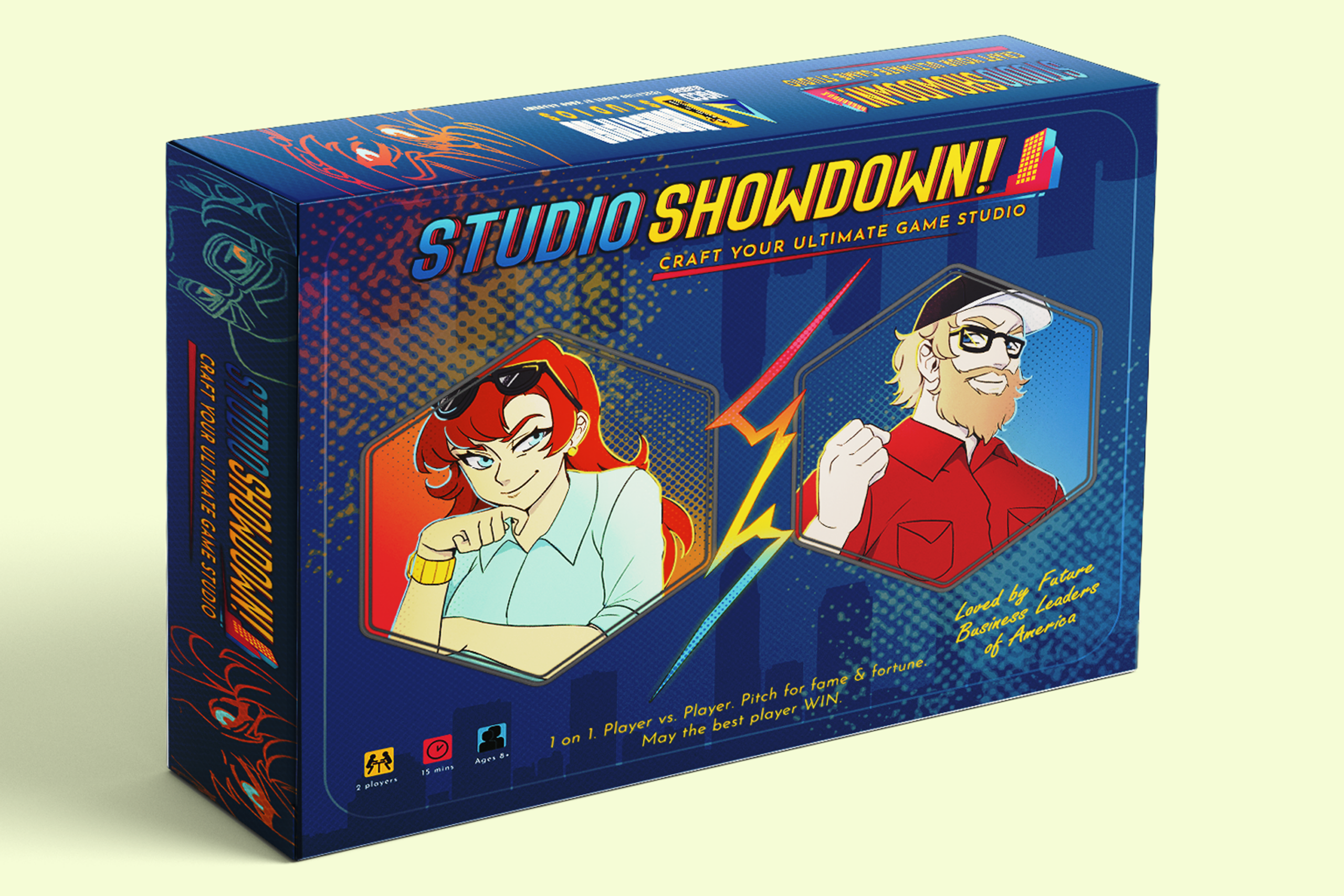
Technical mastery and a documented portfolio are your armor, but strategic intuition is your weapon. The final step in mastering extracurriculars for aspiring game developers is stepping away from the screen to face the raw logic of the industry. Studio Showdown is more than a board game. It’s a high-stakes simulation of the professional game development world. It forces you to inhabit the role of a studio founder today, making the same brutal decisions that define success in the 2026 market.
You’ve learned to code, you’ve joined the jams, and you’ve documented your growth. Now, you must learn to survive the competition. Studio Showdown strips away the distraction of syntax errors to focus on what matters: fundraising, pitching, and studio management. It’s an arena where creative vision meets financial reality. You aren’t just playing; you’re rehearsing for a career where market dominance is the only goal that counts.
Real-World Skills in an Analog Format
Analog training is the fastest way to sharpen your business logic. Ditching the screen allows you to focus entirely on the core mechanics of the industry. In Studio Showdown, you engage in “creative combat” with rivals. You’ll learn to manage limited resources, time your releases for maximum impact, and pivot when the market shifts. This isn’t a passive exercise. It’s a battle for dominance that builds the confidence you need to pitch your ideas in any boardroom. By mastering this business board game, you develop the thick skin and quick thinking required of a top-tier producer.
Join the Next Generation of Developers
Top students and innovators are already using Studio Showdown to supplement their STEM education. They know that raw code isn’t enough to build a legacy. For those in leadership roles, the Studio Showdown: Educator Edition provides a structured way for schools to integrate professional business logic into their curriculum. It transforms a standard after-school club into a powerhouse of entrepreneurial talent. If you’re leading a group, the Classroom Bundle is your toolkit for building a community of future founders.
Don’t wait for a job offer to start acting like a professional. The industry moves too fast for those who wait for permission. Take control of your career path by mastering the business of games in a tactile, high-pressure environment. You can start building your studio legacy right now by ordering your copy of Studio Showdown. Rise above the visual noise. Outmaneuver your rivals. Become the founder you were meant to be.
Forge Your Future in the 2026 Arena
The shift from player to professional requires more than technical syntax; it demands a strategic mindset. High-impact extracurriculars for aspiring game developers provide the arena where you prove your ability to lead, pivot, and execute. By mastering game jams and documenting your “Founder’s Journey,” you transform from a candidate into a visionary leader. You’ve seen how business logic and market positioning are the real engines of studio success. Now, it’s time to put those theories into practice.
Developed by VGCD Academy and DEMYSTIFIED Studios, Studio Showdown offers immersive strategy gameplay that mirrors the high-stakes reality of the industry. It’s already being used by educators to bridge the gap between STEM and entrepreneurship. Don’t leave your legacy to chance. Master the business of games with Studio Showdown and secure your place at the top of the leaderboard. It is the ultimate training ground for those who refuse to settle for mediocrity.
The industry is waiting for its next titan. Make sure it’s you. Your studio legacy starts today.
Frequently Asked Questions
What are the best extracurriculars for game design college applications?
Project completion and leadership are the gold standard for design applications. Participating in game jams, leading a coding club, or contributing to open-source projects proves you can ship. These extracurriculars for aspiring game developers signal that you have the grit to handle a rigorous degree and the professional world beyond. Highlight roles where you managed a team or balanced a budget to stand out from candidates who only focus on raw syntax.
Do I need to know how to code to start a game dev club?
You don’t need to be a master coder to launch a successful club. A studio founder’s role is often about vision and talent management rather than raw execution. Focus on organizing workshops, inviting guest speakers, or coordinating team projects. By acting as the producer, you learn to bridge the gap between art and engineering. This leadership experience is often more valuable than being the best programmer in the room.
How can I learn the business side of game development as a student?
Start by treating your small projects like a commercial studio. Use pitch decks to explain your game’s value proposition and simulate resource allocation. Engaging with business-focused simulations helps you master fundraising and market timing. This practical experience prepares you for the high-stakes reality of the industry, where artistic vision must align with financial viability. It ensures your project survives the launch and rises above the visual noise of the competition.
Are board games helpful for learning video game design?
Board games are essential for mastering core system design and player balance. Without the distraction of complex code, you can focus purely on mechanics and the player experience. Designing a tabletop game forces you to write clear rules and iterate quickly based on live feedback. Many successful digital developers use analog prototyping to find the “fun” before they ever touch a keyboard. It’s the fastest way to learn complex logic without syntax errors.
What should be in a high school student’s game dev portfolio?
Your portfolio should prioritize quality over quantity. Include two or three finished projects, detailed post-mortems, and a professional pitch deck. These artifacts, born from extracurriculars for aspiring game developers, prove you have the analytical thinking required for professional production. Don’t just show the final product; show the strategic decisions that led you there. It’s about demonstrating your unique signature style and professional grit to recruiters who value execution over theory.
How do I find Game Jams for beginners in 2026?
Platforms like Itch.io host a constant stream of themed jams specifically designed for newcomers. Look for events that emphasize learning and community over high-stakes competition. Local community centers and school clubs often host beginner-friendly sprints during the summer months. These low-pressure environments are the perfect place to build your first professional-grade artifacts. You’ll network with peers who share your creative ambition and start building your studio legacy early without the fear of failure.
Can playing strategy games help my career in game development?
Strategy games sharpen your ability to analyze complex systems and anticipate rival maneuvers. Mastering these games teaches you about resource management, risk assessment, and tactical positioning. These are the exact skills needed to run a successful studio in a crowded market. By understanding how different systems interact to create a balanced experience, you become a more effective designer. You’ll also become a much sharper business leader capable of securing market dominance through superior logic.
What is the most important soft skill for a game studio founder?
The ability to communicate a vision clearly is the most critical skill for any founder. You must be able to pitch to investors, motivate your team, and explain your game’s value to the public. Without strong communication, even the best technical projects will struggle to find an audience. Mastering the art of the pitch ensures that your creative ideas receive the funding and support they need to survive the battle for market dominance and achieve lasting success.