The most valuable business degree in 2026 isn’t printed on cardstock; it’s played on it. Dry academic curricula often leave students disengaged and suffering from chronic screen fatigue. You’ve likely felt the disconnect. A textbook defines venture capital, but it never captures the adrenaline of a high-stakes pitch. It doesn’t teach you how to outmaneuver a rival in a shifting market. Modern entrepreneurship board games have evolved into lethal strategic simulations that mirror the grit of the real world.
We agree that theory alone is a hollow substitute for experience. That’s why this guide explores how immersive games bridge the gap between academic concepts and professional success. You’ll learn how these tools build essential soft skills like pitching and strategic foresight through direct, competitive play. We’re breaking down the shift toward tactile learning and how titles like Studio Showdown transform the classroom into a professional arena. It’s time to stop memorizing definitions and start winning the game.
Key Takeaways
- Stop reading; start doing. Analog entrepreneurship board games outpace digital tools by forcing you to master social cues and high-stakes negotiation.
- Trade luck for skill. Understand how resource management and the “Pitch” mechanic transform a hobby into a professional development powerhouse.
- Sharpen your edge. Identify the specific soft and hard skills, from leadership to project management, that players refine during every session.
- Command the market. Discover why modern simulations are the new business school. They offer a risk-free environment to test aggressive growth strategies.
- Meet the standard. See how Studio Showdown bridges the gap between academic theory and real-world game dev success.
Beyond the Rules: Why Entrepreneurship Board Games are the New Business School
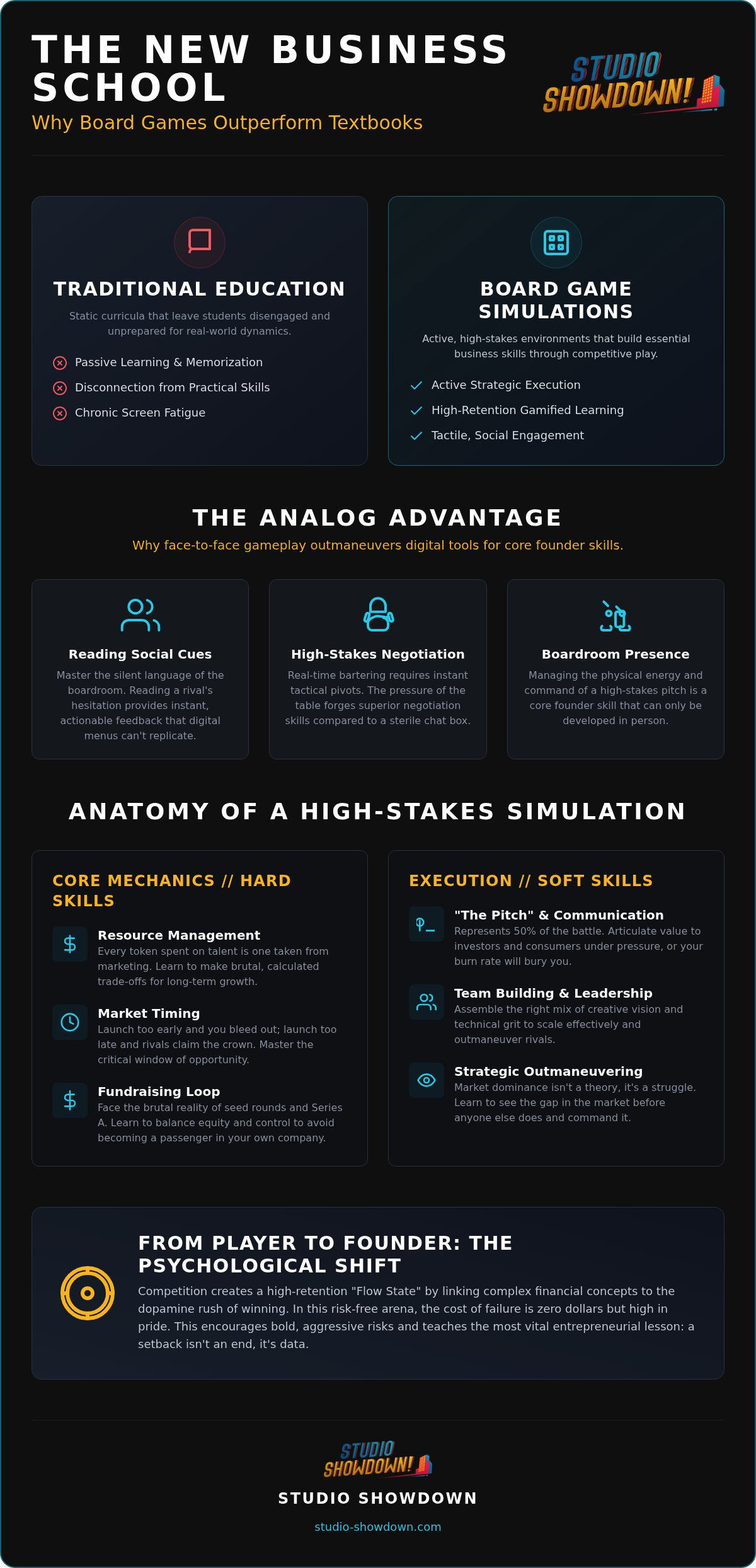
Textbooks are static. Business is a contact sport. While traditional degrees focus on definitions, modern entrepreneurship board games prioritize execution. We’re seeing a massive shift. Passive learning is dead. Active strategic thinking is the new gold standard. In 2026, educators are ditching dry slides for high-stakes simulations that integrate directly into STEM and business curricula. They realize that a student who survives a simulated market crash is better prepared than one who simply reads about it. By lowering the cost of failure, these games encourage the kind of bold, entrepreneurial risks that lead to true innovation.
Analog play holds a distinct edge over digital simulations. Screens create barriers; boards create connections. You can’t master negotiation through a chat box. You need to see the micro-expressions. You need to feel the tension in the room. Social cues are the silent language of the boardroom. Only physical play trains you to read them under pressure. Consider the advantages of the table over the screen:
- Social Cues: Reading a partner’s hesitation across the table provides instant feedback.
- Negotiation: Real-time bartering requires instant tactical pivots that digital menus can’t replicate.
- Presence: Managing the physical energy of a high-stakes pitch is a core founder skill.
The Science of Gamified Learning in Business
Competition isn’t just fun; it’s chemical. When you outmaneuver an opponent, dopamine floods the brain. This creates a high-retention environment for complex financial concepts. ROI isn’t a chore when it’s the key to winning the round. This is the “Flow State.” It keeps players locked in, turning difficult topics into intuitive moves. Educational gamification is a tool for building real-world business portfolios that convert abstract theories into tangible experiences.
From Players to Founders: The Psychological Shift
The transition from player to founder is profound. You stop thinking like an employee and start acting like a studio head. This shift is critical. In a simulation, the cost of failure is zero dollars but high in pride. This allows for bold, aggressive risks that would be suicidal in the real world. You learn resilience. If your game launch fails, you pivot. You learn that a setback isn’t an end; it’s data. For those looking to dominate the table, understanding the mechanics is just the start. You must also focus on Mastering the Board: The 2026 Guide to Strategy Board Games to refine your competitive edge. It’s about moving from surviving the game to commanding the industry.
The Anatomy of a High-Stakes Business Simulation Game
Mechanics are the heartbeat of high-performance entrepreneurship board games. They don’t just simulate business; they pressure-test your survival instincts. It starts with resource management. Every token spent on talent is a token taken from marketing. Team building follows. You need the right mix of creative vision and technical grit to scale. Then comes market timing. Launch too early and you bleed out; launch too late and the rivals have already claimed the crown. It’s a brutal, beautiful cycle of decision and consequence.
Communication is the ultimate multiplier. In these simulations, “The Pitch” represents 50% of the entrepreneurial battle. You can have the perfect product, but if you can’t articulate its value to investors or players, your burn rate will bury you. Market dominance isn’t a theory here. It’s a constant struggle to outmaneuver rival studios for limited consumer attention. It’s about seeing the gap before anyone else does. You don’t just play the game; you command the market.
Mastering the Fundraising Loop
Seed rounds and Series A funding aren’t just milestones. They’re high-stress pivots. Modern entrepreneurship board games simulate the brutal reality of the fundraising loop. You face a constant trade-off between equity and control. Giving away too much early on leaves you a passenger in your own company. It’s a vital lesson. Young founders learn to value their ideas and, more importantly, their time. If you want to experience this firsthand, check out The Ultimate Business Board Game: Master Entrepreneurship in 2026 for a masterclass in strategic growth.
Strategic Outmaneuvering of Rivals
Competitive analysis is the engine of the “Showdown” element. You aren’t playing in a vacuum. You’re watching what other studios build. You’re tracking their hiring. You’re predicting their next move. Sometimes, you collaborate to expand the market. Other times, you compete for total share. It’s a fluid, dangerous dance. This isn’t abstract creative destruction. This is the ground-level reality of being a founder. You must be proactive. You must be ruthless. You must be ready to pivot at a moment’s notice.
- Burn Rate: Managing cash flow while scaling production capacity.
- Investment Rounds: Navigating the stress of equity dilution and board control.
- Market Timing: Executing the perfect launch in a crowded, competitive field.
Comparing Classic Finance Games vs. Modern Entrepreneurship Simulations
Luck is a liability in a boardroom. In classic finance games like Monopoly, success depends on the roll of the dice. That’s not entrepreneurship; that’s gambling. Modern entrepreneurship board games have dismantled this “Roll and Move” relic. They’ve replaced it with systems like “Action Point Allowance” and “Hand Management.” These mechanics force you to prioritize. You have a limited budget of time and energy. You choose where to spend it. Do you hire a developer or pitch to a VC? The choice is yours, not the dice’s.
The business world of 2026 is digital, fast, and unforgiving. Modern simulations reflect this reality. They incorporate the gig economy, viral marketing loops, and remote team dynamics. Variable player powers further deepen the realism. You don’t start as a generic player. You might be a “Technical Co-founder” with a bonus to production or a “Growth Hacker” who dominates social reach. This mirrors the niche-driven reality of modern business. You aren’t just playing; you’re specializing.
The ‘Easy Money’ Trap: Why Luck Isn’t Strategy
Roll-to-win models are a bad teacher. They suggest that business success is a random event. This misrepresents the calculated risks of a true founder. In reality, you don’t wait for luck; you build systems to mitigate it. These “Easy Money” games ignore the grit of the pivot and the nuance of the deal. If you want to understand why tactical depth beats random chance, explore Beyond the Easy Money Game: Why Strategy Wins in 2026. Strategy isn’t about being lucky. It’s about being prepared for every outcome.
Simulation Depth: Accuracy vs. Playability
A simulation that isn’t fun is just a chore. Effective educational tools must engage the player first. Studio Showdown masters this balance. It uses real-world game development jargon, like “sprints” and “burn rates,” but keeps the mechanics accessible. The goal is the “Aha!” moment. This is the precise second a player realizes their in-game strategy is actually a viable business plan. They’re not just moving pieces on a board. They’re drafting a blueprint for industry dominance. It’s professional development disguised as a battle for market share.
Building Real-World Career Skills Through Analog Play
Analog play is a tactical workshop for the 2026 workforce. It’s where theory meets grit. While digital tools simulate data, entrepreneurship board games simulate people. You can’t code charisma. You can’t automate a high-stakes negotiation. These games force you to develop a professional edge through direct, face-to-face conflict. You’re building a portfolio of mental models: financial literacy, resource allocation, and project management. Every win is a proof of concept. Every loss is a post-mortem on your strategy.
Hard skills become second nature at the table. You manage burn rates. You allocate talent. You balance technical debt against market speed. These aren’t just mechanics; they’re the hard skills of a studio founder. For students, these sessions translate into tangible experience. They learn to lead under pressure and make decisive moves when the market shifts. It’s about moving beyond the worker mindset and commanding the room. The social-emotional benefit of screen-free collaboration is the hidden multiplier. It builds trust, resilience, and the ability to pivot as a team.
Pitching as a Core Competency
Communication is your most lethal weapon. Board games force you to articulate your value proposition clearly and concisely. If you can’t convince your opponents or investors to back your move, your studio dies. This is the ultimate “Elevator Pitch” training ground. You practice in a safe environment where the only cost of a failed pitch is a lost turn. A board game pitch mechanic mirrors a Silicon Valley boardroom by stripping away the fluff and forcing you to defend your vision against skeptical, high-stakes peers.
Screen-Free Strategy for the Digital Generation
The digital landscape is crowded. Screen fatigue is real. Tactile, face-to-face strategic planning offers cognitive benefits that a monitor simply can’t match. You engage more senses. You process information differently. It’s tech-adjacent learning without the blue light. You’re still mastering market dominance and fundraising, but you’re doing it through physical interaction. Explore Screen-Free Activities for Teens and Families: The 2026 Strategy Guide to see how analog play sharpens the modern mind.
Ready to build these skills in your own classroom or studio? Secure your copy of the Studio Showdown Board Game and start training the next generation of founders through immersive competition.
Studio Showdown: The Definitive Board Game for Aspiring Game Dev Founders
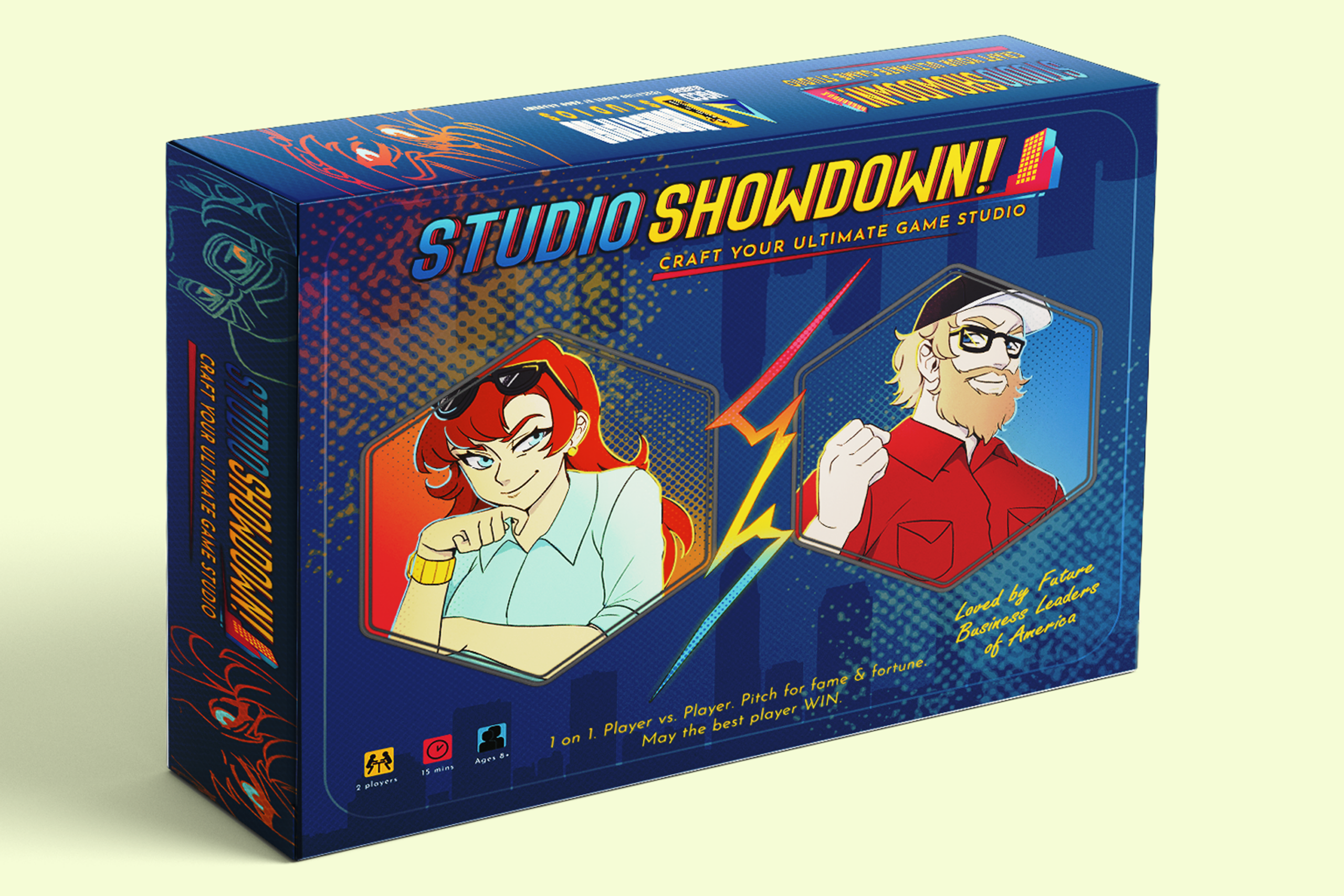
Most entrepreneurship board games treat business as a generic list of tasks. Studio Showdown changes the narrative. It targets the high-growth game development niche, where creativity meets ruthless market strategy. This is a specialized simulation built for the founders of 2026. Developed through the combined expertise of VGCD Academy and DEMYSTIFIED Studios, it captures the grit of the digital startup world. You don’t just manage a store; you command a studio. You start as a scrappy indie developer and fight to become an industry giant. It’s a journey of technical debt, viral marketing, and high-stakes pivots.
The game specifically addresses the video game development lifecycle. You experience every phase. You secure seed funding. You hire specialized talent. You survive the crunch. Every decision affects your burn rate and your market standing. It’s a professional development workshop disguised as a battle for industry dominance. Whether you’re a family looking for a deep strategy experience or a school building a modern curriculum, the Studio Showdown Board Game delivers a premium, high-stakes experience. It’s available as a physical product for personal use and through bulk licensing for institutional growth.
Inside the Box: Immersive Strategy
The components are built for immersion. Every card and token represents a real-world business asset. As a Studio Founder, your perspective shifts as the game progresses. You move from the technical focus of early development to the strategic oversight of a Series A leader. The unique ‘Showdown’ phase is the ultimate test. It’s a noble struggle for market share. Your strategy either rises above the noise or gets buried by the competition. There’s no room for mediocrity here. You win through superior planning and artistic courage.
The Educator Edition and Classroom Bundles
Engagement is the primary challenge in modern education. The Studio Showdown: Educator Edition solves this by turning business theory into a competitive arena. It includes specialized tools for teachers to integrate the simulation into STEM and business classes. We don’t just provide the game; we provide the expertise. Professional development workshops help educators maximize classroom impact, ensuring students walk away with actionable skills. For larger programs, the Classroom Bundle and bulk licensing options support libraries and after-school initiatives across the country. It’s time to replace dry lectures with a high-stakes entrepreneurship board games experience that students actually want to play.
Command the Boardroom of 2026
Business isn’t a lecture. It’s a series of high-stakes decisions and calculated risks. We’ve explored how modern entrepreneurship board games dismantle the “roll-to-win” luck of the past, replacing it with deep strategic thinking and real-world pitching mechanics. You’re no longer just a player; you’re a founder managing burn rates and outmaneuvering rivals in a shifting market. These simulations turn abstract theories into a tangible portfolio of strategic wins.
Studio Showdown represents the pinnacle of this educational shift. Developed by industry experts at VGCD Academy and DEMYSTIFIED Studios, it bridges the gap between classroom theory and industry dominance. It’s designed for students, educators, and parents who refuse to settle for dry, screen-heavy learning environments. With national shipping across the United States, professional development is now accessible at your dining table or in your classroom.
Ready for the ultimate studio showdown? Order your copy of the board game today!
The market is waiting for its next great founder. Grab your seat at the table and start building your legacy today. Your first big win is just one move away.
Frequently Asked Questions
What are the best entrepreneurship board games for high school students?
High school students need games that move beyond basic counting. The best entrepreneurship board games for this age group are those that simulate real-world industry cycles. Studio Showdown is a top contender because it forces students to think like founders. It balances technical grit with creative vision. Students don’t just move pieces; they manage talent and pitch to investors. It’s about preparing them for the high-stakes reality of the 2026 workforce.
Can board games actually teach financial literacy and business strategy?
Yes, they provide a tactile environment for mastering complex financial strategy. Players learn to manage burn rates and calculate ROI in real-time. Unlike a textbook, a board game provides instant feedback on every financial decision. If you overspend on talent, your studio fails. This cost of failure is zero dollars but high in lessons. It builds a deep understanding of resource allocation and capital management that sticks long after the game ends.
How does Studio Showdown differ from traditional business games like Monopoly?
Monopoly is a game of chance; Studio Showdown is a game of skill. Traditional games rely on dice rolls to dictate success. In Studio Showdown, your decisions drive the outcome. You manage a video game development lifecycle from indie startup to industry leader. The Pitch mechanic and Showdown phase require actual negotiation and strategic foresight. It’s a professional simulation designed to bridge the gap between hobby gaming and real-world business acumen.
Are there entrepreneurship games specifically for the video game industry?
Studio Showdown is the definitive simulation for the game development industry. Developed by experts at VGCD Academy and DEMYSTIFIED Studios, it mirrors the actual lifecycle of building a game studio. Players navigate technical debt, hire specialized staff, and battle for market dominance. It’s a high-growth niche that resonates with Gen Z. This isn’t a generic business game. It’s a deep dive into the specific challenges of the creative tech sector.
How can teachers use board games to meet STEM curriculum standards?
Teachers use these simulations to address project management and financial modeling standards. Board games fit perfectly into STEM curricula by teaching logic, resource optimization, and data-driven decision-making. The Studio Showdown: Educator Edition includes specialized tools to help instructors map game phases to learning objectives. It turns a classroom into a professional arena. This hands-on approach reduces screen fatigue while hitting critical benchmarks in technology and business education.
Do entrepreneurship board games require prior business knowledge to play?
No, the mechanics are designed to teach the concepts as you play. Beginners can jump in and learn the basics of fundraising and market timing through intuitive systems. The game acts as the teacher. As players progress, they naturally adopt a founder’s perspective. It’s an entry point into the world of entrepreneurship board games that doesn’t require an MBA to enjoy. You build your expertise one turn at a time.
What skills do students learn from playing business simulation games?
Students master a mix of soft and hard skills through analog play. They practice public speaking during pitching rounds and learn leadership under pressure. Hard skills include financial literacy and strategic resource allocation. These games also build resilience. When a project fails in the simulation, players must pivot and adapt. It’s a safe space to fail fast and learn faster, creating a professional edge that textbooks simply can’t replicate.
Where can I buy a classroom bundle for entrepreneurship board games?
You can secure a Classroom Bundle directly through the official website. We offer specialized packages designed for schools, libraries, and after-school programs. These bundles provide everything needed to scale the experience for multiple groups. Simply visit studio-showdown.com to explore our institutional options and educator resources. We offer national shipping across the United States to ensure your students can start their journey toward industry dominance as soon as possible.