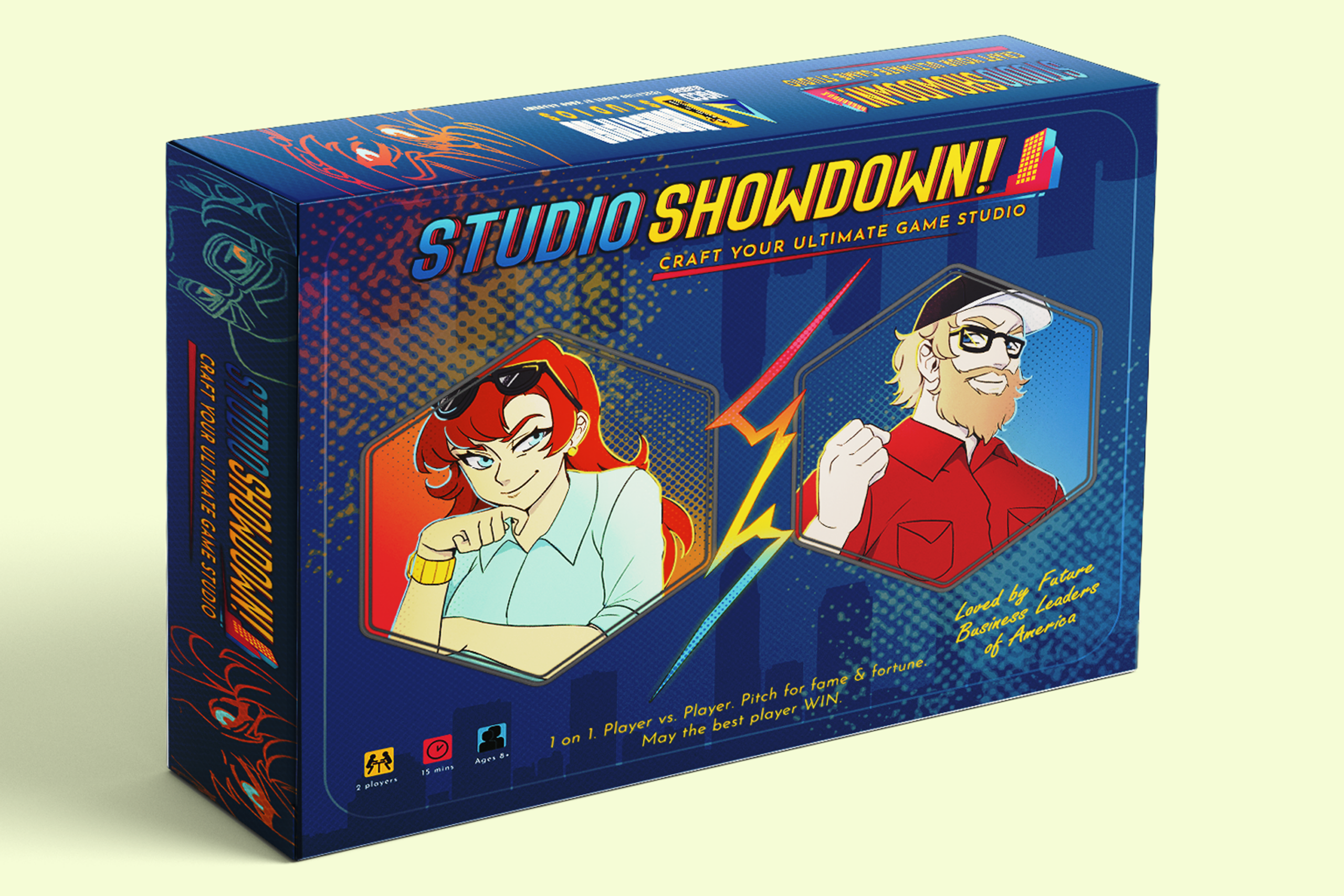
Your next major business breakthrough won’t happen in a lecture hall. It will happen across a table. It will be fueled by adrenaline and high-stakes strategy. Most startup education is trapped in dry textbooks or exhausting digital simulations that leave you with nothing but screen fatigue. You deserve a more visceral way to master the market. This isn’t just about learning; it’s about winning.
We understand the frustration of explaining a complex market pivot or a messy funding round to a team that has already tuned out. It’s why entrepreneur board games have become the ultimate secret weapon for the 2026 business landscape. Discover how these strategic tools transform abstract theories into a competitive, tactile learning experience that sharpens your professional instincts. This article explores the top titles for the year, including the high-octane Studio Showdown series. We will show you how to build a real-world portfolio through play and prove why a strategic showdown is the fastest path to mastering the startup world. Get ready to turn your next game night into a masterclass in venture capital and creative execution.
Key Takeaways
- Modern entrepreneur board games replace dry theory with active, high-stakes strategic execution.
- Master the art of the pitch and learn to manage your most precious assets: time and talent.
- Move beyond the Monopoly trap. Modern simulations teach the gritty realities of resource management and social deduction.
- Bridge the gap between the game board and the boardroom by turning your tabletop victories into a professional portfolio.
- Step into the role of a studio founder with Studio Showdown to dominate the competitive world of game development.
What Are Entrepreneur Board Games and Why Do They Matter in 2026?
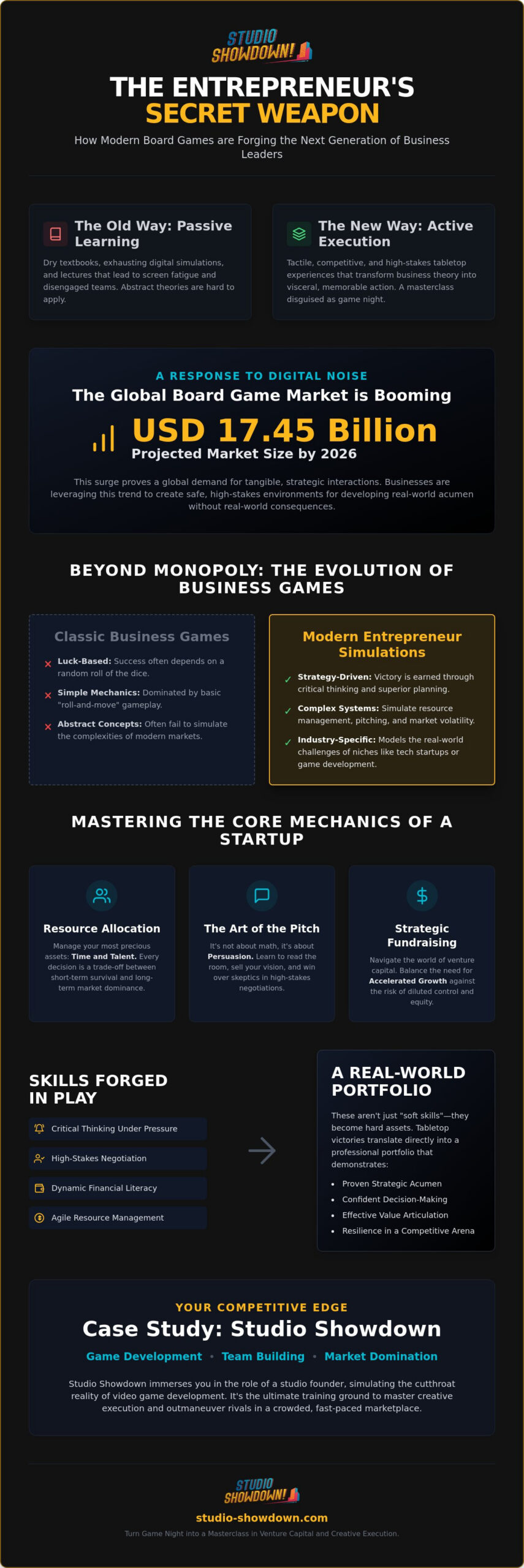
Entrepreneur board games are not just recreational pastimes. They are strategy-based tabletop simulations of real-world business environments. In 2026, the global board games market is projected to reach USD 17.45 billion. This surge isn’t accidental. It’s a response to a world saturated by digital noise. A Business simulation game provides a tactile, high-stakes arena where theories become actions. You don’t just read about market volatility. You feel it when your lead developer gets poached by a rival. This shift from passive consumption to active strategic execution is the only way to build true business acumen.
There’s power in the fail fast mentality. On the board, a bankrupt studio is a lesson, not a legal nightmare. This safe environment encourages artistic courage and aggressive risk-taking. It’s the ultimate antidote to the screen fatigue that plagues modern digital simulations. When you’re physically moving pieces and looking your competitors in the eye, the stakes feel real. The learning sticks because it’s attached to an emotion, a victory, or a hard-fought loss. You aren’t just playing; you’re rehearsing for the real showdown.
The Evolution of Business Simulations
We’ve moved beyond simple roll-and-move mechanics. Today’s entrepreneur board games mirror the fast-paced, cutthroat nature of the 2026 startup world. Modern titles focus on complex resource management and industry-specific challenges. For example, Studio Showdown immerses players in the high-stakes reality of video game studio ownership. It’s no longer about luck. It’s about creative execution and outthinking your competition in a crowded marketplace. The rise of these industry-specific games means you can train for the exact niche you want to conquer.
Key Skills Developed Through Tabletop Play
Playing entrepreneur board games sharpens the instincts you can’t get from a PDF. Critical thinking under pressure becomes second nature. You learn the art of the verbal pitch by negotiating with players who have their own agendas. Financial literacy isn’t just about balancing a ledger anymore. It’s about managing cash flow while betting on long-term investments. These games force you to articulate your value proposition clearly. They turn soft skills into hard assets. You develop a professional edge that is visible, measurable, and highly competitive. It’s about mastering the art of the deal before you ever step into a boardroom.
The Core Mechanics of Entrepreneurship: From Pitching to Fundraising
Success in business isn’t a roll of the dice. It’s a calculated war. Most entrepreneur board games strip away the fluff to reveal the gritty machinery of a startup. You aren’t just moving a token; you are deploying human capital. Resource allocation is the heartbeat of the game. You must manage time and talent with surgical precision. If you burn your lead designer on a minor feature, you’ll lack the firepower for the final release. Every turn is a trade-off between today’s survival and tomorrow’s dominance. It’s about making the hard calls before the market makes them for you.
The pitch phase is where the pressure peaks. This isn’t about math. It’s about persuasion. Games that force you to articulate a value proposition teach you more than any seminar. You have sixty seconds to convince a table of skeptics that your studio is the future. This social deduction element mirrors real-world networking and high-stakes negotiations. Research into Game-based learning confirms that these risk-free environments are essential for developing high-level soft skills. You learn to read the room. You learn to sell the vision. You learn to win.
Fundraising rounds simulate the high-stakes world of venture capital. You’ll face the same dilemmas as a real founder. Do you take the easy money now or hold out for a better valuation? Strategically outmaneuvering rivals for limited market share is the only way to stay relevant. It’s a showdown where only the most adaptable survive the crunch.
Navigating the Funding Landscape
The choice between bootstrapping and external investment defines your trajectory. External capital accelerates growth but dilutes your control. In this context, equity represents the ownership percentage you trade for the resources needed to scale. Taking on early-stage debt carries a brutal risk-reward ratio. One bad quarter can end your run. Mastering this balance is key to winning entrepreneur board games. If you want to test these instincts, exploring the mechanics of Studio Showdown offers a direct path to understanding the funding lifecycle.
Strategic Pivots and Market Changes
Market volatility is a constant threat. Modern simulations use event cards to trigger sudden shifts. A new regulation might kill your main revenue stream, or a competitor might launch a surprise acquisition. You must develop the flexibility to change strategy mid-game. A rigid plan is a death sentence. In the 2026 market, competition isn’t just an obstacle; it’s a catalyst for innovation. If a rival studio dominates the mobile space, you pivot to PC. You don’t just react. You anticipate. You outlast. You conquer.
Comparing Strategy: Classic Business Games vs. Modern Simulations
Luck is the enemy of a sustainable business. For decades, the standard for ‘business games’ was Monopoly. It’s a classic, but it’s fundamentally flawed for anyone serious about the startup world. This is the Monopoly Trap. It teaches that wealth is a product of landing on the right square at the right time. In the real 2026 market, that logic is dangerous. Modern entrepreneur board games have evolved. They move away from the ‘easy money’ fantasy and focus on the gritty reality of strategic execution. You don’t wait for a windfall. You build it.
The gap between classic titles and modern simulations lies in the mechanics. Old games rely on roll-and-move. Modern strategy board games prioritize resource management and social deduction. You aren’t hoping for a lucky dice roll. You’re analyzing your competitors’ body language during a pitch. You’re balancing a tight budget against a looming market shift. This shift is critical for developing entrepreneurial competencies like cooperation and rapid decision-making. It’s the difference between playing a game and running a company. One is a distraction; the other is a training ground.
Beyond the ‘Easy Money’ Concept
Passive wealth doesn’t exist in a startup. Monopoly reinforces bad habits by rewarding players for simply staying in the game. Strategy-based wins require proactivity. You have to hunt for opportunities. You have to create value where none exists. Understanding this distinction is vital. For a deeper dive into why luck-based games fail to prepare you for the boardroom, check out our analysis on Beyond the Easy Money Game. True success is earned through artistic courage and calculated risk, not a lucky double-six. Strategy wins every time.
Choosing the Right Game for Your Goals
Not every game serves the same purpose. You need to match the complexity level to your objective. Finding the balance between ‘fun’ and ‘educational’ is a strategic choice in itself. Pick your arena wisely.
- Best for families: Look for high engagement and simple, intuitive rules. The goal here is to introduce basic financial concepts without the heavy crunch of a full simulation.
- Best for students: Choose titles with deep alignment with business curricula. Studio Showdown: Educator Edition is designed specifically for this, turning the classroom into a high-octane production studio.
- Best for aspiring founders: You need high-fidelity startup simulations. These entrepreneur board games should force you to manage fundraising, team burnout, and market pivots simultaneously.
- Best for youth organizations: Leaders looking for program ideas and supplies to support leadership or entrepreneurial projects can find excellent resources at MakingFriends.com.
How Game-Based Learning Builds Real-World Professional Portfolios
A resume is just a list of claims. A portfolio is a collection of proof. In the aggressive 2026 job market, simply saying you understand business isn’t enough. You need to demonstrate it. Entrepreneur board games provide a unique laboratory where strategic decisions leave a measurable trail. When a student or aspiring founder navigates a complex simulation, they aren’t just playing. They are generating case studies. They are proving they can handle resource scarcity, team dynamics, and market pivots. This is where the gap between the game board and the boardroom finally closes.
Recruiters are moving away from traditional metrics. They want to see how you think under pressure. A high-fidelity business simulation game allows you to articulate exactly why you chose to pivot your strategy in the third quarter. You can show how you managed a fundraising round or how you outmaneuvered a rival studio. These aren’t abstract concepts. They are documented victories. By translating these tabletop outcomes into professional narratives, you create a portfolio that speaks the language of results. It’s about turning a win into a career-defining moment.
The Educator’s Strategy for Classroom Bundles
Modern educators are ditching the lecture for the showdown. By integrating Classroom Bundles into business programs, they hit STEM and financial literacy targets with surgical precision. Managing multiple studios in a single room creates a vibrant, competitive ecosystem. Assessment becomes more than a multiple-choice test. It becomes an analysis of strategic game decisions. Did the student over-leverage their equity? Did they prioritize short-term gains over sustainable growth? This hands-on approach ensures that the theory sticks because the consequences are immediate and visible.
Translating Game Wins to Career Skills
Every mechanic in a quality simulation maps directly to a leadership skill. Managing your hand of cards is project management. Negotiating a trade is a masterclass in soft skills. The in-game pitch phase prepares you for real-world presentations where the stakes are millions of dollars. You aren’t just learning facts; you’re developing a founder mindset before graduation. This proactive attitude is what separates a participant from a leader. To start building your professional edge through strategic play, explore the Studio Showdown game editions and take control of your creative future.
Studio Showdown: Your Competitive Edge in Game Dev Entrepreneurship
Generic startup simulations often fail because they lack focus. They try to be everything to everyone, which usually means they teach very little about specific industries. Studio Showdown is different. It’s a precision tool designed for the cutthroat world of the video game industry. You don’t just start a business in this game. You launch a studio. You manage the volatile intersection of art and commerce. This industry-specific lens is why it stands above other entrepreneur board games. Developed by VGCD Academy and DEMYSTIFIED Studios, it bridges the gap between creative passion and commercial survival. You’ll master the art of the pitch. You’ll navigate the science of fundraising. It’s a hands-on portfolio builder for the next generation of digital architects.
The role of a Studio Founder is a high-wire act. You’re constantly balancing developer burnout against aggressive release deadlines. You’re pitching to cynical investors while your competitors are whispering in their ears. Studio Showdown captures this tension perfectly. It’s built for students who want a head start and educators who demand measurable results. By the time you finish a session, you’ve lived through an entire development cycle. You’ve made the hard calls. You’ve earned your victories. This is how you build a professional game dev portfolio that actually matters to recruiters in 2026. It’s about proving you can survive the crunch and come out on top.
Mastering the Business of Games
Navigating the business side of creativity requires more than just a good idea. It requires a strategy for market dominance. Studio Showdown forces you to outmaneuver rival studios for limited attention and capital. You’ll face the brutal reality of launching a hit title in a crowded marketplace. It’s a high-octane production simulation where every decision impacts your studio’s reputation and bottom line. This isn’t a passive exercise. It’s a creative showdown. You’ll learn to anticipate market shifts and pivot your production pipeline before your rivals even notice the change. The hands-on experience gained here is visceral, memorable, and immediately applicable to real-world studio management.
Specialized Editions for Maximum Impact
Educators need tools that scale with their ambitions. The Studio Showdown: Educator Edition is built for seamless classroom integration, providing the structure needed to turn a lecture into a competitive arena. For larger institutions, Classroom Bundles offer scalable solutions that allow an entire cohort of aspiring founders to compete simultaneously. These editions are the ultimate tools for hitting STEM and financial literacy targets while keeping students fully engaged in the learning process. Don’t settle for theoretical unreality. Choose a simulation that prepares you for the actual fight. Secure your copy of Studio Showdown and start building your empire today!
Dominate the Market: Your Studio Journey Starts Now
The era of dry textbooks is over. In 2026, the real winners are those who embrace the competitive edge of entrepreneur board games. You’ve seen how modern simulations bridge the gap between classroom theory and boardroom reality. They transform abstract concepts like VC funding and market pivots into visceral, high-stakes experiences. By mastering these mechanics, you aren’t just playing. You’re building a professional portfolio that speaks the language of strategic success.
Studio Showdown is the ultimate tool for this transformation. Developed by industry experts at VGCD Academy, this classroom-tested simulation focuses on the high-growth world of video game entrepreneurship. It pushes you to outthink, outpitch, and outlast the competition. It’s time to stop reading about success and start creating it. Every move you make on the board is a rehearsal for your future empire. Ready to launch your studio? Shop Studio Showdown now!
Step into the arena. Take the risk. Victory is waiting for those brave enough to play.
Frequently Asked Questions
What are the best entrepreneur board games for teenagers?
Teenagers respond best to games that offer high-stakes roleplay and tangible results. Look for titles that simulate modern, fast-paced industries like tech or entertainment rather than generic wealth building. Studio Showdown is a top choice for this age group because it mirrors the high-energy world of game development and rewards artistic courage. It turns a simple game night into a competitive arena where they can test their professional instincts against their peers.
Do business board games actually teach financial literacy?
Can board games help with college or job applications?
Strategic play builds a unique professional portfolio that demonstrates your ability to think under pressure. You can use specific game outcomes to prove your grasp of market mechanics or your success in a high-stakes pitch. It shows recruiters and admissions officers that you have the proactive founder mindset required for the 2026 job market. It’s about turning a tabletop victory into a measurable career advantage that sets you above the visual noise of other candidates.
How long does a typical session of Studio Showdown take?
A standard session usually lasts between 45 and 90 minutes. This timeframe is designed to fit perfectly within a single classroom period or a focused evening game night. It’s fast, pulsing, and keeps the pressure high from the first resource trade to the final market showdown. The game’s rhythm ensures that no time is wasted on filler, focusing entirely on the high-stakes decisions that define a successful studio launch and long-term survival.
Are there specific board games for learning video game development?
Studio Showdown is specifically designed to teach the business side of the game dev industry. It covers the entire lifecycle from the initial pitch to the complex science of fundraising. Most entrepreneur board games are generic and lack an industry-specific lens. This title offers a specialized arena for aspiring developers to rehearse their studio ownership skills. It’s the ultimate tool for anyone looking to master the art of the deal in modern game production.
What is the difference between a business game and a strategy game?
Business games focus specifically on commercial outcomes, resource management, and social deduction in a competitive marketplace. Strategy games are a much broader category that can include anything from military conquest to abstract resource harvesting. A true business simulation prioritizes the art of the deal and financial sustainability. It forces you to think like a founder, where every move has a direct impact on your studio’s bottom line and your professional reputation.
How can teachers use board games to meet curriculum standards?
Educators use specialized editions to hit STEM and financial literacy targets through active, competitive play. The Studio Showdown: Educator Edition includes specific tools for managing multiple studios and assessing student performance based on their strategic decisions. It turns a standard lesson into a high-octane production simulation that meets modern curriculum standards. This approach ensures that the theory is not just heard but practiced in a risk-free, engaging environment that encourages artistic bravery.
What skills do startup board games focus on most?
These games prioritize the art of the pitch, the science of fundraising, and surgical resource allocation. You’ll spend your time articulating value propositions and outmaneuvering rivals for limited market share. It’s about mastering the strategic pivot and developing the flexibility to survive a volatile economic landscape. These are the core skills that separate a successful founder from a dreamer, and tabletop simulations provide the perfect training ground to sharpen these instincts before you enter the boardroom.