What if the controller in your child’s hand isn’t a distraction, but the blueprint for a future empire? By 2025, the global game-based learning market reached $29.46 billion. It’s no longer just a hobby. It’s a high-stakes arena for talent. You’ve likely felt that familiar sting of guilt over excessive screen time. You want them to learn, but finding “cool” materials often feels like a losing battle against the visual noise of the digital world. You’re looking for a way to bridge the gap between entertainment and professional acumen.
It’s time to stop viewing games as the subject and start viewing the game studio as the ultimate classroom. You’ll discover how to transform a passion for gaming into professional-grade skills in business and design through high-impact offline engagement. We’re diving into educational activities for kids who love video games that build portfolios instead of just high scores. This guide previews how to channel that energy into STEM and entrepreneurship; moving from the couch to the boardroom with screen-free tools like the Studio Showdown Board Game that demand creative courage.
Key Takeaways
- Reframe gaming from a dead-end hobby into a high-octane launchpad for interest-led learning. Understand why the gamer mindset is actually a professional toolkit for complex problem-solving.
- Break down the anatomy of game design into its professional pillars: art, code, and business. Learn how systems thinking prepares kids to manage real-world ecosystems and professional workflows.
- Discover the analog advantage of tactile learning. These educational activities for kids who love video games force players to be the computer, mastering complex mechanics through manual rule-processing.
- Master the business of play with hands-on entrepreneurial challenges. Learn how to pitch ideas like a pro and manage developer budgets to build a balanced, winning team.
- Shift from consumer to creator with tools like the Studio Showdown Board Game. Learn to outmaneuver rivals through pure strategy and studio management rather than just digital reflexes.
Why Video Games are the Ultimate Gateway to Interest-Led Learning
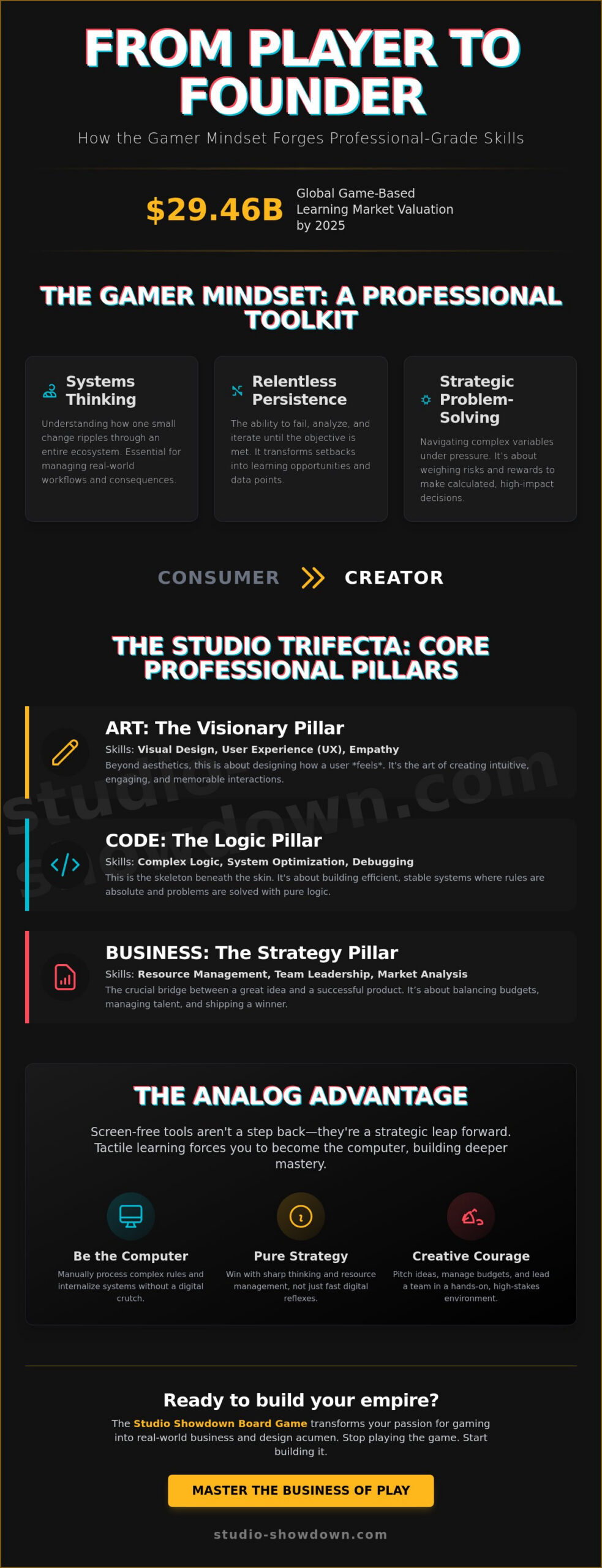
Interest-led learning in 2026 isn’t a luxury; it’s a strategic move for any parent looking to future-proof their child’s education. It means taking a natural obsession and using it as high-octane fuel for mastery. When we discuss the concept of an Educational video game, we’re looking at a gateway to professional competence. A 2025 meta-analysis of 43 studies confirmed that game-based learning significantly improves academic achievement and knowledge retention. The “Gamer Mindset” isn’t a myth. It’s a suite of skills that top-tier executives use to navigate market volatility, including:
- Systems Thinking: Understanding how one small change ripples through an entire ecosystem.
- Relentless Persistence: The ability to fail, analyze, and iterate until the objective is met.
- Strategic Problem-Solving: Navigating complex variables under extreme time constraints.
Stop fighting the screen. It’s a battle you’ll likely lose. Instead, pivot the energy. Most parents view gaming as a dead-end hobby. They’re wrong. It’s the most engaging classroom on the planet if you know how to leverage it. The real shift happens when a child stops being a passive consumer and starts thinking like a creator. This is where educational activities for kids who love video games become truly transformative. We aren’t looking for “edutainment” that bores them. We’re looking for professional-grade skills hidden in plain sight.
The Hidden Curriculum of Modern Gaming
Strategy games are masterclasses in resource management. They force players to weigh immediate gains against long-term stability. In multiplayer environments, coordination isn’t just “chatting”; it’s team leadership. It involves delegating roles, managing expectations, and executing a shared vision. This isn’t just about winning. It’s about organizational design. Players must align diverse skill sets toward a single objective, mirroring the production flow of a modern tech startup. Even fast-paced titles have depth. They sharpen split-second decision-making and risk assessment. Every move is a calculated gamble. These aren’t just digital reflexes. They’re the building blocks of a career, making educational activities for kids who love video games essential for developing real-world acumen.
Pivoting from Player to Studio Founder
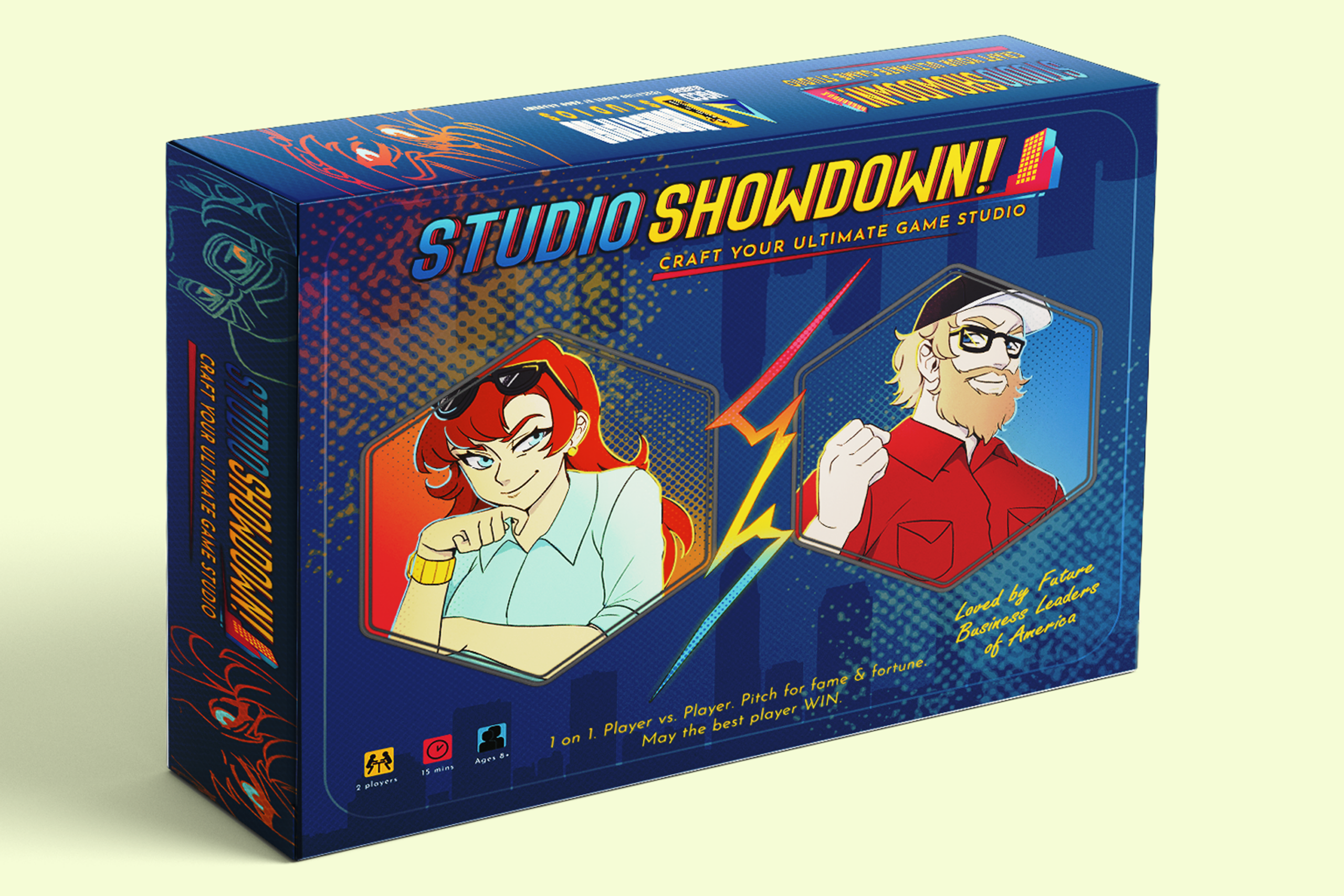
The game industry is a multidisciplinary titan. It combines visual art, complex logic, and hard economics. Understanding the “how” behind the mechanics is infinitely more valuable than just clearing a level. You want your child to see the skeleton beneath the skin. When they understand that a “bug” is a logic error and a “feature” is a design choice, they start looking at the world through a lens of optimization. They stop asking “what can I play?” and start asking “what can I build?” This is exactly why we developed the Studio Showdown board game. It bridges the gap between digital play and real-world business logic. It turns the living room into a high-stakes production studio where kids learn to lead, not just follow.
Core Professional Skills Kids Learn Through Game Design
Game design isn’t just about “making a game.” It’s a high-stakes trifecta of Art, Code, and Business. When kids dive into this world, they aren’t just playing; they’re managing a multidisciplinary production. They balance the visual impact of Art with the rigid logic of Code and the market viability of Business. This creates a high-pressure environment where educational activities for kids who love video games thrive. It forces them to see the world as a series of interconnected systems rather than isolated events.
Systems Thinking is the core of this experience. A game is a living ecosystem. If you double the player’s speed, you have to double the size of the world to keep the challenge intact. Understanding how one small change ripples through an entire project is a professional-grade skill. It’s about consequences. Then there’s User Experience (UX). Designing a level requires deep empathy. A child must step outside their own head and ask: “How will someone else feel while playing this?” This audience awareness is the exact same skill needed for modern marketing and product design.
Game economics serve as the ultimate sandbox for financial literacy. Managing a virtual shop or balancing a resource pool teaches the value of scarcity, investment, and inflation. It’s hard business logic without the classroom boredom. These social and collaborative layers are part of the broader Benefits of Playing Video Games Together, where shared systems lead to shared intellectual growth. If you want to see this logic in action, consider how a Classroom Bundle can transform a group of students into a functioning production studio.
Level Design and Spatial Reasoning
Designing a map is an intense exercise in geometry and architectural flow. It isn’t just drawing; it’s pathfinding and spatial problem-solving. To start, grab some graph paper for a quick offline challenge. Sketch a level with specific constraints: one entrance, three distinct obstacles, and one hidden reward. This forces kids to think about spatial limitations and player movement. It’s a perfect way to learn game development concepts by visualizing the physical flow of a digital space.
Narrative Design and Creative Writing
Narrative design goes far beyond simple storytelling. It focuses on player agency and branching logic. Instead of a linear plot, kids must create a “Choose Your Own Adventure” logic map. If the hero opens the red door, what happens? If they choose the blue one? This teaches branching dialogue and logical “if-then” structures. It turns writing into an interactive puzzle. This complexity builds a dual foundation for both advanced creative writing and the fundamental logic used in computer science.
The Analog Advantage: Why Screen-Free Activities Win in 2026
Screens are loud, fast, and relentless. In 2026, the real competitive edge comes from stepping back. Analog play offers a tactile advantage that digital spaces simply can’t replicate. When a child moves a physical piece, they aren’t just playing; they’re engaging multiple senses simultaneously. This sensory input anchors abstract concepts deeper in the brain. It’s the difference between seeing a map and building one with your hands. Tactile learning turns theory into muscle memory.
Analog games force players to “be the computer.” In a video game, the software calculates damage, tracks inventory, and enforces rules automatically. The logic is hidden behind a curtain of code. In a board game, the child does the math. They track the resources. They enforce the rules manually. This manual processing is where true systems mastery happens. It’s why research has linked gaming to better cognitive performance in children, but the analog version pushes that performance into the realm of deep work. No notifications. No pop-ups. No distractions. Just pure, unadulterated focus.
The social benefits are equally sharp. Digital spaces allow players to hide behind avatars or mute their rivals. Physical games demand negotiation. They require players to read body language, detect bluffs, and manage real-world tension. These are the “soft” skills that define hard-hitting leaders. For parents seeking educational activities for kids who love video games, moving to the table isn’t a step backward. It’s a leap toward professional maturity.
Analog vs. Digital Learning Comparison
Digital coding often gets bogged down in syntax; one missing semicolon breaks the entire project. Board game design is different. It’s about logic, balance, and human psychology. You’re designing for people, not processors. This makes board games superior for teaching high-level business negotiation. You can’t “lag” out of a difficult conversation at the table. You have to pivot your strategy based on the person sitting across from you. It builds social grit. To understand how these systems scale, explore the mechanics of strategy board games and how they mirror professional decision-making.
Building a ‘Game Studio’ in Your Living Room
Top-tier studios don’t start with high-end engines. They start with paper. Physical prototyping is an industry standard because it’s fast. You can test a mechanic, realize it’s broken, and scrap it in seconds. No debugging required. Turn your living room into a production floor using household items like dice, coins, or index cards. This “fail fast” mentality is the hallmark of a professional creator. It removes the fear of failure. It replaces it with the thrill of iteration. It’s about the process. The struggle. The win. These are the ultimate educational activities for kids who love video games because they teach that success is built on a mountain of discarded prototypes.
5 Hands-On Activities for Aspiring Game Entrepreneurs
Gaming isn’t just about reflexes. It’s about market share. These educational activities for kids who love video games move beyond the screen to teach the brutal, exciting logic of entrepreneurship. You’re shifting their focus from the controller to the boardroom. It’s a transition from playing the game to owning the studio. Here’s how to build that professional acumen at home.
- The Shark Tank Pitch: Ask your child to sell their game idea to “investors.” They shouldn’t just describe the gameplay. They need to explain the hook. Why would someone pay for this? This builds the ability to articulate a vision under pressure.
- Budgeting a Hit: Use “Dev Points” as a currency for production. Give them a limited pool. Do they spend on high-end graphics or complex mechanics? They can’t have both. This teaches the reality of resource allocation and trade-offs.
- The Rulebook Challenge: Communication is king. Have them write clear instructions for a simple mechanic. If a sibling can’t play it without asking questions, the design failed. It’s a lesson in precision and audience awareness.
- Market Research: Analyze why their favorite game is a hit. Is it the subscription model? The limited-time events? This turns them from a passive spender into a critical strategist who understands profitability.
- The “Re-Skin” Project: Take a classic like Checkers or Chess. Change the theme to a cyber-security breach or a Mars colony. Adjust the mechanics to fit the new world. It’s the ultimate exercise in creative iteration.
Ready to turn these concepts into a competitive reality? The Studio Showdown Board Game provides the perfect framework to launch their first “studio” and master these business skills through play.
The ‘Elevator Pitch’ Workshop
In the industry, we call it a UVP. That’s a Unique Value Proposition. It’s the one thing that makes a project stand out in a crowded market. Challenge them to a 60-second workshop. They have to pitch a “Platformer with a Time-Travel mechanic” and make it sound like a multi-million dollar success. It builds confidence. It sharpens public speaking. Most importantly, it forces them to think about audience demand and market positioning. They aren’t just talking; they’re selling a vision.
Economic Balancing Act
In-game shops are perfect for teaching supply and demand. Have them design a shop where prices fluctuate based on player actions. If every player has a “Legendary Sword,” its value plummets. That’s inflation. This hands-on approach makes complex economics feel like a win rather than a chore. It’s about understanding the systems that drive the world. You can explore why deep strategy always beats simple luck in our guide to the easy money game and how to move beyond it.
Studio Showdown: The Ultimate Educational Tool for Gamers
Stop talking about the industry. Start leading it. Studio Showdown is the definitive bridge between passive play and professional production. It’s where theoretical knowledge meets the high-pressure reality of the market. This isn’t just about entertainment. It’s about turning educational activities for kids who love video games into a tangible career path. The game forces players to step into the shoes of a studio founder, where every decision carries weight and every resource is finite. It transforms the living room or the classroom into a high-stakes production floor.
The ‘Showdown’ mechanic is the heart of the engine. It eliminates the randomness that often plagues traditional board games. Success isn’t found in a lucky roll; it’s found in superior logic. You have to anticipate your opponent’s move three steps ahead. Managing a development budget in this environment isn’t a dry math exercise. It’s a high-stakes survival tactic. You learn to pivot when a project stalls and double down when you find a market gap. These educational activities for kids who love video games prepare them for the realities of fundraising and professional pitching. By 2026, these skills are the baseline for success in any technical or creative field.
From Tabletop to Portfolio
We believe every player is a potential creator. Studio Showdown was forged through a collaborative effort between VGCD Academy and DEMYSTIFIED Studios to ensure professional accuracy. It provides a foundation for professional game development that goes beyond simple mechanics. It’s about the “why” behind the “how.” Using this tool sparks an immediate interest in business board games and entrepreneurship. It turns a hobby into a portfolio piece. It proves that the student doesn’t just understand games; they understand the systems that make them profitable.
Getting Started with the Classroom Bundle
Scaling this impact is a priority for modern educators. The Studio Showdown: Educator Edition is built specifically for high-impact learning environments. It includes specialized guides to help facilitators lead deep discussions on market economics, team dynamics, and project management. We offer bulk licensing and a comprehensive Classroom Bundle that fits perfectly into after-school programs, summer camps, or specialized STEM workshops. It’s a turnkey solution for turning a room of gamers into a room of entrepreneurs. The process is efficient. The results are visible. Order your copy of Studio Showdown or the Classroom Bundle today.
Forge the Next Generation of Studio Founders
Screen time isn’t a dead end. It’s a launchpad. You’ve seen how game design pillars like Art, Code, and Business build real-world acumen. Moving from digital play to analog strategy sharpens social grit and financial literacy. These educational activities for kids who love video games bridge the gap between a bedroom hobby and a professional portfolio. It’s about taking the gamer mindset and aiming it at the market. Stop managing minutes and start managing a studio.
The transition from consumer to creator happens at the table. You can Master the business of gaming with the Studio Showdown Board Game. Developed by VGCD Academy experts and used by educators for STEM and Financial Literacy, it offers high-impact, strategy-based gameplay with no ‘pay-to-win’ mechanics. It’s the ultimate way to turn a passion for play into a mastery of production. The controller was just the beginning. The boardroom is where they’ll win. Let’s start the showdown.
Frequently Asked Questions
Can video games actually help with school work?
Yes, video games significantly improve academic achievement and knowledge retention. A 2025 meta-analysis of 43 studies confirmed this link. They sharpen systems thinking, persistence, and complex problem-solving. When used correctly, they function as high-octane classrooms. They don’t just provide data; they teach kids how to process variables and make decisions under pressure. This builds a cognitive foundation that translates directly to STEM subjects and logical analysis.
What are the best screen-free activities for kids who love gaming?
Analog prototyping and level sketching are the most effective alternatives. Use graph paper to map out spatial challenges or household items to playtest new mechanics. These educational activities for kids who love video games force them to “be the computer.” They have to calculate the math and enforce the rules manually. Board games like Studio Showdown are the ultimate tool here. They turn digital passion into physical, tactile mastery.
Is game design a viable career path for my child?
Game design is a multidisciplinary titan with massive growth potential. The global game-based learning market alone is projected to reach $80.22 billion by 2030. It isn’t just a niche hobby. It’s a career path that demands art, logic, and hard economics. The skills learned here, such as project management and UX design, are highly transferable. They are the same skills used by top-tier engineers and creative directors in every tech sector.
How do I teach my child about the business side of video games?
Reframe their hobby from playing to owning by introducing the “Studio Founder” mindset. Start with simple exercises like the elevator pitch or developer budgeting. Have them identify the Unique Value Proposition of their favorite titles. Tools like Studio Showdown are built specifically for this. They teach kids to manage resources, negotiate contracts, and understand market profitability. It turns the living room into a high-stakes production studio where business logic is the key to winning.
What skills do board games teach that video games don’t?
Board games demand manual processing and real-world negotiation. Unlike video games, there is no software to calculate damage or track inventory automatically. Players must do the math and enforce the rules themselves. This builds deep focus and systems mastery. Socially, board games require reading body language and managing physical tension. You can’t hide behind an avatar. You have to pivot your strategy based on the person sitting across from you.
How can I use Studio Showdown in a classroom setting?
The Classroom Bundle is designed to turn students into competing production teams. It fits seamlessly into STEM or Business curricula as a hands-on workshop. Use the Educator Edition to lead debriefs on resource allocation, market strategy, and team leadership. It’s a turnkey solution for after-school programs. Students don’t just learn about entrepreneurship; they experience it. They build portfolios, manage budgets, and outmaneuver rivals through pure strategy and professional acumen.
What is the best age to start teaching game design concepts?
Ages 7 to 12 are the sweet spot for introducing foundational logic and spatial reasoning. At this age, kids are already analyzing mechanics in their favorite digital worlds. Starting early allows them to build the analytical “Gamer Mindset” before they face professional hurdles. By middle school, you can introduce more complex educational activities for kids who love video games, such as narrative logic and economic balancing. It’s about building layers of mastery over time.
How do I reduce my child’s screen time without them losing interest in their hobby?
Pivot the medium, not the message. Instead of cutting off gaming entirely, move the experience to the table with analog prototyping or board game design. This keeps them engaged with the world they love while removing the digital fatigue. They stay in the “creator” role, which is more intellectually demanding than passive consumption. It’s a strategic shift. They gain the cognitive benefits of deep work and tactile learning without feeling like they’ve lost their favorite hobby.