Strategy isn’t just a hobby; it’s a high-stakes rehearsal for market dominance. Most players chase points, but true masters build systems that outpace the competition while they sleep. You’ve likely felt the sting of dry educational tools that are all math and no soul. You want the rush of a real-world pivot, the tension of a tight budget, the glory of a massive return on investment. You need a game that balances professional logic with raw, creative adrenaline.
We understand that the line between simple mechanics and complex economic systems often feels blurred. This guide cuts through the noise. You’ll discover how economic engine board games simulate the pulse of a growing business and help you sharpen your entrepreneurial edge. From resource snowballing to strategic fundraising, we’re profiling the titles that turn financial literacy into a visceral, premium experience. We’ll show you how to frame your strategy, scale your assets, and dominate the board. It’s time to stop playing and start scaling.
Key Takeaways
- Master the “investment today, returns tomorrow” loop to transform your strategy from linear to exponential growth.
- Decode the core mechanics of economic engine board games to optimize resource conversion and maximize every action on the board.
- Distinguish between internal efficiency and true market dominance to thrive under external pressure and competitor interference.
- Sharpen your real-world financial literacy by navigating ROI, debt, and high-stakes risk management in a simulated environment.
- Step into the role of a Studio Founder to bridge the gap between tabletop systems and the competitive game development industry.
What is an Economic Engine Board Game?
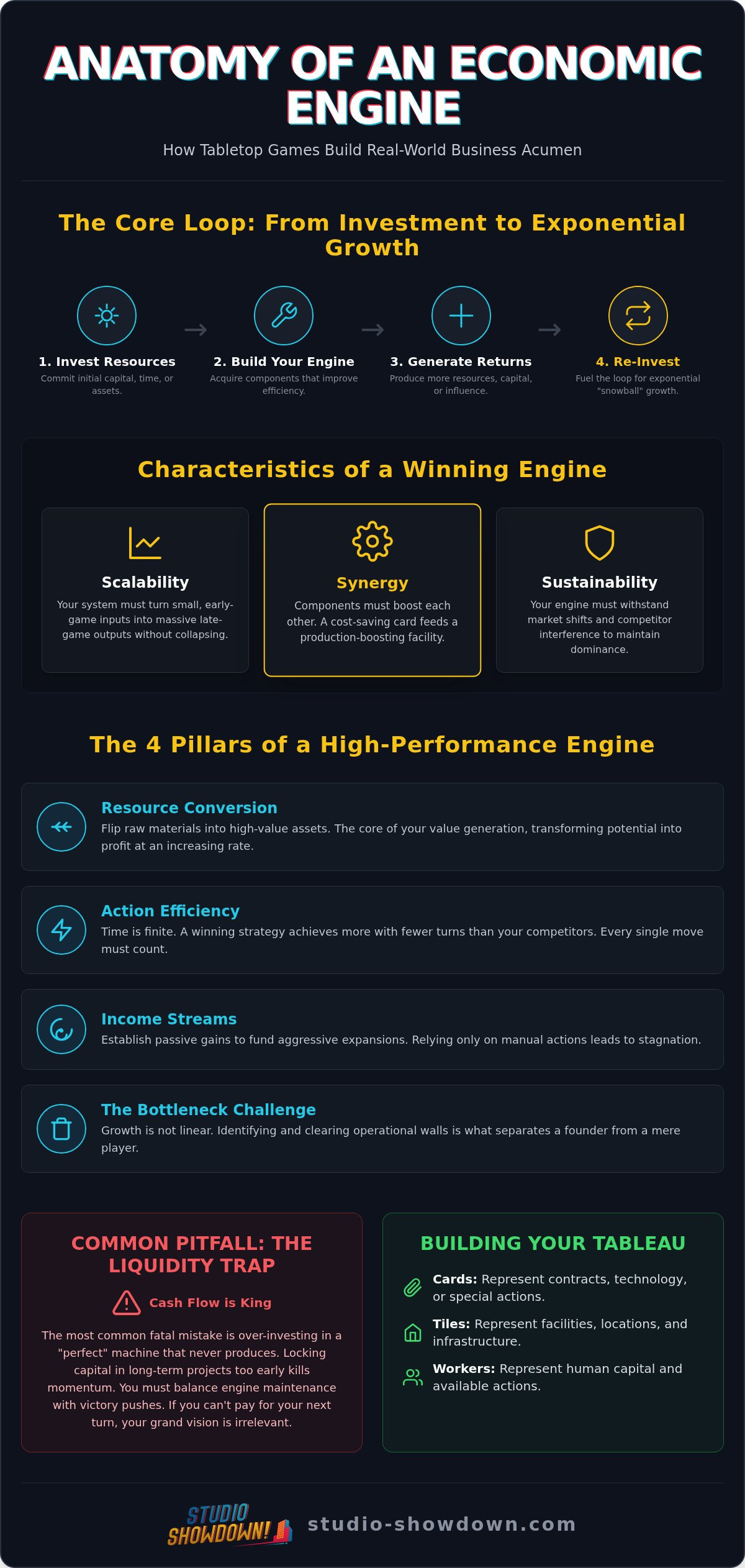
Imagine a machine that generates wealth while you sleep. In the world of tabletop strategy, that machine is your engine. To understand What is an Economic Engine Board Game?, you have to look past the plastic components and colorful boards. It’s a strategy game where players build a system designed to generate increasing resources, capital, or influence over time. You aren’t just playing cards; you’re building an infrastructure. The core loop is simple but lethal: investment today for exponential returns tomorrow. Every decision is a high-stakes trade-off between immediate survival and future dominance.
The “economic” label is what adds the pressure. While some games focus on internal efficiency, economic engine board games force you to interact with shifting markets. You’ll face supply shortages, fluctuating demand, and the constant threat of a rival cornering the market. It’s a simulation of real-world business logic where your growth isn’t guaranteed. The thrill comes from the “snowball effect.” You start with a handful of coins and end with a global empire. That moment when your machine finally clicks into gear is pure creative adrenaline. It’s satisfying. It’s powerful. It’s why we play.
The Evolution of Economic Tabletop Games
Tabletop gaming has moved far beyond simple trading. We’ve seen a massive shift from basic resource exchange to complex, high-stakes business simulations. In 2026, players are demanding more than just abstract victory points. They want realistic industry themes that mirror the modern economy. The current trend favors market dominance as the ultimate win condition. You don’t just want to win; you want to own the industry. This evolution reflects a modern desire for games that teach real entrepreneurship through a lens of artistic production and professional scaling.
Key Characteristics of a Winning Engine
Efficiency is the baseline, but true mastery in economic engine board games requires three things. First, scalability. Your system must turn small, early-game inputs into massive late-game outputs without collapsing. Second, synergy. Your components shouldn’t just exist; they must boost each other. A card that lowers costs must feed directly into a machine that increases production value. Finally, sustainability. A powerful engine is useless if a rival can dismantle it in one turn. You must protect your assets from market shifts and competitor interference to stay on top of the food chain.
The Anatomy of a Powerful Tabletop Engine
A superior engine doesn’t just happen. It’s engineered. In the world of economic engine board games, your success depends on how effectively you transform potential into profit. It’s a game of momentum. You start with friction and end with a machine that hums with efficiency. If you’re just collecting pieces, you’re playing a game of chance. If you’re building a system, you’re playing for market dominance.
Four pillars define a high-performance engine:
- Resource Conversion: Raw materials are dead weight. Your engine must flip them into high-value assets, credits, or influence at an increasing rate.
- Action Efficiency: Time is the only finite resource. A winning strategy means doing more with fewer turns than your competitors. Every move must count.
- Income Streams: Relying on manual actions for every cent is a recipe for stagnation. Establish passive gains to fund aggressive, high-risk expansions.
- The Bottleneck Challenge: Growth is rarely a straight line. You will hit walls. Identifying and clearing these obstacles is what separates a founder from a player.
Mastering these mechanics is exactly what makes games like Studio Showdown so compelling for those with a competitive edge. It’s about more than just numbers. It’s about the rush of a perfectly executed pivot.
Input vs. Output: Managing Your Cash Flow
Liquidity is king. In most economic engine board games, players fail because they lock their capital in long-term projects too early. You need blood in the veins to keep the lights on. If you can’t pay for your next turn, your grand vision is irrelevant. You must balance engine maintenance with victory pushes. Reinvesting is vital, but you have to know when to stop building and start cashing out. Over-investing in a perfect machine that never produces is a common, fatal mistake. Cash flow isn’t just a metric; it’s your survival.
Engine Components: Cards, Tiles, and Workers
Your business infrastructure takes a physical form on the table. Cards represent contracts. Tiles represent facilities. Workers represent your human capital. As you acquire these, you create a tableau. Tableau building is the visual representation of a player’s economic engine. It’s a snapshot of your growing company. Every new component must add synergy, not clutter. If a card doesn’t make your engine faster or your output higher, it’s just visual noise. Build with purpose. Scale with precision.
Economic Strategy vs. Pure Engine Building
Efficiency is a goal, but it isn’t the whole game. To master economic engine board games, you must understand where personal growth ends and market warfare begins. Pure engine builders focus on the internal. You’re fine-tuning a private machine. Think of titles like Splendor. You collect gems to buy cards to get better gems. It’s clean. It’s satisfying. But it’s often lonely. This style frequently falls into the “multiplayer solitaire” trap. You’re sitting at a table with three other people, yet you’re playing a solo game in a shared space. Your engine exists in a vacuum.
Economic strategy games break that vacuum. They introduce external pressure. You aren’t just building a system; you’re manipulating a market. Your success depends on how you handle player interaction and shifting demands. The stakes are higher because your competitors can actually touch your plans. They can drive up prices, snatch resources, or flood the market to devalue your inventory. This distinction is vital for any group looking for a premium, competitive experience. You have to decide if you want to be a quiet architect or a bold industry leader.
Market Dynamics and Player Interaction
True business simulation requires friction. In high-level economic engine board games, blocking and outbidding aren’t just mean moves. They’re essential tactics. They simulate real-world competition where resources are finite. Shared resource pools drive economic tension to a breaking point. If there’s only one top-tier talent available, the bidding war becomes the game’s pulse. Studio Showdown takes this further with its rival studio mechanics. You can’t just look at your own board. You have to anticipate the moves of every other founder at the table. If you don’t react to their growth, you’ve already lost.
Which One Should You Play?
Your choice depends on your group’s competitive vibe. Beginners often prefer low-interaction engine builders. These games offer a safe environment to learn how to snowball resources without the threat of a rival dismantling their work. It’s about the joy of the build. However, aspiring CEOs and seasoned strategists should seek out high-interaction economic strategy games. These titles demand more than just mathematical optimization. They require psychological grit and the ability to pivot under fire. If you want to dive deeper into these mechanics, explore Mastering the Board: The 2026 Guide to Strategy Board Games for a comprehensive look at the best titles for 2026. Pick the style that challenges your ambition.
Tabletop Business Schools: Skills You Learn Through Play
A board game is a low-stakes simulator for high-stakes decisions. When you play economic engine board games, you’re doing more than moving pieces. You’re training your brain to see the world through the lens of a founder. Financial literacy becomes second nature. You start to understand that ROI isn’t just a buzzword; it’s the lifeblood of your operation. You learn to manage debt, calculate risks, and decide exactly when to reinvest your hard-earned capital into the next phase of growth. This isn’t abstract theory. It’s a visceral lesson in capital flow.
Strategic planning takes center stage. You aren’t just thinking about your next move. You’re thinking three turns ahead, mirroring the way a CEO plans for upcoming fiscal quarters. This foresight allows you to anticipate market shifts before they happen. Risk management is about the pivot. In a competitive engine, your original plan will eventually hit a wall. You have to decide: do you double down on a failing strategy or cut your losses to chase a new market? This teaches an invaluable lesson about sunk cost fallacy. You learn to value your future gains more than your past investments.
You also develop the soft skills that define modern leadership. Negotiation and pitching are core pillars of the experience, especially in games like Studio Showdown. You have to convince investors and rivals of your value to secure the resources you need for dominance. In this environment, the social layer is as important as the mechanics. You aren’t just playing against a board; you’re interacting with people. Pitching your studio’s vision to gain an advantage requires clarity and confidence. These are the same skills you’ll use in a real boardroom or a high-pressure production meeting.
The ROI of Board Games in Education
Traditional business education can be dry. Board games offer a “safe failure” environment where the cost of a mistake is a lost game, not a lost company. This hands-on approach is becoming a staple for those building professional portfolios in the creative tech sector. Engaging with economic engine board games bridges the gap between theory and practice. If you’re looking to sharpen these skills, check out The Ultimate Business Board Game: Master Entrepreneurship in 2026 to see how play transforms into professional expertise.
Critical Thinking Under Pressure
The market is a living thing. You must analyze competitor moves to predict where the next shortage will occur. If your primary resource becomes scarce, your engine has to adapt or die. This pressure builds a specific type of mental resilience. Economic games force players to prioritize limited actions for maximum impact. You learn to cut the fluff and focus on what actually moves the needle. Ready to test your founder instincts? Start your journey with Studio Showdown today.
Studio Showdown: The Ultimate Game Dev Economic Engine
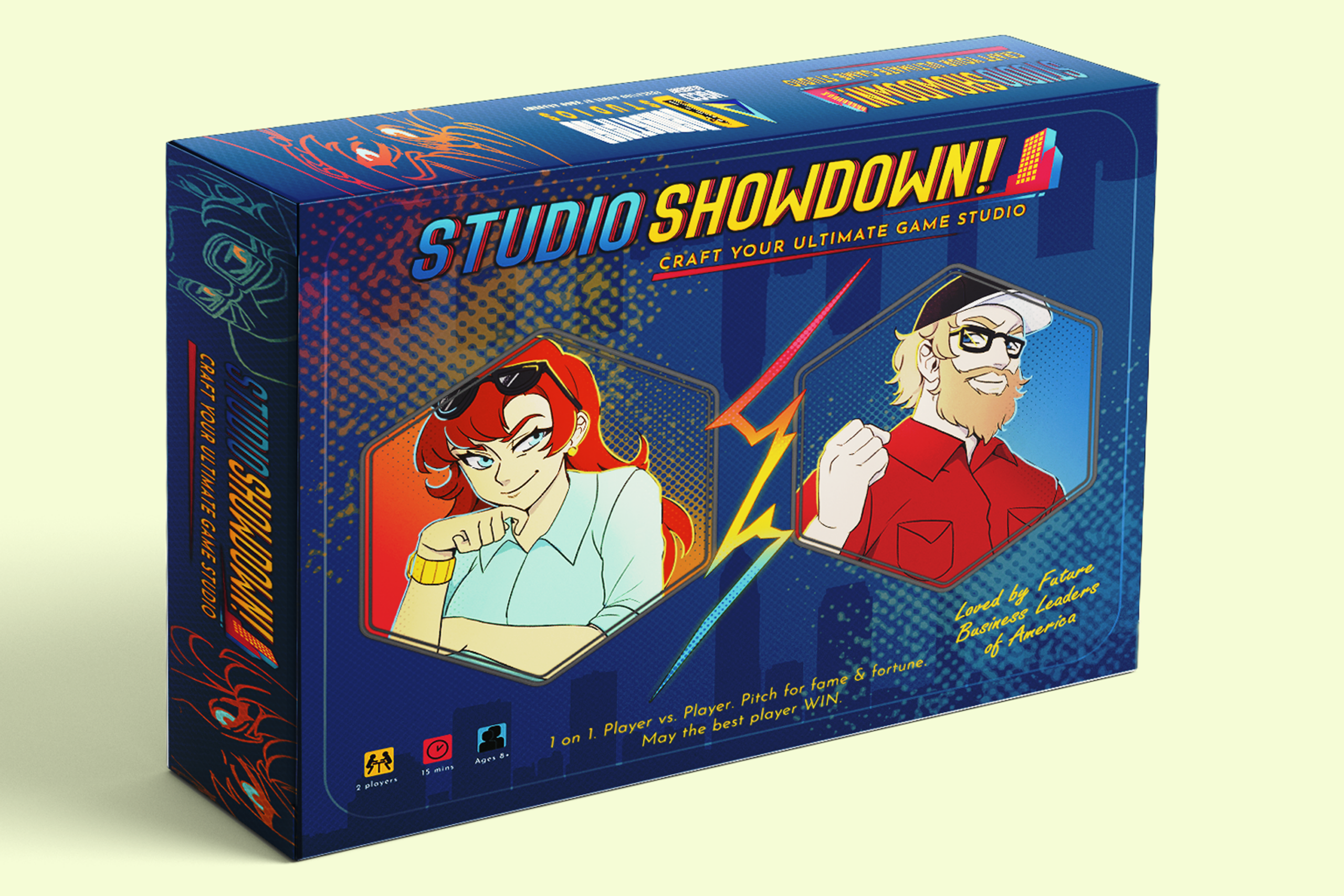
Building a business is a high-stakes performance. Studio Showdown takes the abstract mechanics of economic engine board games and grounds them in the gritty, fast-paced world of video game development. You don’t just win by collecting points; you win by owning the market. As a Studio Founder, you’ll experience the adrenaline of a successful pitch and the tension of a rival studio snatching your top talent. It’s a masterclass in scaling. You’ll manage development cycles, clear production bottlenecks, and reinvest capital to stay ahead of the curve. This is the definitive engine for the modern creator who values both artistic courage and professional precision.
The game forces you to adopt a true founder’s mindset. Every turn requires a balance between long-term infrastructure and immediate liquidity. If you over-invest in a project that the market doesn’t want, your studio will stall. If you play it too safe, your rivals will outpace your growth. This dynamic interaction creates a lüktető, competitive atmosphere that mirrors the real-world creative tech sector. It’s about more than just resource management. It’s about the strategic bravery required to dominate a crowded industry.
Fundraising and Pitching: Beyond the Board
Success in the game dev world depends on your ability to secure resources. Studio Showdown simulates the brutal reality of securing venture capital and the constant pressure of hit-making. It’s about the struggle to turn a creative spark into a commercial success. The Studio Showdown: Educator Edition brings this professional acumen directly into the classroom. It allows students to build portfolios and understand the economic foundations of the industry they love. You aren’t just playing; you’re rehearsing for the challenges of a real-world startup. It bridges the gap between tabletop theory and professional practice.
Start Your Studio Today
In a world dominated by digital noise, screen-free strategy offers a tactical edge. It forces you to look your competitors in the eye and react to their moves in real time. You can integrate the Studio Showdown Board Game into your next high-stakes game night or use the Classroom Bundle to transform your curriculum into a production studio. The goal is simple: build a system that dominates the visual and economic landscape. Don’t settle for a simple game when you can build an empire. Build your empire with the Studio Showdown Board Game and prove your founder instincts today.
Master the Art of the Scale
You’ve seen how the right system turns a small spark into an industry giant. Mastering economic engine board games isn’t just about winning a round; it’s about training your brain for the high-pressure world of creative tech. You now know that true scalability requires more than just internal efficiency. It demands market awareness, strategic risk-taking, and the ability to pivot when resources get tight. These games provide the safe failure environment you need to sharpen your instincts before the stakes become real.
Designed by industry veterans at DEMYSTIFIED Studios and used by VGCD Academy for professional training, Studio Showdown is the definitive tool for this journey. You’ll master real-world pitching and fundraising while outmaneuvering rivals in a race for market dominance. This isn’t just play. It’s a rehearsal for your future as a founder. It’s time to take your entrepreneurial edge out of the classroom and onto the table. Dominate the market, order Studio Showdown today! The market is waiting for its next leader. Grab your seat at the table, build your system, and start scaling.
Frequently Asked Questions
What is the difference between engine building and worker placement?
Engine building focuses on creating a permanent system of improvements that increases your output over time. Worker placement is a specific mechanism for selecting actions by placing limited tokens on board spaces. Many economic engine board games use worker placement as the primary way to acquire the components needed to build their system. One is about the system’s growth; the other is about the method of resource acquisition.
Are economic board games good for teaching financial literacy to teens?
Yes, they provide a safe and interactive environment to practice complex financial concepts without real-world risk. Teens learn about return on investment, capital allocation, and the consequences of debt through direct play. By managing a simulated business, they develop a visceral understanding of how money moves and grows. It’s a premium educational experience that replaces dry lectures with competitive, high-stakes decision-making and creative problem-solving.
Can I play economic engine games solo?
Many modern strategy titles include dedicated solo modes or automa systems that simulate a rival’s moves. These modes allow you to test your efficiency and optimize your system’s output without needing a full group. While the social negotiation layer is lost, the mathematical challenge of building a high-output engine remains intact. It’s a great way to master a game’s logic before bringing it to a competitive table.
How long does a typical economic strategy game take to play?
Playtimes vary, but most mid-to-heavy strategy games range from 90 to 180 minutes. The duration often depends on the complexity of the market mechanics and the number of players involved. Faster engine builders might finish in 45 minutes, while deep simulations of industrial growth require a full evening. Always check the box for a specific estimate, as scaling a massive business infrastructure naturally takes time to execute.
What are some of the best economic board games for beginners in 2026?
Start with games that have clear resource loops and low player interference. Titles like Wingspan or Splendor offer a gentle introduction to snowballing assets. For those ready for a slightly higher challenge, Power Grid: Recharged Edition provides a fantastic look at market demand and infrastructure scaling. These games build the foundational skills needed to master more aggressive, high-stakes economic engine board games in the future.
How does Studio Showdown differ from classic business games like Monopoly?
Studio Showdown replaces luck-based movement with strategic, founder-driven decision-making. Unlike classic games that rely on dice rolls, this experience focuses on fundraising, pitching, and production management. You aren’t just collecting rent; you’re building a sustainable game development studio from the ground up. It’s a modern simulation designed by industry veterans to teach real entrepreneurship through a lens of artistic excellence and professional scaling.
Do I need business experience to enjoy an economic engine game?
No, the game mechanics are designed to teach you the underlying logic as you play. You’ll naturally pick up concepts like supply and demand or asset synergy through the trial and error of each turn. While a background in finance might give you a slight early-game edge, the most successful players are those who can adapt their strategy to the board’s current state and outmaneuver their rivals.
Are there classroom-specific versions of business board games?
Yes, several publishers offer editions tailored for educational environments. For example, the Studio Showdown: Educator Edition and the Classroom Bundle are specifically designed to teach entrepreneurship and pitching in schools. These versions often include supplemental materials to help instructors link game mechanics to real-world business portfolios. They turn the classroom into a high-energy production studio where students learn the art of the scale by doing.