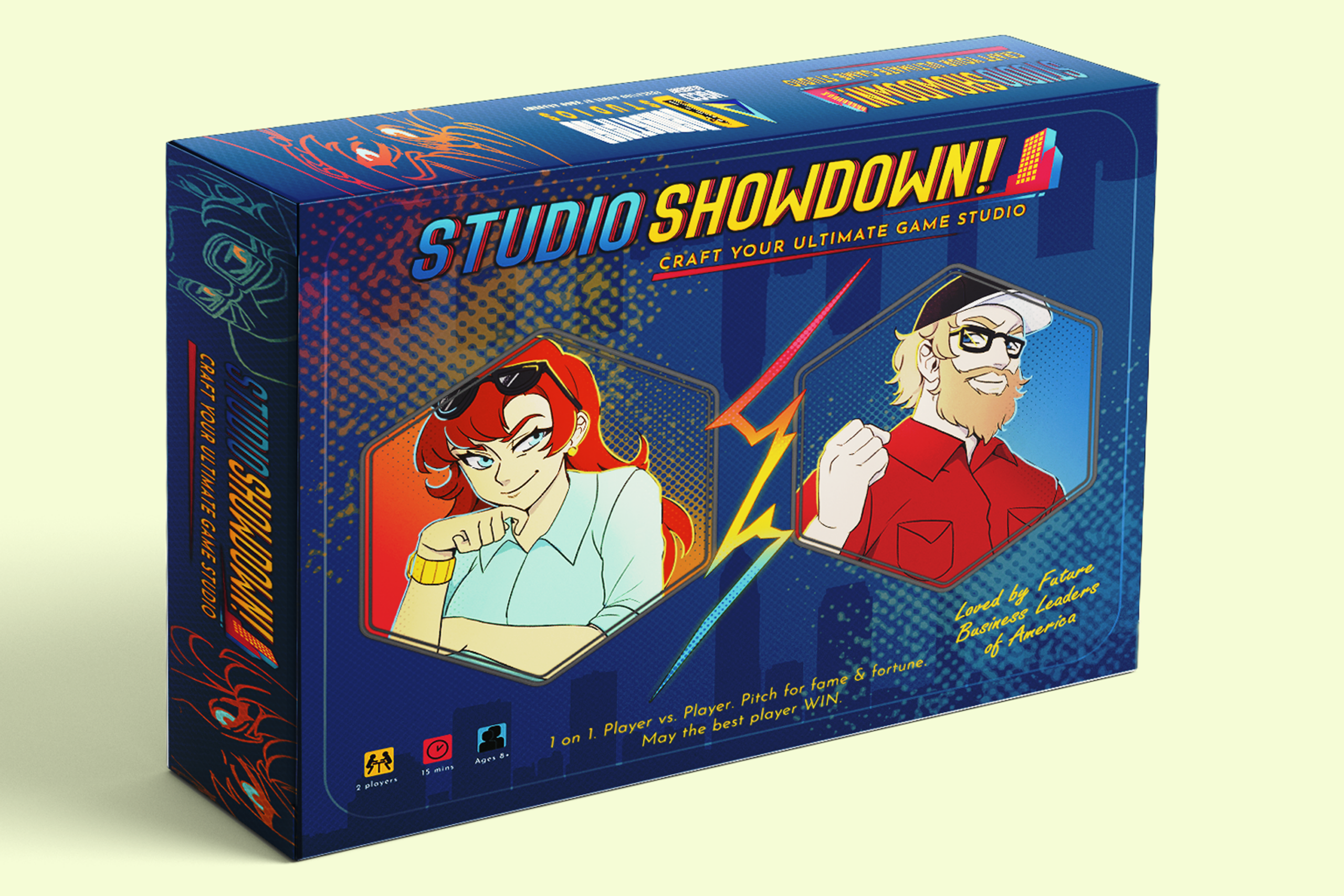
With 90% of startups destined to fail, the traditional business textbook isn’t just outdated; it’s a liability. You’ve seen the glassy-eyed stare of students trapped in a lecture about market theory. They don’t want definitions. They want to build, compete, and win. Designing a modern curriculum for entrepreneurship class requires a shift from passive observation to high-stakes simulation. It’s about trading the slide deck for a tactical arena where students can test their grit without losing their capital.
We understand the pressure to meet rigorous standards while keeping the classroom vibe electric. You need tools that bridge the gap between theory and the 2026 market reality. This article reveals how to build a high-engagement entrepreneurship curriculum that masters 21st-century business skills through immersive game-based learning. We’ll break down the turnkey solutions that drive measurable growth in financial literacy and strategic thinking, ensuring your students don’t just learn about business; they master the art of the showdown.
Key Takeaways
- Master the five core pillars of modern business education, focusing on identifying market gaps and managing real-world burn rates.
- Learn to build a high-engagement curriculum for entrepreneurship class that swaps dry theory for high-stakes business simulations.
- Discover why video game development provides the ultimate sandbox for teaching complex strategy and technical execution to Gen Z.
- Boost student retention to 90% by integrating analog game-based learning that prioritizes collaboration over passive screen time.
- Get a turnkey implementation guide for running a four-week “Studio Sprint” using the Studio Showdown: Educator Edition.
The New Era of Entrepreneurship Education: Beyond the Textbook
Textbooks are relics. In 2026, the market doesn’t care what you know; it cares what you can execute. Passive learning is a trap. It creates a false sense of security that vanishes the moment a real competitor enters the frame. A modern curriculum for entrepreneurship class must prioritize active simulation over rote memorization. Students need to feel the heat of a burn rate, not just read a definition of it. They need to navigate the chaos of a shifting market in real time to develop true professional intuition.
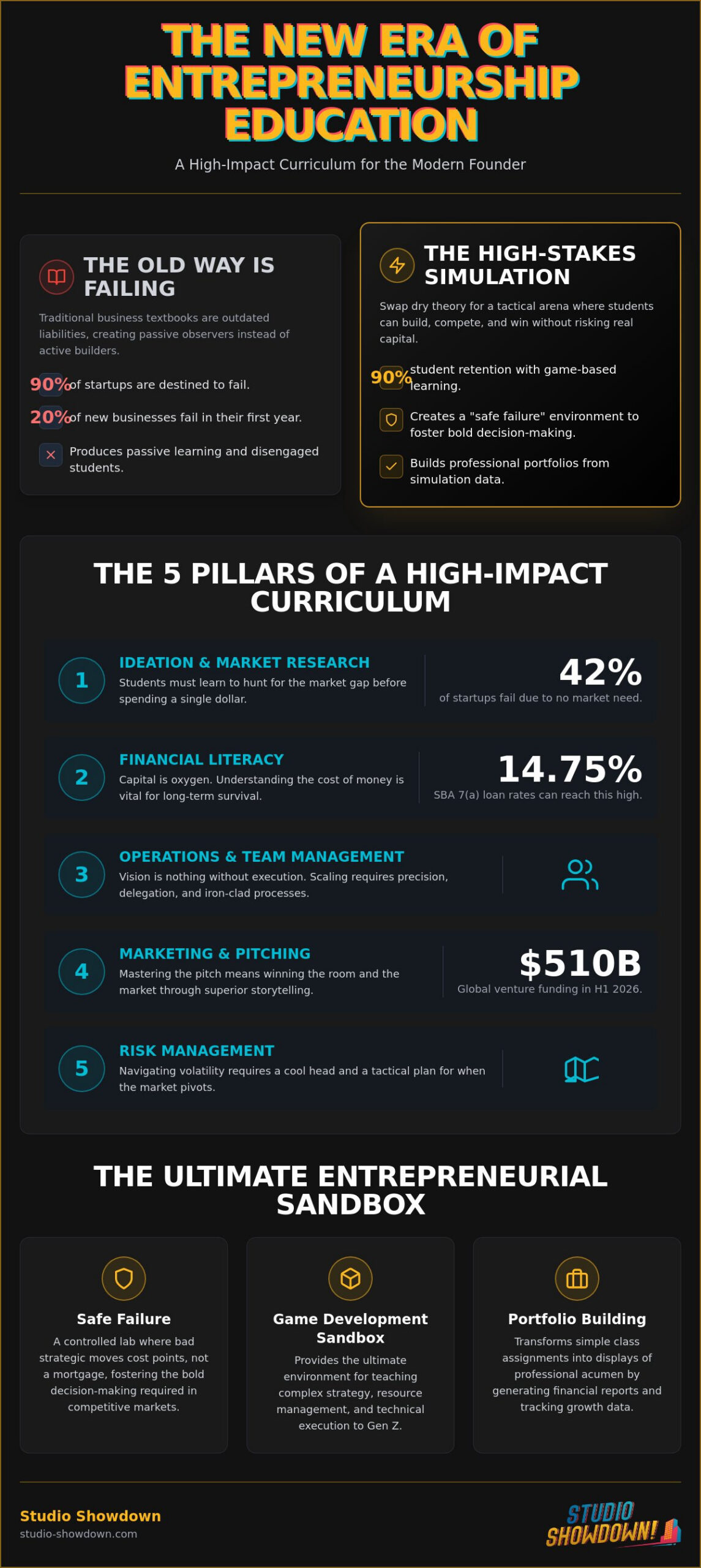
Failure is the best teacher, but in the real world, it’s expensive. In 2026, startup failure rates remain high, with roughly 20% of new businesses failing within their first year. The classroom must be a laboratory for “safe failure.” We provide a controlled environment where a bad strategic move costs points, not a mortgage. This psychological safety net allows students to take risks. It fosters the bold decision-making required in a competitive market arena. When the stakes are simulated, the learning is authentic and the lessons stick.
The Shift from Theory to Tactical Execution
Memorizing “equity” or “ROI” is useless without context. Modern students demand immediate feedback loops. They want to see how a marketing spend affects their bottom line in real time. A high-engagement curriculum for entrepreneurship class replaces static lectures with dynamic systems. To bridge this gap, educators are turning to The Ultimate Business Board Game. It’s tactical. It’s fast. It forces students to move beyond “easy money” concepts into the grit of complex strategic choices. This isn’t about getting the “right” answer on a quiz. It’s about surviving a market crash or outmaneuvering a rival studio in a head-to-head showdown.
Building Professional Portfolios through Classwork
Class projects shouldn’t end in a recycling bin. They should live in a portfolio. By using simulation data, students learn to generate actual financial reports. They track growth. They analyze losses. This data-driven approach transforms a simple assignment into a display of professional acumen. Competition fuels this process. When students compete in a high-pressure environment, they stop being pupils and start identifying as founders. They develop the grit, resilience, and vision that define visual success in the modern economy. They learn that every decision has a ripple effect. This level of complexity prepares them for a world where AI and rapid innovation are the baseline, not the exception.
The 5 Core Pillars of a High-Impact Entrepreneurship Curriculum
A curriculum is a blueprint for survival. In 2026, teaching business isn’t about theory; it’s about tactical dominance. Every high-engagement curriculum for entrepreneurship class must stand on five non-negotiable pillars. These aren’t just topics. They’re survival skills for a market that shows no mercy. If your syllabus lacks these, you aren’t preparing founders. You’re preparing spectators.
- Ideation and Market Research: Data proves 42% of startups fail because there’s no market need. Students must learn to hunt for the gap before they spend a single dollar.
- Financial Literacy: Capital is oxygen. With SBA 7(a) loan fixed rates reaching up to 14.75% in July 2026, understanding the cost of money is vital for long-term survival.
- Operations and Team Management: Vision is nothing without execution. Scaling a studio requires precision, delegation, and iron-clad processes that can withstand growth.
- Marketing and Pitching: You don’t just sell; you outmaneuver. Mastering the pitch means winning the room and the market through superior storytelling and value.
- Risk Management: The “Founder’s Dilemma” is a constant threat. Navigating volatility requires a cool head and a tactical backup plan for when the market pivots.
Mastering the Art of the Pitch
Communication is a weapon. In a simulated market showdown, students must learn to articulate value while the clock is ticking. Fundraising isn’t a polite request; it’s a strategic negotiation. The Pitch Deck becomes the most critical document in a student’s arsenal. It’s the visual proof of their strategic vision. By forcing students to pitch under pressure, you prepare them for the record-breaking global venture funding landscape. Global funding reached $510 billion in the first half of 2026. To help students navigate these evolving capital markets, you can discover STO Foundation and its role in compliant tokenized offerings. They need to stand out in the noise or get left behind.
Financial Literacy in the Trenches
Forget basic accounting. We need strategic investment. Students must grasp why a 9.0% APR on a variable rate loan might be a death trap or a growth engine. They need to weigh the long-term cost of equity against the immediate burden of debt. Burn rate is the monthly speed at which a startup studio spends its available capital before reaching profitability. Mastering this metric is the difference between a successful launch and a quiet exit. To see these pillars in action, educators are integrating tools like the Studio Showdown Board Game to give students a tactile sense of financial stakes.
Why Video Game Development is the Ultimate Entrepreneurial Sandbox
Forget the cliché garage startup story. In 2026, the $200B+ gaming industry is the most potent hook for Gen Z and Gen Alpha. It’s not just about entertainment. It’s a high-stakes arena where art, technology, and business collide. A modern curriculum for entrepreneurship class needs a context that resonates. Game development provides that. It mirrors the startup journey perfectly. You have a vision. You build a prototype. You face technical debt. You fight for market share. It’s a relentless cycle of innovation and survival. This isn’t theoretical. It’s tactical.
The complexity of running a studio forces students to balance competing interests. They can’t just focus on the “fun” parts. They must manage the business backend. They learn to allocate limited resources between art assets and engine stability. This multidisciplinary approach is exactly what the modern economy demands. It’s a perfect model for startup culture. It rewards bold moves and punishes hesitation. By using this sandbox, you prepare students for a world where the lines between technology and commerce have completely blurred.
Understanding this balance is crucial, whether a student is developing a digital game or an artisan is preparing for a premier event like the Art and Craft Expo, where business strategy meets creative execution.
From Player to Founder: The Engagement Hook
Students already speak the language of gaming. We leverage that interest to teach hard business skills. A game studio is a complex ecosystem. It requires STEM precision and creative flair. When you integrate this into a curriculum for entrepreneurship class, you turn players into founders. They learn that a great game fails without a solid monetization strategy. They realize that technical brilliance means nothing without a launch window. While digital tools are everywhere, strategy board games remain the best analog for this process. They strip away the screen and force students to confront the core mechanics of business strategy face-to-face. It’s about the showdown, not the software.
Navigating Market Volatility
The gaming market is brutal. It’s volatile. Innovation moves at a breakneck pace. With over 60% of new entrepreneurs in 2026 planning to use AI, students must learn to integrate automation into their production pipeline without losing their creative soul. In our simulation, we replicate “crunch time” and resource management. Students must decide. Do they polish the art or fix the bugs? Do they launch now or wait for a quieter window? They respond to rival studio launches in real time. We teach resilience through “Game Over” scenarios. Failure in the classroom is a data point, not a disaster. This mirrors real-world studio challenges. Students learn to pivot when a rival drops a blockbuster. They learn to manage burn rates when development stalls. It’s about tactical endurance.
Gamification: Moving Beyond Textbooks with Business Simulations
Reading about a market crash isn’t the same as losing your virtual shirt in a boardroom showdown. The data is clear. We retain roughly 10% of what we read but 90% of what we “do” in a simulated environment. Textbooks are static. Markets are alive. A high-engagement curriculum for entrepreneurship class must bridge this gap by using rigorous game mechanics. This isn’t about distraction. It’s about immersion. When students are locked in a competitive loop, the theory becomes tactical. They stop asking “Why do I need to know this?” and start asking “How do I win?”
Structuring a semester around a recurring simulation creates a cohesive narrative. Instead of fragmented lessons on marketing or finance, students experience the full business lifecycle. They see how a bad production choice in week three creates a cash flow crisis in week seven. This unified “story” of a business is what traditional lesson plans miss. It forces students to live with their decisions. It rewards strategic foresight and punishes reckless spending. The fun is a byproduct of the challenge, not a replacement for the rigor.
The Power of the Analog Arena
Screens are everywhere, but the best business negotiations happen face-to-face. Analog simulations, like board games, force students to look each other in the eye. They can’t hide behind an avatar. They have to read the room. They have to negotiate, pivot, and bluff in real time. This develops social-emotional skills that digital tools often ignore. Integrating screen-free activities into the classroom isn’t just about reducing eye strain. It’s about fostering authentic human collaboration. It’s about the grit of the physical showdown.
Comparison: Traditional Curriculum vs. Simulation-Based Learning
| Feature | Traditional Model | Simulation Model |
|---|---|---|
| Student Engagement | Passive / Lecture-heavy | Active / High-stakes |
| Knowledge Retention | 10-20% (Rote memory) | 90% (Experiential) |
| Concept Integration | Fragmented / Topic-by-topic | Unified / Full lifecycle |
| Feedback Loop | Delayed (Graded tests) | Immediate (Market response) |
The “fun vs. learning” objection vanishes when the mechanics are deep. If the game is too easy, students get bored. If it’s too hard, they quit. The sweet spot is a system where strategy wins over easy money every time. You want your students to struggle. You want them to sweat the details of a contract. That’s where the real learning happens. To transform your classroom into a high-performance business hub, start by deploying the Studio Showdown Board Game as your central simulation engine.
Deploying the Showdown: Classroom Implementation and Assessment
Implementation is where vision meets the floor. You’ve seen the theory. You’ve understood the pillars. Now, you need a tactical roadmap to turn your curriculum for entrepreneurship class into a high-performance engine. Integrating the Studio Showdown: Educator Edition isn’t about replacing your syllabus. It’s about supercharging it. This tool provides the precise framework students need to apply every concept in a high-stakes environment. It moves the needle from “knowing” to “executing.”
The most effective way to deploy this is through a 4-week “Studio Sprint.” This structure mirrors the rapid innovation cycles of the 2026 tech market. It keeps the energy high and the stakes visible.
- Week 1: The Launchpad. Students form studios, identify market gaps, and secure initial funding.
- Week 2: The Production Grind. Teams manage burn rates and allocate resources between art and tech assets.
- Week 3: Market Shock. Introduce volatility. Force students to pivot in response to rival studio moves.
- Week 4: The Final Showdown. Studios pitch their final results and face off in the market arena.
The Educator’s Playbook
Your classroom layout matters. To maximize collaboration, set up the “Arena” with clusters that encourage face-to-face negotiation. You aren’t just a teacher; you’re a facilitator of a high-stakes simulation. Facilitating post-game reflections is where the learning cements. Ask them why they failed. Ask them why a rival won. You can customize the game rules to fit specific standards. If you’re teaching STEM, focus on the technical debt mechanics. For business classes, prioritize the fundraising and equity negotiations. This flexibility ensures you meet institutional standards without sacrificing the competitive edge.
Measuring Success and ROI
Traditional grading fails entrepreneurship. Standardized tests don’t measure strategic intuition or leadership. Your assessment framework must reward the strategy, not just the win. A student might lose their capital but demonstrate flawless risk assessment and financial logic. Grade them on their ability to justify their pivots. Track their progress in financial literacy through their studio’s reporting. Use the game as a capstone project. It’s the ultimate visual proof of their growth and founder identity. When you’re ready to scale this across multiple sections or an entire institution, the Classroom Bundle provides the turnkey solution you need. Stop lecturing. Start building. Invest in your students with a Classroom Bundle and watch them master the market.
Master the Market Arena
The era of passive business education is over. To prepare founders for the 2026 economy, your classroom must become a high-stakes simulation of tactical decision-making and strategic grit. By integrating the five core pillars and leveraging the multidisciplinary complexity of game development, you move beyond theory. You create a space where failure is a data point and success is earned through professional intuition. Building a modern curriculum for entrepreneurship class isn’t just about meeting standards. It’s about giving students the tools to survive and win in a relentless market.
We’ve done the heavy lifting for you. Developed by VGCD Academy and DEMYSTIFIED Studios, our tools bridge the gap between academic theory and real-world execution. We offer specialized pricing for schools and libraries. Professional development workshops are also available to help you master the mechanics. It’s time to elevate your teaching. Order the Studio Showdown: Educator Edition for your classroom today and transform your students into tactical founders. The showdown starts now. Let’s build something extraordinary together.
Frequently Asked Questions
How does an entrepreneurship curriculum meet state standards?
Modern simulations align with state requirements by integrating core benchmarks into active gameplay. Most state standards for a curriculum for entrepreneurship class focus on financial literacy, marketing, and management. By mapping mechanics like resource allocation and market analysis to these specific benchmarks, educators satisfy administrative needs while keeping engagement high. It turns dry compliance into a tactical challenge that students actually want to win.
Can a board game really teach high-level business concepts like fundraising?
Yes, because it forces students to negotiate and justify their strategy under pressure. Fundraising in a simulation isn’t just about luck; it’s about convincing the system or “investors” that your studio has a viable path to profit. This mirrors the real-world process where founders must articulate value to secure capital. It’s a hands-on showdown that traditional lectures simply can’t replicate. The stakes feel real, so the lessons stick.
What is the ideal age group for a game-based entrepreneurship curriculum?
This curriculum is designed primarily for high school and early college students. These age groups have the cognitive maturity to handle complex variables like burn rates and equity while remaining highly receptive to gamified learning. It’s the perfect window to foster a founder identity before they enter the professional market. Gen Z and Gen Alpha find the game development theme particularly relatable and engaging.
How much classroom time is required to implement a business simulation?
Implementation is flexible, ranging from a one-week intensive sprint to a full semester integration. A standard 4-week “Studio Sprint” allows for deep immersion without overwhelming your existing syllabus. Each session can be tailored to fit 45 to 90 minute blocks. This modularity ensures that the curriculum for entrepreneurship class stays fast-paced and goal-oriented. It matches the lashing rhythm of the creative industry.
Do I need prior business experience to teach this curriculum?
No, the Studio Showdown: Educator Edition is built to act as your co-pilot. It includes comprehensive guides and lesson plans that bridge any knowledge gaps. You don’t need to be a venture capitalist to lead the showdown. The system provides the professional framework, allowing you to focus on facilitating student breakthroughs and managing the classroom arena effectively. We provide the map; you lead the expedition.
How do you grade students based on a competitive game performance?
Assessment focuses on strategic logic and data-driven pivots rather than just the final score. You grade their ability to analyze market shifts and justify their resource allocation. A student who loses their virtual studio but provides a flawless post-mortem analysis of their burn rate has mastered the core objectives. It’s about professional growth and measurable strategic thinking. Success is measured by the quality of the struggle.
What are the benefits of analog board games over digital business simulations?
Analog games foster face-to-face negotiation and social-emotional skills that digital platforms often miss. They strip away the screen and force students to read the room. This direct human interaction is where true business deals are made. It’s a screen-free environment that prioritizes collaboration and authentic communication. These are vital skills for any founder navigating the volatility of the 2026 market.
How does the Studio Showdown: Educator Edition differ from the standard game?
The Educator Edition includes specialized rubrics, lesson plans, and assessment frameworks designed for institutional use. It’s built to turn a competitive game into a measurable learning outcome. While the core showdown mechanics remain the same, the Educator Edition provides the pedagogical backbone needed to satisfy standards and track student progress. It’s a turnkey solution for teachers who demand professional results and high engagement.