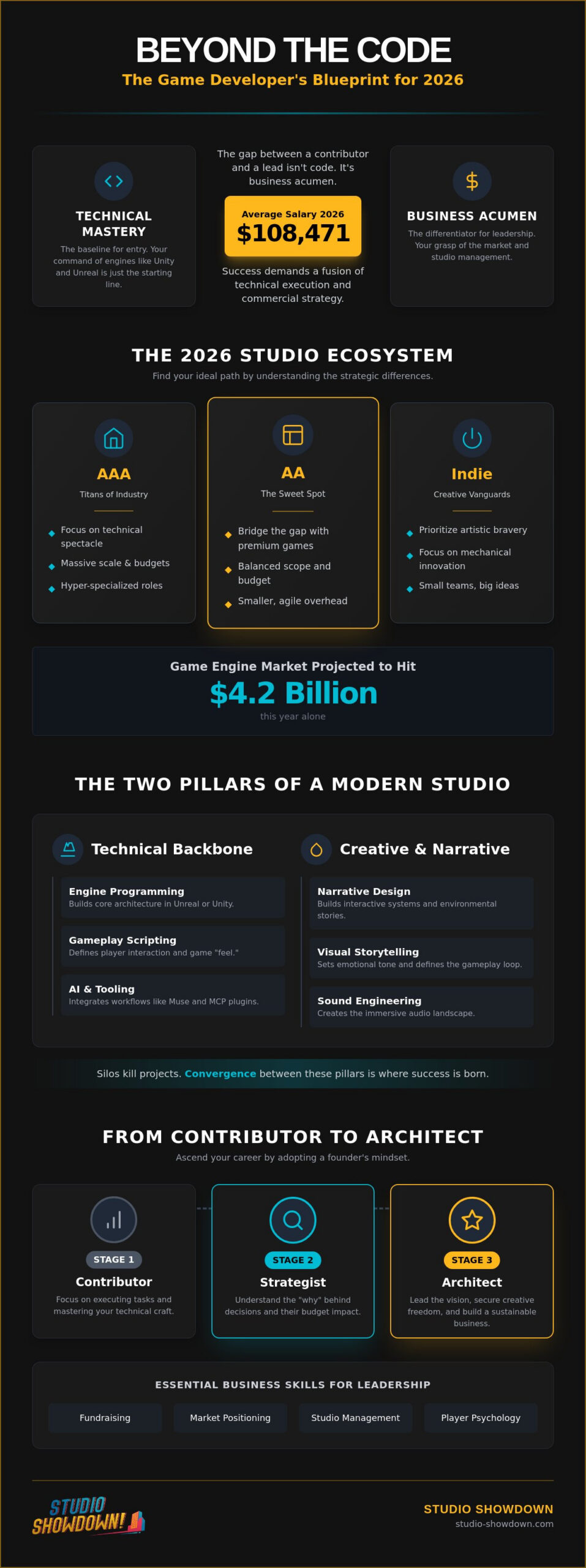
What if your technical mastery is the very ceiling holding your gaming career back? In 2026, the average developer salary has climbed to $108,471, yet the gap between a high-paid lead and a struggling freelancer isn’t just about mastering Unity 6. It’s about your grasp of business skills for game developers. You’ve likely felt the pressure. The entry-level market is a battlefield. Technical skills are the baseline. They aren’t the finish line. Just playing games won’t cut it anymore.
We understand the grind. You want to see the board, not just the pieces. This guide provides a strategic map of the modern industry landscape. You’ll discover how to balance artistic bravery with the cold logic of studio management. We’ll break down the distinction between creative and business paths; identify the roles that actually matter in 2026; and provide actionable steps to build a portfolio that commands respect. It’s time to stop executing and start leading. Let’s build your empire.
Key Takeaways
- Navigate the 2026 ecosystem: Understand the strategic differences between AAA, Indie, and AA studios to find your ideal career path.
- Bridge the divide: Learn how technical execution and creative vision must converge to create premium, market-ready gaming experiences.
- Lead the charge: Master the business skills for game developers required to transition from a technical contributor to a strategic studio leader.
- Build a winning portfolio: Follow a clear framework to showcase project-based problem-solving that captures the attention of elite recruiters.
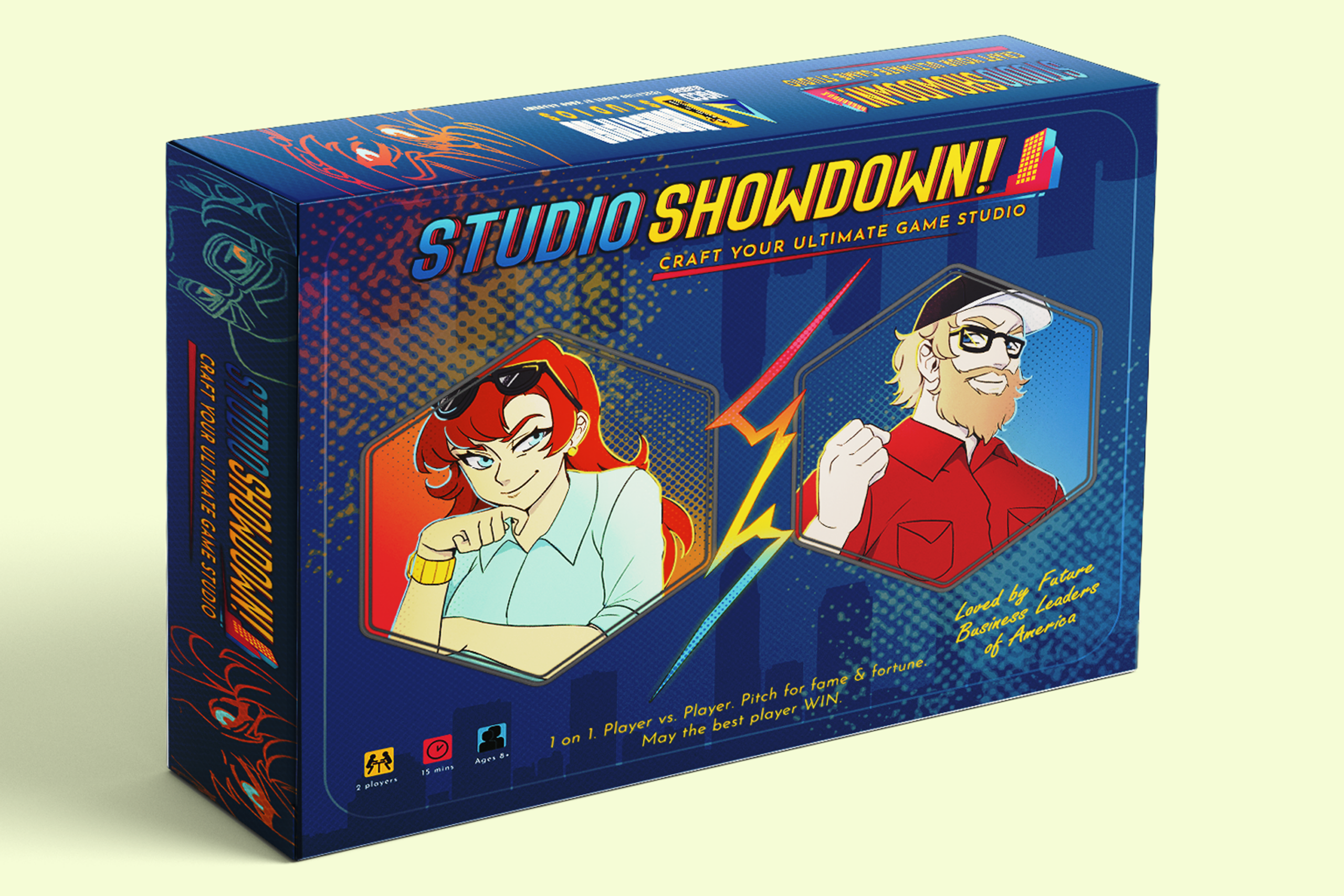
- Train for battle: Discover how analog strategy simulations like Studio Showdown prepare you for the high-stakes world of fundraising and studio management.
Navigating the 2026 Video Game Industry Landscape
The modern landscape of the video game industry isn’t a monolith. It’s a high-velocity ecosystem. In 2026, the lines between AAA titans, agile Indie outfits, and the mid-tier AA studios have blurred. AAA studios focus on technical spectacle and massive scale. Indie teams prioritize artistic bravery and mechanical innovation. AA studios bridge the gap, delivering premium experiences without the thousand-person overhead. This industry is no longer just a hobbyist’s playground. It’s a global economic powerhouse. With the game engine market projected to hit $4.2 billion this year, the stakes are astronomical. Success requires more than just a passion for play. It demands a fusion of technical execution, artistic vision, and sharp commercial strategy.
Development is now borderless. Remote-first workflows are the standard. Teams are global. Collaboration happens across time zones. This shift has democratized production but intensified competition. You aren’t just competing with the studio down the street. You’re competing with the world. Standing out requires a level of professionalism that transcends code.
The Evolution of Game Development Roles
The days of the generalist are fading in the major leagues. Roles have hyper-specialized. A Technical Artist is no longer a luxury; they are the vital bridge between code and canvas. We’ve seen the explosive rise of Live Ops and Community Management as core development pillars. These roles ensure a game survives long after the initial launch. In the 2026 indie scene, the Full-Stack Developer is a Swiss Army knife capable of handling everything from shader optimization to backend server architecture within a single sprint.
Why a Studio Founder Mindset Matters
Every creative choice has a financial ripple. If you want to survive, you need business skills for game developers. It’s not enough to build a beautiful level. You must understand why that level matters to the player and how it impacts the production budget. Modern developers must analyze player psychology and market trends with the same precision they apply to debugging code. Developing business skills for game developers is the differentiator between a hobbyist and a professional who understands the bottom line.
Possessing business acumen isn’t about selling out. It’s about securing your creative freedom. When you understand fundraising, market positioning, and studio management, you stop being a cog in the machine. You become the architect of the machine. This founder mindset allows you to see the visual success beyond the code. It ensures your project rises above the noise of a crowded market. You don’t just make games; you build a sustainable career.
Creative and Technical Pillars: Beyond Just Coding
A game is a complex machine. It’s not just a collection of assets. It’s a symphony of systems. While code provides the foundation, the creative pillars provide the soul. In 2026, the technical and artistic departments must move in perfect sync. Silos are the enemy. They lead to development hell. They waste budgets. They kill projects. Success requires a deep understanding of essential skills for a career in game development, where technical prowess meets collaborative intuition.
The convergence of these departments is where the magic happens. It’s also where the most friction occurs. Modern production requires every team member to look beyond their specific task. You aren’t just “doing art” or “writing code.” You’re building an experience. This requires a level of professional maturity that transcends technical talent. It’s about knowing how your work impacts the person sitting across the digital office from you.
The Technical Backbone: Engineering and Systems
Technical execution is split between the invisible and the interactive. Engine programmers build the core architecture. They optimize for Unreal Engine 5.8 or Unity 6. Gameplay scripters define how the world reacts to the player. They create the “feel.” In 2026, AI workflows have changed the game. Tools like Muse or the MCP plugin for Unreal connect models directly to your project. Technical artists have become the industry’s most valuable players. They speak both languages. They ensure that high-end visuals don’t tank the frame rate. They are the ultimate bridges in the production pipeline.
Visual and Narrative Storytelling
Narrative design is more than writing scripts. It’s about building interactive systems. It’s about environmental storytelling where a bloodstain or a discarded note tells a thousand words. Artists don’t just paint textures. They define the gameplay loop. Concept art sets the emotional tone. Sound engineering provides the tactile feedback. Every footstep and every ambient hum must serve the player’s journey. Narrative and art are mechanics, not just decoration. They guide the player’s eye and reward their curiosity.
UX and UI designers are the final gatekeepers. They ensure the player doesn’t fight the interface. A great game with a bad UI is a failure. This is why business skills for game developers are critical even in creative roles. You must communicate your vision across departments. You need to justify your design choices within the project’s scope. If you want to practice these high-stakes decisions without risking a multi-million dollar budget, exploring a simulation like the Studio Showdown Board Game can sharpen your strategic instincts. Balancing these pillars is a battle. Only those who master the full spectrum win.
The Business of Games: Entrepreneurship and Studio Leadership
Great games die in silence every day. It isn’t always because the code was buggy or the art was lackluster. They die because the business logic failed. In the 2026 market, being a brilliant creator is only half the battle. The other half is won through business skills for game developers. Producers and Product Managers are the unsung heroes who keep the lights on. They aren’t just “suits” in a creative space. They are the tactical navigators who ensure a project actually reaches the finish line without burning through its entire runway.
Launching an independent studio is an act of professional bravery. It requires moving from a contributor mindset to a founder mindset. You’re no longer just responsible for a single mechanic. You’re responsible for payroll, marketing, and long-term sustainability. This entrepreneurial spirit is common across the sector, from software development to specialized services like Arcade Fundi, which provides arcade entertainment equipment for events and venues. Financial literacy is the secret weapon here. If you don’t understand your burn rate or your cost per acquisition, you’re flying blind. Successful founders treat their studio as a product in itself. They optimize the process as much as the game.
Fundraising and Pitching for Developers
The pitch-to-profit cycle is a high-stakes gauntlet. Whether you’re chasing Venture Capital or seeking Angel Investors, your pitch deck must be bulletproof. It shouldn’t just showcase pretty concept art. It needs to demonstrate financial viability. Investors want to see that you understand the market and have a plan for return on investment. This is where many creators stumble. They lead with passion but forget the math. Many professionals now use strategy board games to simulate these high-pressure business environments. These analog tools allow you to practice fundraising and resource management in a consequence-free setting before you step into the boardroom.
Project Management and Production
Creativity needs a container. Without structure, projects drift into development hell. Agile and Scrum methodologies are the standards for a reason. They provide the rhythm for the production cycle. Managing feature creep is perhaps the hardest part of studio leadership. Every “cool new idea” has a cost. Producers must bridge the gap between creative vision and investor expectations. They make the hard calls. They cut features to save the project. They keep the team focused on the core loop. Mastering these business skills for game developers ensures that your artistic vision isn’t just a dream, but a profitable reality that can rise above the visual noise of the global market.
Essential Skills and Portfolio Building for Aspiring Developers
The “starving artist” trope is dead. In 2026, the most successful developers are those who treat their career like a startup. You don’t wait for permission to create. You build a door where there was once a wall. This requires a radical shift in perspective. You must move beyond the purely technical and embrace business skills for game developers as a core competency. Your roadmap to the industry’s elite tier follows a specific, tactical progression.
- Identify your niche: Don’t try to be everything. Choose between Technical, Creative, or Business paths, then master the overlap.
- Build a project-based portfolio: Show the “why” behind the “what.” Document the problems you solved, not just the code you wrote.
- Master soft skills: Communication, pitching, and team management are the lubricants of a high-functioning studio.
- Use simulations: Understand the macro-level pressures of production before you’re in the hot seat.
Building a Portfolio Without a Job
Game Jams are your R&D lab. They function as a high-speed proof-of-concept for potential employers. However, a gallery of finished games isn’t enough. Recruiters want to see your process. They want to see how you handled a mid-jam scope change or a teammate’s departure. Document your business decisions. Explain why you prioritized a specific feature over another based on time constraints. This level of transparency proves you possess the business skills for game developers that lead to project success. It shows you understand the value of time and resources.
Mastering Real-World Business Acumen
Financial literacy is no longer optional. When you are learning game development skills, you must include the ability to read a balance sheet and understand a burn rate. This knowledge transforms you from a task-taker into a strategic asset. Market Dominance in indie game competition is the surgical ability to capture a specific audience niche through superior resource management and strategic positioning. Using business simulation games provides a safe environment to test these theories. You learn to balance the books while chasing the dream. If you’re ready to test your founder instincts, the Studio Showdown Board Game offers the ultimate training ground for building a professional-grade business mindset.
Mastering Game Development Strategy with Studio Showdown
The digital arena is crowded. Noise is everywhere. To rise above it, you need a different kind of training. Studio Showdown provides the premier analog environment for mastering business skills for game developers. It’s a simulation of the actual industry gauntlet. You don’t just code; you compete. You don’t just design; you survive. The game mirrors every high-stakes challenge from initial fundraising to total market dominance. It’s where theory meets the friction of reality. Success here isn’t about luck. It’s about strategy.
Strategic thinking requires intense focus. Engaging in screen-free activities allows for a level of cognitive depth that digital interfaces often disrupt. When you’re away from the screen, you see the board more clearly. You anticipate moves. You calculate risks without the safety net of an undo button. This analog advantage is why top-tier creators use tabletop simulations to sharpen their professional instincts. It’s about building the mental muscle required to lead a studio in 2026. You learn to manage the pressure before the money is real.
Analog Strategy for a Digital Career
Negotiation is an art form. Pitching is a combat sport. Face-to-face interaction builds a level of professional intuition that digital tools cannot replicate. Studio Showdown forces you to read the room. You negotiate for resources. You pivot under pressure. Every session generates a decision log. These logs are gold for your professional portfolio. They prove you have a Studio Founder mindset. They show you can navigate the complex web of production with confidence and clarity. You aren’t just playing; you’re documenting a strategic evolution. You’re proving you can handle the high-stakes world of studio entrepreneurship.
Getting Started with Studio Showdown
This isn’t just a game. It’s a career-prep tool. It’s for students hungry for an edge. It’s for aspiring developers tired of the entry-level grind. Educators use the Studio Showdown: Educator Edition to bring real-world entrepreneurship and business skills for game developers into the classroom. It bridges the gap between creative passion and commercial viability. The Classroom Bundle allows institutions to scale this strategy across entire cohorts, preparing the next generation for the 2026 market. It turns theory into practice. It turns students into founders. Don’t just enter the industry. Dominate it. Join the competition and master the game industry today.
Conquer the 2026 Gaming Frontier
The industry in 2026 demands a fusion of art and strategy. You’ve seen the landscape. You know the pillars. Now, you must choose your path. Success belongs to those who understand the bottom line as well as the core loop. Technical mastery gets you in the door; business skills for game developers keep the studio running. You need to be more than a creator. You must be a strategist who can navigate the high-stakes world of production and profit.
Don’t just be another applicant in a crowded market. Build a reputation for strategic thinking. Whether you’re an aspiring founder or a lead designer, your ability to navigate fundraising and production will define your trajectory. Educators and industry experts at VGCD Academy developed a way to master these skills through play. It’s time to stop dreaming and start executing. Launch your studio career with the Studio Showdown Board Game. Master fundraising, refine your pitching, and build the real-world acumen that elite studios crave. The board is set. Your move.
Frequently Asked Questions
What are the most in-demand career paths in the video game industry for 2026?
Specialization is the new standard. Technical Artists who bridge the gap between high-end visuals and engine performance are in massive demand. Live Ops Managers and Community Managers are now core pillars for sustaining long-term player engagement. Product Managers who can navigate market trends and monetization strategies are the new industry powerhouses.
Do I need a degree to get a job in game development?
A degree is no longer the only gatekeeper. Studios prioritize project-based proof and a killer portfolio over traditional credentials. Your true resume is what you’ve built. Mastering business skills for game developers and showing technical proficiency through shipped projects matters more than a piece of paper. Show your work; don’t just list your classes.
Can I work in the gaming industry if I don’t know how to code?
You don’t need to touch a line of code to be vital. Narrative designers, sound engineers, and concept artists provide the soul of the experience. Production and project management roles focus on the “how” and “when” of the development cycle. Every studio needs strategic leaders who can translate a creative vision into a commercially viable product.
What is the average salary for entry-level game industry roles?
Entry-level pay remains strong in 2026. While the average US salary for a developer is $108,471, the 25th percentile starts around $81,500. High-demand roles and specialized lead positions frequently reach $124,000. These figures reflect the high stakes and specialized talent required to compete in the current global market.
How do I start my own indie game studio?
Start with a niche and a founder mindset. Identify a target audience and secure your initial funding through pitching or venture capital. You’ll need to master the pitch-to-profit cycle early. Build an agile team; focus on a core loop that cuts through the noise. Treat your studio as a business, not just a passion project.
What soft skills are most important for game developers?
Communication is the ultimate lubricant for a high-functioning team. You must be able to pitch ideas clearly and handle brutal feedback without ego. Team management and conflict resolution are critical for avoiding development hell. Resilience in the face of technical hurdles or market shifts separates the professionals from the hobbyists.
How can board games help me learn about game development?
Board games offer a consequence-free training ground for complex strategy. They simulate high-pressure decisions like fundraising and resource allocation in an analog setting. Tools like the Studio Showdown Board Game help you develop business skills for game developers through face-to-face negotiation. You learn the macro-level mechanics of the industry without risking a multi-million dollar budget.
What should be in a game design portfolio for 2026?
Show your process, not just your final assets. Document the specific problems you solved during development. Include decision logs and case studies of project pivots. Highlighting your understanding of production constraints and market positioning proves you’re ready for the professional grind. A portfolio that shows strategic thinking is a portfolio that gets hired.