Your students don’t care about the Enron collapse. To a digital native, 2001 feels like ancient history, and abstract lectures on corporate governance are just background noise. They want to know how to handle a rogue influencer, a data breach, or a predatory investor while trying to keep their own startup alive. You probably agree that traditional textbooks fail to capture the adrenaline of real-world decision-making. It’s time to bridge that gap with business ethics discussion scenarios for students that actually mirror the 2026 marketplace.
This guide equips you with high-stakes ethical dilemmas designed to spark fierce classroom debate and develop portfolio-ready business acumen. We’ll move beyond simple definitions and dive into the complex trade-offs of the modern entrepreneur. You’ll learn how to transform ethics from a required credit into a competitive advantage. We will explore how tools like the Studio Showdown Board Game and the specialized Studio Showdown: Educator Edition turn abstract theory into a visceral, hands-on experience. Get ready to elevate your curriculum and watch your students engage like never before.
Key Takeaways
- Master the new rules of engagement for the 2026 market. Consumers demand transparency. Your students must be ready to deliver it.
- Replace dusty case studies with modern business ethics discussion scenarios for students. Focus on data goldmines, beta bugs, and high-stakes startup dilemmas.
- Use our stakeholder framework to turn passive lectures into active debates. Assign roles, create conflict, and drive critical thinking.
- Integrate the Studio Showdown: Educator Edition into your curriculum. It is the ultimate lab for testing high-stakes founder decisions in real-time.
- Equip your students with portfolio-ready business acumen. They won’t just memorize rules. They’ll forge their own ethical compass through experience.
Why Business Ethics Matter More Than Ever in 2026
Business isn’t a playground. It’s a high-stakes arena where every move counts. In this environment, business ethics aren’t just moral suggestions; they’re the rules of engagement in a competitive market. By 2026, the game has changed. Consumers don’t just buy products; they buy values. They demand radical transparency and social responsibility. If you can’t provide that, you’re out. Business ethics is the strategic balance between profit and integrity.
The “Cost of Corruption” is real. A single ethical lapse, like a leaked data scandal or a deceptive marketing campaign, can tank a startup instantly. In the digital age, news travels at the speed of a refresh button. One bad choice doesn’t just hurt your reputation; it destroys your valuation. Trust is the new currency, and once it’s spent, you can’t just earn it back.
The 2026 Landscape: AI, Data, and Gaming
Emerging technologies have opened a Pandora’s box of ethical grey zones. AI bias, data harvesting, and predatory monetization in gaming are the new frontiers. The “Ethical Entrepreneur” has emerged as the true market leader. These founders understand that trust is a premium asset. Students need to master these skills before they step into the workforce. Using business ethics discussion scenarios for students allows them to navigate these complex digital minefields safely. They learn to lead with vision, not just volume.
Moving Beyond the Textbook
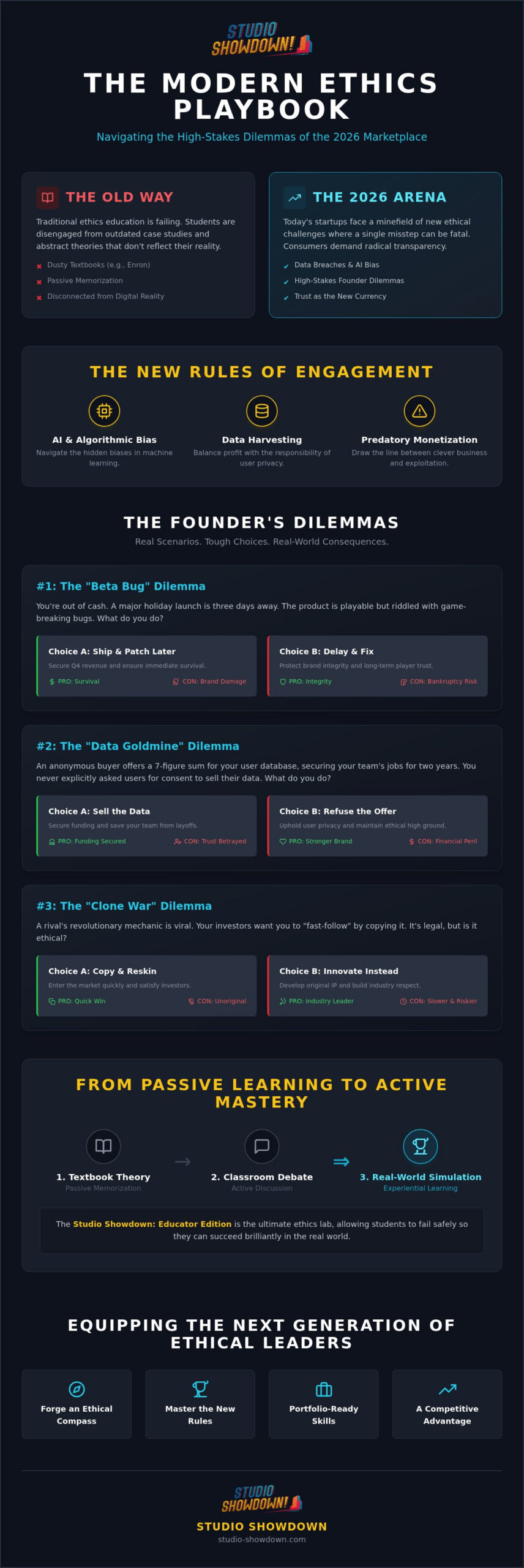
Passive learning is a relic of the past. Reading a chapter on corporate governance won’t prepare a student for a boardroom showdown. Memorization fails under pressure. Simulation, however, builds muscle memory. This is where “The Founder’s Dilemma” comes into play. It’s the choice between a quick, dirty win and sustainable growth. We need to move beyond the textbook. To truly learn, students must face the consequences of their actions in a controlled environment. This is why we position the Studio Showdown Board Game as the ultimate “Ethics Lab.” It forces players to confront real-world business ethics discussion scenarios for students where the stakes feel real, even if the money isn’t. By integrating the Studio Showdown: Educator Edition, you give your students a chance to fail safely so they can succeed brilliantly in the real world.
Scenario Set 1: Product Integrity vs. Market Dominance
In the high-stakes world of digital production, the line between a strategic win and an ethical collapse is razor-thin. We don’t teach ethics through abstract theories. We teach them through “Showdowns.” These are moments where every choice carries a heavy price tag. These business ethics discussion scenarios for students are designed to mirror the actual pressures of the 2026 market. It’s not just a choice; it’s a battle for your studio’s soul.
- The “Beta Bug” Dilemma: Your studio is out of cash. A major holiday launch is three days away. The game is playable but riddled with game-breaking bugs. Do you ship it and “patch it later,” or do you delay, lose the Q4 revenue, and risk bankruptcy?
- The “Data Goldmine”: An anonymous buyer offers you a seven-figure sum for your user database. This funding would secure your team’s jobs for two years. The catch? You never explicitly told your users you would sell their behavioral data.
- The “Clone War”: A rival indie studio just launched a revolutionary mechanic. It’s viral. Your investors want you to “fast-follow” by copying the code and reskinning it. It’s legal, but is it right?
The Launch Deadline Pressure
Cash flow is the oxygen of a startup. Without it, the dream dies. However, launching a “broken” product is a gamble with your brand’s soul. In 2026, the internet doesn’t forget. A disastrous launch day can lead to a permanent “Mostly Negative” rating on storefronts. Discussion question: Is the “fix it later” culture an ethical shortcut or a necessary survival tactic? Students must weigh immediate survival against long-term credibility.
Monetization vs. Player Experience
Clever business models can easily slide into exploitation. Loot boxes and predatory microtransactions are the flashpoints of modern regulation. When does a monetization loop stop being a service and start being a trap? You can’t just chase the easy win. If you want to understand why long-term strategy beats short-term greed, check out Beyond the Easy Money Game. These dilemmas are at the heart of the Studio Showdown Board Game, where players face these exact “Founder’s Dilemmas” in every round. It’s the perfect way to bring business ethics discussion scenarios for students to life in your classroom.
Scenario Set 2: Leadership, Team, and Rival Studios
Leadership isn’t about the name on the door. It’s about the calls you make when the pressure is red-lining. While the first set of scenarios focused on the product, this set dives into the interpersonal combat of running a studio. Managing a team and outmaneuvering rivals requires more than just a legal team; it requires a gut check. These business ethics discussion scenarios for students put them in the hot seat where people, not just code, are the primary asset.
- The “Poaching” Problem: A rival studio is weeks away from a major milestone. You have the budget to hire their lead designer. You don’t actually need them for your current project, but hiring them would effectively kill your competitor’s launch. Is this a savvy talent acquisition or unethical sabotage?
- The “Crunch Culture” Choice: Your biggest competitor just announced a surprise release date that beats yours by a month. To stay relevant, you must force your team into 80-hour weeks for the next six weeks. You’ve built your brand on “employee wellness.” Do you break that promise to win the market?
- The “Whistleblower” Startup: You discover a critical security flaw in your studio’s internal data handling. It hasn’t been exploited yet, and no one outside the dev team knows. Disclosing it now will almost certainly tank your upcoming Series B funding round. Do you stay silent until the check clears?
Building a Culture of Integrity
Every choice a founder makes sends a signal. If you cut corners on safety or honesty, your team will eventually cut corners on quality. This ripple effect can turn a high-performing studio into a toxic environment overnight. Leadership ethics is the courage to choose people over pips. When a leader prioritizes the team’s long-term health over a short-term metric, they build a “Studio Culture” that acts as a competitive advantage. High trust leads to lower turnover and higher creative output.
Navigating Rivalries Strategically
Aggressive competition is the heartbeat of the creative industry. Sabotage, however, is a poison that eventually kills the market for everyone. Knowing the difference between a bold strategic move and an unethical attack is vital for any founder. For a deeper dive into how to position your studio without losing your soul, see Mastering the Board. During class, ask your students: Can you be a “nice” founder and still win? The 2026 market suggests that being principled isn’t a weakness; it’s a survival strategy. Using business ethics discussion scenarios for students helps them define their own boundaries before they are tested in the real world.
How to Facilitate Ethical Discussions in Your Classroom
Handing out a case study isn’t enough. To make an impact, you must direct the classroom like a live production. You aren’t just a teacher; you’re the executive producer of a high-pressure boardroom. To effectively use business ethics discussion scenarios for students, you need a framework that forces them to live with their decisions. Use these five steps to turn a lecture into a simulation.
- Step 1: Set the Stage. Define the “Showdown.” Make the stakes clear. If they fail to choose, the studio goes under. If they choose poorly, their reputation is scorched.
- Step 2: Assign Stakeholder Roles. Don’t let students argue from their own perspective. Assign them as investors, disgruntled employees, or privacy-conscious customers. This builds empathy and complex thinking.
- Step 3: The Ticking Clock. Real founders don’t have weeks to ponder. They have minutes. Set a five-minute timer for the final decision. Force a consensus under pressure.
- Step 4: Analyze the Fallout. Once the choice is made, reveal the secondary consequences. If they sold the data, tell them a major platform has now banned their app.
- Step 5: Portfolio Reflection. Have students write a “Founder’s Memo.” They must justify their choice using evidence and logic. This becomes a tangible asset for their professional portfolios.
The Socratic Method for Business
Don’t be the judge. Be the interviewer. When a student makes a claim, ask “Why?” until they reach the core of their value system. Avoid the trap of telling them what’s right. Instead, encourage peer-to-peer ethical challenges. Let the “investors” argue with the “employees.” This creates a dynamic environment where the business ethics discussion scenarios for students feel like actual market combat rather than a school assignment.
Grading Ethics: Process Over Outcome
You can’t grade a “correct” moral answer. You can, however, grade the quality of the reasoning. Use rubrics that reward evidence-based logic and the ability to pivot when new data emerges. This aligns perfectly with the core principles of the Business Board Game, where strategy and morality collide. Focus on how students navigate the “Founder’s Dilemma” rather than the final checkmark. Ready to transform your classroom? Bring this intensity to your next lesson by grabbing the Studio Showdown: Educator Edition today.
Gamifying Ethics with the Studio Showdown Board Game
Static lectures are dead. To truly understand the stakes of modern commerce, your students need to feel the pressure of a boardroom showdown. The Studio Showdown Board Game transforms abstract principles into a visceral experience. It’s the perfect “Ethics Lab” for the modern classroom. While traditional business ethics discussion scenarios for students often feel like a chore, gamification turns them into a high-stakes competition where every choice has a visible cost. Players act as founders, navigating the treacherous waters of fundraising, market dominance, and team management. They quickly learn that an unethical shortcut might provide a temporary boost, but it often leads to a scorched reputation and long-term disaster.
The game’s mechanics force players to face “Founder’s Dilemmas” in real-time. These aren’t simple right or wrong questions. They’re complex trade-offs where every path has a consequence. Should you take the “dark money” to stay in the game, or risk bankruptcy to keep your creative independence? This hands-on approach ensures that the lessons stick long after the board is packed away. It builds the critical thinking skills that a textbook simply can’t replicate.
Hands-On Entrepreneurship
Students move from reading about integrity to practicing it. In Studio Showdown, failure is a teacher, not a final grade. If a player chooses to sell user data for a quick cash infusion, they might face immediate backlash from market cards or lose the trust of their simulated team. This safe, low-risk environment allows them to experiment with different leadership styles. They aren’t just playing a game; they’re building professional portfolios based on real-time insights and decision-making patterns. They learn to balance the books while keeping their conscience clear. It’s about developing the gut feeling that separates great leaders from the noise.
Classroom Implementation
Integrating a game session into your curriculum is seamless. The Studio Showdown: Educator Edition is built specifically for the 60-minute lesson plan. It includes specialized guides that help you map game events to specific curriculum standards. You can start with a quick briefing, run a 40-minute session, and finish with a debrief that ties back to your core learning objectives. For larger groups, the Classroom Bundle provides enough sets to run full classroom tournaments. This creates a competitive, yet collaborative environment where business ethics discussion scenarios for students lead to genuine breakthroughs. You aren’t just teaching a subject; you’re facilitating a transformation. Bring Studio Showdown to your classroom today and give your students the competitive edge they need for the 2026 marketplace.
Forge the Next Generation of Ethical Leaders
Ethics in 2026 isn’t a lecture. It’s a survival skill. You’ve seen how modern dilemmas like data goldmines and crunch culture require more than a textbook; they require a gut check. By integrating business ethics discussion scenarios for students into your curriculum, you’re not just checking a box. You’re building portfolio-ready acumen that stands out in a crowded market. Active simulation bridges the gap between theory and the high-stakes reality of the studio floor.
Studio Showdown turns abstract concepts into visceral, high-stakes decisions. It’s immersive learning that students actually enjoy. Educators across the country use it to build real-world business acumen through trial and error. Whether you’re facilitating a boardroom debate or running a classroom tournament, you’re equipping them for the real fight. Institutional pricing is available for schools looking to scale this experience across departments.
Don’t let your students enter the workforce with outdated maps. Give them the lab they need to test their integrity before the stakes are real. Empower your students-Order the Studio Showdown Classroom Bundle today! Your classroom is the ultimate training ground. Lead the charge.
Frequently Asked Questions
What are the most common business ethics dilemmas for students?
Common business ethics discussion scenarios for students usually center on these high-stakes dilemmas:
- Product Integrity: Shipping a “Beta Bug” to meet a deadline.
- Data Ethics: Selling user data to secure investor funding.
- Competitive Sabotage: Poaching a rival’s talent just to kill their launch.
These scenarios force students to weigh short-term survival against long-term reputation. It’s about defining their personal rules of engagement before the stakes are real.
How do you explain business ethics to a middle schooler?
Think of business ethics as the sportsmanship of the corporate world. It’s the set of rules that ensures everyone plays fair while trying to win. For a middle schooler, it’s like deciding whether to use a glitch in a game to beat a friend. You might win today, but you’ll lose their trust tomorrow. Business ethics is about building a reputation that makes people want to work with you forever.
Can business ethics be taught through games?
Yes, games provide the ultimate lab for testing moral boundaries. The Studio Showdown Board Game forces players to face the immediate fallout of their choices. If you choose an unethical path for a quick profit, you might lose your team’s loyalty or face a market crash. This interactive approach makes the lessons far more engaging than a lecture. It builds the critical thinking skills needed for real-world entrepreneurship.
Why is it important for game design students to study ethics?
Game designers aren’t just making art; they’re creating systems that influence human behavior. Designers must navigate the ethics of monetization, data privacy, and inclusive representation. Without a strong ethical foundation, it’s easy to slide into predatory mechanics like exploitative loot boxes. Studying ethics ensures that designers build products that respect the player. In the 2026 market, ethical design is a vital part of building a sustainable studio brand.
What are some “grey area” scenarios in the video game industry?
The video game industry is full of grey zones like loot boxes, data harvesting, and crunch culture. Is forced overtime a necessary push for a holiday launch or a failure of leadership? Is selling anonymized player data a smart revenue stream or a breach of trust? These scenarios rarely have a single right answer. They require founders to think critically about their values and the long-term impact their choices have on the industry.
How does Studio Showdown help teach financial literacy and ethics?
Studio Showdown integrates ethics directly into the financial engine of the game. Players act as founders who must manage budgets, pitch to investors, and outmaneuver rivals. Every financial decision is tied to an ethical trade-off. You might secure a second round of funding, but only if you agree to a predatory data-sharing deal. This teaches students that financial literacy isn’t just about numbers; it’s about the integrity behind every transaction.
What is the best way to grade an ethics discussion?
Focus on the process of reasoning rather than the final decision. Use the Socratic method to ask students why they chose a specific path. A strong grade should reflect their ability to identify stakeholders, predict consequences, and justify their logic with evidence. This approach prevents the teacher as judge trap. It encourages students to engage in fierce, peer-to-peer ethical challenges that mirror the intensity of a real boardroom showdown.
Where can I find a business ethics curriculum for high school?
You can find a complete, game-based curriculum through the Studio Showdown: Educator Edition. It’s designed specifically for high school and institutional use to build real-world business acumen. For a full classroom setup, the Classroom Bundle provides everything needed to run ethical tournaments and deep-dive discussions. This curriculum helps students build professional portfolios by documenting their reasoning through complex business ethics discussion scenarios for students.