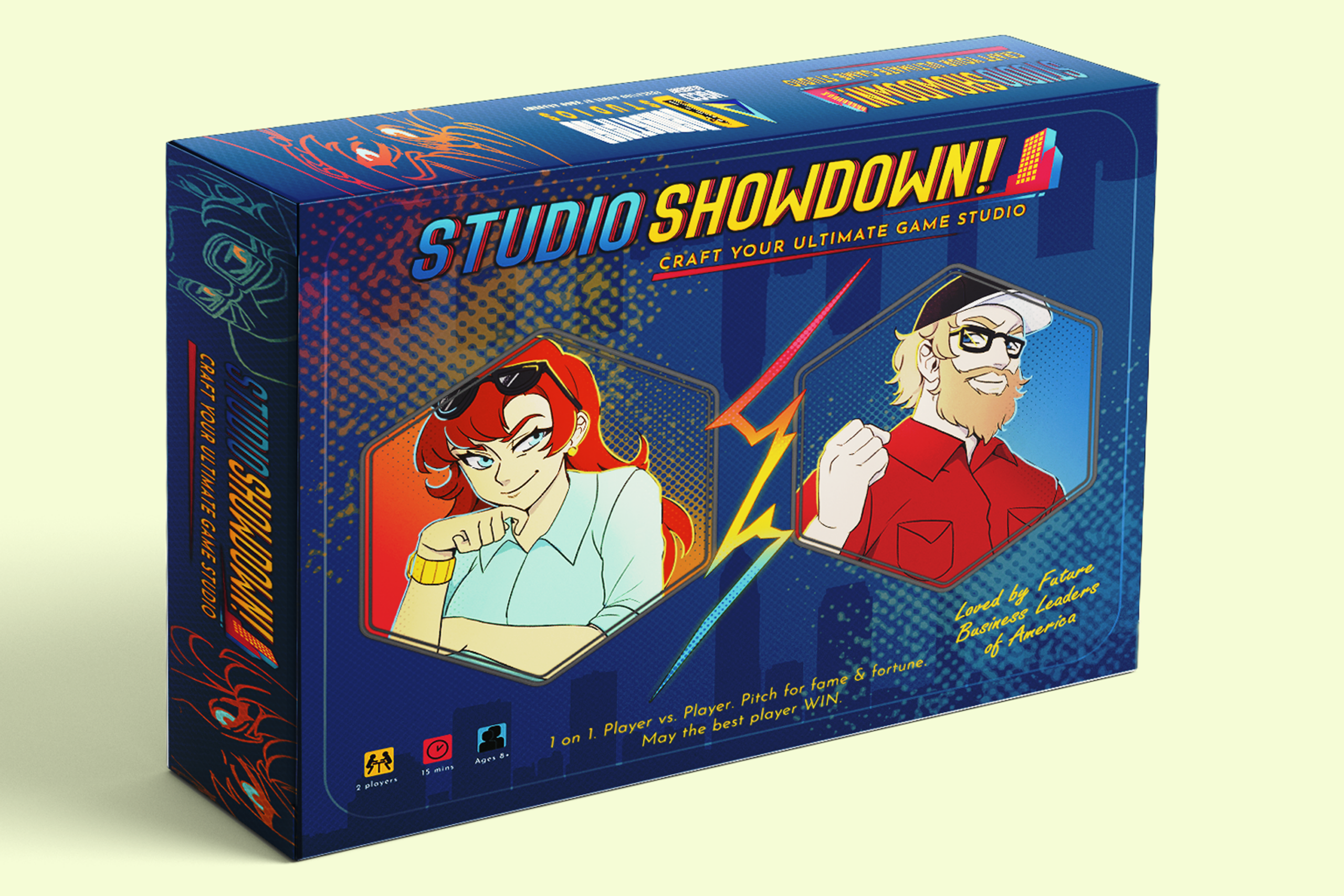
Monopoly is a lie. It suggests success is a roll of the dice and a bit of rent-seeking luck. Real founders know better. True growth requires grit. Sharp market analysis. The ability to pitch under pressure. If you’re tired of edutainment that feels like a dry lecture, it’s time to change the board. Finding board games that teach business strategy is no longer just a hobby. It’s a competitive advantage for the creative economy. It’s a way to rise above the visual noise of the market.
You know that real-world success isn’t about landing on Park Place. It’s about pivot points, burn rates, and outmaneuvering the competition. This guide reveals how modern strategy games turn abstract economic theories into a tactile, high-stakes battleground. We’ll break down the 2026 heavy hitters. We’ll look at the industrial depth of Brass: Birmingham and the studio-founding intensity of Studio Showdown. You’re about to find a screen-free way to master fundraising, market analysis, and complex economic systems before you ever step into a real boardroom.
Key Takeaways
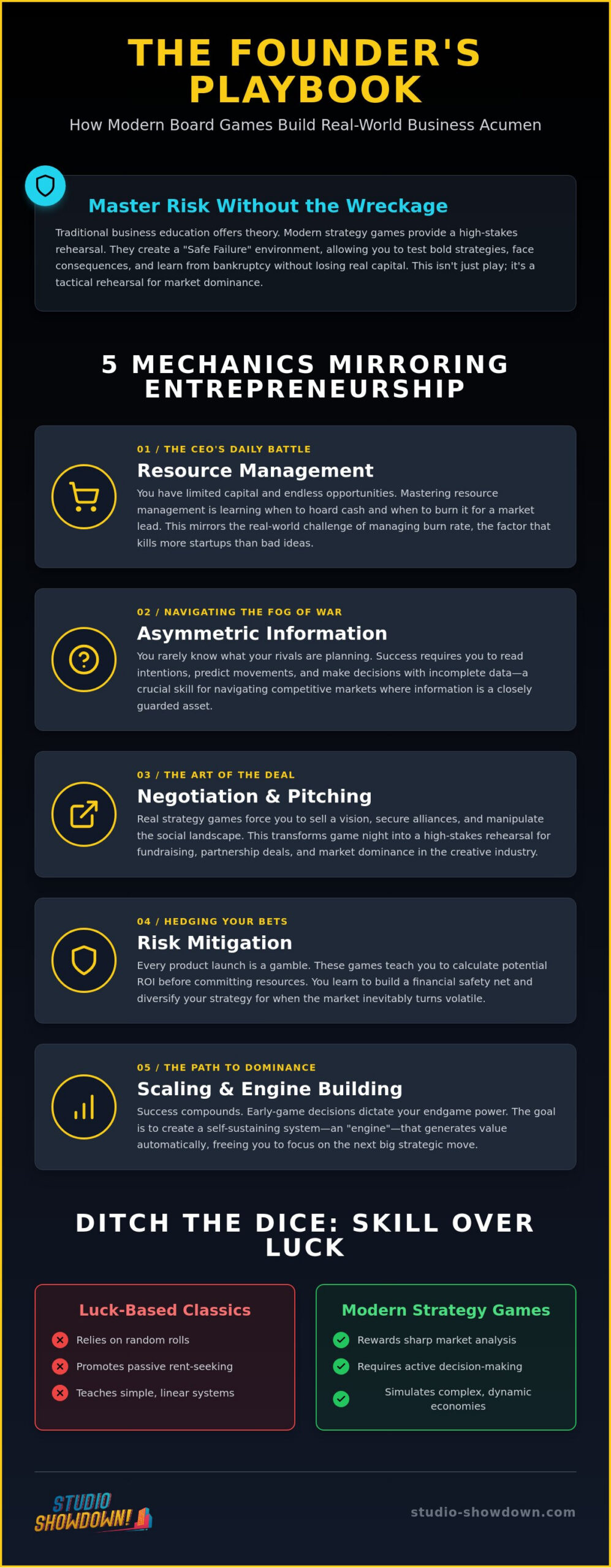
- Master risk without the wreckage. Learn how the concept of “safe failure” builds the tactical resilience needed for real-world leadership.
- Decode the mechanics. Discover how the best board games that teach business strategy use resource management to mirror the daily hustle of a startup.
- Ditch the dice. Move away from luck-based classics and embrace skill-heavy systems where sharp market analysis beats a lucky roll every time.
- Build your professional portfolio. Use our framework to select games that sharpen specific skills like debt management or aggressive negotiation.
- Dominate the pitch. See how Studio Showdown transforms game night into a high-stakes rehearsal for fundraising and market dominance in the creative industry.
The Power of Experiential Learning in Business Education
Reading about strategy is like reading about swimming. You can memorize every stroke and study the physics of buoyancy, but you’ll still struggle the moment you hit the water. Traditional business education often stops at the theory. It delivers facts without the friction of reality. Experiential learning flips this script. It demands immediate action. By engaging with board games that teach business strategy, students don’t just absorb information; they embody it. They make choices, face consequences, and navigate a simulated market that reacts to their every move. This isn’t just play. It’s a high-octane rehearsal for the creative economy.
The core of this transformation is the “Safe Failure” concept. In the real world, a bad fundraising round or a failed product launch can end a career. In Business simulation games, bankruptcy is just a data point. It’s a lesson learned without losing real capital. This psychological safety allows founders to test bold, artistic risks that they might avoid in a high-stakes boardroom. There’s also the vital element of human psychology. Tabletop simulations bypass the screen fatigue that plagues modern professional development. They force face-to-face negotiation. You have to read the room, detect a competitor’s hesitation, and pitch your vision with confidence. This tactile experience cuts through the visual noise of digital life, anchoring complex lessons in physical reality.
Why Textbooks Fail Aspiring Entrepreneurs
Static case studies are fossils. They describe a market that existed years ago, not the one fluctuating in real-time. Aspiring entrepreneurs need a dynamic environment where variables change every turn. Textbooks lack emotional stakes; there’s no adrenaline in a chapter summary. Games bridge the gap to the “Founder’s Journey” by making the risk feel personal. When your studio’s survival depends on a successful pitch, you aren’t just a student. You’re a leader fighting for dominance. This shift from passive observer to active participant is where true professional acumen is born.
The 2026 Shift Toward Game-Based Learning
The educational landscape is undergoing a massive tactical shift. Modern curricula now integrate tabletop strategy into STEM and professional business courses to drive deeper retention. We see a rise in “Serious Games” used within high-level corporate workshops to sharpen leadership. Game-based learning is the primary driver for 2026 educational engagement because it delivers results that stick. Institutions are moving fast to secure these tools. For schools and accelerators, verifying current shipping availability for institutional bundles, such as the Studio Showdown: Educator Edition or the comprehensive Classroom Bundle, is the first step toward building a modern entrepreneurial battleground.
5 Essential Strategy Mechanics That Mirror Real-World Entrepreneurship
Mechanics are the engine of every startup. They define the rules of engagement. When you choose board games that teach business strategy, you’re selecting a high-fidelity simulation of the Founder’s Journey. The best titles don’t just look like business; they feel like business. They force you to make the same gut-wrenching choices that CEOs face every Monday morning. To win, you must master the underlying systems that drive growth and survival in a competitive landscape.
- Resource Management: You have limited capital and endless opportunities. Learning to say “no” is the first step to survival. It’s about knowing when to hoard cash and when to burn it for a market lead.
- Asymmetric Information: You rarely know what your rivals are holding. Navigating this fog of war is essential for market dominance. It forces you to read intentions and predict movements rather than just reacting to visible data.
- Negotiation and Pitching: Trading basic resources is child’s play. Real strategy games require you to sell a vision, secure alliances, and manipulate the social landscape to your advantage.
- Risk Mitigation: Every product launch is a gamble. Calculating ROI before you commit keeps you in the game. You learn to hedge your bets and build a safety net for when the market turns volatile.
- Scaling and Engine Building: Success compounds. The decisions you make in the opening rounds dictate your power in the endgame. It’s about creating a self-sustaining system that generates value while you focus on the next big move.
Resource Management: The CEO’s Daily Battle
Burn rate kills more studios than bad ideas do. In board games that teach business strategy, resource management isn’t just about counting coins. It’s about ruthless prioritization. You must balance immediate operational costs against long-term growth assets. Vanity metrics don’t pay the bills; liquidity does. If you’re all-in on a single project and the market shifts, your studio is finished. You can find more tactical depth on managing these complex systems in our guide on Mastering the Board: The 2026 Guide to Strategy Board Games.
The Art of the Pivot: Adapting to Market Shifts
Markets are volatile. Competitors innovate. A mechanic that forces a mid-game pivot is the ultimate test of a founder’s resilience. Adaptability is often ignored in traditional textbooks, but it’s one of the primary Business Benefits of Board Games. You might face a sudden economic crash or a rival’s technological breakthrough. The ability to scrap your original plan and forge a new path is what separates industry leaders from the bankrupt. If you want to experience this pressure firsthand, the Studio Showdown Board Game puts you directly in the crosshairs of a shifting creative industry. It’s a battleground where only the most agile survive.
Beyond Monopoly: Evaluating Modern Business Strategy Games
Monopoly is a relic of 20th-century economic thought. It focuses on rent-seeking and attrition. Worst of all, it relies on roll-to-move mechanics. This teaches a dangerous lesson: that success is purely a matter of luck. If you’re looking for board games that teach business strategy, you need to look past the classics. Real entrepreneurship isn’t about landing on the right square by chance. It’s about agency. It’s about making calculated decisions that outweigh the whims of fortune.
High-value strategy games prioritize skill over luck. They demand depth of play. A game that becomes repetitive after five sessions offers no long-term educational value. You want a system that remains fresh after 50 sessions. Theme integration is equally vital. If a game claims to be about game development but feels like generic spice trading, the lesson is lost. The mechanics must mirror the specific hurdles of the industry they represent. This ludo-narrative harmony is what makes a simulation stick.
The Evolution of the Economic Board Game
The industry has moved from simple property hoarding to complex “engine builders.” Modern games reward long-term planning. They force you to invest in infrastructure that pays dividends later rather than chasing short-term gains. This shift reflects the reality of the 2026 market. You can explore this deeper in our analysis of Beyond the Easy Money Game: Why Strategy Wins in 2026. The focus is now on sustainability and compounding growth, not just surviving the next turn.
Criteria for a High-Value Business Simulation
Educators and founders must be selective. A game must teach fundraising and capital allocation to be relevant. It needs a competitive element that mirrors real-world rivalry. We define the “Skill-to-Luck Ratio” as a mandatory metric for any educator choosing tools for the classroom. If the luck factor is too high, the educational impact vanishes. Look for games that offer:
- Capital Allocation: Do choices regarding debt and investment have a lasting impact?
- Market Rivalry: Do players interact in a way that forces competitive pivots?
- Negotiation Depth: Is the “pitch” a core part of the winning strategy?
In the creative sector, these elements are the difference between a studio that scales and one that stalls. Choose tools that challenge your artistic and professional intuition simultaneously. Don’t settle for mediocre simulations that fail to rise above the noise.
A Framework for Choosing Games Based on Professional Goals
Strategy isn’t a monolith. You don’t just “learn business.” You master specific, high-stakes disciplines. To get the most out of board games that teach business strategy, you must align the game’s mechanics with your professional objectives. A game that focuses on simple resource conversion might sharpen your operational efficiency, but it won’t help you close a series A funding round. You need a targeted approach. You need a toolkit that addresses the specific hurdles of the 2026 creative economy. Stop choosing based on box art. Start choosing based on the skill gaps in your portfolio.
- Financial Literacy: Prioritize games that simulate debt management and cash flow. These titles teach you that profit is an opinion, but cash is a fact. They force you to balance liquidity against aggressive expansion.
- Leadership and Negotiation: Look for semi-cooperative titles. These force you to find common ground with rivals while ensuring your own studio comes out on top. It’s about the art of the deal.
- Entrepreneurship: Focus on founder simulations. These games mirror the chaotic early days of a startup. Fundraising, market maneuvering, and rapid pivots are the only things that matter here.
- Strategic Planning: Choose long-term resource acquisition games. These build the mental muscle required to see five steps ahead of the competition. They reward foresight over immediate gratification.
Mapping Games to the Entrepreneurship Curriculum
Educators are now using tabletop simulations to fulfill complex business-related STEM requirements. It’s a move toward active, high-impact engagement. You can structure a “Game Night” that functions as a high-intensity business workshop. This bridges the gap between classroom theory and the daily grind of a real-world founder. For those looking to dominate this space, The Ultimate Business Board Game: Master Entrepreneurship in 2026 provides the perfect roadmap for institutional success. It turns a standard lesson into a memorable battle for market share.
The Founder’s Journey Skill Matrix
The “Studio” model is the perfect microcosm for general business strategy. It forces you to manage creative talent, technical debt, and market expectations simultaneously. Within this matrix, the “Pitching” mechanic is vital. It isn’t just about the game; it’s about building the professional-grade communication skills required to secure capital. Scaling mechanics then teach you how early decisions compound. You learn to see the forest and the trees. You understand how a single hire or a strategic pivot can alter the trajectory of an entire company. Ready to test your mettle? Secure the Studio Showdown Board Game and start building your legacy today.
Studio Showdown: The Ultimate Entrepreneurial Battleground
The market is crowded. The noise is deafening. To survive in the creative economy, you need more than a good idea; you need a tactical edge. While other board games that teach business strategy focus on generic trading, the Studio Showdown Board Game puts you in the hot seat of the video game industry. This is where theory meets the high-stakes reality of the Founder’s Journey. You aren’t just moving pieces. You’re building a legacy. You’re fighting for market dominance in an arena where only the most agile strategists survive.
Mastering the “Pitch” is the core of the experience. In this simulation, communication is a weapon. You must sell your vision to investors and navigate the brutal challenges of fundraising. Securing capital isn’t a roll of the dice; it’s a test of your professional-grade communication skills. You’ll learn to calculate burn rates, manage technical debt, and outmaneuver rival studios. This is a high-fidelity battleground. Success requires you to balance artistic intuition with ruthless market analysis. It’s the ultimate rehearsal for the real-world boardroom.
Institutional support for this method is growing rapidly. For 2026, forward-thinking educators are moving away from dry lectures and toward high-impact simulations. The Classroom Bundle has become the definitive choice for accelerators and universities. It provides a durable, physical toolset that engages students in complex economic systems without the distraction of a screen. If you’re looking to elevate a curriculum, verify current shipping availability for these institutional bundles to ensure your students are ready for the struggle.
Inside the Box: A Professional Portfolio Builder
Every mechanic in this game translates directly to a business resume. Developed by VGCD Academy and DEMYSTIFIED Studios, the game ensures deep educational rigor. It frames the startup process as a creative struggle. You aren’t just playing; you’re building a professional portfolio of skills. You’ll understand the compounding nature of early-stage decisions. You’ll learn how to scale a team under pressure. This isn’t just entertainment. It’s a career-building exercise disguised as a competitive showdown.
Ready for the Showdown?
Your first studio launch is waiting. Whether you’re an aspiring founder or an educator looking for the next level of engagement, the path to mastery is clear. We offer professional development workshops and the Studio Showdown: Educator Edition to help you integrate these lessons into any leadership program. Don’t let your strategy remain a theory. It’s time to test your mettle against the best in the industry. Order Studio Showdown and start your founder journey today. The battle for market share starts now.
Secure Your Market Lead
Success in the creative economy isn’t a gift. It’s earned through tactical grit and sharp execution. We’ve explored how board games that teach business strategy bridge the gap between dry theory and the high-stakes reality of the Founder’s Journey. By prioritizing skill over luck and mastering the art of the pitch, you build a professional portfolio that rises above the noise. Redefining business education requires moving beyond roll-of-the-dice classics and embracing simulations that demand artistic courage.
Studio Showdown, developed by experts at VGCD Academy and DEMYSTIFIED Studios, is the definitive battleground for this transformation. Whether you’re a student or a seasoned pro, these tools turn every session into a high-octane rehearsal for market dominance. National shipping is available for our Classroom Bundles and Educator Editions, making it easier than ever to bring this experience to your team. Your studio’s legacy starts with the right move.
Master the Market: Get Studio Showdown for Your Home or Classroom
The boardroom is waiting. It’s time to play for keeps.
Frequently Asked Questions
Do board games really teach business strategy better than books?
Board games provide a dynamic feedback loop that textbooks simply can’t replicate. While a book explains the theory of capital allocation, a game forces you to live the consequences of a bad investment. This experiential approach builds muscle memory for decision-making under pressure. It turns abstract concepts into tactile, high-stakes lessons that stick long after the session ends.
Can Studio Showdown be used in a middle school or high school classroom?
What is the best board game for teaching financial literacy to teens?
Studio Showdown is a top choice for teaching financial literacy because it focuses on the “Founder’s Journey” rather than just rent-seeking. It’s one of the few board games that teach business strategy by introducing concepts like burn rates, fundraising, and debt management. Teens learn to view money as a tool for growth and investment, mirroring the reality of modern entrepreneurship.
How long does a typical session of Studio Showdown take to play?
A typical session of Studio Showdown takes approximately 60 to 90 minutes to complete. This timeframe is ideal for a standard classroom period or a focused professional development workshop. The game’s pace is designed to maintain high energy and constant engagement. It ensures that every turn feels like a critical step in your studio’s survival or market expansion.
Does Studio Showdown require any prior knowledge of video game coding?
No prior knowledge of video game coding is required to play or win. The game focuses exclusively on the business and production side of the creative industry. You’ll master pitching, fundraising, and market maneuvering without ever writing a line of code. It’s about the strategic vision and the tactical execution required to lead a successful creative team.
What are the main differences between the Educator Edition and the standard game?
The Studio Showdown: Educator Edition is specifically tailored for institutional use and professional workshops. While the core gameplay remains the same, this version includes comprehensive lesson plans, assessment tools, and workshop guides. It’s designed to help teachers integrate the game into a broader entrepreneurship curriculum. The standard edition is built for home play and competitive game nights.
Is Studio Showdown a cooperative or competitive board game?
Studio Showdown is a highly competitive board game. It’s designed as a battleground for market dominance where you must outmaneuver rival studios to win. While you might find temporary common ground during the negotiation phase, the ultimate goal is to build the most successful studio. This competitive edge mirrors the real-world rivalry found in the creative sector.
How does Studio Showdown help students build a professional portfolio?
The game helps students build a professional portfolio by developing high-demand soft and hard skills through play. Players practice pitching their visions to investors and managing complex capital structures under pressure. These experiences translate directly to a business resume. By mastering board games that teach business strategy, students can demonstrate a practical understanding of the startup lifecycle and market dynamics.