What if students could explore competitive strategy by stepping into a founder’s shoes instead of only memorizing definitions? Market analysis and business planning can seem abstract until learners have to make choices and explain their reasoning. A competitive advantage game for students gives those ideas a practical context: building a video-game studio and deciding how it can stand out.
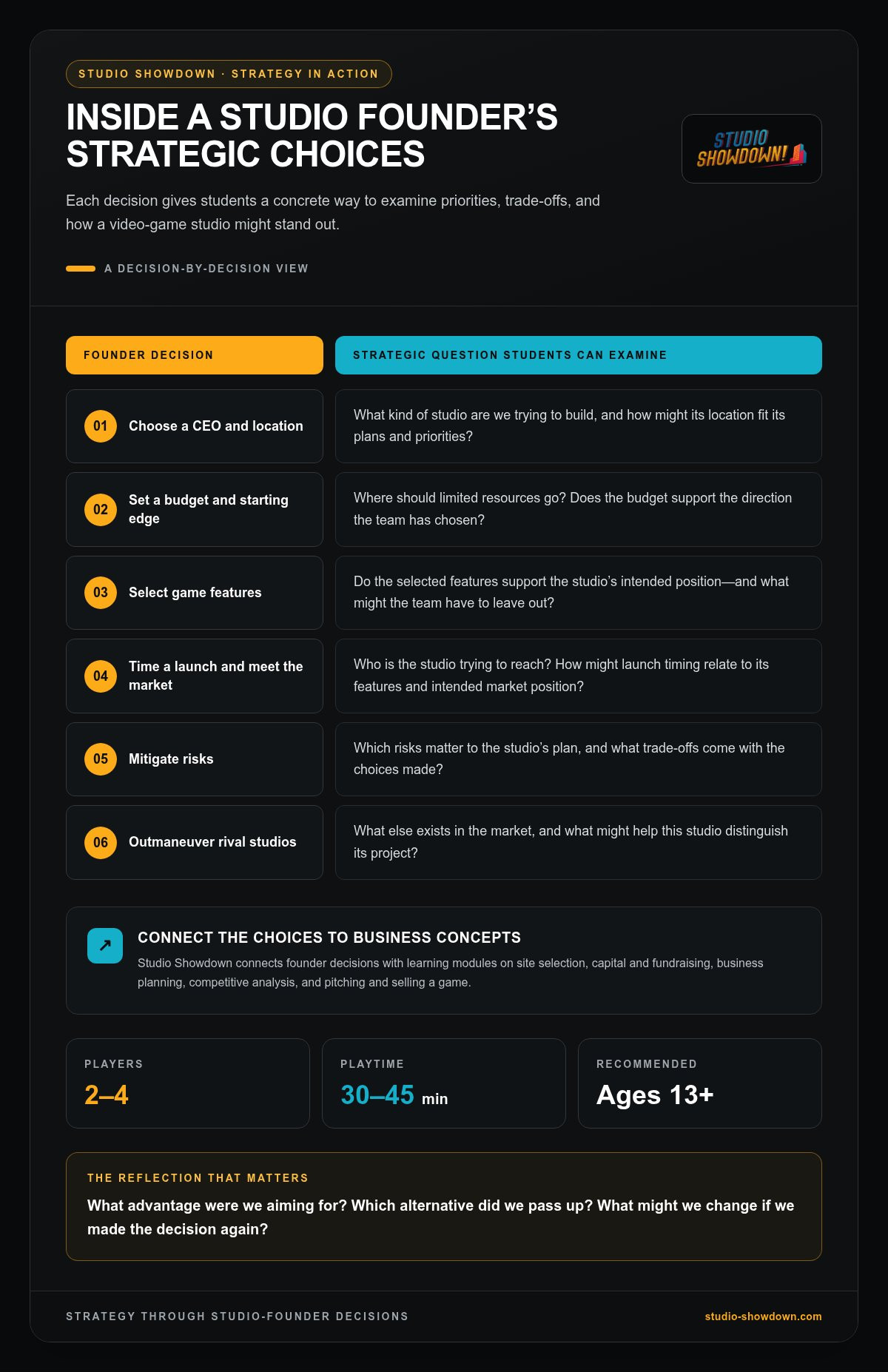
Studio Showdown puts players in the role of studio founders. They choose a CEO and location, define a budget and starting edge, select features, time a launch, meet the market, mitigate risks, and outmaneuver rival studios. The decisions connect to learning modules on site selection, capital and fundraising, business planning, competitive analysis, and pitching and selling a game.
Developed by VGCD Academy and Demystified Studios, Studio Showdown is for 2-4 players, has a playtime of 30-45 min, and is recommended for Ages 13+. It’s launching soon on Kickstarter, with an exclusive backer offer available. Read on to see how students can use the studio-founder perspective to examine strategic choices, discuss trade-offs, and connect business concepts to game development and entrepreneurship.
Key Takeaways
- Competitive advantage is about the choices that help an organization stand out and compete effectively.
- A competitive advantage game for students can make strategy tangible by connecting decisions with their consequences.
- Compare learning focus, format, audience, duration, and facilitation to decide whether an experience fits your goals.
- Turn play into reflection: identify a decision, explain its rationale, and consider trade-offs involving budgets, risks, markets, or pitching.
- Studio Showdown uses the perspective of a video-game studio founder to explore business strategy with future developers and people interested in the video-game industry.
What Does a Competitive Advantage Game Teach Students?
A competitive advantage comes from choices that help an organization stand out and compete effectively. That could mean focusing on a particular audience, using limited resources carefully, or shaping an offer around what customers value. The concept is broader than beating a rival: it asks why an organization might appeal to customers and what it needs to prioritize to build a distinctive position. A foundational overview of competitive advantage can help students connect the term to how organizations create and maintain an edge.
In a simulation, strategy moves from definition to decision. Players consider options, commit resources, and see how one choice can shape what becomes possible next. Investing in one opportunity can mean giving up another. Choosing when to launch can affect how a studio approaches the market. The learning comes from explaining the reasoning behind a move, not simply from reaching a winning result.
A game provides a setting for testing ideas, not a shortcut to professional expertise. It cannot reproduce every pressure involved in running a real organization. It can help students ask more precise questions: What advantage were we aiming for? Which alternative did we pass up? What might we change if we made the decision again?
How does a competitive strategy game make business concepts tangible?
Simulations connect business concepts to choices about resources, markets, timing, and risk. For instance, Studio Showdown asks players to define a budget and starting edge, select features, consider launch timing, and think about meeting the market. Students can trace how these decisions relate to one another: Does the budget support the studio’s direction? Do the selected features fit the position the team hopes to create? What trade-off comes with a particular choice?
After a decision, students can explain what they were trying to achieve and which alternative they left behind. A short review turns a move into a strategic argument. Encourage learners to point to the details that informed their reasoning rather than treating the outcome as proof that a choice was right or wrong in every situation.
Why use a game about the video-game industry?
Video-game development combines creative ambition with business decisions, making it a relevant setting for students interested in development or the industry. Studio Showdown simulates running a video-game studio and covers site selection, fundraising, business planning, competitive analysis, and pitching. These themes give students a focused way to discuss how creative goals connect with practical decisions.
For future developers, the studio context can make entrepreneurship feel less like a list of terms and more like a series of choices to examine. Students can also explore how business games approach those choices through this business board game entrepreneurship guide. To make the discussion useful, go beyond the result: identify the intended advantage, weigh the trade-offs, and explain what the decision reveals about the studio’s priorities.
How Studio-Founder Decisions Build Students’ Competitive Thinking
A studio needs more than a creative idea. It needs a direction, resources, a plan, and a reason to stand out. Studio Showdown is a strategy board game that simulates running a video-game studio, putting those founder-level considerations at the center of play. Students encounter business concepts through decisions about a studio rather than through an abstract company example.
Players choose a CEO and location, define a budget and starting edge, and select features. Each choice gives students something specific to explain. What kind of studio are we trying to build? Where should limited resources go? Which features support the direction we chose? Looking at how decisions fit together helps students distinguish a coherent strategy from a collection of disconnected ideas.
Studio Showdown connects the choices involved in building a game studio with the strategic question of how that studio can stand out.
From studio location and funding to a business plan
Site selection turns location into a business consideration: how might a chosen base fit a studio’s plans and priorities? Capital and fundraising introduce questions about how a venture obtains resources. Business planning brings these considerations together. Students can examine whether a studio’s budget, location, and intended direction support one another.
Make the connections explicit. Ask how the chosen location relates to the studio’s aims, how its funding needs fit its plans, and whether its budget reflects its priorities. For example, a team can describe which parts of its plan it chose to prioritize and what it had to leave out. These prompts help students discuss trade-offs without treating game decisions as instructions for running a real business.
Using competitive analysis before a game launch
Competitive analysis and comparables help students consider what else exists in a market and how a studio might distinguish its project. In Studio Showdown, players consider launch timing and meeting the market. That opens up useful questions: Who is the studio trying to reach? How might timing relate to its planned features and intended position? What might the team want to understand about rival studios?
Keep the discussion focused on the reasoning students can support. The game offers a way to frame market questions, not real market data or a forecast of demand. If a team selects certain features, it can explain how they relate to its proposed position and launch plans, while recognizing that the choices do not predict what customers will do in the real world.
For learners interested in development, entrepreneurship, or the video-game industry, this studio-founder lens makes a competitive advantage game for students especially relevant. The modules also include pitching, giving students a reason to consider how a business plan and competitive position can be communicated clearly. Studio Showdown is developed by VGCD Academy and Demystified Studios and is launching soon on Kickstarter. Explore Studio Showdown to learn more about the game’s studio-building focus.
How to Compare Competitive Advantage Games for Students
A useful comparison starts with your learning goals and the details each experience provides. Look at what it teaches, how it’s delivered, who it’s intended for, how long it takes, and how facilitation works. Then consider whether those details fit your group and planned activity. A tabletop strategy game, a digital marketplace, and a company simulation may all involve decisions, but they offer different formats and learning contexts.
Which learning goals should educators compare?
Start by naming the ideas students should explore. Studio Showdown’s learning modules cover studio and business site selection, capital and fundraising, business planning, comparables and competitive analysis, and pitching and selling a game. That makes its focus relevant to planning, resources, market analysis, and presenting a business idea. Other simulations may focus on different kinds of business or economic decisions. Match the stated topics to your learning goals, and avoid assuming that playing a game will produce a particular academic result or align with a specific curriculum.
Use the table to compare learning focus and format. For the broad categories, consider the format and audience that fit your group, then look at the experience’s own details when choosing a specific activity.
| Experience | Learning focus | Format | Audience | Duration | Facilitation |
|---|---|---|---|---|---|
| Studio Showdown | Site selection, fundraising, business planning, competitive analysis, pitching | Strategy board game simulating a video-game studio | Ages 13+ | 30-45 min | Educator-led discussion can extend reflection after play |
| Team-based company simulation | Business decisions involving markets, capacity, production quantities, and prices | Team-based company simulation | Teams | Depends on the activity | Can be discussed by teams or with an educator |
| Digital trading simulation | Economics concepts through trading | Digital marketplace | Depends on the activity | Depends on the activity | Can be paired with discussion |
| Facilitated business simulation | Corporate strategy and resource decisions | Online, face-to-face, or blended simulation | Business learners | Depends on the activity | Facilitated simulation |
How do format and audience affect the fit?
Studio Showdown is for 2-4 players, takes 30-45 min, and is recommended for Ages 13+. These details help educators and players decide whether its group size, duration, and age recommendation fit a planned activity. Other approaches, such as a team-based company simulation or a digital trading simulation, have different formats. Consider how the format suits the way your students will participate and discuss their decisions.
Studio Showdown is a tabletop strategy board game for 2-4 players, recommended for Ages 13+, with a 30-45 min playtime. This makes its format and time commitment easy to assess without assuming classroom requirements or unlisted mechanics. For a broader look at strategic play formats, explore this strategy board games guide. A competitive advantage game for students is easier to evaluate when its learning focus, audience, and practical format are considered together.
How Students and Educators Can Turn Gameplay into Reflection
Gameplay creates decisions; reflection helps students explain them. After play, guide a simple review: identify a choice, explain the reasoning behind it, and consider what it made easier or harder. This keeps the conversation grounded in strategy rather than treating the final result as proof that one player had the “right” answer.
With Studio Showdown, discussion can draw on the game’s themes, including budgets, risks, markets, studio planning, competitive analysis, and pitching. Students can connect an observation from play to a business or entrepreneurship concept, then consider how a different priority might have changed their approach. This flexible discussion framework can help educators connect gameplay to their own teaching goals.
Prompts for discussing strategic choices
Ask questions that invite students to explain their thinking instead of searching for a guaranteed winning strategy. They might describe what influenced a choice about studio location, budget, selected features, or launch timing. Follow up by asking how they considered rival studios, potential risks, or the market they hoped to reach.
- Which priority shaped your location or budget decision?
- How did your selected features relate to the studio direction you had in mind?
- What risks or competing options did you consider?
- What might you reconsider, and what trade-off could that create?
- How would you explain your studio’s position in a pitch?
Encourage students to point to the reasoning behind their answers. A choice that seemed sensible at the time may look different after the group considers its trade-offs. Rather than labeling a decision a universal success or failure, help students explain what they were aiming for and what they learned from the result.
Making the learning relevant to students
A game-studio scenario gives students interested in game development and entrepreneurship a creative context for business questions. Educators can connect observations from play to topics they’re already discussing, such as planning, fundraising, market choices, or presenting an idea. Keep conclusions grounded in the game’s scenario, and invite students to distinguish between an idea they explored and a claim about what would happen in a real studio.
Studio Showdown is recommended for Ages 13+. Educators can invite students within that recommendation to explain their decisions in their own words, compare different approaches, and identify a question they would investigate further. For example, students could compare the priorities behind two studio plans and describe how each might affect its competitive position. This makes strategic thinking visible and gives the group something concrete to discuss.
For a hands-on way to bring studio-founder decisions into the conversation, explore Studio Showdown. The strategy board game simulates running a video-game studio and is launching soon on Kickstarter. A competitive advantage game for students gives learners a scenario to examine, while thoughtful reflection connects each choice to broader ideas in business and entrepreneurship.
Studio Showdown: A Student-Focused Competitive Advantage Game
For future developers, board-game enthusiasts, and people interested in the video-game industry, Studio Showdown is a strategy board game centered on running a game studio. Rather than separating business from creative work, it puts studio-founder decisions into the same scenario. Its learning modules cover site selection, fundraising, business planning, competitive analysis, and pitching, giving players connected business themes to explore.
What players do in Studio Showdown
Players choose a CEO and a studio location, then define a budget and starting edge. They select smart features, consider when to launch, think about meeting the market, and mitigate risks. Each decision gives players a chance to weigh priorities: How should the studio use its resources? What might distinguish its game? Which risks should shape its choices? These questions connect the founder scenario to strategic thinking without implying that there is one guaranteed winning approach.
The goal is to outmaneuver a rival and lead your studio to glory and fortune. Alongside the competitive challenge, the learning modules bring business questions into play and reflection:
- Site selection: Consider how a studio’s location relates to its plans.
- Fundraising and budgeting: Think about capital, resources, and financial priorities.
- Business planning: Connect choices into a coherent direction for the studio.
- Competitive analysis: Consider the market and how a game might stand apart.
- Pitching: Practice framing a studio’s idea and direction clearly.
Studio Showdown is designed for 2-4 players, takes 30-45 min, and is recommended for Ages 13+. Those details make its format clear for students and educators considering a tabletop strategy experience. The game’s focus may also appeal to board-game fans who enjoy strategic decisions and learners interested in how creative projects connect with entrepreneurship.
Where to learn more about the upcoming game
Studio Showdown is launching soon on Kickstarter, where an exclusive backer offer is available. Developed by VGCD Academy and Demystified Studios, the game brings site selection, fundraising, planning, analysis, and pitching into a focused strategy experience. Its stated player count, playtime, and age recommendation make the format clear for prospective players.
If you’re looking for a competitive advantage game for students that places business choices inside a video-game studio scenario, discover Studio Showdown and learn more about its upcoming Kickstarter launch and exclusive backer offer.
Studio Showdown is developed by VGCD Academy and Demystified Studios. © 2026. All rights reserved.
Make the Next Strategy Conversation Count
Students don’t need another vocabulary list to start thinking like strategists. Give them a decision to make, a reason to defend, and a trade-off to discuss. That can turn competitive advantage from a phrase in a textbook into a question they explore through conversation and play.
For learners curious about game development and entrepreneurship, Studio Showdown brings that approach to a strategy game simulating a video-game studio. Its learning modules connect fundraising, business planning, competitive analysis, and pitching to the choices founders face. A competitive advantage game for students can start a discussion and encourage strategic questions without promising professional success.
Studio Showdown is launching soon on Kickstarter, with an exclusive backer offer available. Discover Studio Showdown and its upcoming Kickstarter launch, then bring a strategic question into your next classroom or game-night discussion. Start with curiosity and let the ideas compete.
Frequently Asked Questions
What is a competitive advantage game for students?
A competitive advantage game for students gives learners a scenario in which they can examine strategic choices, not just study terminology. Studio Showdown places those choices in a video-game studio setting, with learning modules on business planning, fundraising, competitive analysis, and pitching. Students can explain what they would prioritize as founders and why, then discuss the trade-offs behind their choices.
What can students learn from Studio Showdown?
Studio Showdown covers studio and business site selection, capital and fundraising, business planning, comparables and competitive analysis, and pitching and selling a game. Its play experience also involves decisions about budgets, features, launch timing, markets, and risks. An educator can use a student’s chosen studio direction to start a discussion about how business plans connect to creative ideas.
How does Studio Showdown involve competitive strategy?
Players take the role of studio founders, make choices for their studio, and try to outmaneuver rival studios. The experience includes setting a budget and starting edge, choosing smart features, timing a launch, meeting the market, and mitigating risks. Students can explain how their decisions fit together and what they might change after considering a rival. The game presents strategic choices to explore, rather than a formula for success.
Who is Studio Showdown designed for?
Studio Showdown is intended for future game developers, board-game enthusiasts, and people interested in the video-game industry. Its recommendation is Ages 13+. The studio-founder scenario gives players a way to engage with business themes connected to game development while keeping the age recommendation clear.
How many players can play Studio Showdown, and how long does it take?
Studio Showdown is designed for 2-4 players, with a playtime of 30-45 min. These details help educators and players decide whether the group size and duration suit a planned activity. They describe the game’s intended player count and playtime.
Is Studio Showdown available now?
Studio Showdown is launching soon on Kickstarter, and an exclusive backer offer is available. Visit the Studio Showdown website to learn more about the upcoming Kickstarter launch and backer offer.