The best cashflow for kids alternatives may not be money games at all. The right choice depends on what players should explore: everyday money skills, investing concepts, or how to build and run a business.
Comparing games can be difficult when product descriptions list features but leave the learning focus or age fit unclear. A useful comparison starts with what each game says it covers, then checks whether its age guidance and format suit the players. Money-focused games, investing games, and entrepreneurship simulations can serve different goals, even when they all have an educational angle.
Studio Showdown is one option to consider for players interested in entrepreneurship. It simulates running a video-game studio, with learning modules on business planning, fundraising, competitive analysis, and pitching. Designed for Ages 13+, it’s for 2-4 players and has a 30-45 min playtime. It’s launching soon on Kickstarter. If you’re looking for a teen-focused business simulation rather than a money-first game, those distinctions can help you decide whether it fits.
Key Takeaways
- Choose cashflow for kids alternatives by the skill players should explore, from everyday money habits to investing or entrepreneurship.
- Compare games using their stated learning goals, recommended age, player count, and playtime. Don’t fill gaps in product details with assumptions.
- Use a simple shortlist process: define the learning goal, match the age guidance, compare formats, then review the available facts.
- Studio Showdown takes an entrepreneurship-focused approach, with learning modules on fundraising, business planning, competitive analysis, and pitching a game.
- Consider whether a video-game studio simulation fits the players’ interests and age, rather than choosing by the “money game” label alone.
Cashflow for Kids Alternatives: Start with Learning Goals
Searching for cashflow for kids alternatives doesn’t necessarily mean looking for another game about money. You might want a closer age fit, a theme that interests the players, or a more direct introduction to business decisions. Those goals point to different kinds of games, even when each has an educational purpose.
Start by naming the lesson. Is the aim to build familiarity with money and financial habits, explore investing, or think through the choices involved in starting and running a business? CASHFLOW for Kids is presented as focusing on money, investing, and financial habits. A business simulation has a wider frame: it explores how an organization operates and makes decisions, rather than focusing on money alone.
Starting with the learning goal helps match the game’s subject, age guidance, and play experience to what players are ready and curious to explore.
What do people mean by a Cashflow for Kids alternative?
“Alternative” describes a comparison, not a promise that two games teach the same material. Financial-literacy games focus on money-related learning; investing games take a narrower financial angle; business simulations and strategy games can explore organizational choices. These categories may overlap, but they aren’t interchangeable. For a foundation on the broader idea, see financial literacy.
That distinction keeps comparisons useful. A game’s theme or title isn’t enough to establish what players will learn. Look for a stated learning focus, then compare it with the skills or concepts you want to introduce. Avoid assuming a game covers a particular skill unless its product information says so.
Start with the lesson, not the product label
Use three questions to set your direction: Do players need an introduction to money concepts? Are they interested in investing? Or do they want to explore entrepreneurship, perhaps through the business side of video games? The answers help separate a money-focused experience from a broader simulation. They also give you a practical basis for comparing games with different themes and learning goals.
Check age suitability early, not at the bottom of a feature list. A game’s recommended age is a useful first filter for deciding whether its subject and intended experience match the players. For example, Studio Showdown is designed for Ages 13+ and simulates running a video-game studio, making it an option for players interested in entrepreneurship and game-development business.
- Money habits: Look for a stated focus on financial basics or everyday money decisions.
- Investing: Check whether investment learning is explicitly part of the game’s purpose.
- Entrepreneurship: Seek a stated focus on planning, operating, or making business decisions.
Players’ interests matter, too. Those drawn to business-building may engage more with a studio or company premise than with a game centered on money alone. Build your shortlist by identifying the intended lesson, filtering for an appropriate age, and checking whether the theme gives players a reason to join the challenge.
Compare learning focus: money skills, investing, or entrepreneurship
Not every educational game teaches the same lesson. A useful comparison separates financial literacy from entrepreneurship: financial-literacy themes focus on understanding money, while entrepreneurship simulations focus on decisions involved in building and running a business. The themes can intersect, but one shouldn’t be treated as a substitute for the other.
The snapshot below compares the stated focus and format of each example. Use a game’s own product information to fill in details such as audience, player count, and playtime, rather than estimating them from its theme.
| Learning focus | Example or category | Audience and format |
|---|---|---|
| Money, investing, and financial habits | CASHFLOW for Kids | Recommended age 6+; board game |
| Investing | Investing-focused games as a category | Specific audience and format vary by game |
| Entrepreneurship and video-game business | Studio Showdown | Ages 13+; board game for 2-4 players, 30-45 min |
When a money-focused game is the closer match
CASHFLOW for Kids is described as focusing on money, investing, and financial habits. If those are your learning goals, prioritize alternatives whose product information names those subjects directly. Don’t infer a game’s rules, components, or outcomes from its title or general educational positioning; compare its stated focus instead.
This keeps the search precise. A game may involve business or strategy without claiming to teach personal finance. Likewise, a money-centered theme doesn’t automatically mean it covers the business decisions involved in launching a company.
When a business simulation may fit better
For players curious about how a video-game company takes shape, Studio Showdown offers a different perspective. Developed by VGCD Academy and Demystified Studios, it simulates running a video-game studio. Its stated learning areas include capital and fundraising, business planning, comparables and competitive analysis, and pitching and selling a game. The focus is entrepreneurial: consider studio and business choices, then think about how a game is positioned and presented.
That makes it distinct from a personal-finance game, not a replacement for one with the same lesson. Studio Showdown is designed for Ages 13+, is for 2-4 players, and has a 30-45 min playtime. It’s launching soon on Kickstarter. If the business of game development is the draw, explore the Studio Showdown board game as a focused option.
Use the learning goal as the deciding line: choose a money-focused title for money, investing, or financial habits; consider a business simulation for entrepreneurship and studio decisions. That distinction makes cashflow for kids alternatives easier to compare without treating every educational game as interchangeable.
Compare gameplay and age fit before choosing an alternative
A product’s learning theme is only part of the decision. The intended players, group size, and available playtime can determine whether a game suits a classroom session, a family game night, or another setting. Compare published facts side by side, and keep any missing details distinct from confirmed specifications.
| Game or category | Recommended age | Players and duration | Premise and stated learning focus |
|---|---|---|---|
| CASHFLOW for Kids | 6+ | Not stated in the available product details | Money, investing, and financial habits |
| Studio Showdown | Ages 13+ | 2-4 players; 30-45 min | Running a video-game studio; business planning, fundraising, competitive analysis, and pitching |
| Other alternatives | Check the game’s stated age guidance | Check the stated player count and duration | Depends on the game; use its stated learning focus |
Use age recommendation as a decisive filter
Start with the age guidance for the actual players. CASHFLOW for Kids is recommended for ages 6+, while Studio Showdown is designed for Ages 13+. These recommendations aren’t interchangeable. Compare each alternative’s published age guidance with the intended group, then narrow your shortlist before weighing theme or other features.
Age guidance is a practical starting point, not a detail to bury beneath a game’s premise. If a product page doesn’t state an age, treat that as an open question in your comparison rather than estimating who the game might suit.
Match group size and session length to the occasion
Next, compare how many people can play and how long a session takes, using published specifications. Studio Showdown is designed for 2-4 players and 30-45 min. Those details help you assess whether its format aligns with your planned group and available time. For other games, use their own stated player count and duration to make a fair comparison.
Premise matters alongside logistics. Studio Showdown simulates running a video-game studio, while CASHFLOW for Kids is described through its focus on money, investing, and financial habits. They offer different subject matter. A theme can help players connect with a game, but it doesn’t establish unstated rules or gameplay details.
Use this checklist as you review cashflow for kids alternatives:
- Age: Is a recommended age published, and does it match the intended players?
- Group and time: Are player count and duration stated for your planned occasion?
- Premise: Does the description explain what players are simulating or exploring?
- Learning focus: Are the intended topics named, or would you be relying on assumptions?
A clear comparison doesn’t need every box filled. It needs enough reliable detail to reveal which options fit, which don’t, and what you still need to learn about each game.
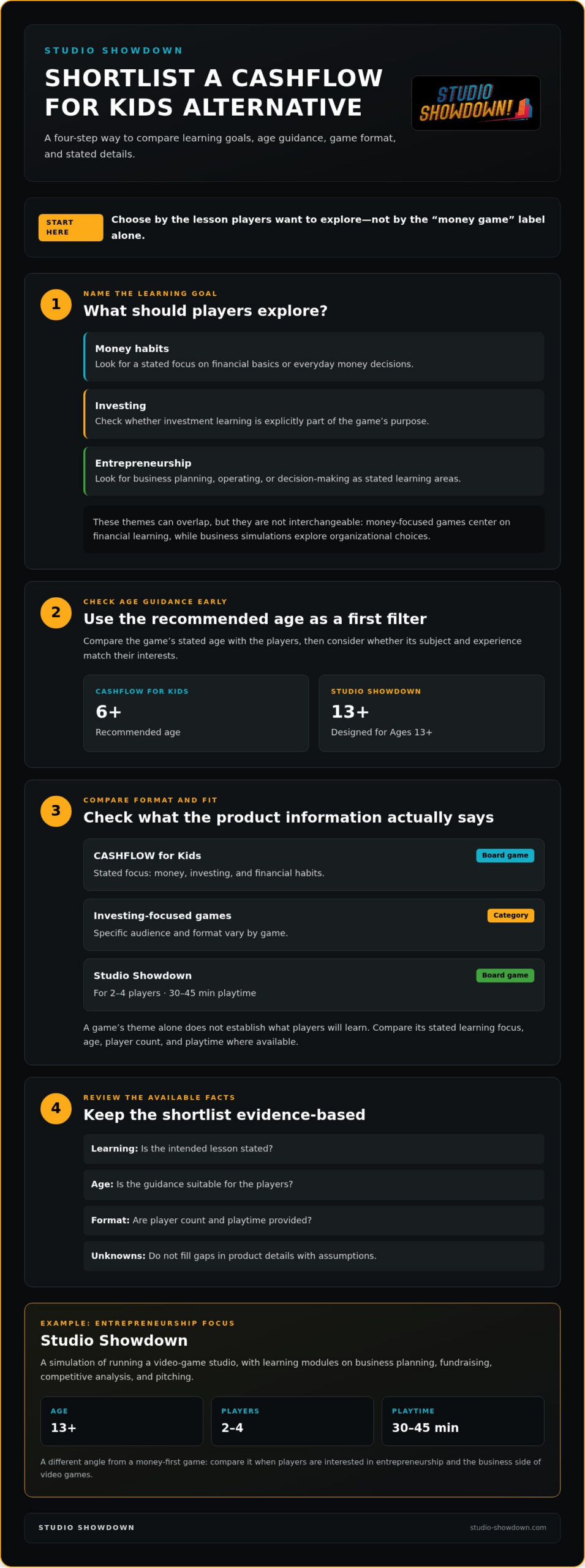
Use this decision framework to shortlist Cashflow for Kids alternatives
A useful shortlist starts with the players and the purpose, not a product label. Parents might prioritize money habits or a theme that holds a child’s interest. Educators may focus on a particular topic, group format, or available session time. Clear criteria make it easier to compare what each game says it offers and decide whether its focus suits your setting.
A four-step shortlist for parents and educators
Move through these steps in order. Each one narrows the field without assuming that every educational game teaches the same skills.
- Define the learning goal. Write down the main topic players should explore: money concepts, investing, entrepreneurship, or another stated subject. A focused goal helps distinguish a financial-literacy game from a business simulation.
- Check age guidance. Compare the published recommendation with the intended players before weighing other features. If the product information doesn’t state an age, note that gap rather than guessing.
- Compare the format. Review published player-count and duration details against your group and available time. For classroom use, consider whether the listed format fits the session; for home play, consider the planned group.
- Check the premise and facts. Match the game’s stated premise and learning areas to your goal. Separate confirmed details, such as a named topic or specification, from details the product description doesn’t provide.
This order keeps the comparison practical. A game can sound appealing but still miss the target if its subject, stated age guidance, or format doesn’t line up with the players and occasion.
Avoid common comparison traps
Educational is a broad label, not a shared curriculum. Don’t assume a strategy game teaches financial skills, or that a money-themed game explores how businesses operate. Look for specific learning areas in the product description, then compare them with the lesson you have in mind.
- Separate theme from learning focus. A compelling premise can help a game stand out, but it doesn’t prove what players will learn.
- Keep missing details visible. Note when age, player count, or playtime isn’t stated. Don’t substitute estimates.
- Read claims carefully. Marketing language describes a product’s positioning; it isn’t proof of a guaranteed educational result.
Strategic play may be the priority for some groups, while others want a direct focus on money or entrepreneurship. When comparing strategy games, consider how the stated decisions and premise fit the group instead of relying on the strategy label alone.
For an entrepreneurship-focused option, explore Studio Showdown’s game-studio simulation. Developed by VGCD Academy and Demystified Studios, it’s designed for Ages 13+, supports 2-4 players, and has a 30-45 min playtime. It’s launching soon on Kickstarter.
Consider Studio Showdown for an Ages 13+ game-studio simulation
Some cashflow for kids alternatives focus on personal finance. Studio Showdown takes a different route: it’s a strategy board game simulating the work of running a video-game studio. Designed for Ages 13+, it’s aimed at players interested in entrepreneurship and the business decisions behind game development, rather than a game centered on money habits alone.
The shift in perspective is clear. Instead of treating a company’s finances as the whole subject, the game’s stated learning modules bring together studio choices, business planning, market analysis, and presenting a game. That makes the premise worth considering when players are curious about how a creative idea moves through business decisions, not only how people handle money.
What the Studio Showdown experience focuses on
Developed by VGCD Academy and Demystified Studios, Studio Showdown frames play around running a video-game studio. Its confirmed learning areas include studio and business site selection, capital and fundraising, business planning, comparables and competitive analysis, and pitching and selling a game.
Those topics create a founder-oriented perspective. Players consider decisions about where a studio might operate, how it could seek funding, how to plan its business, and how to analyze or present a game. This is a broader entrepreneurship focus than a personal-finance game. It doesn’t mean the two categories teach the same material, and the listed topics shouldn’t be stretched into claims about specific rules, components, or guaranteed learning results.
- Site selection: Consider the studio and business location as part of the premise.
- Funding and planning: Explore the stated topics of capital, fundraising, and business planning.
- Analysis and pitching: Look at competitive comparisons, then the work of pitching and selling a game.
Studio Showdown is designed for 2-4 players, with a 30-45 min playtime. Those specifications can help you judge whether the format suits your group and available session time. Keep the age recommendation front and center: Ages 13+.
How to take the next step
If the intended players are drawn to video-game development and business-building, Studio Showdown offers a focused alternative to money-first games. It’s launching soon on Kickstarter, with an exclusive backer offer available. Explore the game’s premise and stated learning areas as you decide whether a studio simulation matches your goal; treat it as a distinct option, not a like-for-like substitute for financial-literacy play.
The fit comes down to the subject players want to explore. For money, investing, or financial habits, compare games that explicitly state those themes. For a game-studio and entrepreneurship premise, Studio Showdown brings site selection, fundraising, planning, analysis, and pitching into view. Use the Ages 13+ recommendation and published format details to make your shortlist relevant to the players you have in mind.
Choose the Next Game with Purpose
Your shortlist is a starting point, not a verdict. Before choosing, picture the conversation you want the game to open up: money choices, investing, or the decisions involved in building a creative business. That final check can help you choose a theme players are genuinely curious to explore, rather than relying on a familiar label.
The right cashflow for kids alternatives depend on the intended players and the experience you want around the table. Keep the goal specific, use published information to guide the comparison, and leave room for players to bring their own questions and ideas to the game.
If a video-game studio premise sparks that curiosity, take the next step and explore Studio Showdown and its upcoming Kickstarter launch. See whether its entrepreneurship focus belongs on your shortlist, then choose the game that best fits the challenge you want to share.
Frequently Asked Questions
How many players can play Studio Showdown?
Studio Showdown is designed for 2-4 players. Use that published range to check whether it suits your planned group, then compare it with the player count stated for any other game you’re considering. If a product description doesn’t give a player count, treat that detail as unknown rather than assuming it accommodates the same group size. This keeps your shortlist grounded in practical information.
How long does a game of Studio Showdown take?
The stated playtime is 30-45 min. That gives you a concrete duration to consider when planning a game session, whether it’s part of a class activity or a game night. For another title, use its own published playtime rather than estimating from its theme or format. If no duration is stated, leave it out of the comparison instead of treating a guess as a product fact.
What age is Studio Showdown recommended for?
Studio Showdown is recommended for Ages 13+. Use that guidance as a firm filter when considering the game for a group, and don’t apply its recommendation to other titles. For any alternative, look for the age guidance published for that specific game. If you’re choosing for a mixed-age group, compare each title’s own stated recommendation with the players you have in mind before weighing other features.
Who owns Studio Showdown’s game content?
VGCD Academy and Demystified Studios own Studio Showdown’s game, story, names, and other content. The copyright notice is © 2026. Keep this attribution specific to Studio Showdown when discussing its ownership; it doesn’t establish who owns another game in an alternatives comparison. For competing titles, refer to information provided by their respective creators or publishers rather than carrying Studio Showdown’s ownership details across.
What business topics does Studio Showdown cover?
Studio Showdown’s learning modules cover studio and business site selection, capital and fundraising, business planning, comparables and competitive analysis, and pitching and selling a game. These topics sit within its video-game-studio premise, so they may be relevant to readers exploring business decisions around game development. They describe the game’s stated learning areas, not a promise of a particular educational result. Compare them with the specific topics you want players to explore.
Is Studio Showdown available now?
Studio Showdown is launching soon on Kickstarter, with an exclusive backer offer available. That is the stated launch status; the game shouldn’t be described as already released or available through another purchase channel. For current launch information, visit the Studio Showdown website. No launch date or price is stated, so avoid relying on estimates when planning around its release.