What if the best finance lesson isn’t another slide deck, but a decision employees have to make under pressure? People may understand financial terms and still struggle to apply them at work. Games for teaching financial acumen to employees give teams a chance to make choices, see what follows, and discuss how those decisions connect to business priorities.
The format matters. A personal finance activity, business simulation, scenario exercise, and tabletop strategy game each create a different kind of challenge. Choose by the decision employees need to practise, the time available, and how much facilitation the activity requires. This roundup compares those options and offers a practical way to turn gameplay into a focused learning discussion.
In Studio Showdown, for example, players take on the role of competing video game studio founders and face entrepreneurship challenges such as fundraising and pitching. Those choices offer a concrete starting point for discussing priorities, trade-offs, and business judgment. Set a clear learning goal, observe how teams make decisions, and use the debrief to connect the game to work. That is what gives an activity purpose beyond the play itself.
Key Takeaways
- Financial acumen means applying financial information to workplace decisions, not just knowing the terminology.
- Compare tabletop games, business simulations, scenario exercises, and workshops by the decisions they involve, facilitation needs, and debrief potential.
- Choose games for teaching financial acumen to employees based on the financial decisions you want participants to explore.
- Set a clear learning goal, observe player choices, and lead a debrief that connects those choices to employees’ roles.
- Studio Showdown offers a tabletop way to explore entrepreneurship challenges such as fundraising and pitching.
Why Use Games to Teach Financial Acumen at Work?
Knowing terms like cash flow, budget, and return on investment is useful. Applying them when priorities compete is harder. Financial acumen means using financial information to make considered decisions, weigh likely consequences, and explain trade-offs. Games for teaching financial acumen to employees can give people a more active starting point than a presentation focused mainly on definitions and formulas.
Financial acumen is using financial information to choose wisely, not just knowing the vocabulary.
Budgeting is more than limiting spend. Teams need to decide where limited time, people, and money can have the greatest impact. Cash flow focuses attention on when money is available, not only whether a plan looks profitable on paper. Trade-offs make competing priorities visible, while return on investment encourages people to compare an expected result with the resources committed to achieve it.
Which workplace decisions call for financial acumen?
These decisions arise across roles. A project lead may prioritize one initiative over another. A marketing team may compare the expected return of two campaign options. An operations team may weigh whether extra capacity justifies its added cost. Each choice can affect spending, revenue, or resource allocation, even when finance isn’t an employee’s main responsibility.
That doesn’t mean every employee needs specialist accounting expertise. General financial confidence helps people ask better questions, understand a proposal’s implications, and communicate their assumptions. Finance professionals bring deeper technical skills, while other teams benefit from seeing how everyday choices connect to business results.
What can a game add to financial learning?
A game gives participants a decision to make, constraints to work within, and an outcome to consider. They might allocate limited resources, choose between growth and caution, or respond when an assumption changes. Rather than simply hearing a concept described, players encounter a simplified version of the tension behind it and have a specific choice to discuss afterward.
For instance, the Cashflow 101 board game uses gameplay to explore financial literacy and investing concepts. Workplace activities can take a different direction, focusing on business choices relevant to employees’ roles. Don’t treat any game as a complete model of the workplace. Rules simplify reality, while actual decisions involve context, uncertainty, and factors a game may not capture.
Use gameplay as practice and a conversation starter, not as a replacement for instruction, coaching, or role-specific guidance. A strong debrief helps participants identify the assumptions behind their choices and consider where similar trade-offs arise at work. Without that connection, an engaging session can remain just a game. The activity creates the experience; the discussion makes it relevant.
How Game Mechanics Turn Financial Concepts into Practice
A game supports financial learning when its mechanics make a decision visible. Players face a choice, work within a constraint, and see a result they can examine. The point isn’t simply who wins. It’s whether the choices bring a financial idea into view and give the group something concrete to discuss.
Repeated decisions, followed by a focused debrief, give employees a practical way to examine financial trade-offs. Use that as a test for games for teaching financial acumen to employees: can participants name a choice, describe its consequence, and connect the experience to a workplace decision?
Connect game decisions with core financial concepts
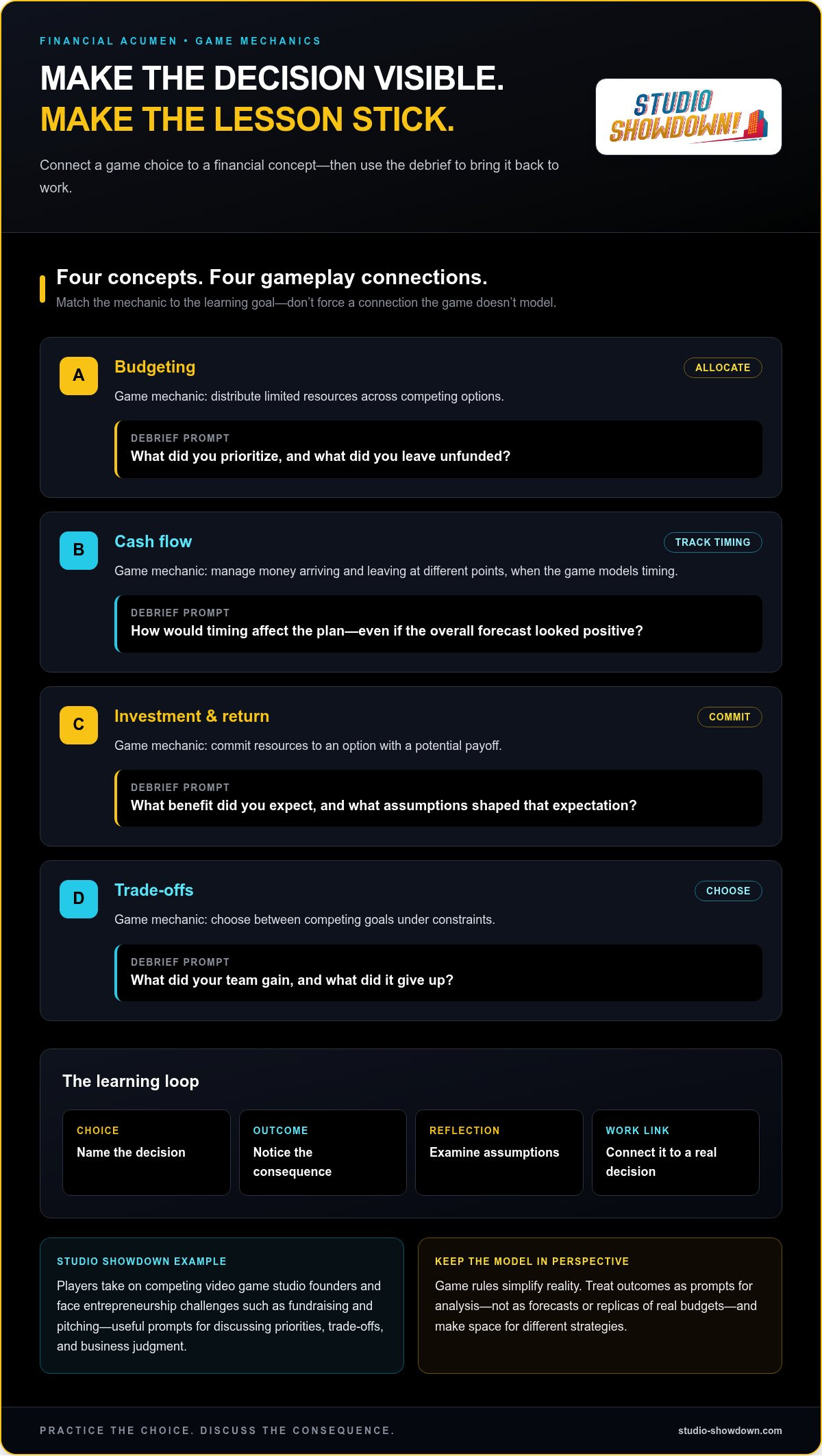
Look for a clear link between the concept and the gameplay. A resource limit can prompt budgeting choices. A sequence of incoming and outgoing funds can illustrate cash-flow timing. An investment decision can ask players to weigh a possible benefit against what they commit. Not every game models every concept, so match the mechanic to the learning goal instead of forcing a connection.
| Financial concept | Possible game mechanic | Workplace discussion prompt |
|---|---|---|
| Budgeting | Allocate limited resources across competing options | What did you prioritize, and what did you leave unfunded? |
| Cash flow | Manage money arriving and leaving at different points, if the game models timing | How would timing affect the plan, even if the overall forecast looked positive? |
| Investment and return | Commit resources to an option with a potential payoff | What benefit did you expect, and what assumptions shaped that expectation? |
| Trade-offs | Choose between competing goals under constraints | What did your team gain, and what did it give up? |
Use feedback and consequences without oversimplifying finance
Outcomes give participants a chance to inspect their reasoning. If a choice produces an unexpected result, ask what the team assumed, what information it used, and what it might change next time. Make room for different strategies rather than relying on hindsight or searching for a single “correct” answer.
Keep the model in perspective. Game rules simplify company finances and can’t represent every market condition, internal dependency, or uncertainty. Treat the result as a prompt for analysis, not a forecast or replica of a real budget. Ask questions such as, “Where might a similar trade-off arise in our work?” and “What additional information would we need before deciding?”
For a tangible example, Studio Showdown puts players in the role of competing video game studio founders facing entrepreneurship challenges such as fundraising and pitching. The scenario can open a discussion about business choices, while a debrief connects those choices to the concepts the group is exploring. Explore the Studio Showdown board game as one tabletop option for bringing business decisions into the conversation.
Compare Games for Teaching Financial Acumen to Employees
The right format depends on what employees need to practise, how much time the session allows, and what you want them to discuss afterward. Compare games for teaching financial acumen to employees by the decisions they involve, interaction, facilitation needs, replayability, and debrief potential. A lively game may hold attention, but entertainment alone doesn’t make it useful learning. Look for mechanics that surface meaningful choices and leave time to examine them.
Which game format fits your team’s learning goal?
Each format creates a different experience. Use this comparison to match the activity to your goal, group, and session design.
- Tabletop strategy games: Tactile and social, these bring participants together around shared rules and decisions. They can make negotiation and trade-offs visible, and replaying a scenario may let teams try a different approach. A facilitator can help draw out the financial ideas behind the play.
- Digital business simulations: These can present structured scenarios and let participants revisit choices within the simulation’s rules. They may suit practice involving a sequence of decisions, though a facilitator still needs to connect the model’s outcomes to the organization’s context.
- Scenario exercises: A short business situation asks participants to analyze or resolve a decision. This format can focus on a specific challenge. Replayability depends on whether the exercise includes alternative scenarios or new information.
- Facilitated workshops: These combine guided activities with discussion and can be adapted to a specific learning goal. Their impact depends on session design and facilitation, so make room for participants to explain their reasoning, not just hear answers.
Studio Showdown Board Game is a tabletop option in which players take the role of competing video game studio founders and encounter entrepreneurship challenges, including fundraising and pitching. The premise can support a discussion of business trade-offs. A facilitator can guide the group toward the financial questions most relevant to the session. Explore the Studio Showdown Board Game as a hands-on option for a team learning conversation.
What should buyers evaluate before choosing?
Start with the skill or decision employees need to practise. Then check whether the activity brings that concept into play. If the goal is budgeting, participants should make resource choices. If it’s investment thinking, they should weigh a possible benefit against a commitment. A finance theme in the story isn’t enough if players never make the relevant decision.
Next, assess practical fit: group size, session length, facilitator capacity, and participants’ familiarity with games. A format with complex rules may need more explanation; an unfamiliar style may benefit from a quick, low-pressure introduction. Most importantly, reserve time to discuss the choices and their workplace relevance. Ask what participants prioritized, what they would change, and where a similar decision arises in their work. That discussion helps turn a fun activity into purposeful practice.
How to Run a Workplace Finance Game That Leads to Discussion
A well-run finance game needs more than clear rules and an enthusiastic group. Give the activity a focused purpose, make the decisions observable, and guide participants from what happened in play to choices they face at work. This keeps games for teaching financial acumen to employees tied to a learning goal instead of letting the session stop at entertainment.
Prepare the session around one clear financial objective
Choose one priority, such as allocating resources, weighing an investment trade-off, or exploring business decision-making. Tell participants what to notice, not what conclusion to reach. Before the session, review the rules and materials, plan how groups will be formed, and assign someone to facilitate, keep play moving, and capture useful observations. Set aside time for discussion as well as gameplay.
- Set the goal. State the financial idea the activity will surface. For example: “Notice what your team prioritizes when resources are limited.” Keep the framing brief so it directs attention without turning the opening into a lecture.
- Explain the play. Cover the objective, core rules, and how participants make decisions. Before starting, make sure everyone understands what to do. Unclear rules can distract from the choices you want the group to examine.
- Observe decisions. Watch for moments when teams make trade-offs, change direction, or rely on an assumption. Note what prompted a choice and who contributed. Avoid interrupting every decision to teach. Let the activity unfold, then save questions for the debrief.
- Debrief the choices. Ask what mattered most, what information the team used, and what it would reconsider. Invite more than one perspective. Focus on reasoning and consequences rather than labeling an approach right or wrong.
- Apply the discussion. Ask where similar choices show up in participants’ roles and what differs in real work. Close with one practical takeaway, such as a question to bring to the next resource-planning discussion.
Debrief decisions and connect them to work
A structured debrief gives participants a chance to examine decisions and relate them to workplace situations. Ask which trade-offs shaped their choices, what information they wished they had, and whether another team’s approach changed their thinking. Then invite them to identify decisions they can influence in their own roles, from proposing a project to deciding how to use team resources.
Keep the application specific without promising that one session will change performance. A useful closing question is: “What will you look for next time a decision involves limited resources or an uncertain return?” Readers exploring business-game learning can also look for the guide The Ultimate Business Board Game: Master Entrepreneurship in 2026.
For a tabletop activity built around business decisions, explore Studio Showdown, where players take on the role of competing video game studio founders and face entrepreneurship challenges such as fundraising and pitching.
Where Studio Showdown Fits in an Employee Learning Roundup
Among games for teaching financial acumen to employees, Studio Showdown is a tabletop strategy game built around entrepreneurship and business decisions. Players act as video game studio founders, competing as they navigate challenges that include fundraising and pitching. This gives a team a shared scenario to respond to rather than a set of isolated finance questions.
Its fit is specific. It can suit teams looking for a social, competitive activity that opens discussion about business decisions. Use it when entrepreneurship and strategic choices match the session’s purpose, then guide the discussion toward the trade-offs participants noticed. As with any game, keep the scenario distinct from the complexity of real company finances.
What makes Studio Showdown relevant to business learning?
The game places participants in the role of founders launching competing studios. Fundraising and pitching provide concrete business challenges for teams to discuss how they make a case, respond to constraints, and think strategically. Those moments can prompt broader conversations about assumptions and competing priorities. The facilitator can connect the conversation to the learning objective the group has chosen.
How to decide whether it suits your team
Start with the intended learning objective. If your team wants to practise detailed accounting procedures, a founder-focused strategy game is not a close match. If the goal is to explore entrepreneurship decisions through shared play and discussion, the game’s premise is more relevant. Also consider whether participants will enjoy a competitive board-game format and whether the session allows time for both play and reflection.
Before choosing, clarify what you want the group to take away:
- Business strategy: Use the founder scenario to discuss how teams assess options and make choices.
- Fundraising and pitching: Focus discussion on how participants approach those specific entrepreneurship challenges.
- Workplace relevance: Ask where comparable decisions arise in your organization, without assuming the game mirrors those decisions exactly.
A debrief connects the activity to the learning goal. Ask what shaped each team’s approach, which assumptions influenced its choices, and what participants would want to know before making a similar decision at work. Keep the discussion anchored in examples employees can recognize, while distinguishing the game’s scenario from the complexity of real business conditions.
For more context on the strategic side of business-game learning, explore Beyond the Easy Money Game: Why Strategy Wins in 2026. Comparing that perspective with your team’s goals can help you decide whether a competitive studio-founder scenario fits the learning experience you want to create.
Put Business Decisions on the Table
Pick one decision your team wants to examine, then build a learning session around it. That simple step turns games for teaching financial acumen to employees into a purposeful experience instead of an activity chosen only because it’s fun. Give participants room to try an approach, explain their thinking, and consider how they might handle a similar challenge at work.
If a shared, strategic format suits your goal, Studio Showdown offers a scenario for that conversation. Developed by VGCD Academy and DEMYSTIFIED Studios, the board game casts players as video game studio founders facing entrepreneurship challenges, including fundraising and pitching. Use those moments as a starting point for discussion, alongside any financial training your team specifically needs.
Explore Studio Showdown and bring business strategy to the table. Choose a clear objective, invite your team into the challenge, and make the debrief count. The next useful business conversation can start with a game.
Frequently Asked Questions
Can games improve employees’ financial acumen?
Games can give employees a chance to practise financial thinking, but playing alone doesn’t guarantee lasting improvement. Choose an activity with decisions that relate to the learning goal, set aside time to discuss the reasoning behind those decisions, and consider how participants can apply the ideas later. For example, after a team makes a resource-allocation choice in a game, ask how it would evaluate a comparable proposal at work and what information it would need.
What financial concepts can employees learn through business games?
Depending on the game, employees can explore budgeting, cash-flow timing, investment trade-offs, costs, revenue, and return on investment. A team might compare whether to spend limited resources on improving a product or promoting it, then discuss what assumptions could affect each option. Treat the activity’s rules as a simplified model, and make sure the concept you want to teach is part of the decisions participants actually make.
How do you choose a financial literacy game for workplace training?
Begin with a decision employees need to understand better, then choose a format that lets them practise it. Compare the concepts covered, level of interaction, setup demands, replay options, and usefulness for discussion. Account for session time, group size, participants’ comfort with games, and who will facilitate. Finally, consider how to explain the activity’s relevance to employees’ responsibilities without overstating how closely gameplay reflects work.
Are board games effective for adult employee training?
Board games can support adult learning when the rules are clear, decisions connect to a relevant objective, and participants have space to reflect. Their shared, face-to-face format can make different viewpoints easier to hear. Because not every employee enjoys competition, explain that the goal is to examine choices, not judge individuals. Invite participants to discuss team reasoning rather than focus only on who won.
How should a facilitator debrief a financial game?
Start by asking participants to recall a specific decision, then explore what information, assumptions, or priorities shaped it. Invite another team to describe a different approach and what it might have changed. Finish by asking where a similar choice could arise at work and what additional context would matter. Capture one takeaway the group can use in a future discussion rather than promising a particular performance result.
Can Studio Showdown be used for employee learning?
Yes. Studio Showdown can serve as a shared business-decision activity for employees, particularly when the session includes a facilitated discussion afterward. Use it to prompt reflection on participants’ reasoning and how they respond to business challenges. Pair it with accounting instruction or training on a specific company process when those are the learning goals. Its entrepreneurship focus makes it most relevant when that subject matches the session objective.
What is the difference between a business simulation and a financial literacy game?
A business simulation usually places participants in a company or management scenario, where connected decisions can affect the simulated business. A financial literacy game may focus more narrowly on understanding or practising concepts such as budgeting, borrowing, or investing. The categories can overlap. For example, a business game might involve allocating resources, while a financial literacy activity could ask players to compare costs and expected benefits.