A group project rarely goes off course because students lack ideas. It loses momentum when the work is invisible: one person carries the load, roles blur, or a disagreement turns personal. If you’re wondering how to manage group dynamics in student projects, start by making expectations, contributions, and decisions visible.
It’s frustrating when effort feels uneven or nobody knows who owns the next step. Clear structure doesn’t limit creativity; it gives every teammate room to contribute. Agree on what “done” means, set realistic milestones, and make it easy to raise concerns before they become conflicts.
This guide explains how to set shared expectations, divide responsibilities fairly, choose communication routines, and handle disagreements without losing momentum. It also covers ways to keep in-person, hybrid, and virtual teams aligned with regular check-ins and clear next steps. The goal is a finished project built on shared responsibility, productive discussion, and contributions the whole team can stand behind.
Key Takeaways
- Make team expectations visible with a brief agreement on participation, respectful discussion, and communication.
- Address uneven contributions by describing specific actions and their effect on the project, not by labeling a teammate.
- Learn how to manage group dynamics in student projects with a simple rhythm for setting goals, assigning ownership, checking progress, and adjusting.
- Use reflection to help teammates notice habits and choose one concrete way to improve their collaboration.
- Compare project work with low-stakes classroom simulations as different ways to practise communication and decision-making.
How to manage group dynamics in student projects from day one
Group dynamics are the interaction patterns that shape how a team works: who speaks, how decisions get made, and whether people follow through. The term describes more than individual personalities. As the overview of Group dynamics explains, it concerns how people behave and influence one another within a group. In a student project, patterns can appear quickly: one person takes on too much, messages get crossed, quieter members stop contributing, or competing ideas stall a decision.
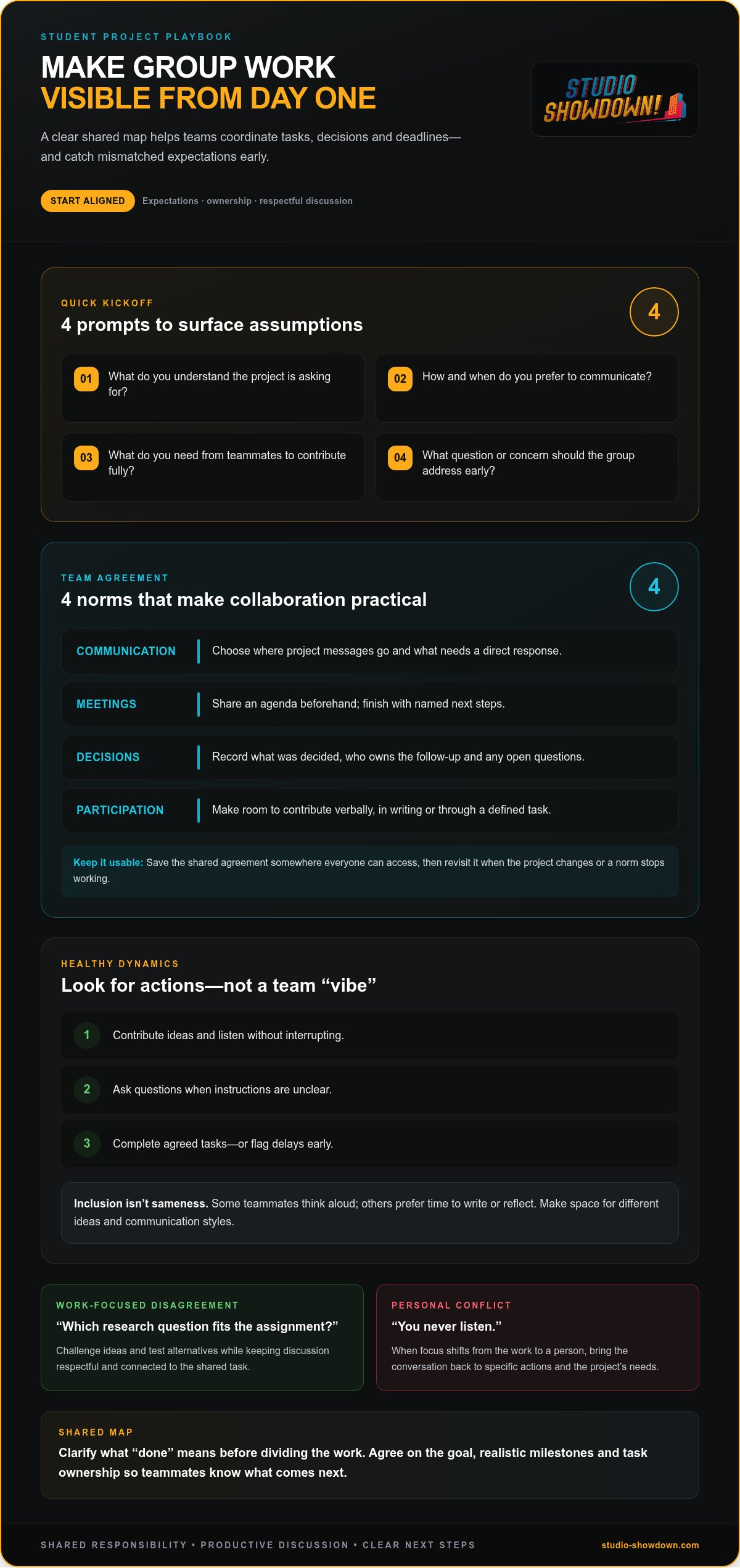
Not all friction is a warning sign. A productive disagreement focuses on the work: “Which research question fits the assignment?” Personal conflict shifts the focus to the person: “You never listen.” Teams need room to challenge ideas and test alternatives. The goal isn’t to eliminate tension; it’s to keep discussion respectful and connected to the shared task.
Clear expectations give every teammate a shared map for coordinating tasks, decisions, and deadlines.
Make that map practical from the start. Before dividing up the work, read the assignment together and agree on what the finished project needs to include. Ask each person to explain their understanding of the goal. If answers differ, clarify the requirements before confusion spreads into missed tasks or conflicting drafts.
A short kickoff can surface assumptions without becoming a lengthy planning session. Ask each teammate to share:
- What they understand the project is asking for.
- How and when they prefer to communicate.
- What they need from teammates to contribute fully.
- One question or concern they want the group to address early.
What healthy group dynamics look like in a student team
Look for actions, not a particular team “vibe.” Members contribute ideas, listen without interrupting, ask questions when instructions are unclear, and complete agreed tasks or flag delays early. Inclusion means making space for different ideas and communication styles. Some students think aloud; others prefer time to write or reflect before responding. Agreement on every choice isn’t necessary. Respectful discussion is.
Why student project teams run into friction
Unclear goals, deadlines, or task ownership leave room for different assumptions. One student may think a draft is due for feedback, while another expects a final version. Work habits and confidence levels can also shape who volunteers, speaks up, or waits for direction. There’s rarely just one cause. Check what’s happening before deciding why: ask a quiet teammate for input, or clarify who owns a task and what “finished” means.
That early check matters in in-person and remote teams alike. A pause in a meeting or a delayed message doesn’t automatically mean someone is disengaged. They may need a clearer prompt, another way to contribute, or a reminder of the agreed next step. Treat observations as information, not proof of intent. This keeps the project conversation open and gives the team a chance to fix its process before a small mismatch becomes a bigger dispute.
Build trust, inclusion, and shared direction before problems grow
Trust doesn’t require instant closeness. It grows when teammates know they can ask a basic question, flag a concern, or suggest a different approach without being mocked or dismissed. That sense of psychological safety gives the group room to catch misunderstandings early. It doesn’t mean every idea must be accepted; it means people can explain and examine ideas respectfully.
Shared goals give a team its direction; clear communication helps every member move toward it together. A short team agreement makes that direction practical, whether students are working around one classroom table, on a large project, or online between classes.
Create team agreements students can actually use
Keep the agreement brief enough to revisit. Ask each person what helps them participate, then agree on a few clear norms for communication, meetings, and decisions. Record the final choices somewhere everyone can access, such as a shared document or project notebook. The point isn’t paperwork. It’s a common reference when different assumptions surface.
- Communication: Choose where project messages go and what needs a direct response.
- Meetings: Set a simple norm, such as sharing an agenda beforehand and ending with named next steps.
- Decisions: Record what the group decided, who owns the follow-up, and any open questions.
- Participation: Agree that members can contribute verbally, in writing, or through a defined task.
Fit the process to the team. Younger students may benefit from sentence starters such as “I’d like to add…” or “I see it differently because…”. Older students can draft norms themselves and assign someone to capture decisions. A small group may agree aloud; a larger team can gather suggestions first, then combine similar expectations. Online teams can use the same principles in a shared document or chat.
An agreement is a working tool, not a contract frozen on the first day. Revisit it when the project changes, a communication channel stops working, or someone’s circumstances affect participation. Ask, “Which norm is helping us, and what should we adjust?” That keeps the conversation focused on the process, not blame.
Make participation inclusive without forcing sameness
Equal participation doesn’t require everyone to speak in the same way or take on identical tasks. Offer different routes into the work: researching, drafting, speaking, designing, or presenting. During a discussion, try a round-robin prompt so each person has an opening, or give everyone quiet time to write ideas before anyone responds. These formats can make space for students who need time to organize their thoughts.
Facilitators can invite quieter members without putting them on the spot. Instead of demanding an immediate answer, try: “We’ve heard a few options. Would you like to add a thought now, or share one in the group document?” Then allow time and accept either choice. Inclusion means making the invitation real, not forcing disclosure or treating silence as agreement.
For a hands-on classroom activity about collaboration and decision-making, educators can use the Studio Showdown Board Game to prompt discussion about how a team shares ideas and makes choices.
Handle uneven contributions and disagreement fairly
Fair accountability starts with evidence, not assumptions. A teammate may be behind because a task was unclear, a deadline was missed, or the workload changed. Before deciding what happened, compare the team’s agreed plan with what’s been completed. Focus on observable actions and their effect on the project, not labels such as “lazy” or “controlling.”
Not every disagreement needs escalation. A difference about which source to use or how to organize a presentation is usually a task disagreement the team can work through. Repeatedly ignoring agreed responsibilities, shutting down someone’s participation, or making personal remarks points to a behavior issue that may need more support.
Solvable task disagreement
Recurring behavior problem
Members offer different ways to complete a specific task.
A member repeatedly misses agreed tasks or prevents others from contributing.
The discussion stays focused on options, evidence, and the project goal.
The same conduct continues after expectations have been clarified, affecting trust or progress.
Compare the options, choose a decision method, and record the next step.
Describe the pattern and its impact; seek educator support if it persists or involves safety or harassment.
What to do when work is not being shared evenly
First, check whether everyone understood the task, workload, and deadline. “Finish the research” can mean different things to different people. Make responsibilities visible by naming each task, its owner, its due date, and what counts as complete. Keep a neutral record of assignments and progress in a shared document or project tracker. That creates transparency without turning the record into a scorecard.
If the split still feels uneven, raise it directly and calmly: “The research summary is still unfinished, and we need it to build the presentation. Can we clarify what’s blocking it and adjust the plan?” Rebalance specific tasks together. Fairness doesn’t always mean identical tasks; it means a reasonable contribution that fits the project’s needs, agreed responsibilities, and each student’s capacity. Check in again after the adjustment.
How to disagree without derailing the project
Bring the conversation back to the shared goal before comparing solutions: “We need a clear presentation supported by reliable evidence. Which outline gets us there?” Agree on a decision method in advance, such as choosing the option that best meets the assignment criteria, seeking consensus, or voting when time is limited. Set a time limit so discussion leads to action instead of circling the same points.
A practical part of how to manage group dynamics in student projects is knowing when a team can resolve an issue and when it needs help. For repeated exclusion, harassment, safety concerns, or participation problems the team can’t resolve, document the specific behavior and its impact, then bring the concern to the educator. Asking for support protects the project and the people doing the work.
Use a simple project rhythm to keep student teams on track
A team can have clear expectations and still lose momentum if nobody knows what happens next. A repeatable project rhythm keeps the work moving without adding layers of process. It helps students spot a delay, make a decision, and adjust before a small blocker affects the whole project.
Define the goal, name an owner for each task, check progress, adjust the plan, and reflect before the next stage.
- Define the goal. Turn the assignment into a clear outcome and identify the next deliverable, such as a research summary, prototype, or presentation outline.
- Assign ownership. Break that deliverable into concrete tasks. Name one owner for each task, even if others will contribute, so responsibility stays visible.
- Check progress. Ask what’s complete, what comes next, and what’s blocked. Keep the focus on information the team can act on.
- Adjust. Reassign or reshape work if a task is larger than expected, a dependency is delayed, or the project goal has shifted.
- Reflect. At a milestone, identify one thing the team should keep and one process change to try in the next stage.
Assign roles and tasks around the project goal
Start with deliverables, not labels. “Researcher” or “leader” can become a default identity if the same student gets the role every time. Instead, list the work the project requires, then match students to tasks that support both the outcome and the learning goals. Rotate coordination or presentation duties when appropriate, so students can practise different responsibilities without forcing everyone into the same contribution.
For each task, record its owner, due date, and a short description of what complete looks like. For example, “Gather three relevant sources and add a brief note on how each supports the project question” is easier to act on than “work on research.” Keep the task list, decisions, and next steps in one shared place, whether that’s a class document, project board, or notebook. One source of truth cuts down on conflicting versions and forgotten agreements.
Run check-ins that lead to decisions
A check-in should create movement, not just a round of updates. Ask each member: What’s complete? What’s next? What’s blocked? If someone names a blocker, decide who will help, what needs to change, and by when. Close by recording each next action beside its owner. For remote or hybrid teams, members can answer these prompts in writing before a meeting, leaving discussion time for decisions.
Use milestone reviews to look beyond the task list. Ask what made collaboration easier, where handoffs broke down, and what one adjustment could improve the next stage. Keep the change specific, such as sharing draft sections earlier or recording decisions immediately. This repeatable approach to how to manage group dynamics in student projects gives students a structure they can adapt without turning every check-in into a long meeting.
For a hands-on way to explore teamwork and decision-making, explore the Studio Showdown Board Game as a classroom activity.
Practise collaboration through reflection and classroom simulations
A project ends, but the team habits that shaped it can carry into the next one. Reflection helps students notice what actually happened, not just whether they liked the final result. A team may have delivered strong work while relying on last-minute coordination, or struggled early before finding a better way to share ideas. Naming those patterns gives students something specific to build on.
Turn a team experience into a useful reflection
Keep reflection focused on actions rather than personalities. Ask which team behavior helped the work move forward and why. Then consider whose ideas were heard, how the team made decisions, and what made participation easier or harder. Have each student name one observable habit to carry into the next project, such as sharing a draft earlier or asking for input before a decision is final.
Students can respond privately first, then share a point with the team if they’re comfortable. This gives everyone time to think and helps prevent the discussion from becoming a general verdict on who was “good” or “bad” to work with. Close by choosing one shared adjustment to test next time. Keep it small enough to notice, such as inviting written feedback before a meeting or recording the reason behind a major decision.
Compare project practice with a classroom simulation
Real projects let students practise with authentic course goals, real deadlines, and the complexity of working together over time. That realism is valuable, but it can make it harder to pause and examine a team’s choices while the work is underway. A simulation offers a bounded, lower-stakes setting to discuss decisions as they happen, though it can’t reproduce every pressure or relationship found in a longer project. The two approaches can complement each other; neither replaces the other.
Studio Showdown is an entrepreneurship board game in which participants take the role of studio founders. Its hands-on learning experience includes fundraising and pitching. Use it as a prompt for discussion, not as a shortcut to better teamwork. Ask students what information shaped a decision, how teammates communicated their ideas, and whether everyone had an opportunity to contribute. One round can prompt useful observations, but it doesn’t show how a group will behave in every project.
Afterward, connect observations to the students’ own work without forcing a direct comparison. Ask whether the group shared reasons for its choices, how it handled different suggestions, and what it might try during its next project discussion. This makes the activity a starting point for reflection, not a test of who is naturally good at collaboration. It also gives students a concrete moment to examine before choosing one habit to practise.
Pairing reflection with practice gives students a repeatable way to apply how to manage group dynamics in student projects: notice a behavior, discuss its effect, choose a practical adjustment, then see how that change works in the next task. Educators can explore Studio Showdown as an entrepreneurship-based classroom discussion activity.
Put one small team habit into practice
The next project doesn’t need a perfect plan. It needs one deliberate first move. Before work begins, invite every teammate to name what helps them contribute, then agree on one habit the team will practise, such as recording decisions or asking for input before settling on an idea.
That’s a practical starting point for how to manage group dynamics in student projects: treat collaboration as something a team can observe, discuss, and refine together. A classroom simulation offers another setting for exploring how groups communicate and make choices. Studio Showdown is an educational strategy board game about video game development and entrepreneurship, developed by VGCD Academy and DEMYSTIFIED Studios. Its hands-on experience includes fundraising and pitching.
Bring that curiosity into your classroom with Explore Studio Showdown. Each project gives students another chance to shape a team process that works for them. Start with one clear habit, learn from what happens, and keep building from there.
Frequently Asked Questions
How do you deal with a student who does not contribute to a group project?
Start with a private, curious conversation rather than a public accusation. Ask whether the student understands the assignment and can complete the part they agreed to do. A missed contribution may reflect a practical barrier, not unwillingness. Agree on one manageable next step, such as sending a source or draft by a specific date. If the pattern continues, share the documented concern with the teacher instead of letting resentment build.
What should students do when group members disagree?
Pause and identify what the disagreement is about: the project goal, evidence, workload, or a preferred approach. Ask each person to explain their reasoning, then compare options against a shared criterion, such as which one best answers the assignment prompt. If neither option clearly wins, test a small part of each or ask the teacher to clarify the requirement. Keep the discussion focused on ideas, not motives.
How can teachers make group projects fair for every student?
Teachers can make expectations and assessment criteria visible before teams begin, then check both the final product and how students contributed to it. For example, a shared project grade can assess the outcome while a brief individual reflection lets each student explain their decisions and work. Build in private ways to flag concerns, too. This gives teachers context to investigate uneven participation without relying only on the loudest account.
Should students choose their own groups for projects?
It depends on the purpose of the assignment. Student-chosen groups may feel comfortable for a short task, while teacher-formed teams can help broaden collaboration beyond familiar friends or balance relevant experience. A middle path works well for some projects: let students state a preference or strength, then have the teacher make final groups. Whatever the method, give the team a clear task and a way to address participation concerns.
How often should student project groups meet?
Meet when the work needs coordination, not simply to fill a calendar. A team combining research from several members may need a brief meeting before merging drafts; a task completed independently may only need a written update. Set the next check-in around a real milestone or decision. If the team can’t name what it needs to resolve, an asynchronous update may be more useful than another meeting.
What roles should students have in a group project?
Choose roles that serve the assignment, such as coordinating a meeting, checking sources, organizing materials, editing a draft, or presenting. Some roles can be shared, and the team may not need every role on every project. Make responsibilities specific: an editor might check that claims have supporting evidence, not simply “make it better.” Rotate roles across projects so one student doesn’t always handle the same visible or behind-the-scenes work.
Can games help students practise teamwork?
A game can give students a shared scenario in which to notice how they exchange ideas, respond to competing priorities, and reach decisions. Treat it as a conversation starter, not proof that a team will work well on a graded assignment. After playing, ask what helped the group move forward and what it would try differently next time. Keep the discussion grounded in observed actions rather than fixed judgments about personalities.