What if the best way to break down departmental silos is to give people a shared problem to solve? The right cross-functional collaboration games do more than break the ice: they let colleagues practise listening, comparing priorities and making decisions together. The key is choosing an activity connected to a real collaboration challenge, rather than relying on forced fun.
A well-chosen game gives people from different roles a low-pressure way to contribute. A focused debrief then turns the experience into observations the team can use beyond the activity. Without that link, even an entertaining game can feel disconnected from everyday work.
This guide will help you match a game to your team’s collaboration challenge, facilitate it for a range of personalities and group sizes, and debrief it for practical takeaways. You’ll also see how a structured tabletop strategy experience like Studio Showdown, which explores decisions in video game development and entrepreneurship, can support hands-on learning. The goal is to rehearse shared work, then identify a practical behaviour to try next.
Key Takeaways
- Use cross-functional collaboration games to notice how different roles communicate, share information and approach competing priorities.
- Match the activity format to your goal, from practising clear handoffs to discussing broader strategic decisions.
- Frame the game as a practice space, not a performance test or a way to rank departments.
- Connect the activity to action: set a goal, facilitate the challenge, debrief what happened and follow up at work.
- Consider a tabletop strategy game such as Studio Showdown to explore shared decisions in video game development and entrepreneurship.
Why cross-functional collaboration games need more than an icebreaker
A quick icebreaker can help people feel at ease, but easing into a conversation is different from practising how to work through one. Cross-functional collaboration games bring people with different roles or expertise together around a facilitated challenge. Shared constraints make their choices, communication and assumptions easier to notice.
A cross-functional collaboration game is a facilitated exercise where people with different expertise practise listening, sharing information and making decisions together. Workplace teams and classrooms can use one to explore how collaboration happens. The activity is a starting point for discussion, not proof that everyday habits have changed.
What makes cross-functional collaboration different?
Departments often bring distinct knowledge, language, responsibilities and measures of success. A product team may focus on user needs, while finance watches costs and operations considers what can be delivered. Each perspective can be valid, yet dependencies and handoffs can be missed when people plan only within their own area.
A shared challenge brings those connections into view. Imagine a group planning a product launch with limited time and resources. Marketing might propose a campaign before operations has clarified what can be delivered. The example illustrates how an activity can reveal unspoken assumptions; it isn’t a prediction of workplace results.
What should a useful collaboration game achieve?
The goal isn’t to crown the fastest solver or manufacture a burst of fun. A purposeful activity gives participants a specific behaviour to practise and discuss. Look for observable actions such as:
- Listening to information from another role before settling on a solution.
- Asking clarifying questions instead of relying on assumptions.
- Combining perspectives and explaining how the group reached a decision.
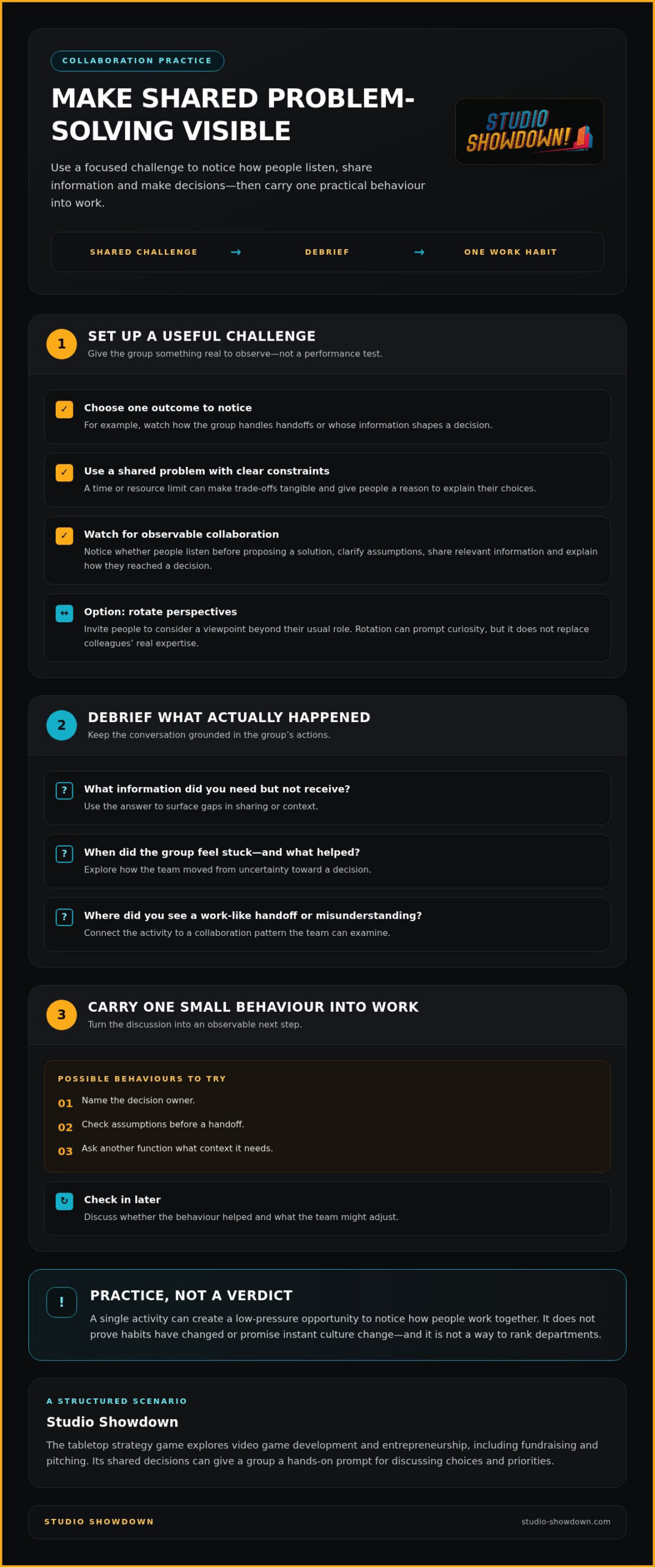
Before starting, choose one outcome to observe, such as how the group handles handoffs or whose information shapes a decision. In the debrief, ask what helped, where perspectives were missed and what the team might try in an upcoming project. Treat the game as practice, not a performance test or departmental ranking. Linking it to a real team need helps the activity feel purposeful.
Cross-functional collaboration games can surface patterns for teams to examine, but a single activity can’t promise instant culture change. Its value is in creating a clear, low-pressure opportunity to notice how people work together and identify one behaviour to carry forward.
How collaboration games help teams practise shared problem-solving
A useful activity creates a small, focused version of a challenge the group can unpack together. Participants encounter a shared problem, exchange information, make a decision and reflect on how they reached it. The task gives the group something to do; reflection connects what happened to how they work together.
Enjoyment can bring people into an activity; deliberate collaboration practice helps them notice how they listen, share information and decide together. Cross-functional collaboration games make those behaviours easier to discuss, but one session doesn’t prove that a person or department has changed for good. The activity is a rehearsal, not a verdict.
Which behaviours can a shared challenge make visible?
As a group works through a task, a facilitator can watch for specific actions. Do participants listen before proposing a solution? Do they clarify what they don’t know? Do they share relevant information with the whole group, or assume others already have it? Can they negotiate priorities when each role sees a different risk?
Time or resource constraints can make these choices tangible. A group may need to decide which task to prioritize, what to set aside and whose expertise should shape the next move. The point isn’t to create pressure for its own sake. A clear constraint gives participants a reason to explain trade-offs and make a decision together.
Role rotation offers another perspective. Invite participants to temporarily consider a viewpoint beyond their usual department, using a simple scenario or assigned perspective. Someone who usually focuses on delivery might consider the customer-facing impact; someone from planning might take on an operational concern. Rotation can prompt curiosity, but it doesn’t replace colleagues’ real expertise.
Why the debrief turns an activity into learning
Without a debrief, participants may remember the challenge but miss what it revealed about how they work. Keep the conversation grounded in what the group actually did. Ask:
- What information did you need but didn’t receive during the activity?
- When did the group feel stuck, and what helped it make progress?
- Where did you see a handoff or misunderstanding like one that can happen at work?
Then choose one behaviour to try in the next real project, such as naming the decision owner, checking assumptions before a handoff or asking another function what context it needs. Keep the action small and observable. At a later check-in, discuss whether it helped and what to adjust.
In an educational setting, a structured strategy experience can give participants a shared decision-making scenario to discuss. Studio Showdown board game explores video game development and entrepreneurship, including fundraising and pitching. It can provide a hands-on prompt for examining how a group approaches choices and priorities.
Which cross-functional collaboration game format fits your team?
Start with the friction you want the group to explore, not the activity that looks most exciting. If teams struggle to pass information between roles, a short communication exercise may fit better than a complex strategy game. If they need to combine expertise or weigh competing priorities, choose a challenge that makes those behaviours part of the task.
Choose the format for the behaviour you want to practise, not entertainment alone. Compare cross-functional collaboration games by purpose, participation needs and the discussion they can prompt afterward.
Match the format to the collaboration challenge
Information-sharing exercises help teams practise clear handoffs. Creative design challenges suit goals that involve combining different perspectives into one concept. Strategy games give participants a shared scenario for considering trade-offs and making decisions together. Cooperative problem-solving can support several of these goals, particularly when the task depends on contributions from more than one role.
Use the table as a starting point, then adjust the activity to your group and available time.
| Format | Best-fit goal | Participation demands | Preparation | Debrief opportunity |
|---|---|---|---|---|
| Cooperative problem-solving | Coordinate around a shared task | Discuss, share clues or divide responsibilities | Set a clear challenge and shared rules | Explore how the group coordinated and used information |
| Creative design challenge | Combine different expertise | Offer, develop and refine ideas | Provide a prompt and simple materials | Discuss whose perspectives shaped the final concept |
| Strategy game | Consider trade-offs and shared decisions | Compare options and explain choices | Prepare the game and clarify its objective | Reflect on priorities and decision-making |
| Short communication exercise | Practise clear handoffs | Listen, clarify and relay information | Give concise instructions and roles | Identify where messages became unclear |
Choose an activity people can enter comfortably
Before selecting an activity, consider group size, accessibility, available time and materials, and how familiar participants are with games. Make room for different communication styles: allow quiet thinking time, invite written contributions or take turns speaking. Avoid challenges that rely on physical ability, personal disclosure or niche knowledge unrelated to the learning goal. The focus should be collaboration, not who already knows the rules.
For a strategy-based option, Studio Showdown Board Game offers a structured tabletop experience about video game development and entrepreneurship, including fundraising and pitching. It gives a group a concrete scenario for discussing choices and priorities. The game is an educational experience, not a guaranteed workplace intervention.
How to run a collaboration game and turn it into a work habit
A strong activity needs a clear start, active facilitation and a deliberate finish. Use this five-step sequence to keep cross-functional collaboration games focused on practice, not performance:
- Define the goal. Choose one behaviour to practise, such as sharing information across roles or checking assumptions before making a decision.
- Brief participants. Explain the purpose before the rules. Make clear that the activity is practice, not a test, a competition between departments or a ranking of individual performance.
- Facilitate. Keep instructions concise, set a clear time boundary and explain how people can contribute. Observe airtime, decisions and information-sharing without judging individuals.
- Debrief. Invite participants to describe what they noticed, including what helped the group and what created friction.
- Follow up. Agree on one action to try in an upcoming cross-functional task, then revisit it to discuss what the team learned.
Prepare and facilitate without making the game feel forced
Set the scene with a practical purpose: “We’re practising how we hand off information between roles.” Then introduce the activity. This order explains why the game matters and helps participants connect it to their work without overstating what one session can achieve.
During play, use neutral prompts such as “What information would help the group decide?” or “Whose perspective haven’t we heard yet?” These questions invite contributions without steering the team toward a preferred answer. Notice who speaks, how decisions take shape and whether useful information reaches everyone. Describe patterns, not people: “We moved to a decision before checking the delivery constraints,” rather than “Operations held us back.”
Debrief, apply, and revisit the learning
Make the conversation specific. Ask what helped the group combine perspectives, where communication became difficult and what information arrived too late. Connect moments of confusion or progress to familiar work handoffs, without assuming the game perfectly mirrors a real project.
Close by choosing one action the team can test, such as confirming who owns a handoff or asking each function to name a key constraint before a decision. Agree when to revisit it. At that check-in, discuss what happened when the team tried the action and what it might change next time. Follow-through, not the game alone, creates an opportunity to turn an observation into a work habit.
For a structured tabletop strategy experience about video game development and entrepreneurship, Studio Showdown provides a hands-on learning option.
Use strategy games to make cross-functional learning concrete
A tabletop strategy experience gives a group a shared scenario for discussing choices, priorities and trade-offs. It can be useful when a learning session needs a concrete subject to explore, rather than an abstract conversation about teamwork. Players can reflect on how they approached decisions, while a facilitator connects the discussion to the group’s learning goals.
Studio Showdown is a strategy board game about video game development and entrepreneurship. It offers a hands-on learning experience for aspiring developers and educational audiences, including students, educators and parents. The game can support discussion and reflection, but it isn’t a guaranteed workplace intervention or a promise of specific collaboration outcomes.
Where Studio Showdown fits in a learning-focused session
The game explores fundraising and pitching in a video game development context. Educators can use that defined theme to help participants consider decisions involved in entrepreneurship, then discuss how they reached their conclusions. The subject itself offers a starting point for exploring business ideas and choices.
For educators, the best fit comes from linking the session to an existing learning goal. Before play, name the concept you want students to consider. Afterward, ask what they noticed and how it connects to that goal. The board game provides the hands-on experience; the educator shapes the learning conversation around it. Studio Showdown also offers an Educator Edition, Classroom Bundle and professional development workshops for educators implementing the game in a classroom.
Turn a game session into a shared reflection
Reflection keeps the focus on learning, rather than assuming participation alone has a lasting effect. Invite players to look back at the decisions they made and the information they used. Ask questions like these:
- Which decisions benefited from hearing different perspectives?
- How did the group handle uncertainty or competing priorities?
- What helped players communicate the reasons behind their choices?
Keep answers tied to what participants experienced. An educator might ask students to connect a choice in the game with an entrepreneurship concept they’re studying. A facilitator can invite a team to consider how different viewpoints shaped a discussion, without claiming the activity proves their everyday work habits have changed.
For more context on business-focused tabletop learning, explore this business board game guide. Readers interested in the broader category can also visit the strategy board games guide.
Studio Showdown is available as an individual board game, an Educator Edition and a Classroom Bundle for educational settings.
Bring one shared practice into your next team challenge
The strongest cross-functional collaboration games are built around a real team need. Choose a format that lets people practise a specific behaviour, whether sharing information, weighing priorities or making a decision together. Then protect time for a focused debrief and agree on one action to try in everyday work.
Follow-through matters. A game can make team habits easier to notice, but lasting change comes from what people choose to practise afterward. Keep the next step small, clear and relevant to an upcoming project.
Studio Showdown, developed by VGCD Academy and DEMYSTIFIED Studios, is a hands-on learning experience about video game development and entrepreneurship. Its focus on fundraising and pitching offers a concrete subject for discussion in educational settings and beyond.
Explore Studio Showdown as a hands-on learning experience, and bring a shared decision-making challenge to your next session.
Frequently Asked Questions
What are cross-functional collaboration games?
Cross-functional collaboration games are facilitated activities where people with different roles or expertise work through a shared challenge. They give participants a chance to practise exchanging information, clarifying assumptions and making decisions across perspectives. The activity might be a short communication exercise, a creative task or a strategy game. A debrief helps the group discuss what happened and identify a practical behaviour to try in everyday work.
Which games help different departments work together?
The best fit depends on the challenge. Communication exercises can help teams practise clear handoffs, while creative design challenges invite people to combine different expertise. Cooperative problem-solving activities and strategy games can prompt shared decisions and discussion of competing priorities. Choose a format that connects to the team’s needs, then leave time to reflect. A popular activity isn’t automatically useful if it doesn’t practise the behaviour the group wants to strengthen.
How do you make team-building games less awkward?
Explain the purpose before the rules, and connect the activity to a real team need. Make participation options clear, keep instructions concise and frame the game as practice, not a test or a contest between departments. Avoid activities that depend on personal disclosure, physical ability or specialist knowledge unrelated to the goal. A focused debrief helps participants understand why the activity mattered, rather than leaving them with an unexplained exercise.
Can collaboration games improve communication between departments?
Collaboration games can give people a low-pressure setting to practise listening, sharing relevant information and checking assumptions across roles. They can also make communication patterns visible for discussion, such as a handoff that lacked context or a decision made before all perspectives were heard. One session can’t guarantee lasting improvement. Connect observations to an upcoming project, agree on one behaviour to test, then revisit how it worked.
How long should a cross-functional collaboration game take?
There’s no single ideal duration. Plan enough time to explain the purpose and instructions, complete the activity and debrief what participants noticed. A short communication exercise may suit a limited session, while a more involved challenge needs room for discussion afterward. Don’t let gameplay crowd out reflection. Set a clear time boundary in advance and choose a format that fits the group’s schedule and learning goal.
How do you choose a collaboration game for a mixed group?
Start with the behaviour you want to practise, then consider group size, accessibility, available materials and time, and participants’ familiarity with games. Choose an activity that gives people different ways to contribute, including time to think or share ideas in writing. Clear rules and a relevant challenge can help newcomers participate. Avoid relying on niche knowledge or a single communication style, since those can distract from the collaboration goal.
Are strategy board games useful for collaboration activities?
Yes, strategy board games can give a group a shared scenario for discussing decisions, priorities and trade-offs. Their usefulness depends on how well the facilitator connects the experience to a learning goal and leads a thoughtful debrief. Studio Showdown, developed by VGCD Academy and DEMYSTIFIED Studios, is a hands-on learning experience about video game development and entrepreneurship, including fundraising and pitching. It can prompt discussion, but it doesn’t guarantee workplace change.