A polished game can still be one missing agreement away from an ownership dispute. Teaching game development business starts with a reality every founder needs to understand: legal risks often arise where creative work, collaborators, money, and player data change hands.
It’s easy to focus on the build, the pitch, and the launch while putting contracts and records aside. But unclear rights to code, art, music, or story can disrupt a team’s plans. Funding arrangements and player-data practices also deserve attention before questions become urgent.
This founder-focused checklist helps you spot common legal risk areas, understand why they matter, and plan practical next steps. It covers intellectual property, founder and contractor agreements, publishing and fundraising arrangements, and player data, including which records to review before launch and when a qualified legal professional should assess your situation. Studio Showdown explores decisions and pressures in game development and entrepreneurship. This article focuses on legal questions founders should examine.
Key Takeaways
- A playable prototype doesn’t establish who owns its code, art, or other creative assets. Map contributors and project materials before development moves further.
- Copyright, trademarks, and patents protect different things. Identify what your studio needs to protect, then review how agreements and applicable law affect ownership.
- Written founder, contractor, confidentiality, publishing, and licensing agreements can clarify expectations before a disagreement puts the project at risk.
- Use this teaching game development business checklist to organize questions about funding, taxes, player data, marketing claims, and launch readiness.
- Inventory records, document arrangements, prioritize potential blockers, and revisit open issues before fundraising, contracting, or launch. Get qualified legal review for situation-specific questions.
Common legal mistakes for game development startups begin before the first launch
A playable prototype shows that a game works. It doesn’t establish who owns the code, artwork, music, or name, who can make decisions, or how the people building it will share responsibilities. Those questions can arise before a studio has a publisher, revenue, or launch date.
This checklist focuses on common U.S. startup risk areas. It’s educational, not individualized legal advice: the right answer can depend on the team’s facts, written agreements, and applicable law. A video game developer may be an independent creator or part of a larger studio, but either way, creative production and business arrangements need to work together.
Consider a hypothetical indie team: one founder writes code, another creates character art, and a third coordinates production. They share files and agree in chat to “split things fairly.” If someone leaves or the team seeks funding, those informal assumptions may not clarify who owns each asset or who can approve a deal. Document ownership and responsibilities early, before uncertainty turns into a dispute.
What makes a game development startup legally different?
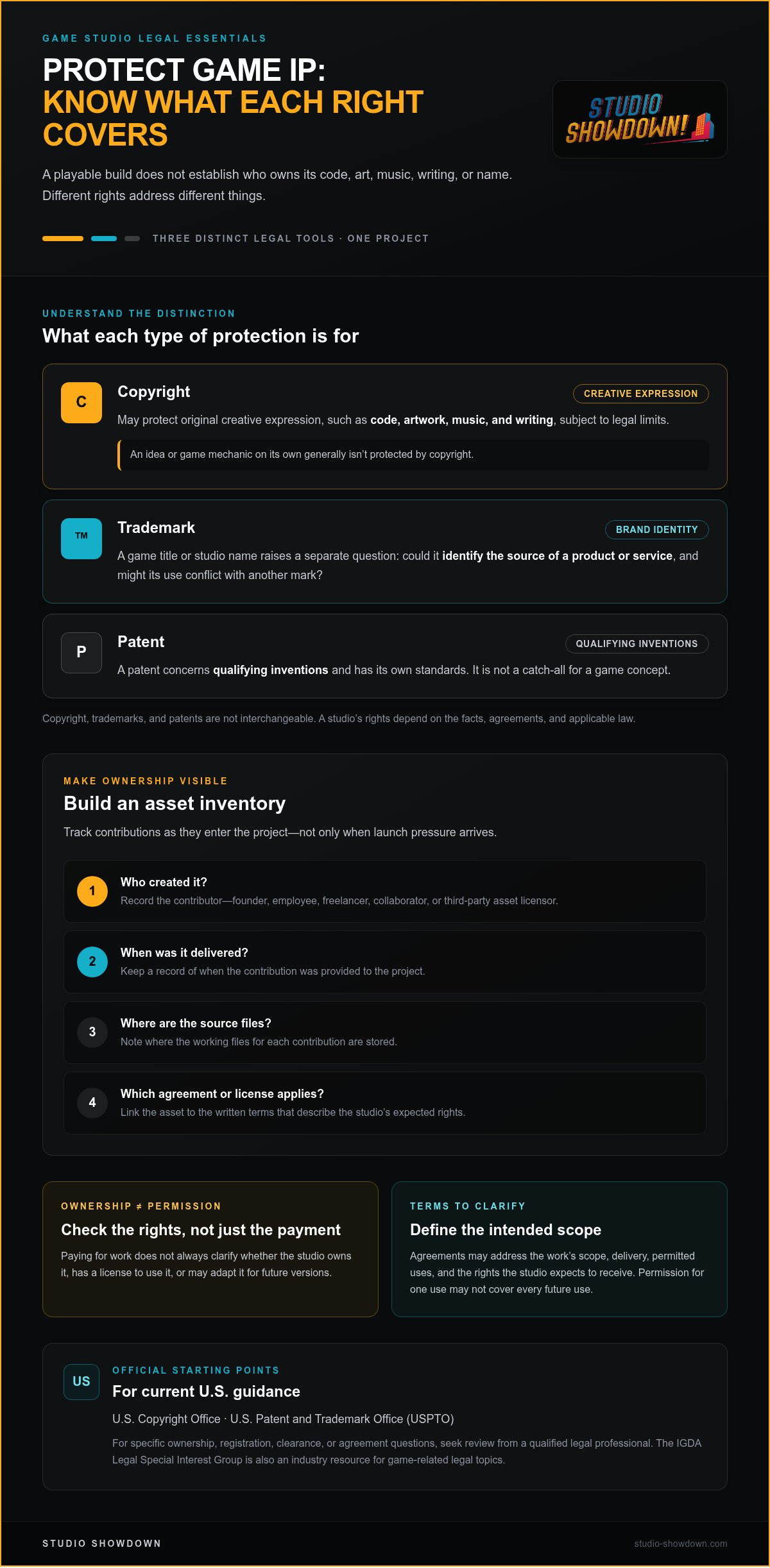
A game brings several kinds of creative and commercial work into one project: source code, artwork, music, writing, a studio or game name, and agreements with contributors. Different legal tools may apply to different parts. Copyright, trademarks, and patents aren’t interchangeable, and a studio’s rights depend on the facts, agreements, and applicable law.
The game itself also isn’t automatically the business that operates it. A team may develop a creative project together while separately deciding whether and how to form a company or another business arrangement. In our example, the game files, the team’s working relationship, and any future studio are connected, but they aren’t the same thing. Teaching game development business means helping students understand that distinction before commitments accumulate.
Which early decisions deserve a written record?
For the hypothetical team, a written record can turn broad assumptions into specific questions to resolve. Start by documenting:
- Each founder’s role, expected contribution, and ownership expectations.
- Who can make which decisions and how the team handles disagreements.
- What happens if a founder leaves, pauses work, or can’t continue.
- Which assets each person brings to the project and what they create for it.
A chat can capture an intention, and a shared folder can organize files, but neither necessarily establishes the ownership the team expects. Keep organized records of contributions and decisions, then review whether formal agreements are needed. Incorporation and tax choices also depend on the founders’ situation. Treat them as questions for qualified legal and tax professionals, not decisions to copy from another studio.
Protect game IP: avoid unclear ownership of code, art, and names
A studio can have a playable build and still lack a clear record of who may use its underlying assets. Copyright, trademarks, and patents address different kinds of rights, and none automatically settles every ownership question. Copyright can protect creative expression; a trademark helps identify the brand behind a game or studio.
For the indie team introduced earlier, imagine a freelancer creates character art while a founder writes code and another contributor supplies music. Paying for the work doesn’t always clarify whether the studio owns it, has a license to use it, or may adapt it for future versions. The answer depends on the facts, agreements, and applicable law. Written terms can make the intended scope of use clearer.
Who owns game code, art, music, and other contributions?
Build an asset inventory before release pressure sets in. Include work from founders, employees, freelancers, collaborators, and third-party asset licensors. For each contribution, record who created it, when it was delivered, where the source files are, and which agreement or license applies.
Agreements may need to address the work’s scope, delivery, permitted uses, and the rights the studio expects to receive. A license to use an asset isn’t necessarily the same as owning it, and permission for one use may not cover every future use. Have qualified counsel review agreements that affect important project rights. The IGDA Legal Special Interest Group is also an industry resource for exploring game-related legal topics.
When should a startup review copyright and trademark issues?
Review rights as assets enter the project, not only at launch. Copyright may apply to original creative expression, such as code, artwork, music, or writing, subject to legal limits. It doesn’t generally protect an idea or game mechanic on its own. A game title or studio name raises a separate trademark question: could it identify the source of a product or service, and might its use conflict with another mark? A patent concerns qualifying inventions and has its own standards. It isn’t a catch-all for a game concept.
Use the U.S. Copyright Office and the U.S. Patent and Trademark Office (USPTO) as starting points for current official guidance. For a specific ownership, registration, or clearance question, seek advice from a qualified legal professional. Teaching game development business can also mean helping students practice a useful habit: identify each asset, its contributors, and the written permission that governs its use. For a game-based look at studio decisions and entrepreneurship, explore Studio Showdown.
Game studio agreements: prevent founder, contractor, and publishing disputes
“We’ll figure it out later” can mean different things to different people. Imagine two founders agree verbally that one will build the game and the other will manage production, then hire a contractor and discuss a publishing offer. Without documented expectations, they may disagree about decision-making, payment, asset use, or what happens when someone leaves. A written agreement gives the team a shared reference point, though its requirements and enforceability can vary by jurisdiction and circumstances.
Teaching game development business includes showing how to turn goodwill into clear working expectations. The IGDA Legal Special Interest Group offers a starting point for exploring legal topics relevant to game developers, but it isn’t a substitute for having qualified counsel review a specific agreement.
Which founder and contractor terms are easy to overlook?
Before work begins, identify the subjects the team needs to resolve. Founder discussions can cover roles, compensation, decision rights, expected contributions, and what happens if someone exits. Contractor arrangements may need to address scope, payment, deadlines, deliverables, revisions, confidentiality, and intellectual-property rights. The aim isn’t to copy a generic template. It’s to surface gaps and have the right terms reviewed for the situation.
A checklist can guide the conversation, but it can’t replace a lawyer-reviewed agreement. Use it to prepare questions and make sure the final document reflects what the parties intend.
| Relationship | Key issue to document | Risk if unclear |
|---|---|---|
| Co-founders | Roles, decision authority, ownership expectations, and departures | Deadlock or disagreement over who can act for the studio |
| Contractors | Scope, payment, revisions, confidentiality, and rights to work | Disputes over deliverables, payment, or permitted use |
| Publisher | Rights granted, platforms, territories, duration, and termination | Different expectations about control or the deal’s limits |
| License partner | Permitted use, limitations, and responsibilities | Use beyond what the parties intended |
What should a studio understand before signing a publishing deal?
Look beyond the headline offer. Consider which rights are granted, for which territories and platforms, for how long, and what happens at termination. Milestones, revenue accounting, marketing obligations, and responsibility for updates can shape the relationship just as much.
For example, a hypothetical studio might expect a publisher to handle promotion, while the publisher expects the developer to deliver marketing materials and ongoing updates. If the agreement doesn’t clarify those expectations, both sides may believe the other is responsible. Flag unclear or high-impact terms for qualified legal review before signing. For a hands-on way to explore studio decisions and entrepreneurship, explore the Studio Showdown board game.
Money, player data, and launch claims: a practical legal-risk checklist
A studio’s business risks extend beyond contracts and creative rights. Funding conversations, tax decisions, player information, and public promises all deserve a deliberate review before launch. Securities, tax, privacy, and consumer-protection obligations depend on the studio’s circumstances and applicable law. Use this checklist to identify questions, not to assume one rule fits every game.
What should founders document before taking outside money?
A casual conversation about backing a game isn’t the same as a formal fundraising arrangement. Before accepting money or making commitments, record what’s been discussed and flag proposed terms for qualified review. Consider how an investment could affect ownership, control, future decisions, and required disclosures. The U.S. Securities and Exchange Commission’s capital-raising resources are a useful starting point. Check current SEC information and get advice that reflects the specific proposal.
Keep funding records organized, including pitch materials, investor communications, draft terms, and decisions about how funds will be used. A game studio should also review its tax setup and recordkeeping with a qualified tax professional. The right approach can vary with the business structure and other facts.
What should studios check before collecting player information?
Map the full data flow, from account creation to gameplay, analytics, support, and deletion. For each type of information, record:
- What the game or its tools collect, and why.
- Where information is stored, who can access it, and whether it’s shared.
- How long it’s kept, and what happens when it’s no longer needed.
- What the privacy notice and consent steps tell players, including age-related considerations.
Player-data practices should match both the studio’s clear disclosures and what it actually does. Compare the game’s data flows with its notices and consent experience, then seek qualified legal guidance on which privacy rules apply to its audience and operations.
What belongs on a prelaunch claims check?
Review the store page, trailers, in-game prompts, and marketing materials as one connected experience. Check that statements about features, online play, purchases, data use, and availability are clear and supported by the product as delivered. Also assign responsibility for final approvals, support processes, and launch-day decisions. These checks can catch mismatches before players encounter them.
Teaching game development business can make these decisions tangible: students can weigh a funding offer, trace a game’s data practices, and test whether a launch claim matches the build. Explore Studio Showdown’s game-development scenario to bring studio and entrepreneurship decisions into the conversation.
Turn the legal checklist into a game studio’s next-step plan
A legal checklist works best as a living production tool, not a one-time reading exercise. Turn it into a sequence: inventory what exists, document current arrangements, prioritize open questions, get the right review, then revisit the list as the studio changes. This keeps decisions visible without treating every issue as an emergency.
How can a founder prioritize legal tasks without getting overwhelmed?
Start with risks tied to work already underway: who contributed to the game, what agreements cover that work, and how founders share responsibilities and decision-making. Then set review points before key milestones:
- Before more development: identify unresolved ownership or founder-role questions that could affect ongoing work.
- Before fundraising: organize investor communications and proposed terms for review.
- Before contracting: clarify the expected work, payment, deliverables, and intended rights in agreements reviewed for the situation.
- Before launch: revisit player-data practices, public claims, and open business or tax questions.
Maintain a dated issue log with each question, its owner, relevant documents, decisions made, and a follow-up date. Mark immediate blockers separately from matters to revisit before fundraising, signing a contract, or launching. A qualified legal professional can assess jurisdiction-specific questions against the startup’s actual agreements and facts. A general checklist can’t replace that review.
How can teaching game development business make these decisions easier to discuss?
Use a hypothetical studio scenario to get students talking through trade-offs. A team has a playable prototype, limited resources, and a potential funding opportunity. Which decisions need attention first? What assumptions should the founders test? What could change if one contributor leaves? The point is to practice weighing uncertainty and consequences, not to reach legal conclusions without professional guidance.
Teaching game development business can connect those discussions to the pressures of running a creative venture. Studio Showdown is a strategy board game about video game development and entrepreneurship, with opportunities to explore studio decisions, fundraising, and pitching. It supports entrepreneurial discussion, not legal instruction or compliance advice.
Educators can use the Studio Showdown Board Game, Studio Showdown: Educator Edition, or Classroom Bundle to bring these business decisions into learning activities. Professional development and workshops help educators implement the game in the classroom and connect its mechanics with broader STEM and business curricula.
For more game-based learning ideas, explore the business board game entrepreneurship guide and the strategy board game guide. For a hands-on entrepreneurship experience, explore Studio Showdown.
Build stronger studios by making decisions visible
A playable game is only part of a studio’s foundation. Clear records of creative contributions, written expectations between collaborators, and thoughtful checks on funding, player data, and launch claims can help founders spot uncertainty before it becomes a conflict. The right legal steps depend on the studio’s circumstances, so use a checklist to identify questions and have a qualified professional review specific documents and concerns.
For educators, teaching game development business can turn founder choices into practical discussion: Who takes the lead? What trade-offs come with funding? How might competition shape a studio’s next move?
Studio Showdown, developed by VGCD Academy and DEMYSTIFIED Studios, is a strategy board game designed for students, educators, and parents. Its gameplay explores studio founding, fundraising, pitching, and competition. It creates space to examine entrepreneurship decisions, not a substitute for legal guidance.
Explore Studio Showdown for a hands-on look at game development and entrepreneurship. Start the conversation, make the risks visible, and help the next generation build with confidence.
Frequently Asked Questions
What legal documents does a game development startup need?
There isn’t one set of documents that fits every game startup. Founders commonly review written agreements covering roles, ownership expectations, decision-making, and departures, plus agreements for employees or contractors that clarify work, payment, confidentiality, and intended rights. A studio may also need publisher, licensing, privacy, and investment documents as its plans develop. The right documents depend on the team, business structure, activities, and applicable law. Have qualified professionals review the startup’s actual circumstances.
Who owns a video game created by a startup’s founders or contractors?
Ownership depends on who created each part of the game, the agreements in place, and applicable law. Code, art, music, and writing may involve different contributors and rights. A founder’s contribution doesn’t automatically settle what belongs to a company, and paying a contractor doesn’t necessarily clarify whether the studio owns the work or has permission to use it. Inventory each asset and its creator, then have relevant agreements reviewed by qualified counsel.
Can a game startup use a contractor’s code or artwork without a written agreement?
Don’t assume payment alone gives the studio every right it needs. Without clear written terms, the parties may disagree about whether the studio can use, modify, distribute, or reuse the code or artwork. Rights can depend on the facts and applicable law. Before work starts, document the project scope, deliverables, payment, permitted uses, and intended ownership or license, and have the agreement reviewed for the specific arrangement.
Does a game development startup need to register a trademark?
Not every startup must register a trademark, but a game title or studio name can raise brand-protection questions worth reviewing early. Trademark rights and registration options depend on the mark, how it’s used, and applicable rules. Search for potential conflicts and consult current U.S. Patent and Trademark Office guidance before investing heavily in a name. A qualified trademark professional can assess a particular mark and explain possible next steps.
What should an indie game studio check before signing a publishing agreement?
Review the rights granted, platforms, territories, duration, milestones, and termination terms. Also examine revenue accounting, marketing commitments, update responsibilities, and who controls relevant game assets or decisions. For example, a studio may expect a publisher to handle promotion while the publisher expects the studio to supply ongoing materials. Put expectations in writing, identify unclear or high-impact terms, and seek qualified legal review before signing.
Do game development startups have to follow privacy laws?
Privacy obligations depend on what information a studio collects, who plays the game, where players are located, and other facts under applicable law. Start by mapping what data the game collects, why, where it goes, who can access it, and how long it’s retained. Check that privacy notices and consent flows reflect actual practices, including age-related considerations. A qualified professional can assess which rules apply to a studio’s specific operations.
Can a game studio raise money without legal paperwork?
Early conversations about funding aren’t the same as accepting investment or making formal commitments. Don’t treat fundraising as legally simple: investor terms, ownership dilution, control, and disclosure questions may require careful review. Applicable securities rules depend on the arrangement and circumstances. Before taking money or promising rights, organize pitch materials and communications, review proposed terms with qualified counsel, and consult current U.S. Securities and Exchange Commission resources for authoritative information.