What if the best business simulation isn’t the one with the most complex dashboard, but the one that gives students decisions worth debating? When comparing business simulation games for college students, it’s easy to focus on who wins. But a high score matters less if students can’t explain their choices or connect them to business concepts. A useful simulation makes strategy playable, discussion natural, and reflection part of the experience.
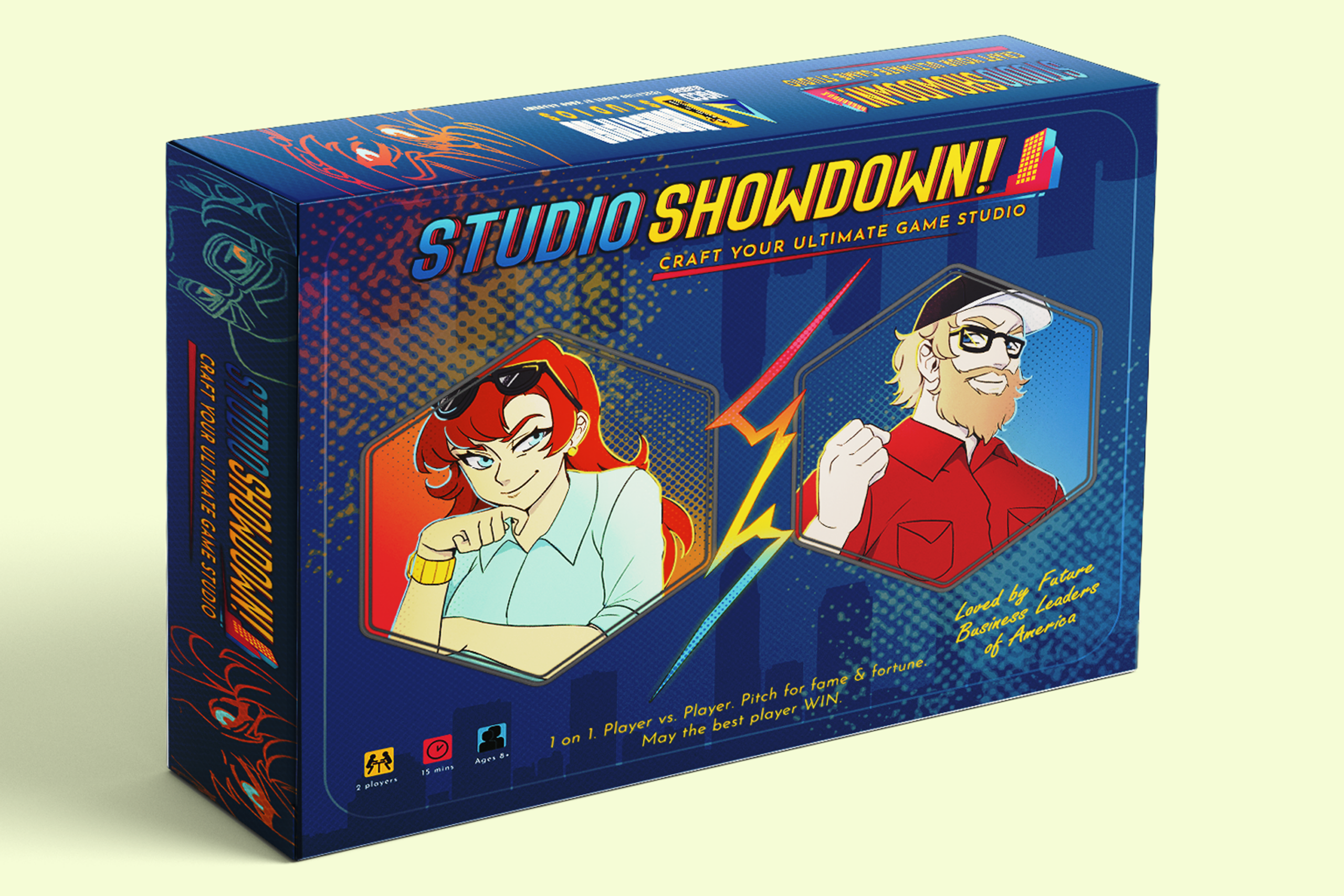
This guide will help you identify learning goals, compare tabletop and computer-based formats, and choose an activity that fits your course, class size, and available time. You’ll also find criteria for judging whether a simulation supports transferable learning, not just competition. Studio Showdown, for example, is a physical strategy board game in which students take the roles of video game studio founders and engage with activities such as pitching and fundraising. It offers one way to put entrepreneurship decisions on the table, alongside discussion and reflection, without treating gameplay as a substitute for coursework. Here’s how to find the right fit for your classroom.
Key Takeaways
- Start with a specific course objective, then choose a simulation whose decisions let students explore it.
- Compare business simulation games for college students by learning goals, access needs, facilitation demands, and opportunities for debriefing.
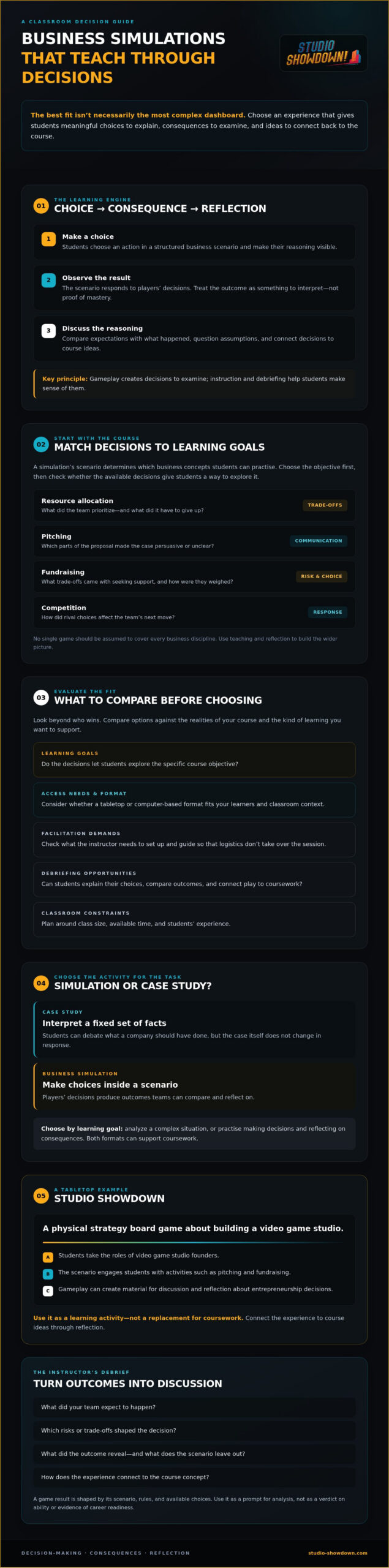
- Use a clear learning loop: make a choice, observe its consequences, and discuss the reasoning behind it.
- Plan around class size, available time, and students’ experience so setup supports learning rather than taking over the session.
- Consider tabletop options such as Studio Showdown for a hands-on entrepreneurship scenario, then connect play to coursework through reflection.
What business simulation games for college students teach beyond the rules
A business simulation gives students more than questions to answer or a strategy to win. It places them in a structured business scenario, where they make choices and see how the game models the consequences. This makes concepts such as risk, trade-offs, and competition easier to examine in action.
A business simulation is a structured scenario where players practise business decisions and examine the consequences the game produces. For instructors, the key is what decisions students can make, not simply the points they earn or whether they win. A quiz checks recall. An ordinary strategy game may reward tactical skill without representing business choices. A business simulation connects player actions to a business context and gives students outcomes to interpret. The Business simulation overview describes the format as an educational tool for training and analysis, distinct from the broader video game genre.
The basic learning loop is straightforward: choose an action, observe its in-game result, then discuss why it happened. A result isn’t proof that a student has mastered a concept. Outcomes depend on the scenario, its rules, and the choices available. Treat gameplay as a prompt for analysis, not a substitute for instruction or evidence of career readiness. A thoughtful debrief helps students connect decisions to course ideas and consider what the simulation leaves out.
How a business simulation differs from a case study
A case study gives students a fixed set of facts to interpret. They can debate what a company should have done, but the case itself doesn’t change in response. In a simulation, players make choices inside the scenario, and those decisions produce outcomes that teams can compare. Both formats can support coursework. Choose based on the goal: analyze a complex situation, or practise making decisions and reflecting on consequences.
Which business concepts can a simulation put into play?
The scenario determines which concepts are relevant. A focused simulation might let students practise:
- Resource allocation: What did the team prioritize, and what did it have to give up?
- Pitching: Which parts of the proposal made the case persuasive or unclear?
- Fundraising: What trade-offs came with seeking support, and how did students weigh them?
- Competition: How did rival choices affect the team’s next move?
These questions turn outcomes into material for discussion. Don’t assume one game covers every business discipline. Match its decisions to the course objective, then use instruction and reflection to build the wider picture.
How business simulations turn college concepts into decisions
A concept becomes easier to examine when students have to act on it. In a simulation, a team makes a choice, sees the result the scenario produces, then considers whether its original reasoning still holds. The result isn’t a verdict on the team’s ability. It’s material for testing assumptions, spotting trade-offs, and applying course ideas in context.
That’s the practical value of business simulation games for college students: they create a structured opportunity to practise judgment, not a guarantee of improved performance. MIT Sloan’s management simulations resource presents simulations as action learning and describes their use alongside other teaching approaches, including innovative and interactive games. The instructor’s role is key. Gameplay creates decisions to examine; teaching and discussion help students make sense of them.
From a business concept to a playable choice
Consider fundraising. A scenario might ask a team how to present its venture or whether to pursue outside support. Before acting, students can note what they believe the opportunity requires, which risks they’re accepting, and what they expect to happen. After the game responds, they can compare the result with those assumptions. This is a learning prompt, not a description of a specific product mechanic or a guaranteed outcome.
Limited resources and competing priorities sharpen the conversation. If a team must choose where to focus, ask what it prioritized and what it set aside. If it responds to a rival, ask what information shaped that move. The aim isn’t to find a universally correct play. It’s to make the reasoning visible enough to challenge and refine.
Why debriefing matters after the simulation
Play gives students a shared experience. The debrief turns that experience into analysis. Invite teams to compare their choices, the outcomes they observed, and the assumptions behind each decision. Then connect those observations to the course topic rather than treating the game’s result as a complete lesson.
- What information guided your decision, and what did you assume?
- Which trade-off was hardest to make? What did your team prioritize?
- How did another team’s approach differ, and what might explain the difference?
- Where does the scenario reflect the course concept, and where is it an imperfect model?
These questions help students explain what they practised and consider where the same reasoning might apply beyond the game. Transfer isn’t automatic; it takes instruction, reflection, and opportunities to connect play with real course material. Educators considering a tabletop example can review Studio Showdown’s entrepreneurship game as one possible starting point for that discussion.
How to compare business simulation games for college students
The right format serves your course objective without letting setup, access, or rules crowd out learning. Tabletop, digital, and case-based activities can all support business education, but they ask students and instructors to work in different ways. Use this comparison as a starting point, then check the requirements of the specific activity.
| Format | Best suited to | Facilitation and access | Debrief potential |
|---|---|---|---|
| Tabletop simulation | Shared, in-person decisions and face-to-face discussion | Requires physical materials, a clear rules introduction, and space for groups to play | Teams can compare choices and discuss what happened together |
| Digital simulation | Scenarios that use on-screen decisions, data, or computer-based play | Check device and internet access, setup steps, and how much guidance students may need | Consider whether students can review their decisions and explain results after play |
| Case-based activity | Analyzing a situation and building an argument through discussion | Requires access to the case materials and facilitation that draws out different perspectives | Strong fit when comparing interpretations is the main learning goal |
Strategy and simulation can overlap: both may ask players to plan, respond, and weigh choices, but a business simulation frames decisions in a business scenario. For more on the strategy side of that distinction, see this strategy board games guide. The American Public University System’s The Use of Simulations in Business also discusses simulations as a way for students to apply concepts and consider the consequences of decisions.
Which format fits your course and students?
Tabletop play offers a shared, in-person experience, but may not suit every class or learning objective. Digital options can support computer-based scenarios, though device access, technical setup, and facilitation deserve a close check before class. Case-based activities are useful when the main goal is to interpret evidence, debate choices, or develop recommendations rather than play through a changing scenario.
Choose against real constraints: course topic, available class time, group size, student experience, and what you want to observe. Even a compelling format needs enough room for students to explain their thinking afterward.
A college-ready checklist for evaluating a game
Before selecting an option, check whether its decisions match your course or program learning objectives. Then review the practical details:
- Are the rules clear enough to introduce without consuming the session?
- Can every student contribute, and is the activity suitable for the group structure?
- Does the session length leave time for discussion and reflection?
- What preparation or facilitation will the instructor need to provide?
- Can a structured debrief connect play to course concepts and student reasoning?
The strongest fit isn’t automatically the most elaborate one. Choose the format that makes the target decisions visible, works with students’ access needs, and gives the instructor a clear path from activity to discussion.
How to use a business simulation game in a college class
A strong class session starts before anyone plays. Decide what students should be able to explain or apply by the end, then choose an activity that lets them practise that objective. Business simulation games for college students work best as part of a lesson, with time for preparation, play, and reflection. Winning can add energy, but it shouldn’t be the only measure of learning.
Prepare students before the first turn
Give students a clear objective, such as identifying trade-offs in a business decision or explaining how a team responded to competition. Introduce only the rules they need to begin, and check that the directions make sense before play starts. A brief orientation can help keep setup from taking over class time.
Plan groups around class size and students’ experience. If useful, assign simple participation responsibilities, such as tracking decisions, noting assumptions, or reporting the team’s reasoning. Ask each group to record what it expects a choice to achieve and what it is willing to risk. These notes give students something concrete to revisit after play.
Turn the game session into a learning activity
During play, listen for meaningful choices rather than trying to direct every move. Pause when a decision reveals a trade-off or when teams take noticeably different approaches. Ask students to explain their reasoning: What did the team prioritize? What information shaped the decision? What did it set aside? Keep interruptions purposeful so students can stay engaged.
Adjust the session plan to the time available. A shorter class may focus on part of an activity and a targeted discussion; a longer session may leave room to compare more decisions. For planning ideas, explore this business board game entrepreneurship guide.
After play, lead a debrief that connects decisions to course concepts. Invite groups to compare strategies and outcomes without treating the top result as proof of the best learning. Ask:
- Which decision best reflected the course concept, and why?
- What assumption would your team reconsider?
- How did another group approach the same challenge differently?
Assess students’ explanations, decision notes, or reflections against the stated learning objective. Look for relevant concepts, reasoning supported by evidence, and thoughtful analysis of trade-offs. This keeps evaluation focused on what students can explain, not on unsupported claims that playing a game guarantees improvement. A tabletop option for an entrepreneurship activity is the Studio Showdown board game.
Studio Showdown: a tabletop business simulation for college learners
Once you’ve matched a simulation’s format to your learning objective, consider which decisions it puts in students’ hands. Studio Showdown is a physical strategy board game developed by VGCD Academy and DEMYSTIFIED Studios. Players take the role of video game studio founders and compete with rival studios as they pursue success in the market. Its focus is entrepreneurship through play, not coding instruction or a digital game download.
What students experience as studio founders
The founder premise gives students a shared business context to explore. Fundraising and pitching are among the activities, giving students natural points to pause and examine their choices. What assumptions shaped a pitch? How did a team think about seeking funding? What might it change after hearing how other teams approached the challenge?
These questions make the activity a starting point for analysis, not a shortcut to expertise. The game gives students decisions to discuss; the instructor connects those decisions to relevant course ideas. Reflection can focus on reasoning and trade-offs, rather than treating a winning outcome as proof that one team learned more than another.
When Studio Showdown may fit an educational setting
Consider it if you want a physical, in-person activity centered on entrepreneurship in the video game studio setting. It may suit a class exploring entrepreneurship, pitching, fundraising, or business decision-making, provided those themes match the course objective. As with any simulation, the instructor remains responsible for introducing the activity, setting expectations, and leading the discussion that follows.
Before using it, check current product availability and educator implementation details, then plan where the game fits alongside your course materials. It can complement instruction, not replace coursework. Use it as a structured experience students can reflect on, with questions that connect choices in the scenario to the concepts they’re studying.
For educators comparing business simulation games for college students, a tabletop option creates an opportunity to make decisions together and discuss what informed them. If that approach aligns with your teaching goals, Studio Showdown is one option to consider.
Turn business concepts into decisions students can discuss
The strongest business simulation games for college students do more than reward a winning move. They give students decisions to practise, outcomes to examine, and space to explain their reasoning. Choose a format that fits your course goals, students, and available class time, then plan a debrief that connects gameplay to concepts rather than treating victory as proof of learning.
Studio Showdown is a tabletop entrepreneurship option that puts students in the role of video game studio founders. Developed by VGCD Academy and DEMYSTIFIED Studios, the game includes fundraising and pitching as activities that can prompt discussion about choices and assumptions. It can complement a course, but it doesn’t replace instruction or coding education.
If this format aligns with your teaching goals, explore Studio Showdown and consider how its decisions could connect to your course. Pick an objective, prepare students to explain their choices, and make reflection part of the session.
Frequently Asked Questions
What are business simulation games for college students?
Business simulation games for college students place learners in a business scenario where they make decisions within the game’s rules and consider the consequences. Depending on the activity, students might practise allocating resources, pitching an idea, or responding to competition. Formats and learning goals vary, so check which decisions a particular game offers. Playing can prompt practice and discussion, but it doesn’t guarantee mastery or career readiness.
Are business simulation games effective for college students?
They can give students an opportunity to practise business decisions and discuss their consequences, but effectiveness depends on the fit with course objectives and how the activity is facilitated. Instructors can set a clear goal, listen for student reasoning during play, and lead a debrief afterward. Consider whether students can explain their choices using course concepts. Don’t assume a game produces measured learning gains without reliable evidence for that specific game and context.
Can business simulation games be used in college classes?
Yes. Educators can use a suitable simulation as a class activity, workshop, or discussion prompt. First, check whether its decisions align with the course and whether its rules, timing, and preparation fit the class size and students’ access needs. Plan a debrief that connects student choices to relevant business concepts. The game should complement instruction, not replace coursework or stand alone as proof that students have mastered a topic.
What skills can college students practise with business simulation games?
Depending on the game, students may practise making decisions, explaining assumptions, comparing strategies, and discussing trade-offs. Some business scenarios include activities such as pitching or fundraising, which can prompt analysis of how teams present ideas or consider support. The opportunities depend on the game’s actual mechanics and how the instructor facilitates it. A short game alone doesn’t guarantee professional competence, career readiness, or employment outcomes.
How do you choose a business simulation game for a college course?
Start with the learning objective, then check whether the game gives students decisions that support it. Compare the format, rule clarity, group participation, access requirements, session time, and instructor preparation. Consider whether the activity leaves room for students to explain their reasoning and reflect afterward. Choose based on your course, class, and teaching goals, not popularity or competition alone. A well-matched activity is easier to connect to instruction.
Are tabletop business simulation games better than digital simulations?
Neither format is automatically better. A tabletop game can support shared, face-to-face decisions, while a digital simulation may suit an activity built around software or digital interaction. Compare each option against your course objectives, students’ access to materials or devices, setup demands, facilitation needs, and time for a debrief. The best choice is the format that supports the planned learning activity and gives students an opportunity to discuss their decisions.
Does Studio Showdown teach college students coding?
No. Studio Showdown is a physical strategy board game about the competitive world of video game development and entrepreneurship, not a coding course or digital game download. Students take the role of video game studio founders, and confirmed learning activities include fundraising and pitching. Educators can use those activities as prompts for discussion and reflection. Students seeking coding instruction will need separate learning resources designed to teach programming.