The biggest mistake in game education is assuming studio success starts and ends with code. It doesn’t. Real studio mastery comes from managing budgets, crunch cycles, talent, and high-stakes publisher pitches. You already know your students light up the second video games enter the syllabus, yet dry business lectures still put them to sleep. Bridging that gap doesn’t require expensive lab licenses, IT troubleshooting, or weeks of syntax debugging. Implementing a tabletop game studio simulation for students transforms your room into an active, competitive production floor from day one.
Discover how game studio simulations teach students real-world business acumen, agile teamwork, and game production without writing a single line of code. They step directly into executive roles, negotiate terms, manage runway, and ship commercial titles under real constraints. In this complete 2026 classroom guide, we’ll break down the exact framework to run frictionless studio competitions, master project scoping, and cultivate career-ready leadership within a standard class period.
Key Takeaways
- Explore how a game studio simulation for students builds executive-level decision-making without the overhead of complex programming languages.
- Connect hands-on classroom mechanics directly to national CTE, STEM, and entrepreneurship competencies like cash flow forecasting, hiring, and project scoping.
- Compare digital engines, browser apps, and physical tabletop simulations to eliminate software licensing costs and technical troubleshooting.
- Implement a clear, four-phase studio integration strategy that assigns defined executive roles and fits within standard class periods.
- Discover how purpose-built tools like Studio Showdown create an active, screen-free production floor designed by game industry veterans.
What Is a Game Studio Simulation for Students?
A game studio simulation for students strips away dry lectures and drops learners straight onto the production floor. Unlike generic corporate exercises or passive case studies, this experiential model mirrors the high-stakes reality of commercial entertainment. While digital business simulation games have existed for decades, modern educational simulations place students directly in the executive chair.
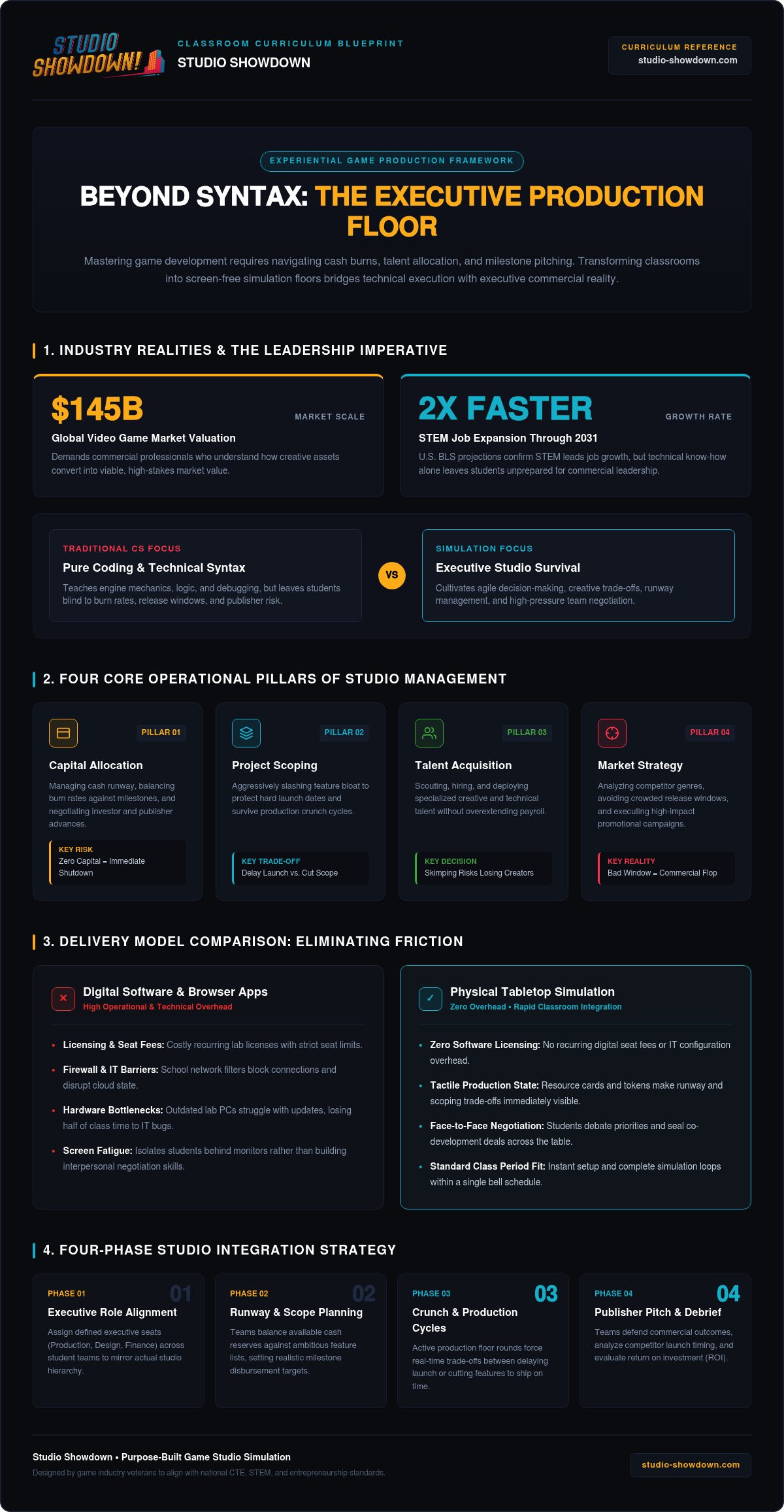
Instead of memorizing abstract business theories, learners make active operational calls across four core pillars:
- Capital Allocation: Managing cash runway, investor terms, and milestone funding.
- Project Scoping: Slashing feature bloat to protect delivery dates.
- Talent Acquisition: Scouting, hiring, and deploying specialized creative talent.
- Market Strategy: Executing promotional campaigns that rise above commercial noise.
Students don’t just consume media; they master the business apparatus that brings creative visions to life.
The Distinction Between Coding and Studio Leadership
Computer science courses teach syntax. They don’t teach studio survival. Mastering programming languages won’t help a team resolve creative friction, manage burn rates, or pitch skeptical publishers. Technical execution is merely one piece of a complex puzzle.
A dedicated game studio simulation for students forces hard trade-offs where artistic ambition clashes directly with the balance sheet. Students face authentic executive dilemmas: do they delay a launch and burn remaining cash reserves, or cut core features to ship on schedule? These role-driven scenarios cultivate agile thinking, preparing learners for impactful career pathways across creative direction, product management, and commercial publishing.
Analog Tabletop vs. Digital Simulation Software
Digital classroom platforms often introduce unnecessary operational friction. Enterprise seat licenses expire, school firewalls block web connections, and outdated lab computers struggle to run updates. Half the class period can easily disappear into routine technical troubleshooting.
Physical tabletop systems eliminate that digital fatigue entirely. By utilizing tactical board states, resource cards, and shared tokens, these screen-free activities spark authentic, high-energy negotiations across the table. Students read room dynamics, debate production priorities, and seal co-development deals face to face. The result is total immersion, zero technical barriers, and rapid collaborative momentum within a single class bell.
Core Business and STEM Skills Taught Through Studio Simulations
Dry lectures kill engagement. When educators explain profit-and-loss statements on a chalkboard, students check out. Put those same learners at the helm of a digital media enterprise, and the numbers suddenly dictate survival. A modern game studio simulation for students bridges this divide by embedding critical financial, analytical, and interpersonal skills into competitive play. Instead of abstract math, students handle cash burns, aggressive release schedules, and high-pressure negotiations.
According to the U.S. Bureau of Labor Statistics, STEM careers are projected to grow nearly twice as fast as non-STEM roles through 2031. However, technical know-how alone won’t guarantee career readiness. The global video game market, valued at $145 billion, demands professionals who understand how creative assets generate commercial value. Experiential simulation grounds students in these realities, aligning directly with national standards across Career and Technical Education (CTE), business management, and STEM frameworks.
Financial Literacy and Budget Management
Cash is oxygen. In a studio environment, running out of capital means immediate shutdown. Students track burn rates against tight milestone disbursements, deciding when to take publisher advances or seek outside investment. Every choice has a cost: investing heavily in advanced engine tech limits immediate marketing funds, while skimping on payroll risks losing top creators. These mechanics teach concrete fiscal accountability faster than any textbook exercise.
Strategic Negotiation and Market Analysis
Great games die in bad release windows. Simulation forces students to survey the competitive market before locking down their launch calendar. They analyze competitor genres, spot oversaturated quarters, and pivot production schedules accordingly. In pitch simulations, teams debate licensing terms, royalty splits, and intellectual property rights. They learn to defend their commercial valuation while securing favorable contracts with outside partners.
Team Dynamics and Resource Allocation
Talent drives production. Students build multi-disciplinary squads, hiring specialists across engineering, narrative, visual art, and marketing. When production bottlenecks occur, teams face crunch. Managing these crises teaches vital social-emotional skills: balancing aggressive milestones against team burnout to prevent morale collapse. Educators looking to cultivate these high-stakes leadership competencies can introduce active lab frameworks like Studio Showdown to transform passive lessons into competitive studio showdowns.
By blending collaborative problem-solving with competitive pressure, students develop emotional resilience and agile decision-making, preparing them to lead tomorrow’s creative workforce.
Comparing Educational Game Studio Simulation Models
Most commercial classroom tools fall into two extremes: dry textbook case studies that fail to spark excitement, or convoluted enterprise software designed for graduate students. Selecting an effective game studio simulation for students requires evaluating how smoothly an experiential model integrates into active, high-tempo classrooms.
When comparing educational models, three distinct formats emerge:
- Textbook Case Studies: Zero tech friction, but entirely static. Students read historical post-mortems without exerting any agency or facing immediate consequences.
- Browser-Based Corporate Simulators: Data-dense and broad, but burdened by recurring subscription fees, complex menu navigation, and sterile UI that dulls creative enthusiasm.
- Dedicated Tabletop Engines: Hands-on, dynamic, and social. Physical strategy board games distill high-stakes trade-offs into tactile cards, boards, and resource pools without technical roadblocks.
Evaluation Framework for Classroom Simulation Tools
Standard class periods leave zero room for bloated tutorials. If a game studio simulation for students demands 40 minutes of rule explanation, the lesson collapses. Effective tools feature intuitive rule sets that teams internalize within ten minutes, leaving ample runway for gameplay and analysis. Replayability is equally vital; dynamic scenario decks and shifting market conditions guarantee that different student cohorts never face identical outcomes. Finally, accessible visual design ensures that visual learners, neurodivergent students, and non-gamers participate fully alongside experienced players.
Digital Platforms vs. Modern Tabletop Engines
Digital portals frequently stumble over school network firewalls, browser incompatibilities, and device management logistics. When students sit isolated behind monitors, collaboration slows. Multitasking and off-task browsing creep in, pulling focus away from strategic group dialogue.
Analog tabletop systems create an open arena. Every team’s board state, treasury, and staffing roster remains visible to the entire room, fueling real-time competitive awareness. Physical cards and resource tokens pass back and forth during publishing deals, forcing direct verbal persuasion. Educators can easily run a hybrid model: conduct fast-paced tabletop production runs during the bell, followed by student-led post-mortem pitch decks that dissect their fiscal and creative results.
How to Integrate a Studio Simulation into Your Curriculum
Adopting an experiential learning unit shouldn’t require rewiring your entire course catalog or attending multi-day webinars. You can deploy a game studio simulation for students seamlessly across existing business, CTE, or media courses using a repeatable, four-step production loop:
- Step 1: Define Explicit Competencies: Pinpoint exact educational outcomes, such as balance-sheet forecasting, project scoping, or marketing strategy.
- Step 2: Assign Studio Executive Roles: Divide students into small development teams with defined responsibilities to enforce individual ownership.
- Step 3: Run Development Sprints: Execute structured simulation rounds that mirror production milestones, capital raises, and commercial launch windows.
- Step 4: Conduct Post-Mortem Debriefs: Audit studio decisions to evaluate why specific projects flourished while others ran out of runway.
Structuring Class Periods for Maximum Engagement
Pacing dictates student engagement. A standard 45-minute period fits a brisk two-cycle sprint, while a 90-minute block allows a full product cycle from initial pitch to commercial launch. Within each studio, assign distinct operational hats: a Producer to monitor production timelines, a Creative Director to safeguard quality, and a Finance Lead to track burn rates. Require teams to log real-time cash flow sheets during play, turning casual dice rolls or card plays into auditable business ledgers.
Facilitating Meaningful Post-Game Debriefs
The deepest insights happen right after the game clock stops. Avoid asking surface-level questions about who had fun; dissect the operational balance sheet. Why did a team choose an early debt round instead of publisher advances? Did expanding the engineering roster pay off, or did it sink the studio when market trends shifted? Connecting these tabletop outcomes directly to real-world gaming studio acquisitions or high-profile commercial flops brings immediate relevance to student portfolios.
Assessment Rubrics Beyond Simple Victory Conditions
Rewarding only the richest studio undermines collaborative learning. Ground your grading rubrics in strategic decision logs, crisis mitigation, and peer communication. Grade teams on how thoroughly they documented their risk exposure, how they pivoted when crunch hit, and how effectively they communicated during inter-studio negotiations. Integrating an educational business board game into your unit gives you transparent, objective metrics to assess team performance without grading subjective essays.
Ready to deploy this experiential framework in your classroom? Explore Studio Showdown educational kits to equip your students with turnkey studio leadership skills today.
Studio Showdown: The Purpose-Built Game Studio Simulation
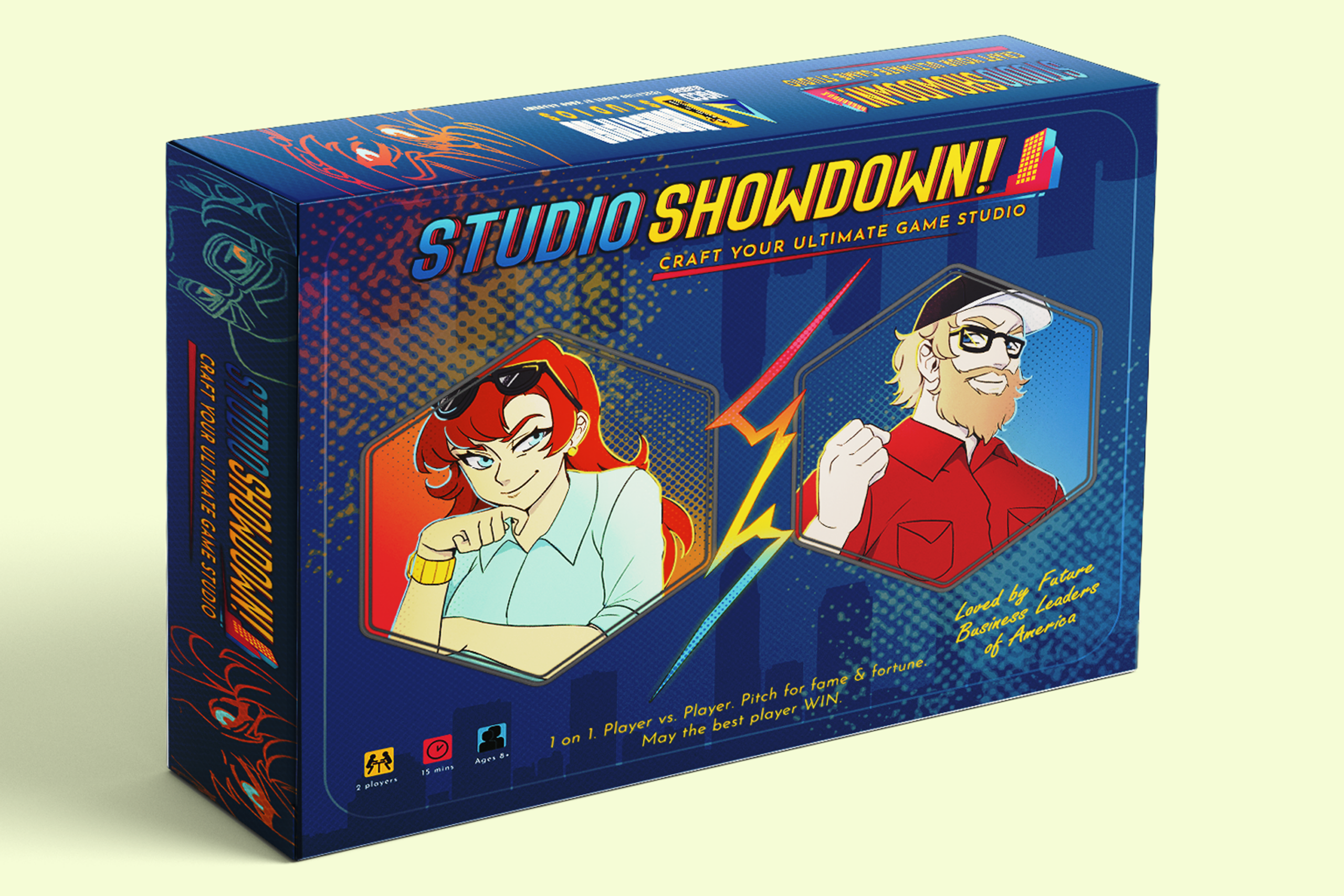
Most commercial business simulators miss the creative grit of entertainment startups. Studio Showdown changes that dynamic entirely. Co-developed by industry veterans at VGCD Academy and DEMYSTIFIED Studios, this strategy board game delivers an authentic game studio simulation for students without requiring technical troubleshooting or digital accounts. It strips away academic fluff, pitching teams directly into the high-pressure ecosystem of commercial game development.
Already adopted across national middle school, high school, and collegiate entrepreneurship programs, the game mirrors true market pressures. Teams don’t just solve abstract equations. They compete for limited shelf space, survive aggressive crunch windows, negotiate publishing contracts, and navigate sudden economic swings.
Authentic Video Game Industry Mechanics
Gameplay tracks every critical milestone of modern studio life. Student squads start with conceptualization, allocating seed funds toward core design elements before entering formal production. Shifting market conditions force rapid adaptation through dynamic event cards, exposing projects to unexpected engine glitches, viral social media trends, or harsh critical reviews. Balancing artistic ambitions against limited cash reserves becomes a matter of immediate survival.
Turnkey Implementation with Studio Showdown: Educator Edition
Bringing hands-on learning into the classroom shouldn’t add hours to your lesson prep. The dedicated Studio Showdown: Educator Edition and multi-table Classroom Bundle arrive fully equipped for rapid instructional rollout. Teachers receive comprehensive facilitator guides, scenario cards, and transparent scoring rubrics that directly track student decision logs. This modular setup allows instructors to grade analytical problem-solving and fiscal accountability with zero administrative friction.
Equally important, students complete each play cycle with tangible entrepreneurial artifacts. Instead of writing abstract summaries, they defend pitch presentations, post-mortem balance sheets, and resource allocation logs that fit neatly into college or career readiness portfolios, all without writing a single line of software code.
Bringing Studio Showdown to Your Educational Institution
Whether you manage a secondary CTE department, run an after-school incubator, or teach collegiate media arts, integrating this tabletop engine requires zero IT oversight. Scalable institutional configurations make it easy to equip entire cohorts simultaneously. Bring true creative entrepreneurship to your academic program with Studio Showdown, and watch your students transform from passive gamers into strategic production leaders.
Launch Your Classroom Studio Floor
Preparing learners for modern creative careers requires moving past isolated code tutorials and static theory. A dedicated game studio simulation for students turns passive listeners into decisive project leads who manage cash runways, lead talent rosters, and pitch publishing partners under real constraints. By shifting focus toward active tabletop strategy, you eliminate software troubleshooting and invite high-energy collaboration straight to the desk.
Co-designed by educational leaders at VGCD Academy and industry veterans at DEMYSTIFIED Studios, the game is already proven across national middle school, high school, and university entrepreneurship programs. Complete turnkey kits include comprehensive instructor facilitation guides and student grading rubrics, letting you run structured development sprints without administrative headaches.
Give your students the creative confidence and business acumen they need to thrive. Bring Studio Showdown to your classroom and empower future studio founders today, watching your room transform into an ambitious production floor where every decision counts.
Frequently Asked Questions
Can game studio simulations be used if students have no prior coding experience?
Yes, absolutely. Studio simulations focus on business decisions, agile team management, and production pipelines rather than software syntax. A game studio simulation for students strips away code complexity so participants concentrate on executive roles. Students act as producers, marketing leads, or creative directors. They manage milestone budgets, negotiate contracts, and allocate staff without writing a single line of script, ensuring strategic thinking takes center stage.
How does a tabletop simulation compare to digital video game development software?
Tabletop simulations prioritize active human interaction over technical troubleshooting. Software engines often demand powerful hardware, software updates, and complex interface training that eats into class time. In contrast, physical tabletop systems provide instant setup, complete board visibility, and direct face-to-face negotiations. Students build crucial leadership and interpersonal communication skills across the table without the isolation or digital distraction common to screen-based computer labs.
What age groups are game studio simulations like Studio Showdown best suited for?
Studio Showdown is specifically designed for middle school, high school, and collegiate learners. The mechanics scale naturally across different grade levels. Middle school classes use the simulation to understand basic team roles and resource budgeting. High school and college entrepreneurship courses leverage the advanced event mechanics and contract negotiations to explore cash runway, publisher royalties, and commercial market positioning. The tactile cards keep every age bracket deeply engaged.
How do educators fit a multi-round simulation into standard 45-minute class periods?
Educators break gameplay into modular production sprints designed around standard bell schedules. A single 45-minute period easily accommodates setup, two focused development quarters, and a rapid financial audit. Because game rounds run on structured phase cards, teachers can pause between quarters and resume the next day without losing state. For 90-minute block schedules, student studios can execute a complete cycle from early pitching to post-launch commercial debriefs.
What educational standards do game development business simulations fulfill?
They align directly with national Career and Technical Education (CTE), STEM, and entrepreneurship standards. Running a game studio simulation for students fulfills core competencies in Arts, Media, and Entertainment pathways, financial literacy benchmarks, and business management curricula. Students demonstrate measurable proficiency in project scoping, capital budgeting, risk assessment, and collaborative problem-solving. These activities produce verifiable decision logs that support objective, standards-based grading rubrics.
Is Studio Showdown: Educator Edition suitable for after-school clubs and summer camps?
Yes, the Educator Edition is built for both traditional classrooms and informal learning spaces. After-school clubs, library programs, and STEM summer camps benefit from its modular, low-friction setup. Without needing digital devices or lab access, facilitators can launch lively studio tournaments within minutes. The collaborative competition keeps energetic learners focused on tangible goals: shipping viable titles, expanding their creative teams, and outmaneuvering rival studios.
How do game studio simulations teach real-world financial literacy to teenagers?
They make abstract numbers matter by connecting cash flow directly to project survival. Instead of balancing hypothetical checkbooks, students track burn rates, weigh debt obligations, and negotiate publisher advances to keep their virtual studio operational. If they overhire or blow their marketing budget, they face immediate in-game consequences like production delays or project cancellations. This experiential feedback loop cements fiscal discipline faster than conventional lectures.