Slide decks don’t teach product strategy; real stakes do. Running an authentic product development cycle classroom activity shouldn’t require complex engineering software, bloated lab budgets, or an unmanageable six-week schedule. Yet most business and STEM curricula still reduce dynamic market competition to static flowcharts, leaving students disconnected from the actual pulse of commercial creation.
You already know the friction. Squeezing authentic prototyping into tight 50-minute blocks is tough, and screen fatigue only deepens student disengagement. That changes here. This guide delivers an actionable, modular framework built to turn passive lectures into high-stakes innovation. You’ll push students past theoretical planning so they can navigate real-world trade-offs like scope creep, rapid budget burn, and high-pressure design pivots in real time.
Ahead, dive into a step-by-step blueprint that transforms your room into an energetic studio arena, guiding student teams from their first wild concept directly to a cutthroat commercial launch.
Key Takeaways
- Master a modular product development cycle classroom activity built for 50-minute sprints, turning static corporate frameworks into dynamic market competition.
- Force students to confront cutthroat trade-offs, balancing runaway scope creep, headcount costs, and budget burn under tight countdown timers.
- Discover why tactile tabletop simulations crush digital design software when combating student screen fatigue and teaching visceral resource limits.
- Revamp your assessment rubrics to reward calculated risk mitigation, strategic pivots, and crisis response rather than cosmetic product polish.
- Explore how dedicated board game simulations like Studio Showdown: Educator Edition immerse student teams directly into the high-stakes reality of creative studio leadership.
Core Architecture of an Impactful Product Development Cycle Classroom Activity
Worksheets kill entrepreneurial drive. When students fill out static prompts about marketing mixes or supply chains, they miss the friction of actual commerce. Real production is messy, competitive, and governed by strict constraints. A high-impact product development cycle classroom activity strips away abstract theory, replacing passive listening with an intense, iterative sprint balancing resources, time, and build quality.
To mirror industry reality, the exercise anchors to the formal new product development process while enforcing the speed of an agile studio. Instead of treating stages as isolated academic chapters, student teams operate under national STEM and career technical education standards, treating every decision as a calculated gamble with finite capital.
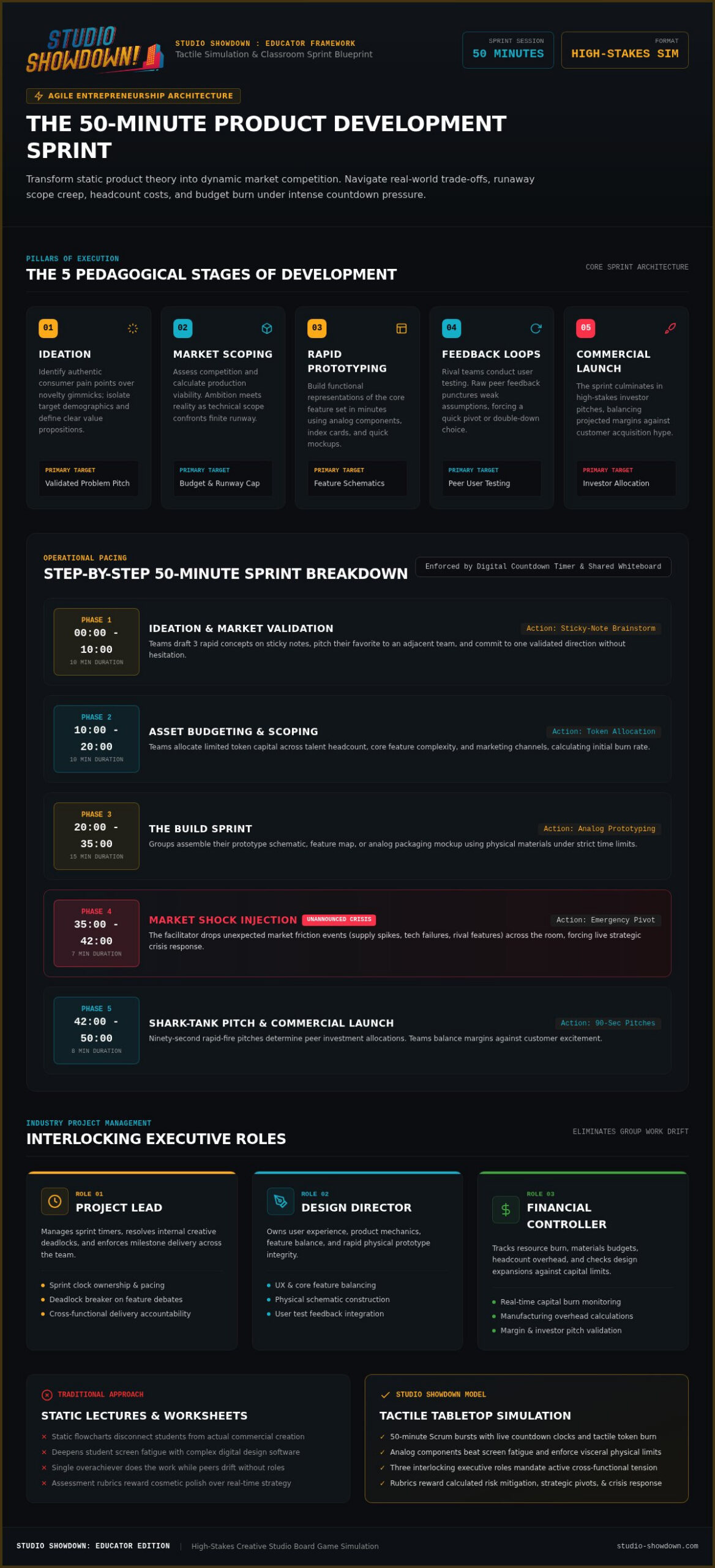
The Five Pedagogical Stages of Classroom Product Development
Structure the activity around five non-negotiable phases designed to test creative agility:
- Ideation: Teams identify authentic consumer pain points rather than pitching novelty gimmicks. They isolate target demographics and define clear value propositions.
- Market Scoping: Students assess competition and calculate production viability. Ambition meets reality as technical scope confronts available runway.
- Rapid Prototyping: Using analog components, index cards, and quick mockups, teams build functional representations of their core feature set within minutes.
- Testing and Feedback Loops: Rival teams conduct user testing. Raw peer feedback punctures weak assumptions, forcing teams to choose between an expensive pivot or a double-down strategy.
- Commercial Launch: The sprint culminates in high-stakes investor pitches, balancing projected margins against customer acquisition hype.
Aligning Team Dynamics to Industry Project Management
Group projects often fail because one overachiever executes the work while three peers drift. Fix this systemic failure by assigning distinct, interlocking executive functions to every participant:
- Project Lead: Manages sprint timers, resolves internal creative deadlocks, and enforces overall milestone delivery.
- Design and Systems Director: Owns user experience, mechanics, and product feature balance.
- Financial Controller: Tracks resource burn, materials budgets, and manufacturing overhead.
Time-box each stage into 10-minute Scrum bursts. Between phases, mandate lightning-fast milestone reviews where teams justify ongoing resource allocations. If a design director wants three extra features, the financial controller must openly verify the capital burn. This cross-functional tension simulates authentic corporate risk, ensuring every student stays locked into the operational fight.
Step-by-Step Lesson Plan: Running the Simulation in 50-Minute Sprints
A standard school bell is unforgiving. Running an authentic end-to-end product development cycle in a tight academic block demands intense operational pacing. When you compress market creation into a single period, hesitation kills momentum. Execute this modular product development cycle classroom activity using an aggressive countdown clock that forces immediate creative commitment.
Sprint Timing and Facilitator Pacing Checklist
Every second counts. Keep a digital countdown timer visible on screen and track team progress on a shared whiteboard board:
- 00:00 – 10:00 (Ideation & Market Validation): Teams draft three rapid concepts on sticky notes, pitch their favorite to an adjacent team, and commit to one validated direction.
- 10:00 – 20:00 (Asset Budgeting & Scoping): Teams allocate limited token capital across talent, core features, and marketing channels.
- 20:00 – 35:00 (The Build Sprint): Groups assemble their prototype schematic, feature map, or analog packaging mockup.
- 35:00 – 42:00 (Market Shock Injection): The facilitator drops unexpected market friction events across the room.
- 42:00 – 50:00 (Shark-Tank Pitch & Commercial Launch): Ninety-second pitches determine peer investment allocations.
Use an airhorn or harsh buzzer between phases. Pens down means pens down.
Injecting Market Friction: Introducing Shocks and Scope Creep
Smooth projects teach bad habits. At minute 35, hit the room with sudden market disruption cards. A critical component supplier hikes prices by 40%. A rival startup launches your exact flagship feature. A server crash burns half the remaining capital.
Students must make brutal triage decisions within two minutes. Do they slash their secondary features, burn contingency cash, or execute an emergency redesign? Forcing teams to murder their darlings under time pressure builds genuine entrepreneurial muscle.
The Shark-Tank Style Peer Showcase and Feedback Loop
End the sprint in an open arena. Give each student three faux investment chips to distribute across rival projects. Founders deliver sharp 90-second pitches outlining problem, solution, unit economics, and target audience. Self-funding is prohibited, meaning teams sink or swim purely on the conviction of their pitch and functional clarity.
Conclude with a five-minute financial audit. Tally earned investment capital directly against development costs to reveal who turned a real profit versus who burned their balance sheet on vanity features. For educators who want pre-balanced market decks and plug-and-play classroom balance sheets, adopting Studio Showdown gives your students an immediate, high-stakes battleground right out of the box.
Analog Prototyping vs. Digital Tools: Beating Screen Fatigue
Laptops open, focus dies. While modern digital design software offers sophisticated mockups, relying solely on screens during a fast-paced sprint often triggers multi-tab distraction and quiet disengagement. Tabletop mechanics transform the room entirely. Integrating tactile screen-free activities into your product development cycle classroom activity pulls students away from passive scrolling and forces direct human collaboration.
Physical manipulatives generate a visceral understanding of resource limits that software simply cannot replicate. Dragging a digital rectangle across a dashboard feels weightless. Physically surrendering your team’s last three resource tokens to fund a marketing gamble creates instant tension. When capital, features, and talent exist as tangible cards and wooden tokens, the consequences of every choice become immediate and visual.
Tactile Learning Mechanics and Decision-Making Speed
Physical board components eliminate the cognitive drag of complex software navigation. Teams gather over a shared physical space instead of huddling behind individual monitors:
- Accelerated Consensus: Physical assets sit in plain view. Teams make rapid, face-to-face decisions without wrestling with hidden layer menus or software permissions.
- Total Participation: Moving physical cards across a table invites contributions from quieter students who might otherwise hide behind an outspoken teammate’s keyboard.
- Tactile Retention: Handling physical cards, tracking tangible tokens, and manipulating component boards grounds abstract financial formulas into concrete experiences.
Eliminating Tech Barriers and Software Setup Headaches
Every educator knows the agony of the first ten minutes in a tech-dependent class. Expired logins, mandatory software updates, Wi-Fi drops, and unsupported browser extensions steal massive chunks of precious instruction time. Digital equity gaps make the problem worse, dividing students between those who run professional suites smoothly and those struggling on basic hardware.
Analog frameworks bypass the digital bottleneck entirely. A structured tabletop setup levels the playing field instantly: every student works with the exact same tools regardless of their home access or technical background. At the end of the sprint, pack-down takes under three minutes. This operational speed lets you run an intense product development cycle classroom activity inside standard period constraints without losing a single second to technical support.
Evaluation Rubrics and Assessing Student Iteration Under Pressure
Grading student projects based on visual polish rewards the wrong skills. A sleek cardboard mockup or a flashy pitch deck means nothing if the underlying unit economics collapsed midway through development. When assessing an authentic product development cycle classroom activity, your rubric must evaluate strategic adaptability, risk mitigation, and the discipline to pivot when data demands it.
Borrowing core principles from modern strategy board games, shift your grading weight toward mechanical execution. Grade students on three balanced pillars:
- Market Alignment (35%): Did the team solve a verified consumer pain point, or did they chase self-indulgent feature creep?
- Resource Efficiency (35%): How effectively did the financial controller manage talent costs, inventory burn, and emergency shocks without going bankrupt?
- Strategic Cohesion & Pivoting (30%): When market friction hit, did the team freeze, or did they execute a calculated, evidence-backed pivot?
Formative Assessment Strategies for In-Progress Sprints
Don’t wait for final presentations to discover a team drifted off course. Run three-minute stand-up milestone audits at each phase transition. Require the project lead and financial controller to justify their current burn rate and next sprint deliverable.
Pair these checks with quick retrospective logs. Award full credit to groups that abandon a failing concept early to protect their capital reserves. Penalize teams that double down on unviable mechanics simply because they refuse to admit their original premise was flawed. Professional resilience means knowing when to cut your losses.
Building Meaningful Portfolio Evidence for Business Curricula
Help students convert high-pressure simulation rounds into tangible career assets. At the end of the sprint, teams log their initial assumptions directly alongside their final post-pivot metrics. This before-and-after tracking generates authentic portfolio evidence for Career and Technical Education (CTE) portfolios.
Wrap up the unit with peer evaluations modeled after real studio performance reviews. Students score their teammates anonymously on communication, reliability under time pressure, and cross-functional leadership. Ready to bring complete grading guides, balanced market event cards, and turn-key rubrics into your next session? Order the Studio Showdown: Educator Edition to outfit your classroom with a complete evaluation framework.
Studio Showdown: Educator Edition for High-Stakes Classroom Learning
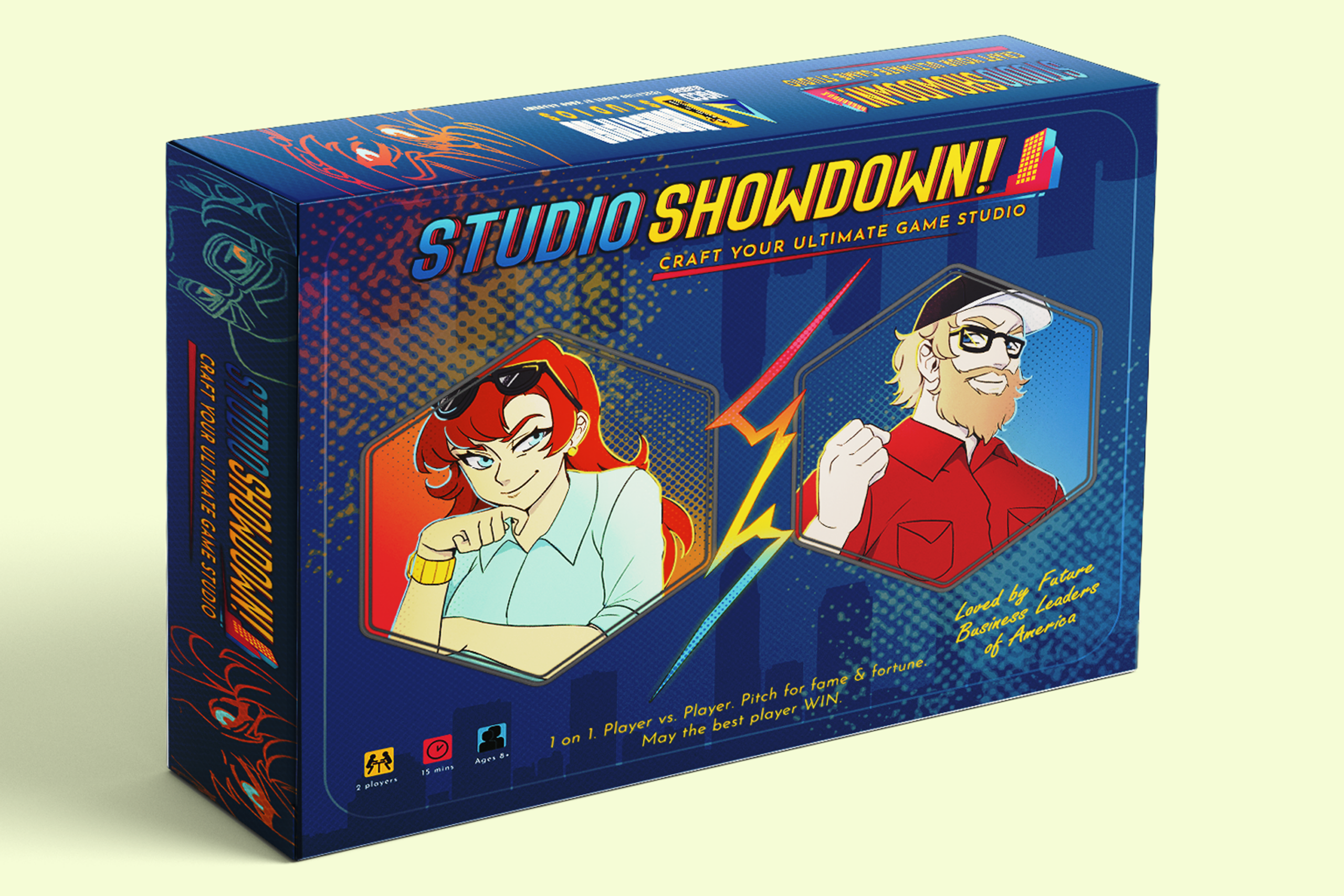
Most business exercises fail because the stakes feel fake. Students spot artificial scenarios instantly and check out. To ignite genuine competitive fire, your product development cycle classroom activity needs a narrative world that students actually care about. Studio Showdown solves this by casting students directly as rival creative studio founders battling to conceptualize, fund, and launch major entertainment titles.
Developed collaboratively by VGCD Academy and DEMYSTIFIED Studios, the game transforms raw creative ambition into rigorous corporate management. Rather than reading about product lifecycles in an abstract case study, teams sit across from each other managing talent burn, shifting consumer hype, and high-pressure release calendars. It serves as an authentic gateway to the ultimate business board game experience, forcing players to navigate the volatile economics of the entertainment industry.
Translating Video Game Development into Core Business Literacy
Video game production represents the ultimate collision of technical scoping, creative design, and financial exposure. Studio Showdown channels organic youth excitement around games into hard-nosed business literacy:
- Scoping vs. Polish: Teams face constant dilemmas. Do they ship an unpolished title early to secure immediate cash flow, or spend additional capital rounds chasing critical acclaim?
- Resource Allocation: Founders hire specialized talent, balancing creative leads against marketing spend while keeping payroll solvent.
- Live Pitch Mechanics: Teams must pitch their projects to secure external publishing capital, making effective communication a core survival requirement rather than a side assignment.
Classroom Bundle Implementation and Professional Development
Designed specifically around academic scheduling, Studio Showdown: Educator Edition removes every logistical barrier for teachers. Built-in session modularity allows facilitators to run fast-paced 50-minute competitive rounds or expand play across multi-week entrepreneurship units. It integrates seamlessly into national curriculum frameworks across STEM, business entrepreneurship, and Career Technical Education (CTE) pathways.
For schools outfitting full student cohorts simultaneously, the multi-unit Classroom Bundle equips an entire room with dedicated game boards, structured lesson materials, student tracking sheets, and clear curriculum crosswalks. Teachers also gain access to dedicated professional development workshop frameworks, ensuring you can facilitate gameplay with confidence on day one. By replacing disconnected worksheets with an all-in-one tabletop arena, you turn every seat in your room into a dynamic testing ground for real-world leadership.
Turn Product Theory Into Studio Reality
Passive lectures don’t build confident founders; calculated friction does. Running an authentic product development cycle classroom activity forces students to confront brutal market trade-offs, manage resource burn, and master the art of the strategic pivot. When you trade abstract slide decks for tactile decision-making, genuine business instincts take root.
You don’t need complicated tech setups or multi-week software tutorials to deliver this impact. Created collaboratively by VGCD Academy and DEMYSTIFIED Studios, the modular Studio Showdown: Educator Edition fits directly into standard academic periods. Ready to equip an entire cohort with scalable, competitive gameplay and turn-key curriculum crosswalks? Bring high-stakes entrepreneurship to your students with the Studio Showdown Classroom Bundle. Step back, start the timer, and watch your students thrive in the arena.
Frequently Asked Questions
How long does a standard product development cycle classroom activity take to run?
A standard simulation runs flexibly from a single 50-minute sprint up to a multi-week modular unit. Single periods force rapid ideation, quick scoping, and pitch execution under tight countdown clocks. Block periods or multi-day units allow educators to introduce deeper market disruptions, iterative prototyping loops, and comprehensive post-launch financial audits.
Can this product development activity work within a standard 50-minute class period?
Yes, the sprint model is specifically calibrated to thrive inside compressed 50-minute academic schedules. By enforcing strict, time-boxed milestones such as ten minutes for scoping and fifteen minutes for building, students bypass operational hesitation. Visual turn trackers and hard cutoff buzzers ensure teams complete the full trajectory from initial concept to commercial launch before the final bell.
What grade levels benefit most from a product development cycle classroom activity?
Middle school, high school, and introductory collegiate programs benefit most from this gamified structure. The core mechanics scale effortlessly across different age cohorts. Younger students grasp fundamental concepts like budgeting, team roles, and creative trade-offs. Advanced high school CTE and university business students engage with complex unit economics, risk management, and competitive market positioning.
How do educators grade student performance in a gamified product simulation?
Educators grade strategic execution and adaptability rather than surface-level aesthetic polish. High-performing rubrics evaluate market alignment, resource burn discipline, and the evidence-based rationale behind mid-sprint pivots. Incorporating peer evaluations, quick stand-up audits, and post-game retrospective logs ensures students are measured on their collaborative problem-solving and financial literacy.
Is an analog board game simulation better than software-based business simulators?
Analog tabletop games outperform software simulations by eliminating screen fatigue and technical hurdles. Digital platforms often lose initial class time to device updates, login errors, and network issues. Tabletop formats place physical cards and tokens directly into students’ hands, sparking vibrant face-to-face negotiations, active communication, and immediate tactical visibility across the entire room.
What makes game studio management an effective theme for teaching product cycles?
Entertainment software development perfectly captures the volatile collision between artistic vision and commercial viability. Students naturally connect with video games, creating instant intrinsic engagement. Simulating a studio forces them to balance feature creep, talent payroll, marketing hype, and hard launch dates, transforming a familiar medium into a masterclass in modern corporate strategy.
How does the Studio Showdown Classroom Bundle support teachers with no game design background?
The Studio Showdown Classroom Bundle delivers turn-key materials designed for immediate deployment by any teacher. It includes comprehensive educator guides, quick-reference rule summaries, student tracking sheets, and national curriculum crosswalks. Teachers also receive access to professional development training workshops, giving educators total confidence to facilitate high-stakes business simulations without technical gaming expertise.