What if your favorite brand isn’t actually selling you a product, but a specific character build for your social life? Most educators and parents struggle with how to explain brand positioning to teens because the standard MBA definitions are painfully boring. You know the feeling. The moment you mention “market differentiation,” eyes glaze over and phones come out. It’s hard to blame them when most resources feel like they were written for a boardroom in 1995 rather than a 2026 gaming lobby.
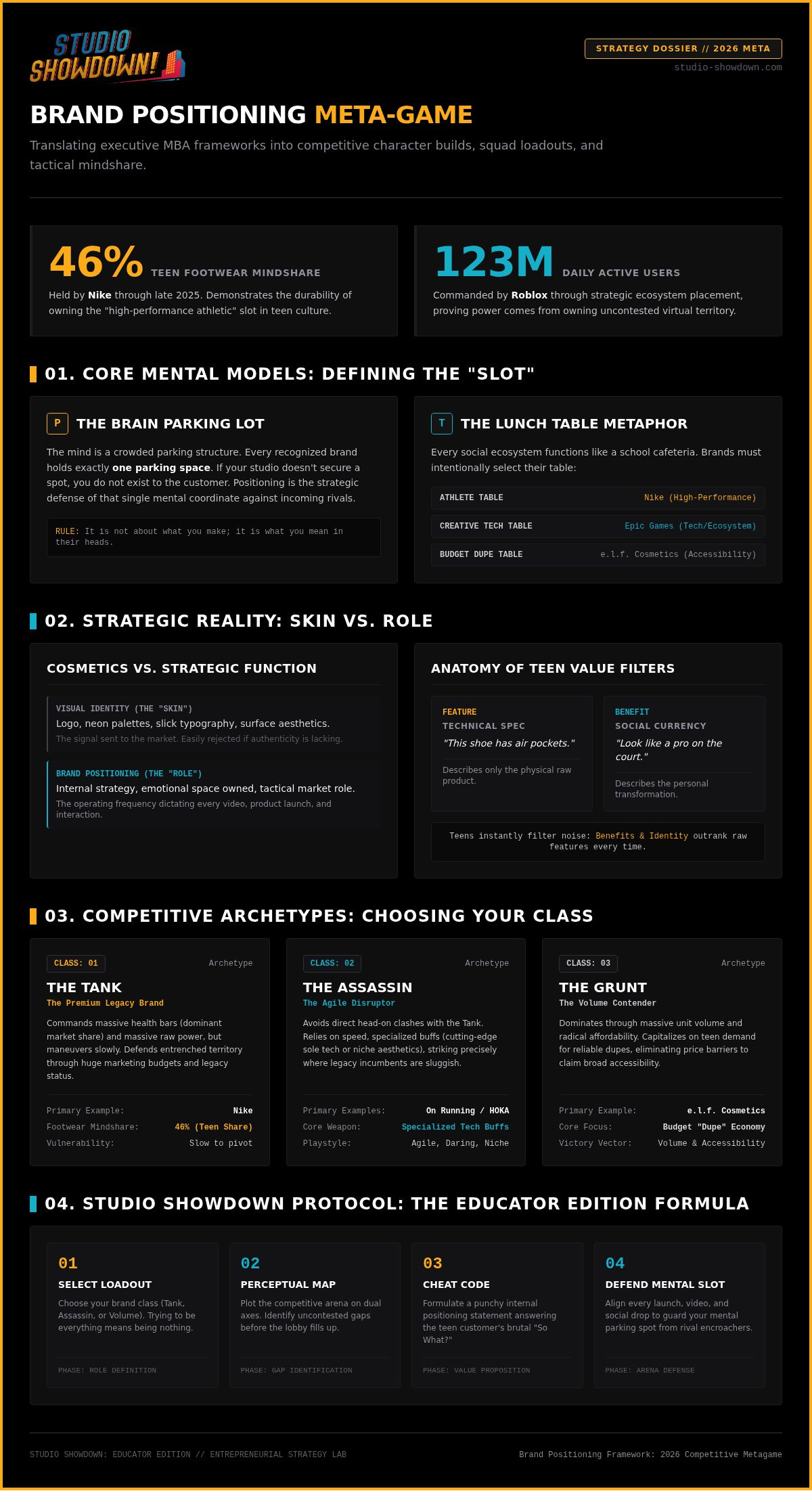
We agree that business strategy shouldn’t feel like a chore. This guide promises to transform “positioning” from an abstract concept into a high-stakes competitive strategy using the logic of gaming metaphors and real-world receipts. You’ll learn to master the art of teaching brand logic through the lens of character loadouts and unique buffs. We will look at why Nike still holds a 46% footwear mindshare among teens and how Roblox maintains 123 million daily active users through smart ecosystem placement. From deconstructing “vibe” to running practical activities with Studio Showdown: Educator Edition, we’re moving past the noise to build real-world entrepreneurial muscle. Strategy is the ultimate power-up.
Key Takeaways
- Discover how to explain brand positioning to teens by reframing corporate jargon into “character classes” and competitive “loadouts” they already understand.
- Learn to distinguish between branding as the visual “skin” and positioning as the strategic “role” a brand plays in the market.
- Master the use of perceptual mapping to visualize the competitive arena and identify uncontested gaps where a new brand can win.
- Apply a punchy, four-step formula to build internal “cheat codes” that define a brand’s unique value proposition.
- Transition from theory to practice using Studio Showdown: Educator Edition to simulate real-world studio founding and market rivalry.
What is Brand Positioning? (The ‘Vibe’ vs. the Strategy)
Imagine your brain is a massive parking lot. Every brand you know owns exactly one parking space. If a brand doesn’t have a spot, it doesn’t exist to you. This is the core of brand positioning theory. It is the specific ‘slot’ a brand occupies in a person’s mind compared to everyone else on the market. It isn’t about what a company makes. It’s about what the company means to the person buying it.
When considering how to explain brand positioning to teens, skip the dry textbooks. Use the school lunch table metaphor. Every table represents a different ‘position’ in the social ecosystem. There’s the high-performance athlete table (Nike), the creative tech-obsessed table (Epic Games), and the budget-conscious ‘dupe’ table (e.l.f. Cosmetics). Positioning is simply deciding which table your brand sits at and why the other students should care. This reputation is your Value Proposition: the primary superpower that makes you the only logical choice for your squad.
The ‘Why’ Behind the Buy
Positioning answers the most brutal question a teen can ask: ‘So what?’ Teens are expert filters for corporate noise. They don’t buy features; they buy identity. A feature is ‘this shoe has air pockets.’ A benefit is ‘this shoe makes you look like a pro on the court.’ It’s the difference between technical specs and social currency. Features describe the product. Benefits describe the transformation.
Mastering how to explain brand positioning to teens requires focusing on these emotional rewards. Positioning is the mental real estate a brand defends against competitors. If you own the ‘performance’ slot, you must defend it with every drop of marketing energy. In the world of Studio Showdown: Educator Edition, this is the difference between a studio that just makes games and one that defines a genre. You don’t just sell a game; you sell the feeling of winning.
Positioning vs. Visual Identity
Don’t confuse the clothes with the person. Branding is the visual layer: the logo, the neon colors, the slick typography. Positioning is the internal strategy. It’s the role the brand plays. A cool logo won’t save a brand if its positioning is ‘expensive but useless.’ Teens see through ‘cringe’ marketing instantly when the visual hype doesn’t match the strategic reality. They value authenticity over aesthetics.
Consider major tech rebrands in 2026. When a company changes its logo but keeps its ‘slot’ in your head, the positioning remains intact. The visual identity is just the signal; the positioning is the frequency. It dictates the tone of every video, every social post, and every product launch. You win by being distinct, not just by looking pretty. True power comes from owning a space no one else can touch.
The Gaming Metaphor: Meta-Gaming the Market
The market isn’t a library. It’s a battle royale. When you’re figuring out how to explain brand positioning to teens, forget the corporate flowcharts. Think about the Arena. Every brand is a player fighting for two finite resources: attention and money. In the 2026 landscape, attention is harder to capture than a legendary drop in Fortnite. To win, a brand needs a “build”-a specific set of attributes that makes them unkillable in their niche. If you don’t have a distinct build, you’re just an NPC in someone else’s story.
Positioning is essentially “Meta-Gaming” the economy. Just as players analyze the current game state to find the most effective tactics, businesses use the American Marketing Association’s branding definitions to move beyond surface-level vibes. You aren’t just picking a logo. You’re picking a strategy that exploits a gap in the competition. You look at what everyone else is doing, find the “uncontested build,” and lock it down before the lobby fills up.
Choosing Your Character Class
Every brand must pick a class. If you try to be everything, you’re nothing. In the branding arena, this determines your playstyle and your target squad.
- The Premium Brand (The Tank): Think Nike. They hold a massive 46% mindshare in footwear as of late 2025. They have massive “health” (market share) and high power, but they’re slow to move. They defend their territory with huge budgets and legacy status.
- The Disruptor (The Assassin): These are brands like On Running or HOKA. They don’t fight the Tank head-on. They use speed and specific “buffs”-like unique tech or niche aesthetics-to strike where the Tank is weak. They’re agile, daring, and precise.
- The Budget Brand (The Grunt): These brands dominate through volume. e.l.f. Cosmetics is a prime example, owning 36% of the teen cosmetic mindshare by leaning into “dupe” culture. They focus on high utility and accessible pricing for the masses.
Reading the Meta
In gaming, the “Meta” changes when developers release a patch. In branding, “Buffs” and “Nerfs” happen through real-world shifts. A new privacy law like the April 2026 COPPA update is a massive Nerf to brands that rely on third-party targeted advertising. A viral TikTok trend is a temporary Buff. To survive, you must adapt your strategy to the current patch notes of the world.
Successful founders look for the “Open Lane.” If every competitor is grinding for the “Professional Athlete” vibe, the winning play might be the “Cozy Gamer” aesthetic. Being a “Jack of all Trades” is a guaranteed Game Over. You’ll run out of resources before you build a loyal squad. If you want to see how these studio founder tactics play out in a high-stakes environment, you can practice your own market entry in Studio Showdown. A specialized build always beats a generic one.
The Competitive Showdown: Mapping the Rivals
Every pro player knows you don’t just run into the arena without scouting the lobby. If you want to master how to explain brand positioning to teens, you need a visual tool to track the competition. We call this the Perceptual Map. It is a battle map that plots brands based on consumer perception. By using two intersecting lines, an X and Y axis, you can see exactly where the rivals are bunched up and where the “Open Lane” exists. This isn’t about where a brand thinks it is. It’s about where the audience puts them.
Choosing the right axes is critical. Forget “High Quality” vs “Low Quality” because those terms are too vague. Modern teens care about different metrics. Try mapping “Aesthetic/Cozy” against “Performance/Grind,” or “Budget/Value-Hack” against “Status/Hype.” This visualizes the psychological space brands occupy. It helps identify your Primary Rival: the one brand currently sitting in the spot you want to take. To win, you must either push them out or find a brand positioning statement framework that makes their strengths look like weaknesses.
Creating a Battle Map
Start by drawing a large plus sign on a page. Let’s look at the “Big Three” in gaming as of late 2026. Nintendo sits firmly in the “Cozy/Family” and “Unique IP” quadrant. Sony’s PlayStation occupies the “High Performance/Cinematic” slot. Microsoft’s Xbox has pivoted toward the “Service/Ecosystem” space. When you plot them, you’ll see a gap in the “Ultra-Portable/Open-Source” corner. That is a Blue Ocean. It’s a space where no one else is playing, allowing you to capture market share without a direct firefight.
Avoid “No Man’s Land” at all costs. This is the center of the map where a brand is too generic to be noticed. If you’re “sort of cheap” and “sort of high-end,” you’re invisible. You have to commit to a corner. In the world of entrepreneurship, being “mid” is a death sentence. Clarity is your greatest weapon.
Strategic Outmaneuvering
The map isn’t static. It’s a living document. When a rival enters your space, you have two choices: double down on your unique “buff” or pivot to a new coordinate. This requires deep authenticity. Teens are hyper-literate in marketing; they can smell a fake “vibe” instantly. If your brand claims to be “for the community” but blocks user-generated content, your reputation will tank. Understanding strategic depth is about aligning your actions with your map position. You don’t just say who you are. You prove it through every update, every drop, and every interaction. Win the map, win the market.
How to Build a Positioning Statement (The 4-Step Formula)
Think of a positioning statement as an internal “cheat code.” It isn’t a public slogan or a catchy tagline. It is the tactical blueprint that ensures every member of your team is playing the same game. When teaching how to explain brand positioning to teens, emphasize that this statement is for the founders, not the customers. It keeps the brand from lagging when the market gets crowded. It is the ultimate filter for every decision the business makes.
To build a high-tier positioning statement, you need to lock in four specific variables. If one is missing, the whole strategy falls apart. Use these steps to define your brand’s role in the arena:
- Step 1: Identify the Target Audience. Who is the specific player you’re equipping? Don’t say “everyone.” Narrow it down to the specific squad that has the problem you’re solving.
- Step 2: Define the Market Category. What lobby are you entering? Are you a “mobile RPG,” a “sustainable snack,” or a “productivity tool”? You must define the genre before you can break the rules.
- Step 3: State the Key Benefit. This is your unique superpower. It is the one “buff” that makes your brand the only logical choice for your target audience.
- Step 4: Provide the Reason to Believe. These are the receipts. It is the technical proof or community consensus that proves your claim isn’t “cap.”
The ‘Mad Libs’ of Branding
The easiest way to assemble these pieces is through a simple template. It works like a Mad Libs for business. The formula is: For [Target Audience], [Brand Name] is the [Market Category] that [Key Benefit] because [Reason to Believe].
Let’s look at a fictional brand called Glitch-Grip. Their statement might look like this: “For competitive PC gamers who hate greasy keyboards, Glitch-Grip is the snack brand that provides mess-free energy because of our patented Zero-Residue coating.” This is clear, punchy, and impossible to mistake for a rival. Challenge the teen to write one for their favorite app or creator. Why do they use Discord instead of Slack? What is the proof that it’s better for their specific squad?
Refining the Power-Up
Cut the fluff during the refining process. Claims like “the best” or “the cheapest” are weak. They’re easily nerfed by a bigger competitor with a larger budget. Instead, aim to own a single, specific concept in the user’s mind. High-performance brands don’t try to be everything; they try to be “The One Thing.”
This statement acts as the North Star for the company. If a new social media post or product feature doesn’t support the positioning statement, it gets deleted. It ensures the brand remains a specialized build rather than a cluttered mess. To see how these internal blueprints shape a winning studio in real-time, grab a Classroom Bundle and start building your own market-leading strategy. Precision beats volume every time.
Studio Showdown: The Ultimate Strategy Lab
Theory is a solid starting point, but in the creative industry, execution is the only metric that matters. You can discuss character classes and battle maps all day, but how to explain brand positioning to teens effectively often requires a hands-on arena. Studio Showdown transforms abstract marketing logic into a high-stakes board game. It moves the conversation from a lecture hall to a competitive studio environment where every decision has a visible consequence. Players don’t just learn about strategy; they live it as studio founders.
In this simulation, positioning becomes your primary weapon. You navigate the complex world of game development, balancing budgets while trying to outmaneuver rivals for market dominance. The game introduces the “boss battles” of entrepreneurship: pitching and fundraising. These phases are the ultimate tests of your brand’s clarity. If your studio’s position is “mid” or confusing, investors will pass. You have to articulate your unique superpower under pressure, proving your studio isn’t lagging behind the current meta.
Learning Through Play
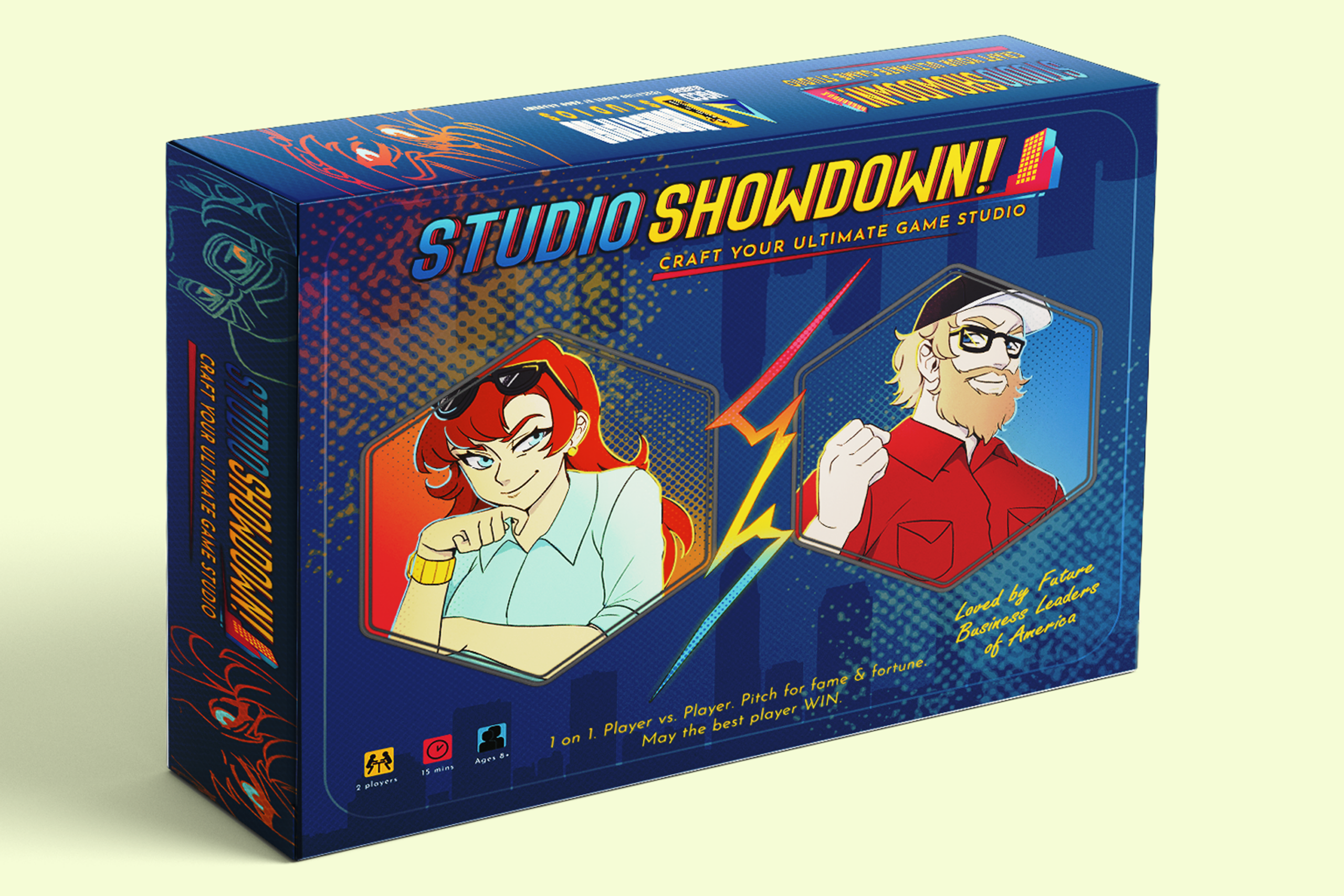
Studio Showdown: Educator Edition is specifically built to bridge the gap between classroom theory and industry reality. It encourages students to think like lead producers, managing resources and defending their mental real estate against other players. This isn’t just about winning a board game. It’s about building professional portfolios. By documenting their strategic choices and market pivots during a session, students create a narrative of business acumen that looks impressive to future employers or college recruiters. They aren’t just playing; they’re practicing for a career in the global creative economy.
There is also a massive secondary benefit: screen time reduction. In a world dominated by 123 million daily active users on Roblox and constant digital noise, an analog strategy game provides a necessary tactical reset. It forces face-to-face negotiation, real-time social reading, and tactile problem-solving. You can’t hide behind an avatar when you’re pitching a venture capitalist across a table. It builds the “soft skills” that digital courses often ignore.
From Board Game to Business Success
The transition from the game board to real-world entrepreneurship is seamless. The same logic used to win a round of Studio Showdown applies to launching a real startup or a YouTube channel. Gen Z and Gen Alpha students demand interactive, high-fidelity learning experiences. They value authenticity and competitive depth. By mastering how to explain brand positioning to teens through play, you equip them with a mental toolkit that survives long after the game is packed away. Strategy is a muscle; this is the gym. Order your Studio Showdown Classroom Bundle here and start building the next generation of industry leaders.
Master the Meta of Modern Business
Strategy isn’t just for boardrooms. It’s the ultimate power-up for the next generation of founders. You’ve moved from understanding the “school lunch table” vibe to building specialized character classes and defending mental real estate. By focusing on “The One Thing” and using perceptual maps to find the “Open Lane,” you’ve cracked the code on how to explain brand positioning to teens in a way that actually sticks. Business logic is no longer a dry lecture; it is a competitive game where clarity always wins.
Success in 2026 requires more than just a cool aesthetic. It demands a tactical blueprint and the courage to outmaneuver rivals. Empower your teen with the strategy skills of a founder, Get Studio Showdown today! Developed by industry experts at VGCD Academy, this game features immersive 2026 strategy mechanics designed for real-world impact. It is the perfect choice for screen-free family or classroom learning that builds genuine business acumen. The arena is waiting. It is time to stop watching the game and start leading it.
Frequently Asked Questions
What is the simplest way to explain brand positioning to a teen?
It is the unique “slot” or parking space a brand owns in someone’s brain. When you think of a category, like fast food or FPS games, the first brand that pops up owns that position. It is about reputation and identity. It is the specific reason a person chooses one squad or product over every other rival in the lobby. Positioning defines who you are and why you matter.
Is brand positioning the same as a marketing strategy?
No, positioning is the foundation, while marketing strategy is the execution plan. Positioning defines the build or role you play in the market. Marketing strategy covers the specific moves you make to reach the audience, like social media ads or influencer drops. You cannot have an effective marketing strategy without a clear position. One tells the world who you are; the other tells them where to find you.
How can gaming help a teenager learn about business?
Gaming provides a low-risk arena to practice resource management, competitive analysis, and strategic pivots. Modern games require players to understand “the meta,” which is exactly how market trends work. When figuring out how to explain brand positioning to teens, use gaming metaphors like character classes. A Tank brand dominates with power and budget, while an Assassin brand wins through speed and niche specialization. It makes abstract business logic feel high-stakes.
What are some real-world examples of great brand positioning for 2026?
Look at brands that own a specific vibe rather than just a product. e.l.f. Cosmetics dominates the accessible cool slot by leaning into dupe culture and viral utility. On Running has successfully outmaneuvered legacy rivals by positioning itself as the performance-tech choice for serious athletes. These brands win because they committed to a specific corner of the perceptual map. They do not try to please everyone; they equip a specific squad.
Can a teenager start a brand with zero budget?
Yes, because positioning is free. You do not need a massive ad spend to define a unique role for a YouTube channel or a custom clothing line. Success comes from identifying an Open Lane where no one else is playing. By focusing on a specific niche and staying authentic to that community, a teen can build a loyal following without spending a dollar on traditional marketing. The strategy is the most valuable asset.
Why is positioning more important than a logo for a new business?
A logo is just the skin, but positioning is the stats and abilities. You can have a neon, high-fidelity logo, but if your brand is cringe or generic, no one will care. Positioning dictates the tone, the price, and the target audience. It ensures that when people see the logo, they actually know what it stands for. A brand with bad positioning but a great logo is just an NPC with a fancy outfit.
How does Studio Showdown teach brand positioning?
Studio Showdown turns theory into a high-stakes battle. Players act as studio founders, forcing them to master how to explain brand positioning to teens through pitching and fundraising phases. You have to define your studio’s unique superpower to win investors and outmaneuver rivals. The game uses immersive 2026 strategy mechanics to show that a specialized build always beats a generic one. It is a tactical reset for any classroom.
What happens if a brand’s positioning is too broad?
It becomes invisible. Broad positioning leads to No Man’s Land, where a brand is too generic to be noticed by any specific squad. If you try to be the best and cheapest for everyone, you will run out of resources before you capture a single niche. You lose the competitive edge because you have no unique buffs. In the branding arena, being mid is a guaranteed game over. Precision is the only path to market dominance.