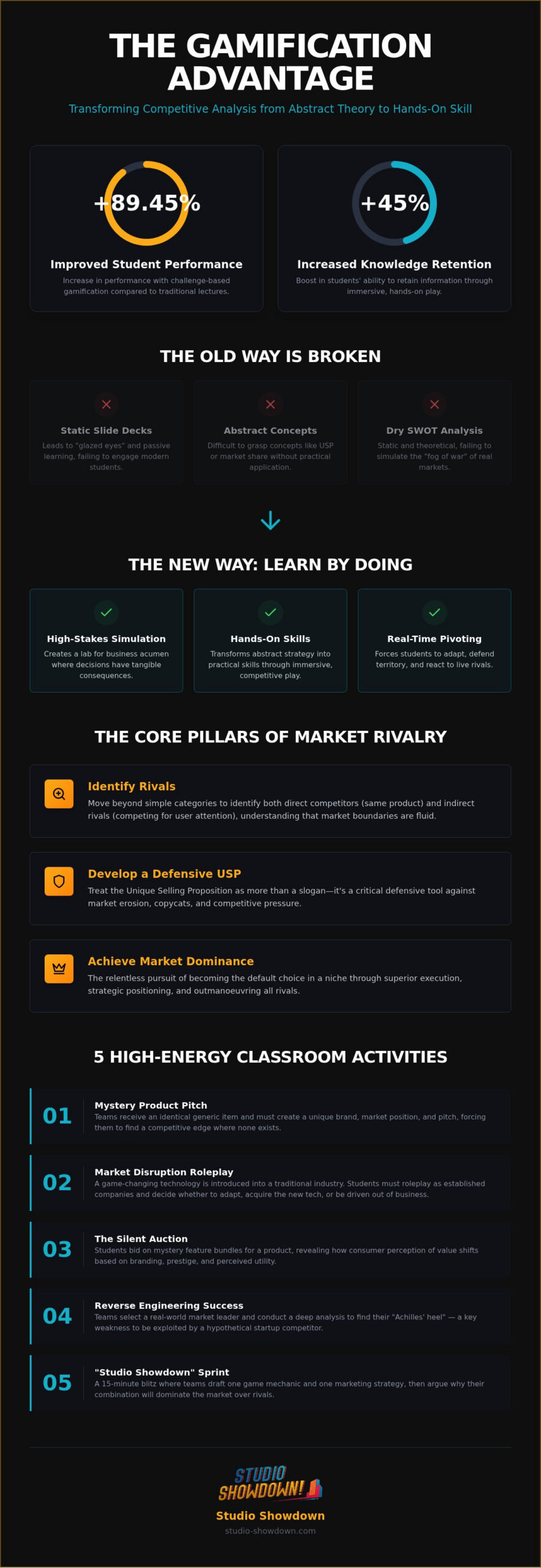
Challenge-based gamification improves student performance by 89.45% compared to traditional lectures. It’s a staggering figure that proves the era of the static slide deck is dead. You’ve likely seen the glazed eyes during market research units. It’s tough to explain a USP or market share when students haven’t felt the heat of a real rival. We know you want more than just compliance. You want engagement, grit, and measurable results. This guide delivers practical, high-energy classroom activities for competitive analysis that transform abstract strategy into hands-on entrepreneurial skills. You’ll discover how to use simulation to create a high-stakes lab for business acumen. We’ll preview ready-to-use lesson plans, examine the impact of tools like the Studio Showdown: Educator Edition, and show you how to increase knowledge retention by 45% through immersive play. It’s time to elevate your curriculum above the noise and turn your classroom into a boardroom. Let’s build something better.
Key Takeaways
- Move beyond static definitions and master the art of differentiation to help students cut through 2026’s market noise.
- Implement five high-energy classroom activities for competitive analysis that force students to pivot against live rivals in real-time.
- Replace outdated SWOT charts with challenge-based gamification to simulate the “fog of war” in market entry and expansion.
- Design a high-stakes studio environment using proven win conditions like market share, revenue, and brand prestige.
- Leverage the Studio Showdown: Educator Edition as a turnkey lab for teaching the full lifecycle of entrepreneurial rivalry.
Why Teaching Competitive Analysis is Crucial for Future Entrepreneurs
Competitive analysis isn’t just a chapter in a textbook. It’s a survival skill. In the high-velocity markets of 2026, entrepreneurs don’t just exist; they compete for every inch of digital territory. To answer the question, What is Competitive Analysis?, we must look beyond simple data collection. It’s the art of identifying, researching, and outmanoeuvring market rivals. For students, this means learning how to cut through deafening market noise. It’s about finding the signal in the static. Differentiation isn’t a luxury anymore. It’s the only way to stay visible in a saturated economy. We’re seeing a massive shift from passive observation to proactive strategic planning. Students shouldn’t just watch the market; they should learn to manipulate it.
This skill is the backbone of successful fundraising. Investors don’t fund ideas. They fund the ability to win against a field of experts. When you integrate high-energy classroom activities for competitive analysis, you give students the tools to build a bulletproof pitch. They learn that a business plan is actually a combat manual for market entry.
The Core Pillars of Market Rivalry
Identifying rivals in 2026 is a complex task. A direct competitor might sell the same software, but an indirect one steals the user’s finite attention. In the digital space, boundaries are fluid and traditional categories are dissolving. Students need to treat their Unique Selling Proposition (USP) as more than a marketing slogan. It’s a defensive tool against market erosion and copycat tactics. Market Dominance in startup culture is the relentless pursuit of becoming the default choice within a specific niche through superior execution and strategic positioning. By mastering these pillars, students move from being spectators to becoming architects of their own success.
Bridging the Gap Between Theory and Practice
Traditional SWOT analysis often feels like a post-mortem on a dead business. It’s static, dry, and frequently fails to engage younger students who are used to the fast-paced logic of the creator economy. Business education needs stakes. Without a consequence for a bad decision, the lesson won’t stick. We have to transition from dusty textbooks to interactive simulations that mirror the pressure of a real studio environment. Using effective classroom activities for competitive analysis bridges this gap perfectly. These exercises force students to pivot, react, and defend their territory in real-time. It’s about making the abstract tangible and the theory actionable.
5 Interactive Classroom Activities for Competitive Analysis
Worksheets are for spectators. In a real market, you don’t fill out forms; you fight for territory. To turn students into entrepreneurs, you need friction. These classroom activities for competitive analysis move beyond theory and drop students into the heat of a simulated rivalry. They learn to pivot. They learn to defend. They learn to win.
Start with the Mystery Product Pitch. Give two teams the same generic item, like a plain white notebook. One team sells it as a luxury journal; the other as a tactical field guide. This forces them to find a competitive edge where none exists. Next, try Market Disruption Roleplay. Introduce a disruptive “teleportation” tech into a traditional logistics industry. Students must decide whether to adapt, acquire, or die. For a lesson in pricing, use The Silent Auction. Students bid on mystery feature bundles, revealing how they perceive value versus brand prestige. This mirrors the complex decision-making often explored in a university course on competitive analysis.
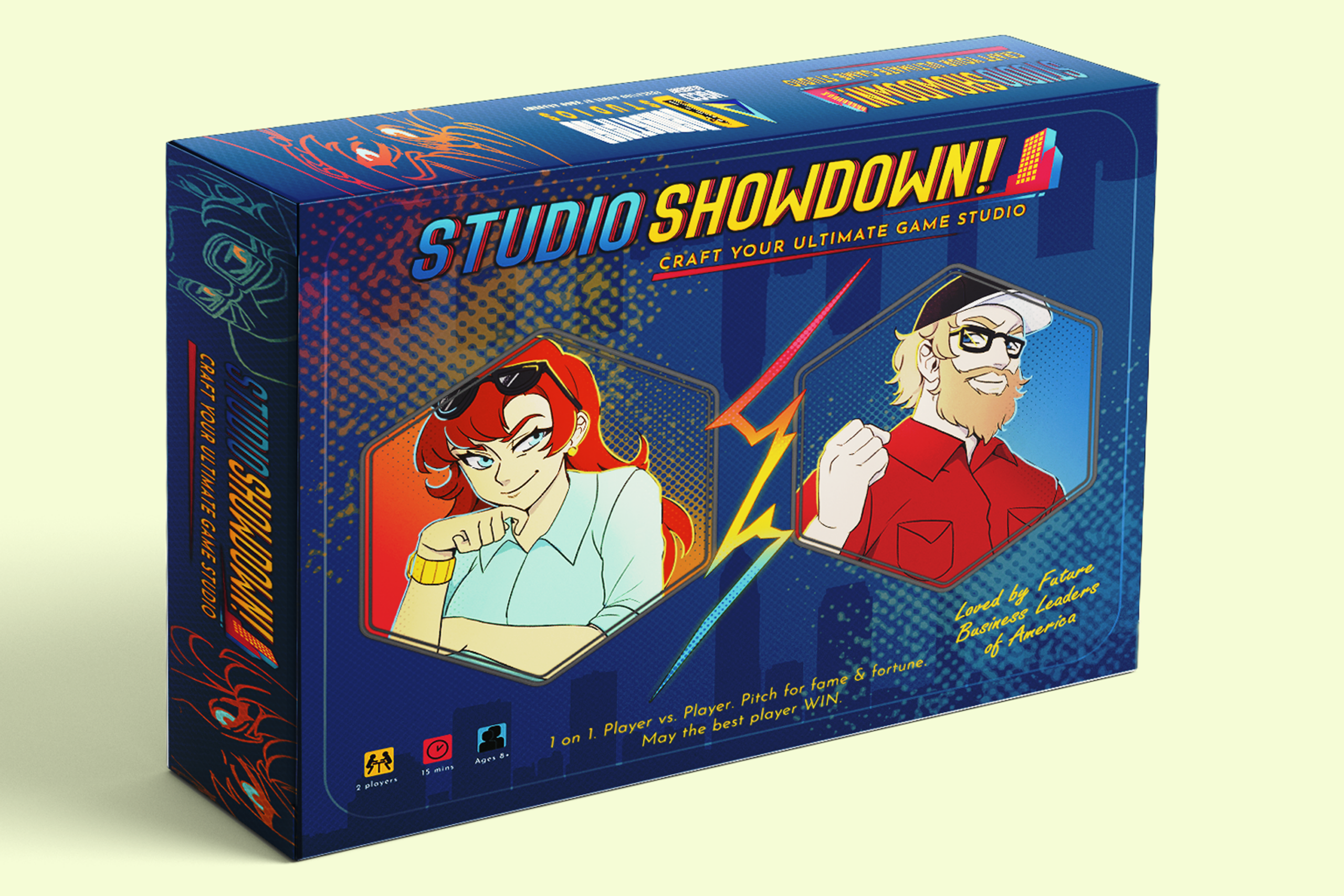
Don’t forget Reverse Engineering Success. Students pick a market leader and hunt for their “Achilles’ heel.” Is the UI clunky? Is the support slow? They build a strategy to exploit that specific weakness. Finally, run a “Studio Showdown” Sprint. It’s a 15-minute blitz where teams draft one game mechanic and one marketing strategy. They must argue why their combo outshines the rival team. It’s the perfect teaser for the full Studio Showdown Board Game experience.
Activity 1: The Feature War
In this exercise, teams build a “v1.0” product on a whiteboard. Mid-way through, they send a “spy” to observe other teams. The goal is to return and add better features. But there’s a catch. Every new feature costs finite “Resource Points.” This teaches students the danger of feature creep. You must debrief on why adding everything is a path to bankruptcy. True strategy is knowing what to leave out to stay lean and focused.
Activity 2: The Pitch-Off
This is the main event. Teams pitch their studio’s vision to a panel of “investors.” Here’s the twist: the rival teams act as the opposition. They get to ask two “poison pill” questions designed to expose flaws in the strategy. Students learn to anticipate objections before they happen. This activity directly links to the fundraising and market dominance mechanics found in the Studio Showdown Board Game. It turns a simple presentation into a high-stakes battle for capital.
Beyond the SWOT Analysis: Teaching Market Dynamics Through Gamification
A SWOT chart is a frozen snapshot. A market is a high-speed chase. Static analysis fails because it assumes your rivals are standing still. They aren’t. Gamification is the superior method for teaching business strategy because it introduces the one thing a worksheet can’t: consequence. When you implement classroom activities for competitive analysis, you move from passive observation to active engagement. Students don’t just list threats. They feel them. This shift is vital for 2026’s fast-moving industries where speed is the ultimate currency.
We simulate this through the “Fog of War.” In a real market entry, you rarely have perfect information. You don’t know your rival’s exact budget or their next feature drop. Simulations force students to manage this uncertainty. They must calculate “Rivalry Risk” in real-time. Should they double down on a current project or pivot to avoid a direct collision? These decisions aren’t just for points. They build the foundation for professional portfolios. Successful outcomes in these simulations provide tangible proof of a student’s ability to navigate real-world volatility.
The Psychology of Competition in Learning
Healthy rivalry is a massive catalyst for retention. Data from March 2026 indicates that challenge-based gamification improves student performance by 89.45% compared to traditional lectures. By using game mechanics to represent financial risks and rewards, you turn abstract numbers into survival tools. It’s the reason we see the natural integration of strategy board games into modern business curricula. These tools provide a high-stakes lab where students can fail safely and learn at a professional pace. Engagement isn’t requested; it’s earned through play.
Moving from Static to Dynamic Analysis
An ongoing competitive strategy requires constant recalibration. In the video game industry, a single “Hit Game” from a competitor can render a year’s worth of research obsolete overnight. Simulations mirror this volatility perfectly. Students learn that a strategy isn’t something you write once. It’s something you live. When a rival launches a superior product, the student must pivot. They learn to analyze the rival’s success, identify the gap, and strike back with a refined USP. These dynamic classroom activities for competitive analysis transform a student from a passive learner into a sharp strategist. They don’t just study the market. They learn to lead it.
How to Design a Competitive Analysis Workshop for Students
Stop lecturing. Start building. A successful workshop doesn’t happen in a vacuum; it requires a high-stakes “Studio” environment where every choice carries weight. You want the room to pulse with the energy of a real production hub. This starts by defining clear, multifaceted win conditions. In the world of entrepreneurship, success isn’t always about the biggest bank account. You might set the goal as achieving 40% market share, reaching a specific revenue milestone, or earning the highest brand prestige. These varied targets force students to choose different strategic paths, creating natural friction between teams.
Your role shifts here. You aren’t a lecturer anymore. You’re a Market Facilitator. You trigger the market shifts, announce the “news updates,” and keep the pressure high. Measuring success isn’t just about who “won” the game. It’s about assessing the logic behind their pivots. Did they anticipate a rival’s move? Did they protect their USP? This is where the real learning happens. To get started, you can leverage the Studio Showdown: Educator Edition to provide a turnkey framework for these sessions.
Workshop Phase 1: Market Intelligence
Intelligence gathering shouldn’t involve dry spreadsheets. Instead, guide students through a rapid research phase where they track rival moves using visual boards or “dev logs.” They need to identify what their competitors are prioritizing. Are they hiring talent? Are they focused on marketing? Market Intelligence is the ethical harvest of public data to forecast rival maneuvers, whereas corporate espionage relies on the illicit theft of non-public secrets. Teaching this distinction is vital. It frames competitive analysis as a professional discipline rather than a dirty trick. These classroom activities for competitive analysis turn research into a tactical advantage.
Workshop Phase 2: Execution and Counter-Moves
Now, enter the “Action Phase.” This is where the analysis hits the pavement. Students must execute their plans while reacting to live threats. Setbacks are your best teaching tools. What happens when a rival outbids a team for a key developer? How do they react when a competitor launches a “Hit Game” that steals their target audience? Encourage collaborative competition. Teams should feel like they’re in a shared ecosystem where one studio’s gain is another’s loss. This dynamic environment ensures that classroom activities for competitive analysis stay relevant, engaging, and intensely memorable. Ready to transform your curriculum? Bring the heat to your next lesson with the Classroom Bundle.
Mastering Rivalry: Using Studio Showdown in the Classroom
The era of passive learning is over. You need a solution that works out of the box. The Studio Showdown: Educator Edition provides exactly that. It’s a turnkey laboratory for entrepreneurship. The game simulates the entire lifecycle of a game development studio, from the first line of code to global market dominance. It strips away the digital noise and focuses on core strategy. This is where classroom activities for competitive analysis become visceral. Students don’t just read about fundraising and pitching; they live it. They learn to manage capital, outmanoeuvre rivals, and defend their brand in an environment where every decision has a consequence.
A Hands-On Business Lab
Every mechanic in the game maps directly to a real-world business skill. Hiring, marketing, and R&D aren’t just cards on a table. They represent critical resource management and strategic trade-offs. Why choose analog over digital? Tabletop games foster superior social negotiation. In a digital sim, you’re clicking buttons. In Studio Showdown, you’re reading people. You’re sensing hesitation. You’re exploiting a rival’s overconfidence. This “analog” play builds a level of business acumen that software simply cannot replicate. It forces students to engage in the “Fog of War” through face-to-face rivalry. They learn to pivot when a competitor steals their lead developer or outbids them for a critical marketing slot. Considering that gamified learning can increase knowledge retention by 45%, this hands-on approach ensures the lessons stick long after the class ends.
Implementing the Classroom Bundle
Scaling these lessons is simple with the Classroom Bundle. It provides the bulk licensing and materials needed for institutional use. You can structure your curriculum around a multi-week tournament, mirroring the pressure of a real fiscal year. Alternatively, use it for a high-octane, single-day workshop. These sessions do more than fill a time slot. They help students build professional portfolios for both STEM and business tracks. They provide measurable evidence of critical thinking, market intelligence, and the ability to handle Rivalry Risk. By the end of the course, students won’t just know the theory of competition. They’ll have mastered it. It’s time to elevate your teaching materials and give your students a premium, high-energy experience. Bring Studio Showdown to your classroom today and turn your students into the market leaders of tomorrow.
Elevating the Next Generation of Strategists
Modern business education demands more than theory. It requires the grit of real-world rivalry. You’ve seen how dynamic classroom activities for competitive analysis can transform a disengaged lecture into a high-stakes strategy lab. By replacing dry spreadsheets with interactive simulations, you give students the tools to navigate the “Fog of War” and master the art of differentiation. They’re not just learning to identify competitors. They’re learning to outmanoeuvre them.
The path to market dominance starts with the right tools. Whether you’re structuring a multi-week tournament or a single-day sprint, the goal is clear: prepare students for the volatility of the 2026 economy. It’s time to move beyond the textbook and into the boardroom. High-energy play builds the social negotiation skills and business acumen that static worksheets simply can’t reach.
Empower your students with the Studio Showdown Classroom Bundle. Specifically designed for STEM and Business curricula, it offers hands-on learning for aspiring game developers and full professional development support for educators. Let’s turn your classroom into a powerhouse of entrepreneurial talent. Your students are ready to compete. Are you ready to lead them?
Frequently Asked Questions
What are the best competitive analysis activities for middle schoolers?
Middle schoolers thrive on high-energy exercises like the “Mystery Product” pitch. This forces them to differentiate identical items using creative branding and unique positioning. These classroom activities for competitive analysis work because they simplify complex market theories into a game of persuasion. You can also use “The Silent Auction” to teach value perception. It’s about making the abstract visible through physical objects and immediate peer feedback.
How do you explain competitive advantage to students?
Explain competitive advantage as the specific reason a customer chooses one studio over another. It’s the “unfair advantage” that makes a product stand out in a crowded market. Use the analogy of a superpower in a video game. If every studio has the same budget, the one with the unique mechanic or better marketing wins. This simplifies the concept of a USP into a relatable goal for students.
Can board games really teach business strategy?
Board games are superior for teaching strategy because they require live social negotiation and risk management. Unlike digital sims, tabletop play forces face-to-face interaction and real-time pivoting. Research shows gamified learning can increase knowledge retention by 45%. Games like the Studio Showdown Board Game act as a lab where students can fail safely while experiencing the financial pressure of a real market entry. It’s about professional execution.
How much time does a classroom business simulation take?
A standard classroom business simulation can range from a 45-minute “sprint” to a multi-week tournament. Short sessions focus on a single mechanic like pitching or hiring. Longer implementations allow students to experience the full lifecycle of a studio. The flexibility of these classroom activities for competitive analysis means you can fit them into a single workshop or use them as a recurring anchor for a whole semester.
What is the difference between direct and indirect competition for kids?
Direct competitors are studios making the same type of game for the same audience. Indirect competitors are any other activity stealing that player’s time, such as social media or a different hobby. For kids, explain it as a choice between two brands of soda versus a choice between soda and a movie ticket. Both compete for the same finite “allowance” or free time in the market.
How do I assess student performance during a competitive game?
Move beyond the final score and assess the strategic logic behind a student’s moves. Look for how they responded to a rival’s “Hit Game” or whether they protected their USP during a pitch. Effective assessment focuses on the quality of their market intelligence and their ability to pivot under pressure. Use “dev logs” or post-game debriefs to have students explain the “why” behind their competitive decisions.
Are there specific business games for the video game industry?
Studio Showdown is specifically designed to simulate the video game development entrepreneurship lifecycle. It’s a strategy board game where students act as studio founders. They navigate the challenges of fundraising, hiring developers, and launching hits while outmaneuvering rivals for market dominance. It provides a hands-on experience that mirrors the volatility of the real industry. This makes it a perfect fit for STEM and business tracks.
What is included in the Studio Showdown: Educator Edition?
The Studio Showdown: Educator Edition is a turnkey solution designed for institutional use. It includes specialized instructional materials and professional development support to help integrate game mechanics into core curricula. When paired with a Classroom Bundle, it provides multiple sets for large groups. It’s built to help educators move from being lecturers to market facilitators, providing everything needed to run high-stakes business workshops without a screen.