The lecture hall is silent. Not because students are focused, but because they’re bored. Traditional business theory is a relic. It fails to capture the heat of the boardroom, the precision of a production budget, or the adrenaline of a high-stakes pitch. You’ve seen the glazed eyes. You’ve felt the disconnect between a dusty syllabus and the fast-paced reality of the 2026 market. It’s time to change the rules of engagement.
We agree that students deserve more than just definitions. They need skin in the game. Resource management games for students are the new gold standard for high-fidelity, high-impact learning. These tools replace static charts with dynamic systems. They transform passive listeners into decisive, pro-active entrepreneurs. This article reveals how these strategic simulators turn complex business concepts into visceral learning experiences. We’ll explore the mechanics of resource allocation, the power of analog strategy, and how tools like the Studio Showdown Board Game build professional portfolios. Prepare to see how classroom STEM concepts translate into real-world market dominance through the lens of creative, competitive play.
Key Takeaways
- Reframe resource management games for students as high-fidelity flight simulators for the 2026 business landscape.
- Compare analog and digital formats to find the perfect balance between social feedback and mechanical complexity.
- Learn to bridge the gap between classroom theory and professional portfolios through immersive fundraising and pitching simulations.
- Gain a practical roadmap for integrating strategic gameplay into existing STEM and business curricula.
- Discover how the Studio Showdown Board Game turns complex asset allocation into a high-stakes battle for market dominance.
What Are Resource Management Games and Why Do Students Need Them?
Resource management is the backbone of entrepreneurship. It’s the art of allocating limited assets to achieve high-stakes goals. In a world where attention spans are shrinking, resource management games for students shift the focus from passive memorization to active strategic decision-making. No more reading about market cycles. Students live them. They feel the weight of every choice. They see the impact of every dollar spent.
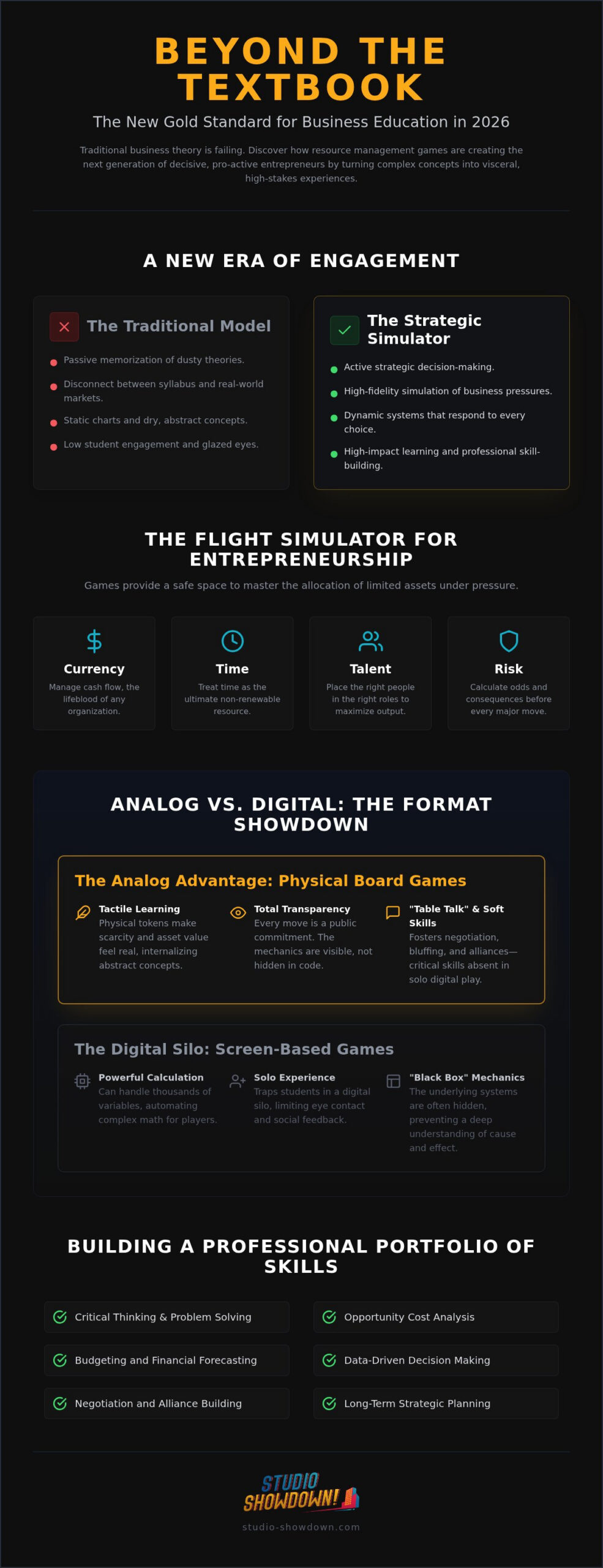
For the next generation of leaders, these simulations act as high-fidelity flight simulators for the professional world. They provide a safe space to fail, pivot, and dominate. These games aren’t just about entertainment; they’re about building the muscle memory required for real-world business survival. The core components of these simulations mirror the actual pressure of the boardroom:
- Currency: Managing cash flow as the lifeblood of an organization.
- Time: Understanding that time is the only non-renewable resource.
- Talent: Placing the right people in the right roles to maximize output.
- Risk: Calculating the odds before making a move that could end the game.
The Cognitive Benefits of Strategic Allocation
Every move has a price. When a student chooses to invest in marketing, they sacrifice research and development. This is opportunity cost in action. Analyzing these trade-offs builds critical thinking skills that traditional textbooks can’t touch. Budgeting becomes a survival skill rather than a dry math drill. Students learn to forecast results. They start to see the long-term consequences of their immediate actions. This low-risk environment allows for bold experimentation. It fosters a mindset where data and intuition work in perfect sync.
Moving Beyond the “Easy Money” Mechanics
Most educational games are too soft. They focus on simple accumulation where everyone wins eventually. That’s not how the market works. Real business involves scarcity and fierce competition. If a game doesn’t force a student to make a hard choice between two vital needs, it isn’t teaching strategy. It’s just a digital toy. Rigorous resource management games for students must include the threat of failure to be effective. You can explore why complexity and real stakes are essential for learning in our analysis of Beyond the Easy Money Game. Scarcity breeds creativity. Competition drives excellence. By mastering these mechanics now, students prepare themselves for the uncompromising reality of the 2026 professional landscape.
Analog vs. Digital: Choosing the Best Format for Student Engagement
Digital management games are powerful. They handle the complex math. They track thousands of variables in milliseconds. But they often trap students in a digital silo. One screen. One player. Zero eye contact. In the professional world of 2026, business doesn’t happen in a vacuum. It happens across a table. It requires reading the room, not just the spreadsheet.
Resource management games for students that utilize a physical board offer something digital can’t: total transparency. When a student moves a physical token, they aren’t just clicking a button. They’re making a public commitment. The mechanics are visible. The consequences are immediate. This visibility fosters a deeper understanding of how systems actually interact. It strips away the “black box” of computer algorithms and puts the gears of the economy directly into the students’ hands.
The Power of Tactile Learning
Holding a physical resource changes the psychology of the game. Scarcity feels real when you can see the pile of tokens shrinking in front of you. This tactile feedback helps students internalize abstract economic concepts like liquidity and asset depreciation. Beyond the numbers, physical games trigger “table talk.” This is where the real learning happens. Students negotiate. They bluff. They form alliances. These are the soft skills that determine career success. For those looking to disconnect from the digital noise, check out our guide on Screen-Free Activities for Teens.
Modern educational environments are saturated with blue light. Students spend hours tethered to laptops. Breaking this cycle is vital for cognitive health and engagement. Screen-free resource management games for students offer a necessary reset. They force players to look up. They encourage active listening and body language reading. These non-verbal cues are essential in business, yet they’re completely absent in digital simulations. By removing the screen, you remove the barrier to genuine human connection.
When to Choose a Classroom Bundle
Individual play has its place, but the modern classroom thrives on collaboration. A Classroom Bundle transforms a lesson into a competitive ecosystem. Physical board games are durable. They don’t require software updates, high-speed internet, or expensive hardware maintenance. They’re ready to deploy at a moment’s notice. They’re professional-grade assets designed to endure years of high-stakes play.
Institutional bundles allow for multi-player showdowns that mirror real market competition. When four or five groups play simultaneously, the energy in the room shifts. Students aren’t just managing their own assets; they’re watching their competitors. They’re reacting to market shifts in real-time. This environment builds a level of professional intuition that a solo digital experience simply cannot replicate. It’s about more than just winning a game. It’s about mastering the art of the deal in a crowded, noisy, and competitive world.
Mastering Professional Skills Through Resource Gameplay
Strategy is more than just moving pieces on a board. It’s about professional leverage. Resource management games for students bridge the gap between having a good idea and building a sustainable empire. In these simulations, students don’t just “play” business. They execute it. They learn that capital isn’t just a number; it’s a tool with a cost. Understanding the difference between debt and equity becomes a survival skill. If they take a loan to scale, they feel the pressure of interest. If they give up equity, they lose future control. These are the high-fidelity lessons that stick.
Winning requires more than internal management. It requires a pitch. Students must translate their resource status into a compelling business case for investors or partners. They learn to speak the language of results. Success in these games isn’t accidental. It’s the result of outmaneuvering rivals for limited consumer attention. Market dominance is a zero-sum game. By competing in this environment, students develop a thick skin and a sharp eye for competitive advantages. These outcomes provide tangible proof of strategic thinking. A successful game run becomes a story for a professional portfolio or a college application.
The Entrepreneurial Mindset
Simulating the video game development cycle exposes students to the brutal reality of product launches. It’s not just about the creative spark. It’s about the burn rate. How long can your studio stay afloat before the product hits the shelf? Students must balance hiring talent with maintaining liquidity. They learn to manage the “crunch” without bankrupting their future. This mindset is at the heart of The Ultimate Business Board Game experience. It’s about keeping the engine running while the plane is being built. This isn’t abstract theory. It’s a pulse-pounding race against the clock and the competition.
Risk Assessment and Mitigation
Every investment is a gamble. Resource management games for students teach players to calculate the Return on Investment (ROI) before committing assets. Should they spend on a high-tier developer or a massive marketing push? The answer depends on the market. Random “Market Events” force players to pivot. A sudden shift in consumer trends can turn a winning strategy into a liability in a single turn. Learning to stay calm under this pressure is invaluable. Failure in a safe, competitive environment is the best teacher. It allows students to analyze their mistakes, refine their intuition, and return to the table with a more resilient plan. This is how professional acumen is forged.
How to Integrate Management Games into Your Curriculum
Implementation is a tactical deployment, not just a classroom activity. To get the most out of resource management games for students, you need a clear roadmap. It starts with alignment. Every game mechanic must serve a learning objective. If your focus is STEM, lean into the mathematical forecasting of production cycles. If it’s business, emphasize the negotiation and asset liquidation phases. By mapping these actions to your syllabus, you turn playtime into a high-octane lab session.
Successful integration follows a four-step process to maximize impact:
- Step 1: Align Mechanics. Match specific in-game challenges with your curriculum goals, whether it’s financial literacy or project management.
- Step 2: The Meta-Game. Connect every turn to a real-world 2026 business example. Show them how their in-game studio’s struggle mirrors a real startup’s journey.
- Step 3: The Debrief. Cement the concepts. Ask why a specific strategy failed. Analyze the burn rate. Discuss the opportunity cost of their final move.
- Step 4: Scale the Experience. Use a Classroom Bundle to ensure every student has a seat at the table. Group play creates a competitive ecosystem that mirrors a real market.
Leveraging Educator Editions
Teachers don’t have time for guesswork. The Studio Showdown: Educator Edition provides the specialized guides needed to lead professional-grade discussions. These resources help you adapt game length to fit standard instructional periods without losing the strategic depth. You can run a “Blitz Mode” for a 45-minute class or a multi-day campaign for deeper immersion. Staff training becomes simpler when the game itself acts as the primary teaching tool. It’s about empowering educators to facilitate, not just lecture.
Measuring Student Progress
Assessment doesn’t always require a written exam. Resource management games for students offer a window into a student’s cognitive process. You can track financial literacy gains by observing their in-game budgeting and ROI calculations. Use game “Showdowns” as a form of alternative assessment. When a student can successfully defend their resource allocation strategy during a post-game pitch, they’ve mastered the concept. Repeated play sessions build a level of business acumen that is visible and measurable. This is how you prepare students for the professional pressure of the real world, one turn at a time.
Studio Showdown: The Premier Resource Management Simulation
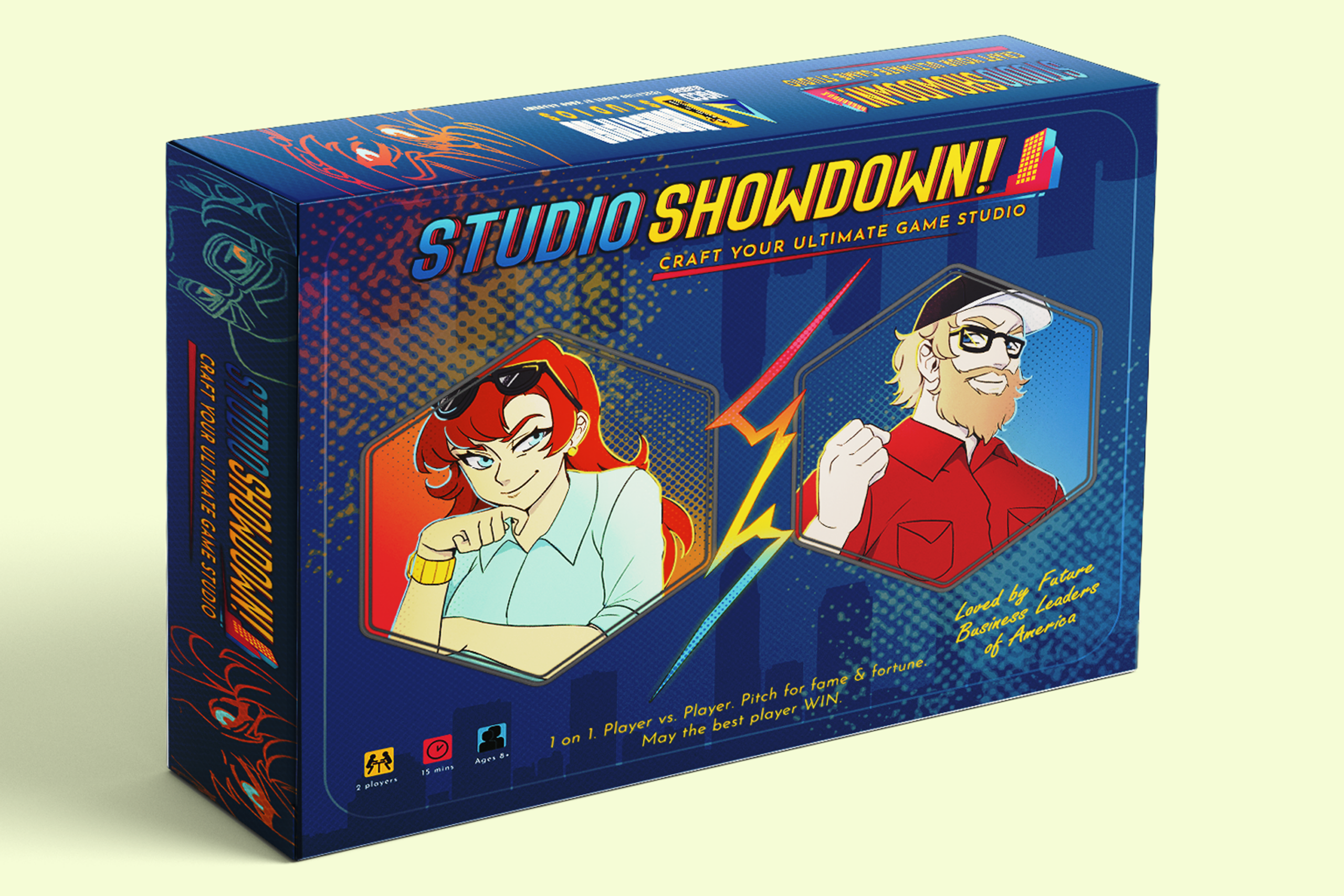
Studio Showdown isn’t just another entry in the category of resource management games for students. It’s a high-fidelity simulation of a $200 billion industry. Most games stop at “fun.” This one starts at professional mastery. Players enter the competitive world of video game development. They aren’t just moving pieces. They’re managing a studio’s reputation, its talent pool, and its survival. The narrative arc is clear. You start as a scrappy founder. You end as a market mogul. Or you go bankrupt trying.
The “Showdown” mechanic is the heart of the experience. This is where the internal management meets external reality. It’s the moment of truth where your production quality is tested against the market. This creates a level of high-stakes engagement that digital simulations often miss. It’s visceral. It’s loud. It’s the adrenaline of the boardroom brought to the classroom table. By the time the game ends, students have done more than play. They’ve built a narrative of strategic success. This experience bridges the gap between a board game and a professional portfolio. It gives students a concrete story of how they allocated capital, managed risk, and dominated a competitive market.
Designed for Aspiring Developers
This simulation didn’t happen in a vacuum. It’s the result of a collaborative effort between VGCD Academy and DEMYSTIFIED Studios. Every mechanic mimics real-world studio challenges. Students must navigate the complexities of fundraising, pitching, and talent acquisition. They feel the pressure of the development cycle. They learn that a great idea is worthless without the resources to execute it. This professional-grade design ensures that every session builds genuine business acumen. For a deeper dive into the tactics that win, explore our Mastering the Board Strategy Guide. It’s the blueprint for turning raw ambition into market dominance.
Getting Started with Your Classroom
Scaling this experience is simple. The Classroom Bundle is designed for multi-student environments. It provides the hardware needed to run simultaneous sessions, creating a living, breathing market ecosystem in your room. This isn’t just about handing out boxes. It’s about a complete educational shift. You can access specialized workshops to maximize the game’s impact. These sessions help educators lead high-level debriefs that connect game outcomes to 2026 business trends. Don’t let your students settle for dry theory. Give them the tools to master the market before they even enter it. Equip your students with the Studio Showdown Board Game today and watch them transform from passive learners into decisive leaders.
Forge the Next Generation of Industry Leaders
The transition from a passive student to a decisive entrepreneur doesn’t happen in a textbook. It happens in the heat of competition. By integrating resource management games for students into your curriculum, you’re giving them more than just a lesson. You’re giving them a high-fidelity flight simulator for the 2026 business world. They’ll master the art of the pitch, the math of the budget, and the grit required for market dominance.
Success requires the right tools. Studio Showdown, developed by industry experts at VGCD Academy, provides the professional-grade experience your classroom needs. With durable physical components designed for repeated institutional use and comprehensive support through workshops, it’s a long-term investment in student success. You’ve seen how the “Showdown” mechanic turns complex theory into visceral experience. Now, it’s time to put that power into your students’ hands.
The market is waiting for those brave enough to lead. Don’t let your students enter the professional arena unprepared. Master Entrepreneurship with the Studio Showdown Board Game today and watch them build the portfolios that will define their future careers. The struggle is noble. The victory is earned. Start the showdown now.
Frequently Asked Questions
What makes a game a “resource management” game for students?
A resource management game forces players to achieve specific goals using strictly limited assets like time, money, or talent. For students, these games translate abstract economic theories into concrete, high-stakes choices. If you spend your budget on marketing, you can’t afford a lead developer. This tension between needs and limits defines the genre. It’s about optimizing efficiency while navigating the constant pressure of competing priorities.
Can board games really teach financial literacy as well as software?
Physical board games often outperform software by making the math visible and manual. When students physically count currency or tokens, they internalize the weight of every expenditure. Software often automates these calculations, hiding the logic behind a digital screen. Board games require active participation in every transaction. This transparency ensures that financial literacy isn’t just a background process; it’s a front and center survival skill.
What age group is best suited for resource management strategy games?
These games are most effective for middle school through university-level students. While the core mechanics are accessible, the strategic depth scales with the player’s maturity. Younger students focus on basic budgeting and asset protection. Older students engage with complex concepts like fundraising, equity, and market dominance. Resource management games for students are designed to grow with the learner, offering new challenges as their business acumen sharpens.
How do these games help students build a professional portfolio?
Gameplay provides a narrative of strategic decision-making that students can reference in interviews or college applications. Successfully navigating a simulation like Studio Showdown proves a student can manage risk and allocate resources under pressure. They can describe specific instances where they pivoted their strategy to save a failing project. These stories demonstrate practical business logic and problem-solving skills that traditional academic grades simply cannot capture.
Is Studio Showdown suitable for non-gamers or beginners?
Yes, the game is built for aspiring professionals, not just hardcore gamers. The mechanics are intuitive and reflect real-world logic that non-gamers find easy to grasp. We focus on clear systems that mirror actual business development cycles. Beginners often bring fresh perspectives to the table because they aren’t bogged down by typical gaming tropes. The goal is mastering entrepreneurship, and the game provides all the tools necessary to start from scratch.
How long does a typical session of an educational management game take?
Session lengths are flexible to fit various educational settings. A standard game of Studio Showdown can be completed in a single 60 to 90-minute instructional block. However, the Educator Edition allows teachers to run specialized Blitz sessions or extended multi-day campaigns. This adaptability ensures that the game fits into a tight syllabus without sacrificing the depth of the strategic experience. It’s about maximizing impact within the available time.
What are the benefits of using a Classroom Bundle over individual units?
A Classroom Bundle creates a competitive market ecosystem that individual units cannot replicate. When multiple groups play simultaneously, the room becomes a living simulation of industry rivalry. Students don’t just manage their own assets; they react to the successes and failures of their peers. This bundle also provides specialized support and workshops for schools, making it the most efficient way to deploy resource management games for students at scale.
Do these games align with STEM and business education standards?
These simulations directly support core standards in financial literacy, mathematics, and career readiness. They require students to apply STEM concepts like data analysis and forecasting to solve real-world problems. Business standards regarding entrepreneurship, risk assessment, and project management are woven into every turn. By playing, students meet educational requirements through active application rather than passive observation. It’s a high-fidelity approach to meeting 2026 academic and professional benchmarks.