The next generation of tech founders won’t find their competitive edge in a spreadsheet. Traditional education often buries the thrill of innovation under a mountain of dry Gantt charts and administrative busywork. It’s time to cut through the noise. High-stakes project management games for students are rewriting the curriculum, replacing screen fatigue with the raw energy of the boardroom. You know the frustration of watching bright minds dim behind a digital glow; students are tired of clicking through platforms that feel more like chores than challenges.
We’re moving beyond mere task tracking to master the business of innovation. This article shows you how modern tabletop strategy transforms learners into founders who can pitch, fundraise, and dominate a competitive market. You’ll discover how to build elite business acumen and portfolio-ready soft skills without touching a keyboard. We’re exploring the shift from passive learning to active, analog systems thinking. Prepare to see how the right showdown creates the professional leaders of 2026. It’s about turning complex theory into a visual, tactile victory.
Key Takeaways
- Ditch the dry spreadsheets. Shift from task tracking to strategic leadership with high-stakes scenarios designed for the modern classroom.
- Discover why project management games for students are the ultimate tool for teaching fundraising, burn rates, and the art of the pitch.
- Reclaim the classroom from screen fatigue. Analog strategy builds the face-to-face negotiation skills that digital platforms cannot replicate.
- Scale your impact with specialized Classroom Bundles. Align gameplay with national standards to transform your room into a high-performance studio ecosystem.
- Master the Showdown. Use industry-backed mechanics to turn students into tech-savvy entrepreneurs ready for the 2026 market.
Beyond the Gantt Chart: Why Project Management Games for Students Must Evolve
Traditional education is stuck in a loop. It’s obsessed with the mechanics of the past. Linear charts. Static lists. Bureaucratic box-ticking. Gen Z and Alpha don’t respond to rows of data; they crave impact. They want to see the “why” behind the “what.” In the current educational environment, teaching project management games for students isn’t just a trend; it’s a necessity for survival in a tech-driven economy. We’re shifting the focus from simple task tracking to high-level strategic leadership.
Modern learning requires a robust project management simulation that mirrors the volatility of the real market. These games serve as high-fidelity simulators for professional risk and reward. Every decision has a visible, tactile consequence. We’re moving past the era of passive observation into an era of active mastery, where the classroom becomes a laboratory for market dominance.
The Crisis of Engagement in STEM Curricula
Digital modules are failing our classrooms. The “click-and-learn” model creates a passive, hollow experience. Students absorb information for a test and then let it drop. This knowledge drop-off is the silent killer of STEM. We need agency. Students must own the failure of their “studio” to truly appreciate the weight of success. We’re moving beyond teaching kids how to code; we’re teaching them the commerce of technology. It’s the difference between being a laborer and being an architect. Real engagement happens when the stakes are high and the outcome isn’t guaranteed.
Bridging the Gap Between Hobbyist and Professional
A professional mindset doesn’t happen at graduation. It’s forged early. By using studio metaphors, we make complex business logic relatable to young gamers who already understand resource management. This isn’t just play. It’s about building a competitive college portfolio that shows a deep understanding of systems thinking. Project management games for students bridge that gap, turning a hobbyist’s curiosity into a founder’s precision. They learn to manage budgets, lead teams, and navigate the “Showdown” of a competitive launch before they even step into their first internship.
Modern project management games for students are sophisticated cognitive tools engineered to instill “Founder-level thinking” by simulating the high-stakes intersection of innovation, capital, and market dominance.
The Core Mechanics of High-Stakes Technology Project Management
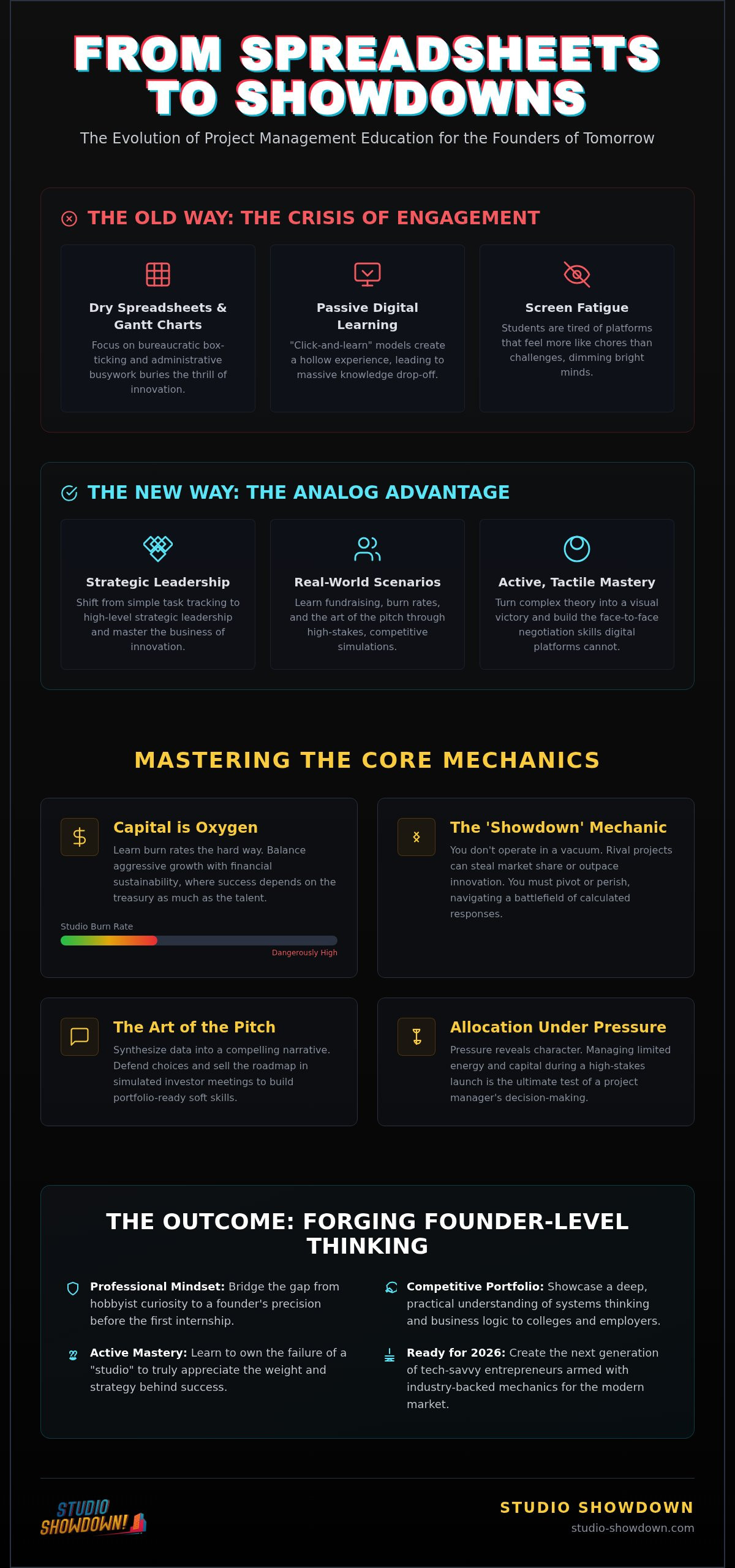
Project management isn’t a checklist. It’s a fight for survival. To win in the tech world, students must master the invisible forces that drive a studio. It’s about more than finishing a task; it’s about sustaining a business. Capital is oxygen. Students learn about burn rates the hard way when their resources vanish before the product hits the market. This isn’t theoretical math. It’s a struggle for project viability. Effective project management games for students simulate this pressure, forcing players to balance aggressive growth with financial sustainability. They learn that a project’s success depends on the treasury as much as the talent.
Competition changes every variable. You don’t work in a vacuum. Rival projects can steal your market share or outpace your innovation. This is the “Showdown” mechanic in action. Strategic outmaneuvering becomes essential. If the market shifts, you pivot or you perish. It’s about reading the room and the board simultaneously. You’re not just managing a timeline; you’re navigating a battlefield where every rival move requires a calculated response.
Mastering the Art of the Pitch
Communication is a technical skill. If a project manager can’t articulate the vision, the project dies in the cradle. Digital platforms often fail to capture the nuance of human persuasion. Tabletop experiences force students into simulated investor meetings. They must defend their choices. They must sell their roadmap. Much like the complex scenarios found in MIT Sloan’s management simulations, these games require students to synthesize data into a compelling narrative. They become the voice of the innovation, building soft skills that translate directly to professional portfolios.
Resource Allocation Under Pressure
Pressure reveals character. Managing limited energy and capital during a launch is the ultimate test. Do you push for speed-to-market and risk a buggy release? Or do you prioritize quality and risk being late? This is the “Founder’s Dilemma.” Tabletop play provides a risk-free arena to explore these high-stakes trade-offs. When students dive into Studio Showdown, they’re managing more than just tokens; they’re managing the future of their virtual enterprise. They learn to allocate resources where they’ll have the most impact, ensuring their studio doesn’t just survive, but dominates the competition.
The Analog Advantage: Why Board Games Outperform PM Simulators
Digital fatigue is a silent tax on learning. Most project management games for students live behind a glass screen, adding to an already overwhelming digital load. The analog advantage changes the dynamic. By unplugging, we strip away the distractions of notifications and UI clutter. We replace them with pure focus. Screens are flat, but business is three-dimensional. Physically moving pieces to represent capital or project milestones creates a mental map that digital progress bars can’t replicate. It’s tactile systems thinking. You don’t just see financial growth; you build it. When you’re mastering the board, you aren’t just playing; you’re internalizing the high-stakes mechanics of a growth-stage studio.
Social Engineering and Conflict Resolution
Code is predictable. People are not. Tabletop games force students into the messy reality of face-to-face negotiation. Reading a rival’s poker face is just as vital as reading a budget. This is where the “Showdown” effect takes hold. Students must decide when to form fragile alliances and when to initiate a strategic rivalry. They learn to resolve “rival studio” conflicts in real-time. This environment builds empathy through competition. Negotiation is an art form. In a board game, you’re practicing the nuances of tone, timing, and leverage. You can’t hide behind an avatar when a deal goes south. You have to look your peer in the eye and find a way forward.
Visualizing the Big Picture
A physical board offers a bird’s-eye view that a small laptop screen cannot match. You see the entire ecosystem at once. This spatial awareness is crucial for understanding how a single move ripples through the market. Tactile feedback isn’t just a gimmick; it’s a memory anchor. When students physically handle resource tokens, the concept of a “burn rate” becomes visceral. This analog preparation provides a powerful foundation for STEM careers. It teaches them to visualize complex systems before they ever touch a professional software suite. They enter the workforce with a mental framework that’s already battle-tested, allowing them to rise above the visual noise of the modern office.
Implementing Game-Based Project Management in the Classroom
Integration isn’t a suggestion; it’s a strategy. Start by aligning game sessions with national entrepreneurship and finance standards. This ensures the play has academic teeth. Next, deploy Classroom Bundles to transform a standard room into a high-stakes “Studio Ecosystem.” It’s about shifting the environment from a lecture hall to a production floor. When students enter the room, they aren’t just pupils; they’re project leads, finance directors, and lead developers. This physical shift in roles is essential for deep immersion and professional growth.
The cycle continues after the board is packed away. Transition from the heat of the game to rigorous post-game analysis and case study writing. Students should dissect their “Studio” decisions with the same scrutiny as a real-world post-mortem. Finally, educators can leverage the Educator Edition to master curriculum integration. This specialized edition provides the roadmap for professional development, ensuring the game becomes a permanent pillar of the syllabus. It provides the tools to bridge the gap between abstract theory and professional execution. Using project management games for students turns a static classroom into a dynamic incubator for talent.
Building a Professional Portfolio Through Play
Outcomes are assets. When students engage with project management games for students, they generate real-world data. They can turn game-winning strategies into business case studies for their resumes. Documenting the iterative process of project development within the game proves they understand the lifecycle of innovation. A record of “Studio” wins isn’t just a score; it’s proof of acumen for college recruiters and future employers. It’s tangible evidence of their ability to lead under pressure and manage complex systems. They don’t just say they’re leaders; they show the receipts from their successful launches.
The Role of the Educator as a ‘Facilitator’
Step away from the lectern. In this model, the educator acts as a “Board Member” in the student’s startup world. You aren’t just teaching; you’re advising. By using workshop fees and professional development modules, you can master the art of game-based learning. Scaling the experience is simple with institutional licensing, allowing larger groups to participate in the same competitive market. You’re building a culture of excellence, one project at a time. It’s about providing the framework and then letting the students navigate the showdown. Ready to elevate your teaching? Secure the Classroom Bundle and Educator Edition to bring elite project management to your students.
Studio Showdown: The Definitive Entrepreneurship and PM Simulator for 2026
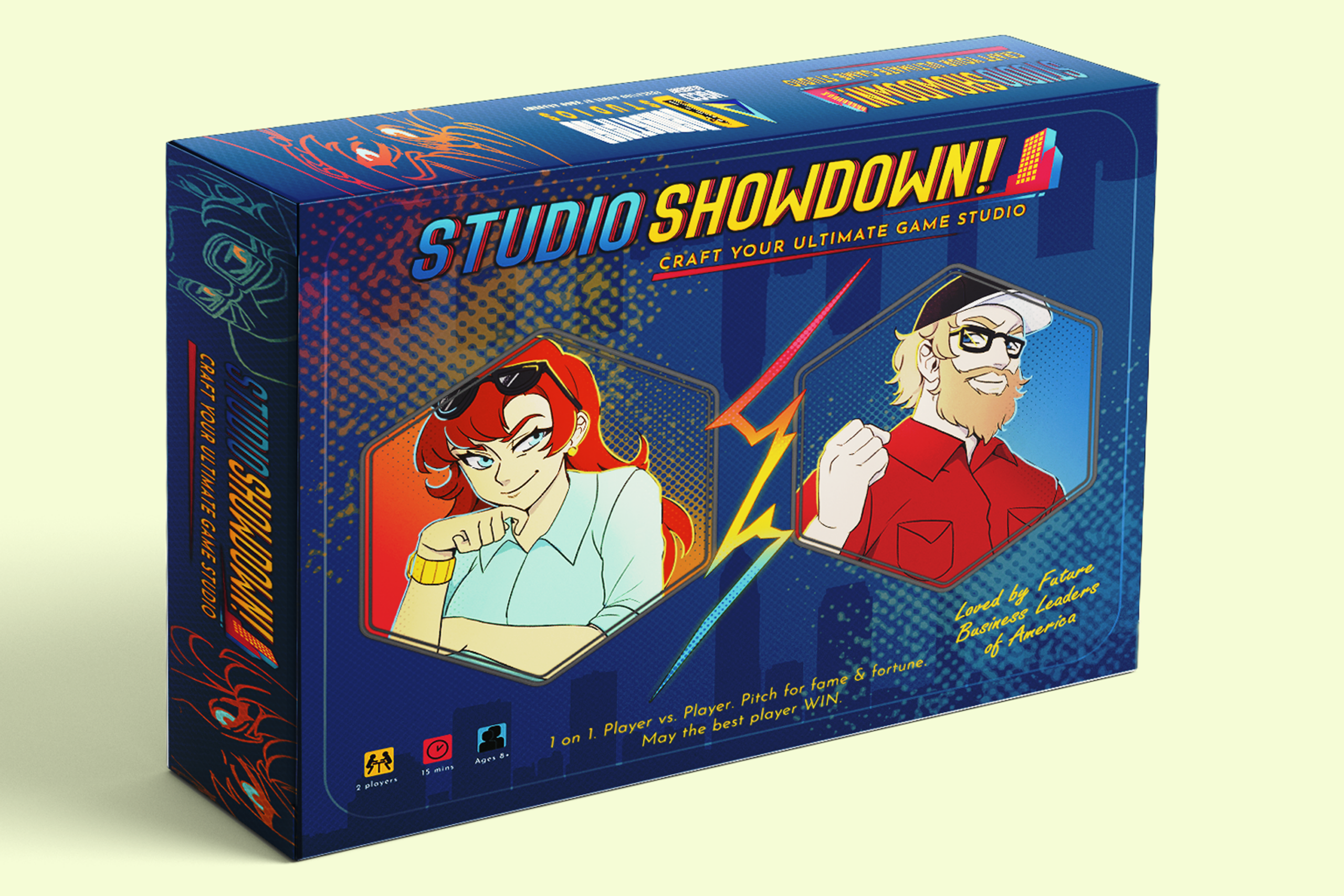
Studio Showdown isn’t just a board game. It’s a high-stakes arena where students step into the shoes of a founder to navigate the cutthroat world of technology development. This isn’t a passive simulation or a dry lecture. It’s a hands-on learning experience. Developed by the industry experts at VGCD Academy and DEMYSTIFIED Studios, it brings professional realism to the tabletop. You’ll master fundraising. You’ll outmaneuver rivals. You’ll fight for market dominance. It’s the elite choice for families seeking screen-free activities that build actual career-ready skills. In a sea of digital noise, this is one of the few project management games for students that prioritizes human interaction and strategic grit over mindless clicking.
Success in the tech industry requires more than technical knowledge. It requires a vision that can survive the market’s volatility. Studio Showdown provides that training ground. It forces players to make the hard calls that real CEOs face every day. Do you invest in more talent or save your capital for a rainy day? Do you launch early to beat a rival or wait for a polished product? These are the questions that define a career. By facing them in a risk-free environment, students build the confidence needed to lead in the real world. They learn that every decision carries weight.
From Founder to Industry Leader
The narrative arc of Studio Showdown mirrors the real journey of a startup. You start with an initial pitch. You secure capital. You manage a team. Finally, you launch a hit game. This makes it the essential business board game for the tech leaders of 2026. We use a “Demystified” approach to teaching high-stakes financial literacy. We strip away the boring jargon. We focus on the decisions that move the needle. Students don’t just read about entrepreneurship; they live it through every turn. They feel the pressure of the burn rate and the thrill of a successful funding round. It’s visceral. It’s real. It’s the professional edge they won’t get from a textbook.
Secure Your Classroom Bundle
We offer flexible options for every learning environment. You can purchase individual units for families. You can secure the Educator Edition for specialized instruction. For larger institutions, our Classroom Bundles create a complete studio ecosystem for project management games for students. You’re not just buying a box of pieces. You’re joining a national community of aspiring developers and strategic thinkers. It’s time to elevate your curriculum and challenge your students to think like founders. Don’t settle for mediocre learning tools. Launch your studio and dominate the market with Studio Showdown.
Forge the Next Generation of Tech Founders
Innovation isn’t found in a textbook. It’s forged in the heat of competition. We’ve moved beyond the static world of Gantt charts to embrace the dynamic reality of studio management. You’ve seen how analog strategy builds the negotiation skills and systems thinking that digital platforms simply cannot touch. Elite project management games for students provide the tactical edge needed to navigate a cutthroat market. By simulating fundraising and high-stakes pitching, you prepare learners for the professional world of 2026. This isn’t just about finishing projects; it’s about dominating them.
Studio Showdown, a collaborative project by VGCD Academy and DEMYSTIFIED Studios, is classroom-tested for maximum teen engagement. It replaces screen fatigue with the visceral thrill of building a hit game from the ground up. It’s time to elevate your curriculum and challenge your students to think like industry leaders. Ready to lead the charge? Master the business of innovation with Studio Showdown. Turn your classroom into a powerhouse of entrepreneurship. The future of tech is waiting for your move.
Frequently Asked Questions
What are project management games for students?
Project management games for students are strategic simulators designed to teach leadership, resource allocation, and project lifecycles. They move beyond theory into active decision-making. Students manage timelines and budgets. These tools bridge the gap between academic concepts and professional execution. In 2026, the best simulators focus on the high-stakes world of technology and entrepreneurship, providing a tactile way to understand complex systems. They turn abstract tasks into a visual struggle for victory.
Can board games really teach technology development skills?
Board games excel at teaching the production mindset behind the code. While they don’t teach syntax, they focus on the logic of management. This includes handling technical debt, balancing feature sets, and understanding market timing. Analog play provides a bird’s-eye view of the development pipeline. It allows students to see how technical decisions impact the entire studio’s survival. These are the core leadership skills required for any professional project lead or tech founder.
How do these games help with student financial literacy?
These games introduce the visceral reality of burn rates and capital management. Students learn to handle limited project budgets while pursuing ambitious goals. They must decide when to seek funding and how to allocate resources for maximum impact. This hands-on approach makes abstract concepts like ROI and cash flow tangible. It’s about learning the financial risks of innovation without the real-world consequences of a failed startup. They gain financial grit through every turn.
Are there specific games for teaching entrepreneurship in high school?
Studio Showdown is a premier example of a strategy game built for this exact purpose. It immerses high schoolers in the world of venture capital, market competition, and studio leadership. Most educational tools are too simple or too dry. High-quality project management games for students at this level must involve social negotiation and strategic outmaneuvering. These mechanics mirror the actual challenges faced by modern tech founders in a competitive, fast-moving landscape.
How can educators integrate board games into a STEM curriculum?
Integration works best when games serve as a capstone or a practical laboratory. Educators can use game sessions to satisfy national entrepreneurship and finance standards. The process typically involves a briefing, active play, and a post-mortem analysis. By using specialized Classroom Bundles, teachers can create a Studio Ecosystem where students apply their technical knowledge to business scenarios. This turns a standard lesson into a dynamic, professional simulation. It replaces passive learning with active mastery.
What makes Studio Showdown different from other educational games?
It prioritizes professional realism and high-stakes social interaction. Developed by VGCD Academy and DEMYSTIFIED Studios, it avoids the hollow “gamified worksheet” trap. The game focuses on the Showdown mechanic, where market dominance is earned through strategic pivots and persuasive pitching. It’s an elite analog alternative to digital simulators. It captures the human element of business that digital platforms often ignore, such as reading rivals, building alliances, and managing professional reputations.
Is Studio Showdown suitable for home use or just classrooms?
It’s designed for both environments. While the Classroom Bundle serves institutional needs, the individual board game is perfect for families seeking screen-free activities. It provides a way for teens to build a professional mindset while engaging in competitive play with friends or siblings. Home use allows for deeper exploration of strategy and longer-term skill building. It’s an investment in a student’s future business acumen, regardless of the setting. It turns family night into a boardroom battle.
Do students need prior coding knowledge to play these games?
No technical coding skills are required to succeed. The focus is on the business of technology rather than the syntax of a specific language. This makes the experience accessible to a wider range of students interested in leadership and innovation. They learn how to manage developers and guide a product to market. It’s about mastering the systems and the strategy that make technology projects successful in the real world. Success depends on strategic grit, not code.