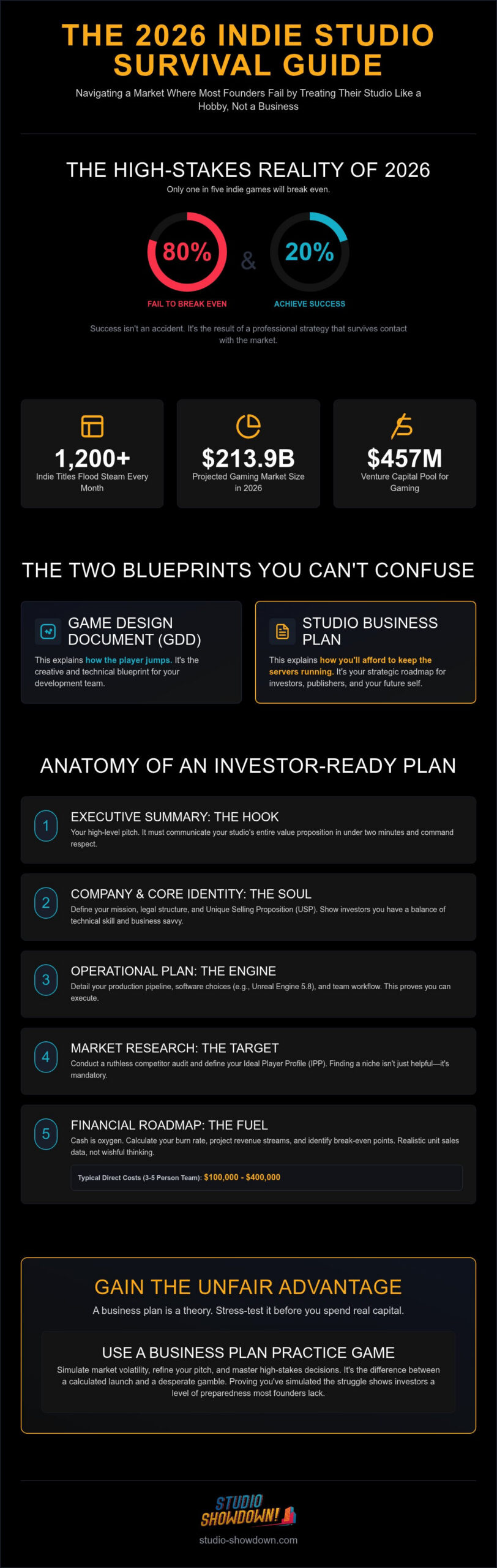
Only 20% of indie games released in 2026 will break even. It is a staggering figure that turns the dream of studio ownership into a high stakes survival mission. Most founders fail because they treat their studio like a hobby instead of a business. To win this fight, you need a strategy that survives contact with the market. Engaging with a business plan practice game to simulate your studio’s growth isn’t just a smart move; it’s the difference between a successful launch and a quiet exit.
You likely feel the tension between your creative vision and the cold realities of market viability. The jargon of venture capital and the fear of a botched publisher pitch can feel paralyzing. We understand that pressure. This guide promises to turn that anxiety into a professional edge by teaching you how to build a business plan that actually attracts investors. You’ll master the art of studio entrepreneurship without sacrificing your artistic soul.
We will dive into the 2026 funding landscape, from the $457 million venture capital pool to the latest R&D tax shifts. You will learn to manage cash flow, navigate the industry shift toward Unreal Engine 5.8, and create a roadmap that transforms your studio from a risky gamble into a visual success story.
Key Takeaways
- Define your studio’s North Star. Conquer 2026 market saturation with surgical precision.
- Master the building blocks of a professional plan. Command respect from every stakeholder.
- Sharpen your acumen. Use a business plan practice game to simulate volatility and refine your pitch.
- Decode the requirements of VCs and publishers. Win the high-stakes game of investment.
- Bridge the gap. Turn high-level strategy into actionable, high-performance production workflows.
Why Your Studio Needs a Game Development Business Plan in 2026
Over 1,200 indie titles flood Steam every month. In 2026, the noise is deafening. You can’t rely on a great idea alone to pay the bills; you need a strategy that cuts through the static. Most founders stumble because they focus on the code and forget the company. A game dev business plan is a comprehensive roadmap that ensures artistic vision translates into sustainable commercial viability.
While a general overview of What is a Business Plan? covers the foundational basics, a studio founder needs specific, interactive tools to survive. Using a business plan practice game during your pre-production phase forces you to confront the financial realities of the current market. It’s the difference between a calculated launch and a desperate gamble. Stop guessing. Start executing.
Don’t confuse your Game Design Document (GDD) with your business plan. Your GDD explains how the player jumps; your business plan explains how you’ll afford to keep the servers running. One is for the dev team; the other is for the stakeholders, the publishers, and your future self. In an era where 80% of indie games fail to break even, your plan is your primary weapon for survival.
The Shift from Developer to Studio Founder
Founding a studio requires a mental pivot. You’re no longer just a creator; you’re a resource manager. You must manage the constant tension between artistic vision and market demand. It’s a high-wire act where risk, reward, and burn rates take center stage. Building a professional identity that attracts serious investors means proving you understand the business of play. Engaging with a business plan practice game like the Studio Showdown Board Game allows you to master these high-stakes decisions before real capital is on the line.
Establishing Your Studio Core Identity
Your studio needs a soul. Define your mission statement with surgical precision. Do you build cozy sims or hyper-competitive shooters? Your Unique Selling Proposition (USP) must be sharp enough to stand out in a crowded marketplace. Set measurable, aggressive goals for Year 1, Year 3, and Year 5. Analyzing these milestones early ensures your studio isn’t just a one-hit wonder but a long-term powerhouse. Success isn’t an accident; it’s the result of a core identity that refuses to settle for mediocrity.
The Essential Sections of a Video Game Studio Business Plan
A generic template won’t save you. You need a document tailored to the specific volatility of the games industry. Start with your Executive Summary. This is your high-level hook. It must communicate your studio’s value proposition in under two minutes. While the SBA guide to business planning provides a solid foundation for any startup, game studios must go deeper into industry-specific milestones like Early Access and Beta testing. Investors don’t just want to see a game; they want to see a path to profit.
Your Company Overview defines who you are. It details your legal structure and team expertise. Investors look for a balance of technical skill and business savvy. Next, your Operational Plan must list your production pipeline and software choices. Whether you are scaling with Unity 6.3 or leveraging the power of Unreal Engine 5.8, your stack dictates your speed. Mentioning that you used a business plan practice game to stress-test these operational assumptions shows a level of preparedness that most indie founders lack. It proves you have simulated the struggle before spending the capital.
Market Research and Player Personas
Stop guessing who will play your game. Conduct a ruthless Competitor Audit on Steam and the Epic Games Store. Look at the 1,200+ indie titles released monthly and find the gaps. Define your Ideal Player Profile (IPP). Go beyond age and gender. What other games do they play? What is their tolerance for microtransactions? In a market projected to hit $213.9 billion in 2026, finding a niche isn’t just helpful; it is mandatory. You aren’t just making a game; you are capturing a demographic.
The Financial Roadmap: Burn Rates and Revenue Streams
Cash is oxygen. Your Financial Roadmap must account for every dollar. For a small team of 3-5 people, expect direct costs between $100,000 and $400,000. Calculate your burn rate. How long can you survive before launch? Diversify your revenue streams with premium sales, DLC, and licensing. Projecting break-even points requires realistic unit sales data, not wishful thinking. Mastering these financial loops before you burn through your seed funding is critical. Engaging with a business plan practice game allows you to see the consequences of poor resource management before they become fatal. If you want to sharpen your acumen, exploring professional strategy board games can provide the hands-on simulation your team needs to survive the 2026 market.
Fundraising and Pitching: Winning the Game of Investment
Investors don’t buy games; they buy studios that can scale. In the first half of 2026, venture capital firms injected 457 million dollars into gaming companies. With a median funding round of 5 million dollars, the competition is fierce. You need to know when to deploy a 30 second elevator pitch and when to present a comprehensive deck. While writing a business plan provides the logic, your pitch provides the soul. You’re selling a future, not just a prototype.
Every founder faces the equity versus control trade-off. Giving up 30% of your studio to a publisher for a 500,000 dollar advance might feel painful, but it beats owning 100% of a bankrupt entity. Publishers typically recoup their advance before the revenue split, which often ranges from 70/30 to 50/50 in 2026. Understanding these terms is vital for long term survival. A Vertical Slice serves as the ultimate proof-of-concept for investors, proving your team can execute the vision at production quality.
Mastering the Art of the Pitch
Your deck must be lean and lethal. Include slides on the team, the unique mechanic, the market size, and the exit strategy. How do investors get their money back? Handle every “No” as a data point to iterate on your business strategy. Using a business plan practice game lets you rehearse these high-pressure negotiations. It sharpens your ability to defend your valuation and manage investor expectations before you step into the boardroom. Practice makes your delivery instinctive and your confidence unshakeable.
Crowdfunding and Alternative Financing
Kickstarter is a battleground. It remains viable for niche genres but requires a massive pre-launch marketing effort to succeed in a saturated market. Early Access provides immediate cash flow but turns your development into a public performance. Don’t ignore institutional support. The 2026 “One Big Beautiful Bill Act” allows US-based small businesses to accelerate R&D tax deductions. This provides a vital lifeline for studios with average gross receipts of 31 million dollars or less, allowing you to deduct expenses immediately. Look for government grants that align with your studio’s mission to supplement your private funding.
Stress-Testing Your Strategy: How Simulation Sharpens Business Acumen
Static business plans are blueprints for a perfect world that doesn’t exist. In 2026, the global games market is projected to reach 213.9 billion dollars, but that wealth is guarded by gatekeepers and aggressive rivals. You need a way to test your assumptions before spending your limited seed capital. Engaging with a business plan practice game provides a safe harbor to fail, iterate, and win. It turns abstract financial jargon into tangible tactical decisions. If your plan cannot survive a tabletop session, it won’t survive a meeting with a venture capitalist.
Analog simulation offers a unique depth that digital tools often miss. By playing strategy board games, founders develop a gut instinct for resource management and negotiation. You learn to read the room. You learn when to pivot. This isn’t just theory; it is a live-fire exercise for your studio’s survival. It exposes the flaws in your burn rate calculations and highlights where your unique selling proposition might fall flat against a competitor. Stop theorizing and start simulating the fight.
The Power of Strategy Board Games in Education
Modern educators are ditching dry lectures for business board games to teach the grit of entrepreneurship. Students use documented simulation results as professional portfolio pieces to prove their studio management skills to future employers. These screen-free activities sharpen critical thinking in ways that a Jira board cannot. They foster a deep understanding of the Founders Dilemma without the high stakes of actual bankruptcy. You build the muscle memory required for success before you ever hire your first developer.
Studio Showdown: A Sandbox for Founders
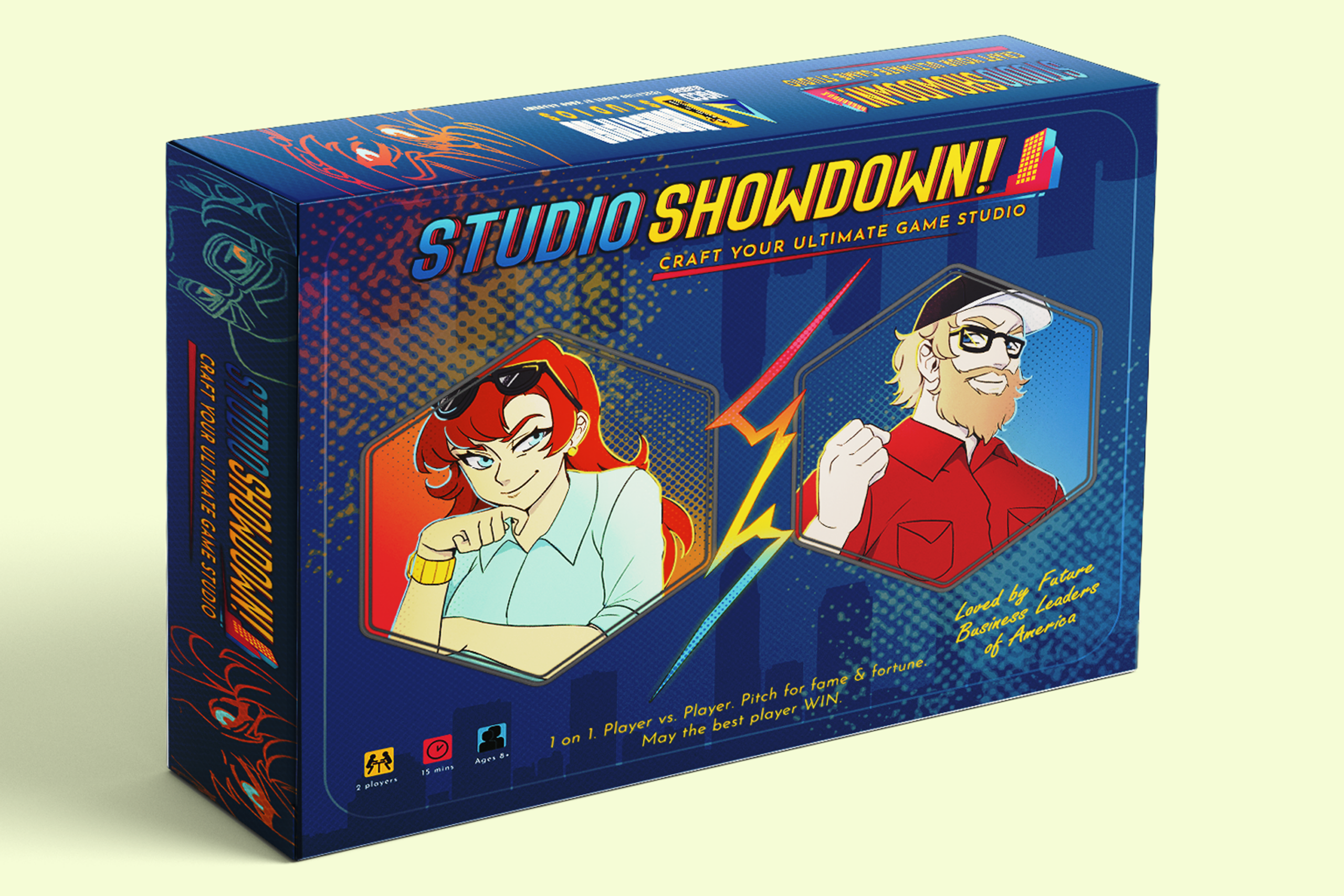
The Studio Showdown Board Game serves as a high-fidelity sandbox for aspiring studio heads. You navigate the cutthroat world of video game entrepreneurship, managing everything from seed funding to rival studio maneuvers. It forces you to identify strategic weaknesses in your real-world plan. If your strategy fails on the table, it will likely fail in the market. Use this simulation to master the art of the deal and the logic of the launch before you risk your real-world runway. Ready to stress-test your vision? Secure your copy of the Studio Showdown Board Game and dominate the 2026 landscape.
From Plan to Production: Launching Your Studio Showdown
A business plan is not a trophy for your shelf. It is a live engine that must drive your daily operations. Transitioning from strategy to execution requires breaking your high-level goals into granular, actionable tasks. Move your milestones into Jira tickets or Trello boards. If your plan identifies a gap in the mobile market, your production backlog must reflect the specific features that fill it. Don’t let your strategy gather dust while your team drifts off course.
Build a digital War Room. You need a centralized dashboard to track your progress and your budget in real time. In 2026, with indie development costs for small teams reaching up to 400,000 dollars, monitoring your burn rate is a survival skill. Compare your actual spending against your initial projections every week. If your burn rate accelerates without a corresponding increase in production velocity, you are heading for a crash. Data is your only defense against a quiet bankruptcy.
Prepare for the pivot. Development reality rarely aligns perfectly with a 2026 market forecast. You might discover a mechanic that doesn’t work or a demographic that doesn’t respond. A pivot is not a failure; it is a tactical maneuver. Use your business plan practice game results to evaluate your options. Changing your business plan based on hard evidence from playtests or market shifts shows the agility of a true Studio Founder. Stay stubborn about your goals but flexible about your methods.
Building Your Community Before Launch
Your business plan must include a community pillar. Discord and social media are not just marketing channels; they are your market validation tools. Turn your Steam wishlists into a primary metric for business health. If you aren’t hitting your wishlist targets, your commercial viability is at risk. Engage with your players early. Their feedback is a form of free stress-testing that ensures your final product actually meets a demand. A loyal community is the ultimate moat against market saturation.
Next Steps for Aspiring Founders
Success in 2026 requires constant vigilance. Review your business plan quarterly to ensure your team remains strategically aligned with the shifting landscape. Invest in team building tools that sharpen your collective business acumen. Playing the Studio Showdown Board Game together isn’t just a break from coding. It is a high-stakes simulation that prepares your team for the fundraising and rival maneuvers you will face in the real world. Every session is a business plan practice game that builds the muscle memory for victory. Start your studio journey today with a solid plan, a sharp team, and a winning strategy. Dominate the showdown.
Conquer the Market: Your Studio’s Next Move
Business planning in 2026 isn’t a formality; it’s a survival tactic. We’ve explored how a structured strategy acts as your North Star, keeping your creative soul aligned with the cold reality of cash flow. Stress-testing your assumptions before the first line of code is written saves thousands in wasted runway and preserves your artistic integrity. Using a business plan practice game transforms abstract risk into a manageable, competitive edge that investors respect. It’s time to stop guessing and start executing with precision.
Ready to turn your vision into a visual success story and rise above the noise? Master Studio Strategy with the Studio Showdown Board Game. This tool is designed specifically for aspiring game entrepreneurs and is trusted by the VGCD Academy for professional development. Educators can also scale these lessons for the next generation with our Classroom Bundles. Don’t just launch a game. Build a studio that survives the market and dominates the competition. Your showdown starts now.
Frequently Asked Questions
Do I really need a business plan for a small indie game studio?
Yes. It’s your North Star for financial and creative decisions. You risk burning through seed funding without it. Steam sees over 1,200 titles monthly in 2026. A structured strategy is your only shield against saturation. It proves you understand the market and have a roadmap for commercial viability. A plan transforms your studio from a risky gamble into a professional venture. Don’t launch without one.
What is the most important part of a game development business plan?
The Financial Roadmap and Market Analysis carry the most weight. Investors demand to see your burn rate and break-even point. You must identify your target player demographic with surgical precision. Stress-testing these assumptions through a business plan practice game demonstrates professional readiness. It separates founders from hobbyists. It proves you aren’t just making a game. You’re building a sustainable company. Precision wins the funding game.
How do I calculate the budget for my first game?
Start with your burn rate. Small teams of 3-5 people face direct costs between $100,000 and $400,000 in 2026. Factor in Unity Pro subscriptions at $2,310 per year or Unreal royalties. Don’t ignore marketing. A modest $5,000 budget can increase revenue by 60%. Always include a 15% contingency fund for production delays. Accurate budgeting is your primary defense against a quiet exit. Know your numbers or lose the fight.
Should I pitch to a publisher or go the self-publishing route?
It depends on your capital and risk tolerance. Publishers offer advances between $50,000 and $500,000 but take a 30% to 50% revenue share. Self-publishing gives you total control. It also requires you to fund all marketing and development. Many founders use a business plan practice game to simulate both paths. This helps them decide which model aligns with their studio’s soul and financial goals. Choose your battle wisely.
How can board games help me learn about game development business?
Board games provide a safe, analog sandbox for high-stakes decisions. The Studio Showdown Board Game simulates the competitive world of fundraising, pitching, and studio management. You fail and iterate without losing real-world capital. Educators use these tools to build professional portfolios and teach complex entrepreneurship. This hands-on approach develops critical thinking that digital tutorials miss. It builds the muscle memory for success. Master the business of play before the launch.
What are the common reasons game studios fail in their first year?
Most failures stem from poor resource management and zero market validation. Only 20% of indie games break even in their first year. Studios underestimate their burn rate or fail to build a community before launch. Without a solid business plan, founders get lost in the creative vision. They ignore the financial realities of 2026 market saturation. Success requires balancing your artistic passion with a ruthless focus on commercial viability. Survival is a strategy.
How do I find investors for my game studio?
Target Angel Investors, VCs, and specialized game funds. In early 2026, $457 million was invested in gaming companies. You need a lethal pitch deck and a Vertical Slice. This serves as your proof-of-concept. Networking at industry events or using simulation tools to refine your pitch under pressure helps secure that median $5 million funding round. Investors don’t just buy games. They buy studios that can scale and dominate the marketplace.
What is the difference between an Executive Summary and an Elevator Pitch?
Your Executive Summary is a high-level written overview of your entire business plan. It covers your team, USP, and financial projections for stakeholders. An Elevator Pitch is a 30-second verbal hook. It’s designed to grab interest during a chance meeting. One is a document for the boardroom. The other is a conversational spark meant to lead to a formal presentation. Both are essential weapons for winning the game of investment.