Publishers don’t buy stories. They invest in studios. If you want to learn how to pitch a game idea in 2026, you must stop acting like a dreamer and start thinking like a founder. The industry is crowded. The noise is deafening. Most pitches die in the inbox because they lead with lore instead of leverage. You have seconds to prove your project is a viable asset, not just a passion project. In a market defined by risk, your ability to project professional authority is your greatest weapon.
It’s exhausting to feel like your vision is being ignored because you don’t have a technical prototype or a deep understanding of fundraising. You’ve likely felt the sting of silence after hitting send. You’re worried about ROI, market fit, and the complex business terminology that investors throw around. You’ve got the creative fire, but the commercial mechanics feel like a boss fight you aren’t geared for yet. You aren’t alone in feeling that the gap between a great mechanic and a funded studio is a chasm.
This guide changes the narrative. You’ll learn to master the transition from artist to strategist, gaining the confidence to speak the language of capital. We’ll explore a clear roadmap for a winning pitch deck, decode the business of games, and show you how to treat your project like the high-stakes tech startup it actually is. It’s time to stop pitching a dream and start selling a success.
Key Takeaways
- Shift from a creative dreamer to a strategic studio founder who speaks the language of investment and ROI.
- Discover how to pitch a game idea using a high-production deck that focuses on market viability, not just story lore.
- Decode the 2026 fundraising landscape by choosing the right path between publishers, venture capital, and crowdfunding.
- Master the delivery with a pre-pitch checklist and strategies to handle the toughest investor questions with professional grace.
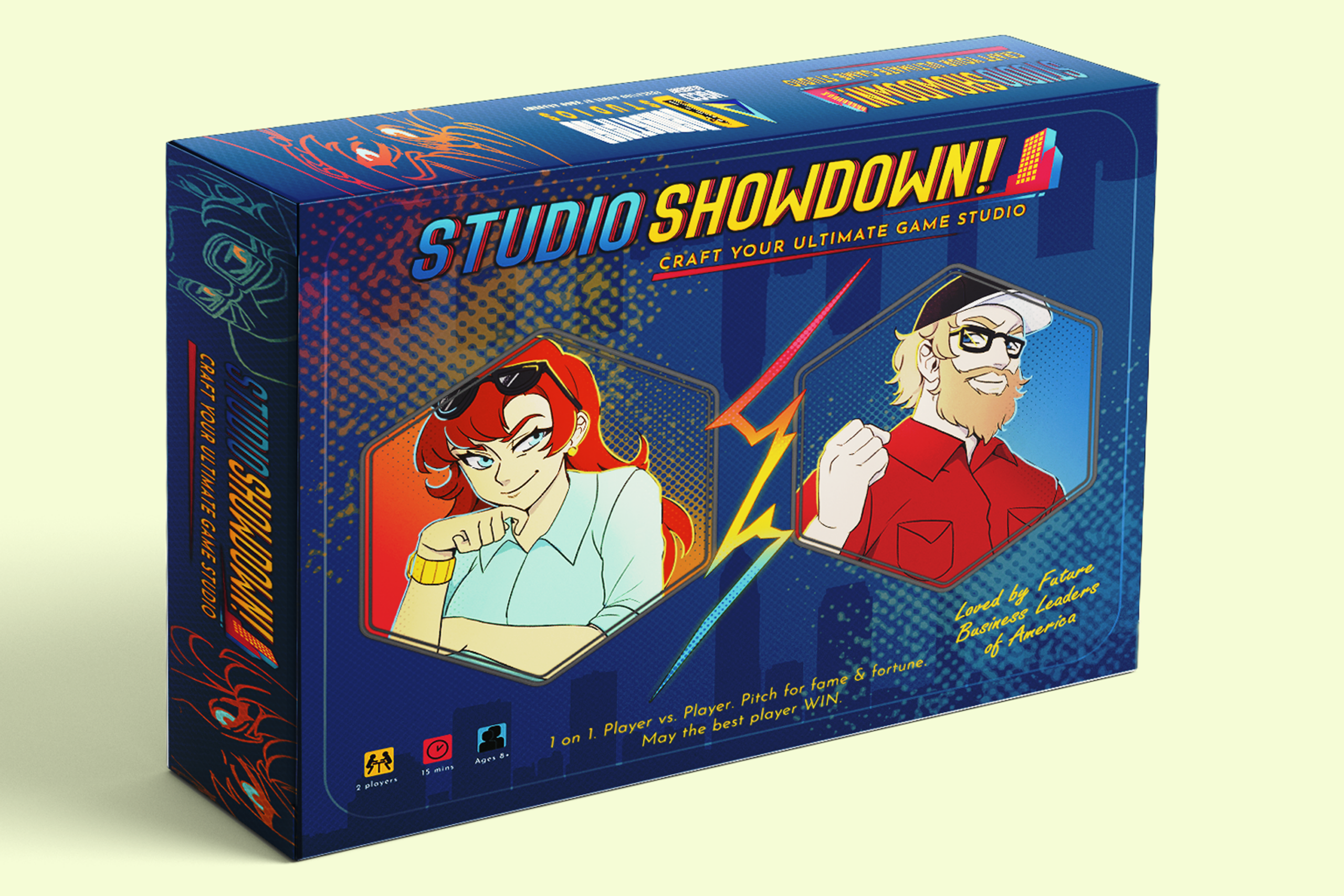
- Practice your strategy with the Studio Showdown Board Game, a professional simulator for mastering real-world game development business.
Beyond the “Idea Person”: Why Business Context Rules the Pitch
Stop calling yourself a dreamer. In the 2026 market, “idea people” are a liability. Publishers don’t buy concepts; they invest in viable, scalable studios. Fundraising. Pitching. Market dominance. These aren’t just buzzwords; they’re the pillars of your survival. If you want to know how to pitch a game idea, you must first understand that your game is a financial product. You’re no longer just a creative lead. You’re a strategic entrepreneur. The industry is saturated with “cool mechanics” that lack a business model. Success requires a shift in vision. You need to see the production pipeline, the marketing funnel, and the exit strategy. Every slide in your deck should scream professional authority.
Mastering these high-level concepts doesn’t have to happen in a high-stakes meeting where your reputation is on the line. Smart founders use tools like the business board game to simulate the brutal cycle of fundraising and market dominance before they ever step into a boardroom. It’s about building a gut instinct for the business of games. You learn to outmaneuver rivals. You learn when to pivot. You learn that a great idea is only the entry fee for a much larger battle. Learning how to pitch a game idea is essentially learning how to sell a vision of future profit.
The Value of Execution Over Concepts
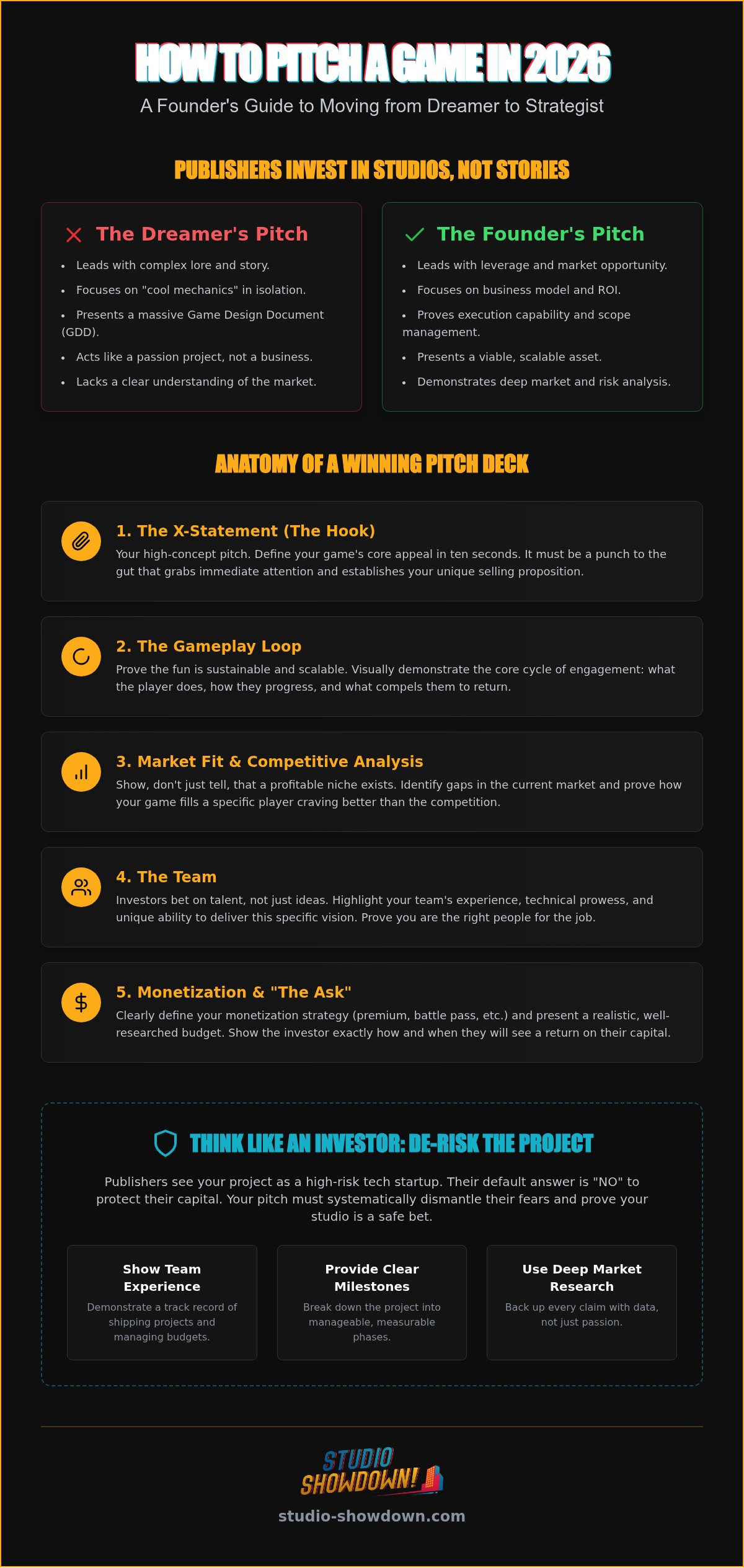
A massive Game Design Document (GDD) isn’t an asset; it’s a red flag. Investors see a 100-page manual and think “feature creep” and “unmanaged scope.” They want proof you can execute. Focus on the Hook, Line, and Sinker framework to drive engagement. The Hook grabs immediate attention. The Line holds interest through core loops. The Sinker closes the deal with long-term retention. In 2026, Product-Market Fit means your game solves a specific player craving within a proven, profitable niche while maintaining a sustainable development budget.
Understanding the Publisher’s Risk Profile
Publishers view your project as a high-risk tech startup. It’s art, yes, but it’s also a financial asset. They’re looking for ways to say “no” to protect their capital. You must give them every reason to say “yes” by demonstrating a mastery of risk management. Mitigate their fear with team experience, clear milestones, and deep market research. Don’t just claim your game is unique; use competitive analysis to prove it can win in a crowded store. Show them you’ve already accounted for the visual noise of the market. Professionalism isn’t just about the art. It’s about the math. It’s about proving your studio is a safe bet in a volatile industry.
The Anatomy of a Winning Game Pitch Deck
Visuals speak louder than code. Your pitch deck is the first build a publisher ever plays. If it feels amateur, they’ll assume your production pipeline is, too. High-production value isn’t just about pretty pictures; it’s about projecting professional authority. You aren’t just showing a game. You’re presenting a business plan that happens to be interactive. When pitching your game to investors, your deck must cut through the visual noise with surgical precision.
The slide breakdown is simple but lethal. You start with the X-Statement. This is your high-concept hook. It defines your game in ten seconds. Then, you move to the gameplay loop. Prove the fun is sustainable. Show them how the player interacts, grows, and returns. Finally, you hit them with “The Ask.” This is where you prove you know how to pitch a game idea by being realistic about the capital. You need to show a clear monetization strategy. Whether it’s battle passes or premium sales, prove you know exactly how the investor gets their money back. Proving market dominance starts before you have a single player. Use competitive analysis to show the gaps in the current market. Explain why players are bored with the status quo and how your game fills that void.
The Essential Slides Every Investor Expects
The Hook is your visual elevator pitch. It needs to be a punch to the gut. The Gameplay Loop proves your game is scalable. Don’t just list features; show the cycle of engagement. Then there’s the Team slide. Investors don’t just buy games; they buy talent. Tell them why your team is the only one capable of delivering this specific vision. Highlight your technical prowess and your artistic courage. Make them believe in the creators as much as the creation.
Budgeting and the “Financial Ask”
Don’t guess your numbers. Amateurs talk about “finishing the game.” Professionals talk about “Burn Rate” and “Milestone Payments.” You need to break down your development costs into monthly expenses. Define exactly what the investor is paying for at every stage. Be prepared to discuss equity. How much of your studio are you willing to fight for? If you want to master these high-stakes negotiations, practicing with a strategy tool like Studio Showdown can give you the edge you need before the real meeting starts. You’ll learn to manage resources and outmaneuver rivals in a low-risk environment. It’s the ultimate flight simulator for the business side of the industry.
Proving Viability: Fundraising and Market Fit
The 2026 market is loud. It’s crowded. It’s unforgiving. In this ecosystem, community-led growth has become the gold standard for validation. If you can’t prove that a specific, hungry audience is already waiting for your project, you’re just another voice in the void. Publishers and investors no longer gamble on “gut feelings.” They want to see engagement. They want to see traction. They want to see that you’ve built a tribe before you’ve even finished the build. Understanding how to pitch a game idea in this climate requires more than a creative spark; it demands a proof of concept that resonates with the current cultural zeitgeist.
Fundraising is a tactical operation. You have three primary paths: Publishers, VCs, and Crowdfunding. Publishers offer marketing muscle and distribution. VCs provide capital for scale and studio equity. Crowdfunding delivers immediate market validation and a core community. Each path has a different price. Each requires a different language. To win, you must identify gaps in the current market and position your game as the only logical solution. Strategic outmaneuvering isn’t about being different; it’s about being necessary. You must prove ROI to people who don’t play games. They don’t care about your character’s backstory. They care about retention rates, lifetime value, and the scalability of your monetization model.
Market Research for Game Founders
Genre Mashups are your secret weapon for finding untapped player bases. Don’t just follow trends. Create new ones by combining proven mechanics in ways rivals haven’t dared. Analyze rival studios with surgical intent. Find where their community feels ignored and make that your strength. Social proof is the new currency of the pitch. High wishlist counts and active Discord numbers are more persuasive than any concept art. Use this data to prove that the market isn’t just ready for your game; it’s actively demanding it.
The Art of the Strategic Pivot
Maintaining your creative vision is a noble goal, but satisfying commercial demands is what keeps the lights on. You must recognize when an idea is too niche for major funding. When you’re learning how to pitch a game idea, you must bridge the gap between artistic vision and fiscal reality. Adapt your pitch to the person sitting across the table. If it’s a VC, focus on the tech and the scale. If it’s a publisher, focus on the brand and the audience. A strategic pivot isn’t a defeat. It’s an evolution toward success.
Mastering the Delivery: How to Pitch Like a Pro
Delivery is the final act. You’ve built the deck and analyzed the market; now you step into the arena. Mastering how to pitch a game idea requires more than a polished deck. It demands a performance that projects absolute confidence. Preparation is 90% of the battle. Run your pre-pitch checklist. Check your build. Verify your tech. Calibrate your mindset. If you stumble on your opening, you’ve already lost the room. You need vocal authority. Speak from the chest. Eliminate filler words. Sound like the studio lead you’re becoming. Investors don’t just back games; they back leaders who can survive the production grind.
The Q&A is where the “Dream Crushers” wait. They’ll probe your budget. They’ll question your retention. They’ll test your resolve. Handle these questions with grace, not defensiveness. If you don’t know an answer, don’t lie. Say you’ll follow up with the data. It shows you value precision over ego. After the meeting, stay on their radar without being a nuisance. Send a concise thank-you note. Include any requested info within 24 hours. Professionalism is about the long game. It’s about showing you’re a partner, not just a solicitor.
The Elevator Pitch: Winning in 60 Seconds
You have one minute to hook them. Use an X-meets-Y statement that hits like a freight train. Don’t waste time on technical specs or complex lore. Sell the emotional Player Experience. The dread of cosmic horror. The rush of a high-speed heist. The satisfaction of a perfect loop. Practice until the words are muscle memory. Focus on the “feel” of the game. You’re selling a vision of future success, not a spreadsheet of features. High-stakes communication is a skill you must sharpen before the meeting starts.
Handling Rejection and “The No”
Rejection is data. A “No” often means “Not Yet” or “Wrong Fit.” Don’t take it personally; take it apart. Every “no” is a lesson in how to pitch a game idea more effectively next time. Extract feedback. Was the scope too big? Was the market too crowded? Use every failed meeting to sharpen your next attempt. Build a professional portfolio of pitches to show your growth. The industry respects persistence backed by tangible improvement. You’re building a studio, not just a single project.
The best way to master these high-stakes showdowns is to practice the business of games in a low-risk environment. Sharpen your instincts, manage your resources, and learn to outmaneuver your rivals before you ever step into a boardroom. Ready to train for the real thing? Order the Studio Showdown Board Game and start building your legacy today.
Studio Showdown: The Ultimate Pitching Simulator
Theory only gets you so far. You can memorize every slide in a pitch deck, but until you’ve felt the pressure of a dwindling burn rate, you aren’t truly ready for the arena. The Studio Showdown Board Game is designed to be the ultimate training ground. It’s a high-production “flight simulator” for the business of game development. This isn’t just about entertainment. It’s about developing the professional gut instinct required to survive the 2026 market. By engaging with this strategy board games framework, you internalize the brutal logic of the industry before you ever risk your own capital.
The game mimics the real-world cycle of fundraising and development with surgical precision. You don’t just play a game; you run a studio. You outmaneuver rivals. You secure investment. You dominate the market. Learning how to pitch a game idea becomes a natural consequence of mastering the tabletop showdown. You aren’t just a player. You’re a founder in training. Every turn forces you to weigh creative ambition against commercial reality. This is the exact mental shift publishers look for when they’re deciding who to trust with their millions. It’s about proving you can handle the heat.
Simulating High-Stakes Decisions
Experience the tension of the arena. In Studio Showdown, you face the same “Dream Crusher” scenarios you’ll encounter in a real boardroom. You must manage limited resources while watching your cash flow like a hawk. One wrong move and your studio collapses. It’s a low-risk analog environment where failure is your best teacher. You learn to identify market gaps. You learn to pivot when a rival steals your niche. This builds the “Business Intuition” that separates the successful founders from the creative dreamers. You’re training your brain to see the math behind the art. Fundraising. Development. Market dominance. It’s all here.
From Tabletop to Boardroom
The transition from the tabletop to the boardroom is seamless. The mechanics of the game reflect the actual milestones of a production pipeline. If you can win at the table, you’ve already practiced the logic needed to win over a skeptical investor. For students and aspiring leads, the Studio Showdown: Educator Edition provides a structured path for professional portfolio building. It’s about proving you understand the ecosystem. It’s about showing you’re ready for the big leagues. Don’t wait for a publisher to tell you you’re not ready. Train. Compete. Win. Start your journey as a studio founder today. The arena is waiting for you.
Secure the Funding. Build the Studio. Win the Market.
Success in 2026 belongs to those who treat their vision like a business. You’ve moved beyond the “idea person” phase. You now understand that mastering how to pitch a game idea is about proving execution, managing risk, and demonstrating market dominance. A high-production deck and a strategic mindset are your primary weapons. The gap between a creative concept and a funded studio is narrow; it requires surgical precision to cross. Every slide you present and every answer you give must project professional authority.
Don’t let your first real pitch be your first time practicing the business of games. Redefine your financial literacy through play with a tool developed by industry veterans at VGCD Academy. It’s the perfect training ground for aspiring founders and students who want to master fundraising and outmaneuver rivals without risking their own capital. Master the business of games with the Studio Showdown Board Game and sharpen your competitive edge before you step into the boardroom.
The industry is waiting for leaders who can survive the production grind. Your project is an asset. Your studio is a startup. Step into the arena with confidence and claim your victory. Your journey from dreamer to founder starts today.
Frequently Asked Questions
Do I need a prototype to pitch a game idea to a publisher?
You almost always need a functional prototype or a vertical slice. Publishers don’t buy dreams; they buy builds. A playable demo proves your team can handle the technical demands of production. It reduces the publisher’s risk and shows you’ve moved past the concept phase. If you’re learning how to pitch a game idea, remember that a playable demo is your strongest argument. It transforms a vague vision into a tangible financial asset.
How long should a professional game pitch deck be?
A professional deck should be between 10 and 15 slides. You have limited time to make an impact. Focus on the core pillars: the hook, the gameplay loop, the market gap, and the financial ask. Avoid clutter. Every slide must serve a purpose. If it doesn’t prove viability or excitement, cut it. Precision projects authority. A lean deck shows you respect the investor’s time and understand your own business model.
What is the most important slide in a game pitch?
The Team slide is often the most critical. Investors aren’t just looking at the game; they’re looking at the people who will build it. They need to know you have the technical and creative grit to survive a multi-year development cycle. Second to that is The Ask. This slide proves you’ve done the math. It shows you’re a strategic founder who understands burn rates and milestone payments, not just an artist.
How do I protect my game idea from being stolen during a pitch?
NDAs are rarely signed during initial meetings. Your best protection is your ability to execute. Ideas are common; the skill to build a studio is rare. Most publishers are too busy managing their own pipelines to steal a concept. Focus on building a unique execution framework. When you’re figuring out how to pitch a game idea, realize that your specific team and your roadmap are what truly hold the value.
What is the difference between a publisher and an investor?
Publishers and investors serve different masters. A publisher typically provides development funding, marketing, and distribution in exchange for a share of game revenue. An investor, like a Venture Capitalist, provides capital in exchange for equity in your studio. Publishers want a successful product launch. Investors want to see your company’s overall valuation grow. Knowing which one you need is the first step toward a successful studio strategy.
Can I pitch a game idea if I don’t know how to code?
You can pitch without coding skills, but you cannot pitch without a technical team. A founder’s job is to assemble talent. If you don’t code, you must have a Lead Programmer or a technical co-founder on your team slide. Investors need to see that the vision can actually be built. Showing a high-production pitch deck and a solid business plan proves you’re a strategist who knows how to manage a production pipeline.
How much money should I ask for in my first game pitch?
Ask for exactly what you need to reach your next major milestone plus a 15 to 20 percent contingency buffer. Don’t pull numbers out of thin air. Base your request on a detailed production schedule and a clear burn rate. Investors respect founders who understand their costs. If you ask for too little, you’ll go bust. If you ask for too much without justification, you’ll look like an amateur.
How do I find game publishers to pitch to in 2026?
Use modern industry databases and networking platforms to identify publishers who specialize in your genre. Research their recent portfolio to ensure they have the right audience for your project. Attend major industry showdowns like GDC or Gamescom to build face-to-face relationships. Success in 2026 is about community and connections. Reach out with a concise, high-impact teaser before requesting a full pitch meeting to respect their inbox and their time.