What if the most influential leaders in the gaming industry never wrote a single line of code? It’s a question that challenges the old gatekeeping of the tech world. You probably feel that the barrier to entry is an impenetrable wall of syntax and logic puzzles. You aren’t alone. Many aspiring creators stall because they think the only path forward is through a terminal window. But the reality of 2026 is different. You can learn game design concepts without coding and still command a room of developers. Success in this field isn’t just about scripts. It’s about vision, mechanics, and the raw business of play.
This guide reveals the high-impact, non-technical roles that drive the world’s biggest studios. You’ll learn how to build a professional portfolio that showcases your strategic talent and business acumen rather than your debugging skills. We’ll break down how to identify your specific career path and understand game mechanics at a level that commands respect. We’ll also look at how simulating the business side of game production can give you the edge you need to lead. It’s time to stop watching from the sidelines. Your career in games starts here.
Key Takeaways
- Redefine your career path by distinguishing between creative game design vision and technical execution to find your unique competitive edge.
- Master the art of analog prototyping to learn game design concepts without coding and ensure your mechanics are engaging before production starts.
- Target high-impact roles like Producer or Business Development Manager where strategy and leadership define the success of a studio.
- Deploy a five-step framework to build a professional portfolio that emphasizes proof of concept and business acumen over programming skills.
- Experience the real-world challenges of studio management by using Studio Showdown as a high-stakes leadership and entrepreneurship simulator.
Breaking the Code Barrier: Can You Really Build Games Without Programming?
The myth that game development is strictly a programmer’s game is dead. In the modern industry, visionaries are reclaiming the throne. You don’t need to be a math genius or a C++ wizard to build a world. Game development is a high-stakes, multidisciplinary practice where storytelling, psychology, and business strategy collide. Design is the soul; code is merely the nervous system.
When you learn game design concepts without coding, you’re focusing on the “what” and the “why.” Programming handles the “how.” A programmer builds the bridge, but the designer decides where it goes, who crosses it, and why the crossing matters. This distinction is the foundation of every hit title. It’s the difference between a technician and an auteur.
The 2026 Gaming Landscape for Non-Coders
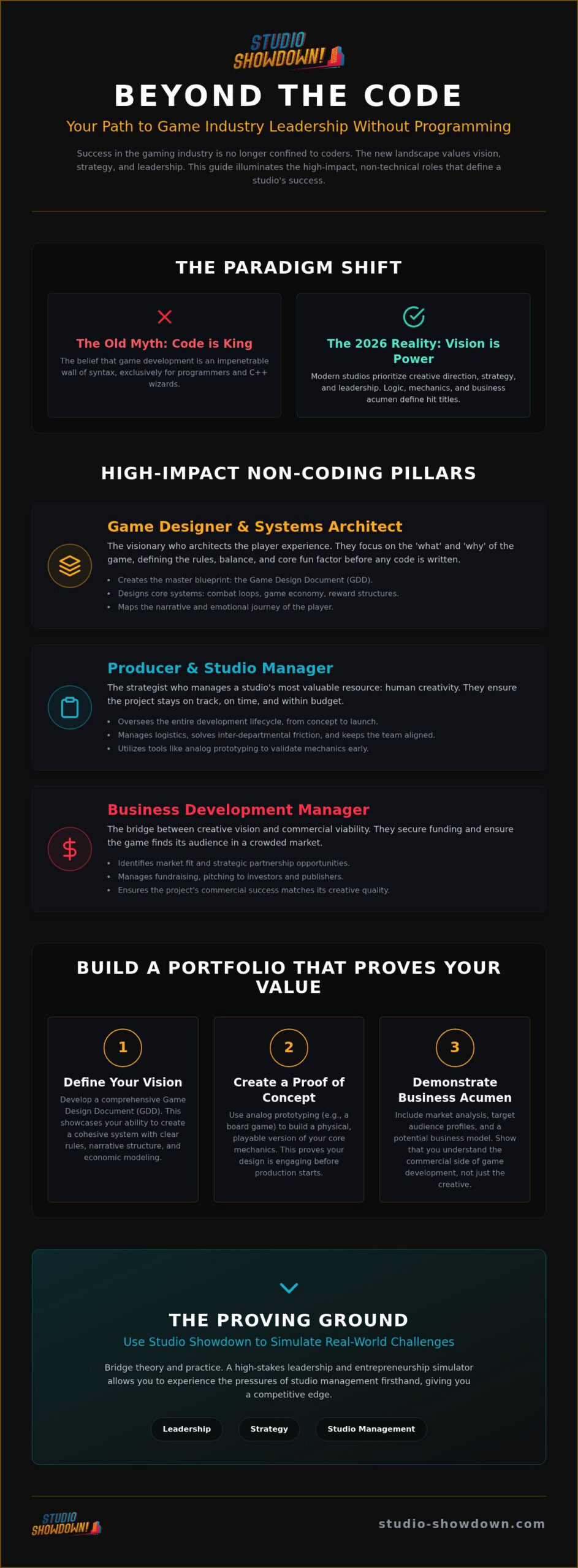
The industry has shifted. Major AAA studios and agile indie teams now prioritize high-level creative direction over raw technical output. No-code tools and AI-assisted workflows have lowered the technical floor, but they’ve raised the ceiling for strategic thinking. Modern creators act as Studio Founders. They manage vision, coordinate talent, and secure capital. They don’t get lost in the weeds of syntax; they stay focused on the horizon of the player experience. Non-technical roles are no longer support staff. They are the architects of visual success and commercial viability.
Why Logic Beats Syntax
Every game is a system of rules. These rules are governed by pure logic, not specific languages. If you can map out a flow chart, you can design a game. Game logic is the architecture behind the player experience. It’s the structural integrity of the fun.
As you learn game design concepts without coding, you’ll start to see games as machines. You aren’t just a builder; you’re the architect of systems. You’re defining the combat loops, the economy, and the emotional arc. Consider these core non-technical pillars:
- Systems Design: Creating the mathematical balance of rewards and challenges.
- Narrative Architecture: Mapping the player’s emotional journey through the world.
- Economic Modeling: Managing the flow of in-game resources and currency.
These are durable skills. Coding languages evolve and die, but the logic of human engagement is timeless. Mastery of this logic allows you to lead a studio with authority. You aren’t just a spectator in the development process. You’re the one drawing the map. Your vision defines the final quality.
The Non-Coding Pillars: High-Impact Roles in Game Development
Studios are more than just server rooms. They are battlegrounds where creativity and commerce collide. To win, you need a command center. These high-impact roles don’t touch a line of code, yet they dictate the fate of every project. If you want to lead, you must master the pillars of design, production, and business. These positions are the architects of visual success and the guardians of studio survival.
Game Design and Systems Architecture
Systems designers are the mathematicians of fun. They balance complex game economies. They tune difficulty curves. They ensure the player stays hooked. To do this, you must learn game design concepts without coding by mastering the Game Design Document (GDD). This document is your master blueprint. It translates your vision into actionable steps for the technical team. Without a solid GDD, even the most expensive code will result in a hollow experience. You are defining the rules of the world. You are the one who makes the game worth playing.
Production and Studio Management
Producers are the ultimate strategists. They manage the most volatile resource in the industry: human creativity. A producer keeps the vision on track. They handle logistics. They solve the friction between departments. This role requires elite soft skills and a deep understanding of the development lifecycle. Analog prototyping is a key tool for producers. It allows them to validate mechanics and systems before a single developer starts typing. Entrepreneurship is the core of studio leadership. It’s about knowing how to pivot when a project hits a wall.
Business Development and Fundraising
The market is crowded. Great games often die because they lack funding or market fit. Business Development Managers bridge this gap. They understand the art of the pitch. They know how to talk to investors and publishers with confidence. They spot market trends before they become noise. This is where games become products and products become legacies. If you want to understand how hit-making works, start mastering strategy board games. These games teach you the logic of resource management and competitive positioning.
You can practice these high-stakes decisions today by exploring how Studio Showdown simulates the reality of running a professional game studio.
Analog Prototyping: Why Board Games are the Ultimate Training Ground
Digital polish is a mask. It hides weak mechanics. If your game isn’t fun on a tabletop, a million dollars in shader code won’t save it. Board games are the ultimate training ground because they strip away the technical distractions. They force you to confront the raw logic of your systems. When you learn game design concepts without coding, you’re essentially learning how to build a machine with your mind. You’re mastering the math of engagement. This process allows you to learn game design concepts without coding while focusing entirely on the player’s emotional journey. Every card drawn and every die rolled is a data point in your systems design.
Mastering Game Mechanics Without a Screen
Tabletop design is the purest form of balancing. There are no physics engines to lean on. There’s no fancy animation to distract from a boring core loop. You only have rules and players. Using physical components like cards and dice forces you to understand probability and risk-reward ratios. This approach is the foundation of screen-free activities for teens and aspiring creators alike. It builds a mental muscle that technical tools simply can’t reach. You aren’t just building a game; you’re architecting human behavior. If a player understands your rules without a computer to enforce them, you’ve succeeded as a designer.
Simulating the Business of a Game Studio
A great game is a great business. Board games excel at simulating high-stakes entrepreneurship and the chaotic nature of the market. They teach you fundraising, resource management, and competitive positioning in real-time. You learn to fail fast. In an analog environment, a failed mechanic costs you a piece of paper and five minutes. In a digital environment, it costs thousands of dollars and weeks of development time. Professional game design schools use tabletop simulations for this exact reason. They teach logic before they teach tools. It’s about mastering the hit-making process before you ever open an editor. You’re not just playing; you’re rehearsing for studio leadership. You’re learning to manage vision and capital while under pressure. This is the ultimate competitive advantage for a non-coder.
Tabletop prototypes are also your first marketing test. If you can’t convince a group of friends to play your game on paper, you won’t convince a publisher to fund your digital version. Board games force you to master player psychology. You see the frustration or the joy on their faces immediately. This feedback loop is instant. It’s brutal. It’s necessary. By the time you reach the digital phase, your game’s logic is already bulletproof. You’ve already won the battle of design.
Building a Non-Coding Portfolio: How to Prove Your Value
Your portfolio is a weapon. It isn’t a gallery of code snippets or character sketches. For the non-technical creator, it’s a record of strategic victories. You must prove you can identify market gaps, architect systems, and lead a project to completion. Studio leads don’t just want to see what you can build. They want to see how you think. Every decision in your portfolio should scream commercial viability and player engagement. High-impact roles are won by those who can demonstrate a clear path from a raw idea to a profitable product.
Step 1: The High-Concept Pitch
A High-Concept Pitch is a one-sentence hook that defines the core conflict and commercial appeal of your game. It’s your first strike. You need to demonstrate a deep awareness of your target audience and current market trends. Don’t just say your game is unique. Prove it fits into a specific niche that players are starving for. Perfecting this delivery requires practice. Professional fundraising simulations allow you to test these hooks against simulated investors before you ever step into a real boardroom. You’re selling a vision, not just a mechanic.
Step 2: Mechanics and Balancing Documentation
This is where you prove you can learn game design concepts without coding. Your portfolio must include detailed breakdowns of your systems. Showcase how you balance risk versus reward. Use spreadsheets, flowcharts, and playtest data from your analog prototypes. This documentation proves your logic holds up under pressure. It shows you understand the math of the fun factor. Mastering these business board game principles demonstrates a level of professional depth that most entry-level designers lack. You aren’t guessing. You’re engineering an experience.
Step 3: Networking and Showdown Mentality
The industry is a crowded arena. To win, you must outmaneuver rival ideas through superior positioning. Networking isn’t just about handing out cards. It’s about building a fortress of developers, investors, and mentors. Active play is your best networking tool. It reveals your soft skills and your ability to collaborate under stress. A showdown mentality means you’re ready to defend your vision while remaining agile enough to pivot when the data demands it. Studio founders aren’t born. They’re forged in the heat of competition. Your ability to communicate complex ideas clearly is what will set you apart from the technical noise.
Build your professional edge today by mastering the logic of hit-making with Studio Showdown.
Studio Showdown: The Hands-On Path to Studio Leadership
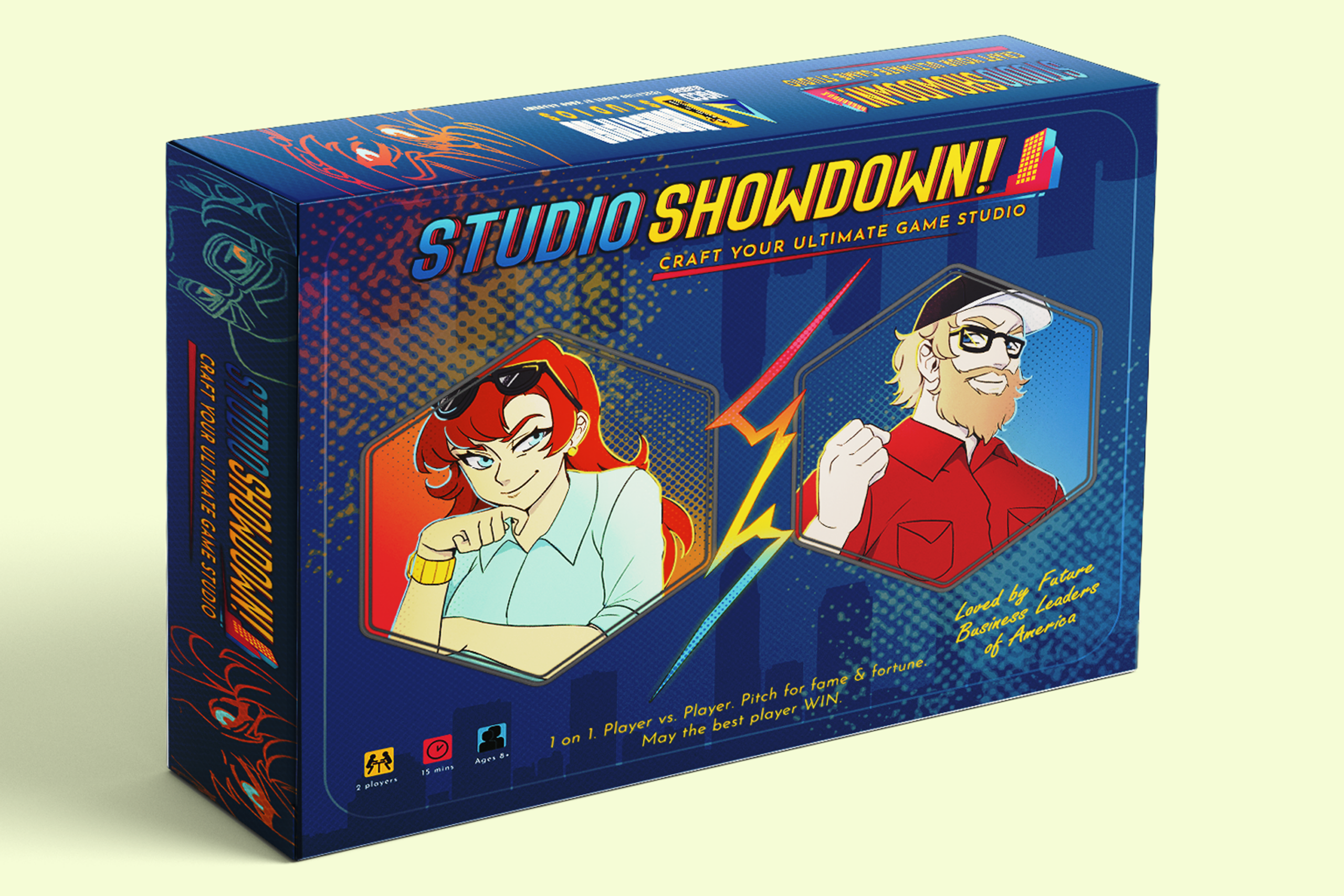
Studio Showdown stands as the premier strategy game for aspiring developers who refuse to be sidelined by technical jargon. It’s a high-stakes simulator. You act as a studio founder navigating the cutthroat reality of the 2026 gaming market. This is the bridge. It connects the joy of play with the cold logic of the game business. You aren’t just a spectator. You’re the architect of a commercial empire. This hands-on approach is the most effective way to learn game design concepts without coding because it forces you to make the decisions that actually matter. Vision. Capital. Execution. Success.
Mastering Fundraising and Pitching
The game replicates the high-stakes world of venture capital and rapid studio growth. You’ll face the Founders Dilemma: the constant struggle between creative purity and financial survival. Competitive play builds professional business acumen that traditional classrooms often miss. You manage fundraising. You refine your pitch. You allocate resources under extreme pressure. These aren’t just game mechanics. They’re the survival skills of the modern industry. You learn the financial risks and rewards of development in an environment where failure is a lesson, not a catastrophe. It’s tactical. It’s brutal. It’s essential for anyone who wants to lead a team to a visual victory.
From Tabletop to Tech Industry
Studio Showdown transforms tabletop play into tech industry readiness. It builds a portfolio of strategic thinking and market logic that impresses studio leads. You’re demonstrating that you understand the “why” behind a hit game. For teachers and institutions, the Studio Showdown: Educator Edition brings professional development directly into the classroom. It’s used to teach STEM, entrepreneurship, and leadership through the lens of visual culture. This edition provides a structured environment for students to fail, pivot, and eventually succeed. It’s a tool for students, parents, and educators who want to see real-world results. The transition from player to professional is a battle. You need the right equipment to win.
The industry doesn’t wait for those who hesitate. It rewards those who take command of the process. By simulating the studio environment, you’re gaining years of experience in a matter of hours. You’re learning the rhythm of the production cycle. You’re mastering the art of the deal. Stop dreaming about the industry and start building your place within it. Your studio’s legacy begins with a single strategic move.
Get your copy of Studio Showdown and start your studio today.
Take Command of Your Studio’s Future
The path to studio leadership doesn’t require a terminal window. It requires a vision. You’ve seen how high-impact roles like production and systems design define the industry’s winners. By mastering the logic of play through analog prototyping, you can learn game design concepts without coding and build a portfolio that commands respect. Logic is durable. Syntax is temporary. You now have the roadmap to move beyond the technical barrier and lead with authority.
Success in 2026 belongs to those who understand the business of hit-making. You don’t need to be a programmer to architect a world. You need to be a strategist who understands player psychology and market positioning. It’s time to transition from a spectator to a studio founder. Sharpen your skills, document your logic, and outmaneuver the competition with pure creative intelligence.
Master the business of games with Studio Showdown. Developed by industry experts at VGCD Academy, this game features durable, high-quality strategy components. It’s already used by educators to teach real-world entrepreneurship and studio management. The arena is waiting. Step up and claim your victory today.
Frequently Asked Questions
Can I be a game designer if I don’t know how to code?
Absolutely. Game design is the architecture of the experience, while coding is the technical construction. You focus on the “what” and “why” of the player’s journey. Many top-tier designers spend their days in spreadsheets and design documents rather than code editors. To learn game design concepts without coding, you must master rule logic and systemic balance. These skills allow you to communicate your vision clearly to technical teams who handle implementation.
What are the best non-coding jobs in the video game industry?
High-impact roles include Producers, Systems Designers, and Business Development Managers. Producers manage the studio’s most vital resource: human creativity. Systems Designers architect the internal economies and reward loops that keep players engaged. Business Development Managers secure the capital and partnerships necessary for a studio to survive. These roles are the command center of any successful studio. They require strategic thinking and market awareness rather than raw technical programming ability.
How do I start building a game design portfolio without digital tools?
Start with analog prototyping. Document your process through detailed Game Design Documents and playtest data. Show how you solved specific balancing issues using physical components like cards or dice. A portfolio that highlights your ability to learn game design concepts without coding through strategic documentation is highly valuable. Studio leads look for proof of concept and logical flow. Your ability to refine a core loop on paper proves your design maturity and vision.
Do I need a degree to work in game development in 2026?
A degree is no longer the only gatekeeper. In 2026, your portfolio and professional network carry more weight than a diploma. Studios prioritize candidates who can demonstrate real-world business acumen and a deep understanding of game mechanics. Whether you’re self-taught or university-educated, you must show you can navigate the complexities of studio management. Hands-on experience with industry-standard strategy simulations can often bridge the gap between academic theory and professional reality.
How does playing board games help me become a video game developer?
Board games strip away the visual noise and force you to confront raw mechanics. When you play or design a board game, you’re managing rule logic and player psychology in real-time. This analog environment is the purest training ground for systems design. It teaches you how to balance economies and create engaging loops without leaning on graphics. Mastering these tabletop principles translates directly into high-level video game production and studio leadership. It’s about logic, not syntax.
What business skills are most important for game studio founders?
Studio founders must master fundraising, pitching, and resource management. You need to know how to secure capital from investors and publishers while keeping your project on schedule. Strategic positioning is vital in a crowded market. You must understand the financial risks of development and how to pivot when data demands it. Entrepreneurship is the core of studio success. It’s about managing vision and capital to ensure your team’s creative work reaches the final audience.
Is Studio Showdown suitable for classroom use to teach game design?
Studio Showdown is specifically designed for educational environments. The Educator Edition and Classroom Bundle provide a structured way to teach STEM, entrepreneurship, and leadership. It allows students to experience the high-stakes world of studio management without needing a computer lab. Educators use it to simulate real-world development challenges, from fundraising to team coordination. It’s an effective tool for teaching students how to think like founders while mastering the logic of the gaming industry.
Can a non-coder lead a game development team?
A non-coder can certainly lead a team as a Creative Director or Producer. Leadership is about vision, coordination, and strategic decision-making. You don’t need to know how to write the code to know if the result feels right for the player. Your job is to set the horizon and ensure every department is moving toward it. By focusing on the architecture of the experience, you provide the direction that technical teams need to succeed.