Most teen developers fail before they ever open a game engine. They treat their studio like a hobby; we treat it like a business. You’ve spent hundreds of hours in coding tutorials. You’ve realized that writing scripts isn’t the same as leading a team, managing a budget, or pitching to investors. It’s frustrating to feel like the industry ignores you because you’re still in high school. You’re ready to move beyond the visual noise and create something with real impact. To win, you need to master the business mechanics long before your first alpha release, often by practicing with a game studio simulator board game to understand the high-stakes decisions of the industry.
This guide is your tactical blueprint. You’ll learn how to secure funding, build a reliable crew, and create a professional portfolio that demands respect from colleges and investors alike. We’re breaking down the exact steps to go from solo coder to studio founder. Strategy. Funding. Execution. Success. We’ll cover everything from navigating the $500 startup floor to signing binding contracts with a guardian’s help in 2026. We’ll show you how to turn artistic vision into a scalable production. Let’s build your legacy.
Key Takeaways
- Pivot from programmer to visionary leader. Business logic is the difference between a hobby and a studio.
- Abandon the “Lone Wolf” trap. Build a diverse squad. Visionaries. Builders. Connectors. Scale your vision.
- Weaponize your age. Learn the pitch deck anatomy that turns your teen perspective into a competitive market advantage.
- Prototype before you code. Use analog tools to stress-test mechanics and validate your core gameplay loop.
- Use a game studio simulator board game as your flight simulator. Master management, fundraising, and production in a high-stakes environment.
Why Starting a Game Studio is a Business Challenge, Not a Coding Problem
Starting a game studio isn’t about how well you can script a character controller. It’s about how well you can lead a team through the chaos of production. Most teen developers get stuck in the “tutorial hell” of coding. They think a finished game equals a successful business. It doesn’t. A Teen Game Studio Founder must be a visionary leader first and a programmer second. You’re the architect of the entire organization. You aren’t just building a game; you’re building a brand.
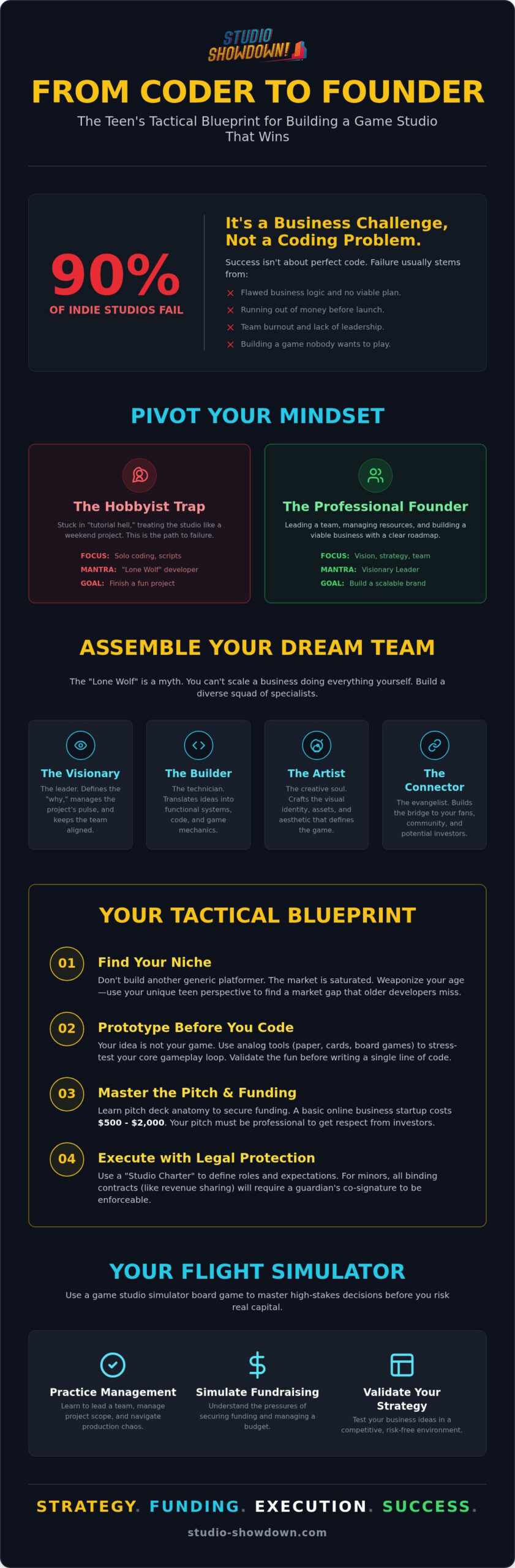
Statistics are brutal. Roughly 90% of indie studios fail. It’s rarely because of bad code or poor graphics. They fail because of flawed business logic. They run out of money. They lose their team. They build something nobody wants. Adopting a “Producer Mindset” means you stop thinking about what’s fun to play and start thinking about what’s viable to build. In the 2026 market, you need to be the one who understands the process of creating video games from a high-level strategic perspective. You need to know how to move a project from a concept to a storefront.
The Shift from Hobbyist to Professional
Strategy is your most lethal weapon. The indie market is a multi-billion dollar arena, and you aren’t competing for participation trophies. You’re competing for attention and revenue. A game project is something you do for fun on weekends. A game studio is a professional entity with a roadmap. Research shows it costs between $500 and $2,000 to get a basic online service business operational in 2026. Professionals set clear 12-month goals. They don’t just hope to finish; they plan for it. They manage resources carefully. They use tools like a game studio simulator board game to practice these high-stakes decisions before risking real capital.
Finding Your Niche in the 2026 Market
Don’t build another generic platformer. The market is saturated. You need to identify gaps where your unique perspective as a teen founder gives you an edge. Maybe it’s a specific social mechanic or a niche aesthetic that older developers miss. Analyzing 2026 trends requires looking at data without losing your creative spark. Your mission statement should be your north star. It’s not just a sentence on a website; it’s the reason your team stays up late and why fans follow your journey. A strong identity attracts the right talent and the right investors. Using a game studio simulator board game can help you define this identity by forcing you to choose which genres and markets to dominate before you ever write a line of code.
Assembling Your Dream Team: Roles and Collaboration
The “Lone Wolf” developer is a myth that kills studios. You can’t scale a business while you’re buried in every line of code, every pixel of art, and every social media post. True growth requires a diverse squad. You must transition from a solo act to a conductor. Scaling depends on trust. It depends on delegating. It depends on finding people who are better than you at specific tasks. Don’t build a team of clones; build a team of specialists.
Success in the studio world requires four core pillars. The Visionary defines the “why” and manages the project’s pulse. The Builder translates ideas into functional systems. The Artist creates the visual soul of the game. The Connector builds the bridge to your future fans. According to video game industry data, the most successful indie teams are those that balance creative intuition with technical discipline. You don’t need a massive payroll to start. You need a shared work ethic. Before you commit to a long-term project, test your potential team’s dynamics with a game studio simulator board game. It’s the fastest way to see who cracks under pressure and who steps up to lead.
Leading Without a Salary
You probably don’t have a massive hiring budget. That’s fine. Professionalism isn’t about the size of your bank account; it’s about the clarity of your vision. Motivate your peers through shared ownership. Use revenue share agreements to give everyone skin in the game. Since most of your team will likely be minors, these contracts require a parent’s co-signature to be enforceable in 2026. Create a “Studio Charter” early. Define your working hours. Set communication standards. This prevents burnout before the first sprint ends. If you want to see how these ownership stakes play out in real-time, you can practice studio management with a strategy-focused simulator.
Managing Remote Teams in 2026
Your studio lives on Discord, but it breathes on Trello. Stop using group chats for production tracking. Use professional boards to assign tasks and set deadlines. Establish a culture of radical honesty. Feedback shouldn’t be personal; it should be surgical. Hold weekly “Showdown” meetings. Review the build. Pivot if necessary. Don’t let silent resentment kill your momentum. High-performing teams talk about failure as much as they talk about success. This level of transparency is what separates hobbyist groups from professional studios.
Mastering the Art of the Pitch: Securing Funding as a Minor
In 2026, your age isn’t a liability. It’s a competitive advantage. The industry is saturated with corporate-led projects that feel sterile. Investors are looking for the raw, authentic energy that only a teen-led studio can provide. You understand the audience because you are the audience. When you pitch, don’t lead with your technical specs. Lead with your unique perspective. You’re not just a developer; you’re a cultural insider with the power to disrupt established markets. Use that leverage to command the room.
You must master the vocabulary of the boardroom. Terms like ROI, Market Fit, and Scalability aren’t just buzzwords; they’re the metrics of survival. If you can’t explain how your studio will scale from a prototype to a global release, you won’t get funded. Practice these high-stakes interactions before you step in front of a real panel. Many aspiring CEOs use a game studio simulator board game to simulate the pressure of a pitch. It’s a risk-free way to learn how to defend your valuation, manage investor expectations, and secure the bag without losing your creative soul.
The 5-Minute Founder Pitch
You have exactly 60 seconds to capture an investor’s attention. This is your elevator pitch. It needs to be sharp, punchy, and memorable. Define your Unique Selling Point (USP) in a single sentence. For example: “We’re creating an AI-driven mystery game that evolves based on real-time community theories.” Don’t waste time showing a buggy prototype. High-fidelity concept art is often more persuasive at this stage. It proves you have a visual goal and the artistic discipline to reach it. Target youth-specific grants and entrepreneurship competitions first. These organizations are specifically designed to fund high-potential founders who haven’t reached legal adulthood yet.
Navigating Legal and Financial Basics
The legal landscape for minors is complex but manageable. You can’t legally sign most binding contracts until you’re 18. This means any formal funding, such as Regulation Crowdfunding (Reg CF) updated in July 2026, or business formation requires a parental custodian. Major platforms like GoFundMe require an adult to manage the campaign as of June 2026. You’ll also need to handle LLC filing fees, which vary by state from $35 to $500. Protect your Intellectual Property from day one. Use available youth entrepreneurship resources to understand how to structure your first $1,000 budget. Professionalism starts with the paperwork. Managing your first studio budget, whether it’s $100 or $10,000, requires a level of fiscal discipline that most adults struggle to maintain. Prove you’re the exception.
Analog Strategy: Validating Your Concept Before You Code
Stop coding. If your game isn’t fun with index cards and a pair of dice, it won’t be fun with ray-tracing and 4K textures. Paper prototyping is the industry’s best-kept secret. It allows you to strip away the visual noise and focus on the core loop. Pro designers at major studios use analog methods to stress-test systems before a single line of code is written. You should too. It’s the only way to ensure your mechanics actually work before you sink hundreds of hours into development.
Use dice to simulate RNG. Use cards to represent abilities. This isn’t just about gameplay; it’s about business logic. Validating your business model happens here. Ask your playtesters if the experience feels premium. Would they pay for this loop? If the answer is no, you’ve saved months of wasted development time. A game studio simulator board game provides a structured environment to practice this validation process without the technical overhead of a digital engine. It forces you to think like a CEO before you think like a dev. You’re managing resources, not just sprites.
The MVP (Minimum Viable Product)
Fail fast. Fail cheap. The analog phase is your laboratory. If a mechanic doesn’t work, you crumble the paper and start over. It takes five seconds. In a digital engine, it takes five hours of debugging. Iterate on your Game Design Document (GDD) based on real-world play sessions. Document every change. This iterative cycle is the hallmark of a professional producer. You aren’t just making a game; you’re refining a product. High-performing founders use these low-cost trials to ensure their vision survives the market. They don’t guess; they test.
Building a College-Ready Portfolio
College recruiters don’t just want to see a finished executable. They want to see your struggle. They want the photos of your coffee-stained index cards and the data from your failed playtests. This shows business acumen and a deep commitment to the production lifecycle. It proves you understand Mastering the Board: The 2026 Guide to Strategy Board Games and how analog logic translates to digital success. Recruits with this mindset are rare. You’re proving you can think critically about systems, not just follow a YouTube tutorial.
Showcasing this level of discipline sets you apart from the thousands of students who only submit a generic platformer. You’re showing them you can manage a product from concept to validation. You’re showing them you’re a founder, not just a hobbyist. Using a game studio simulator board game as a reference point in your portfolio demonstrates that you’ve practiced the hardest parts of the job. To start building these high-level skills today, get your hands on a professional simulator and start leading.
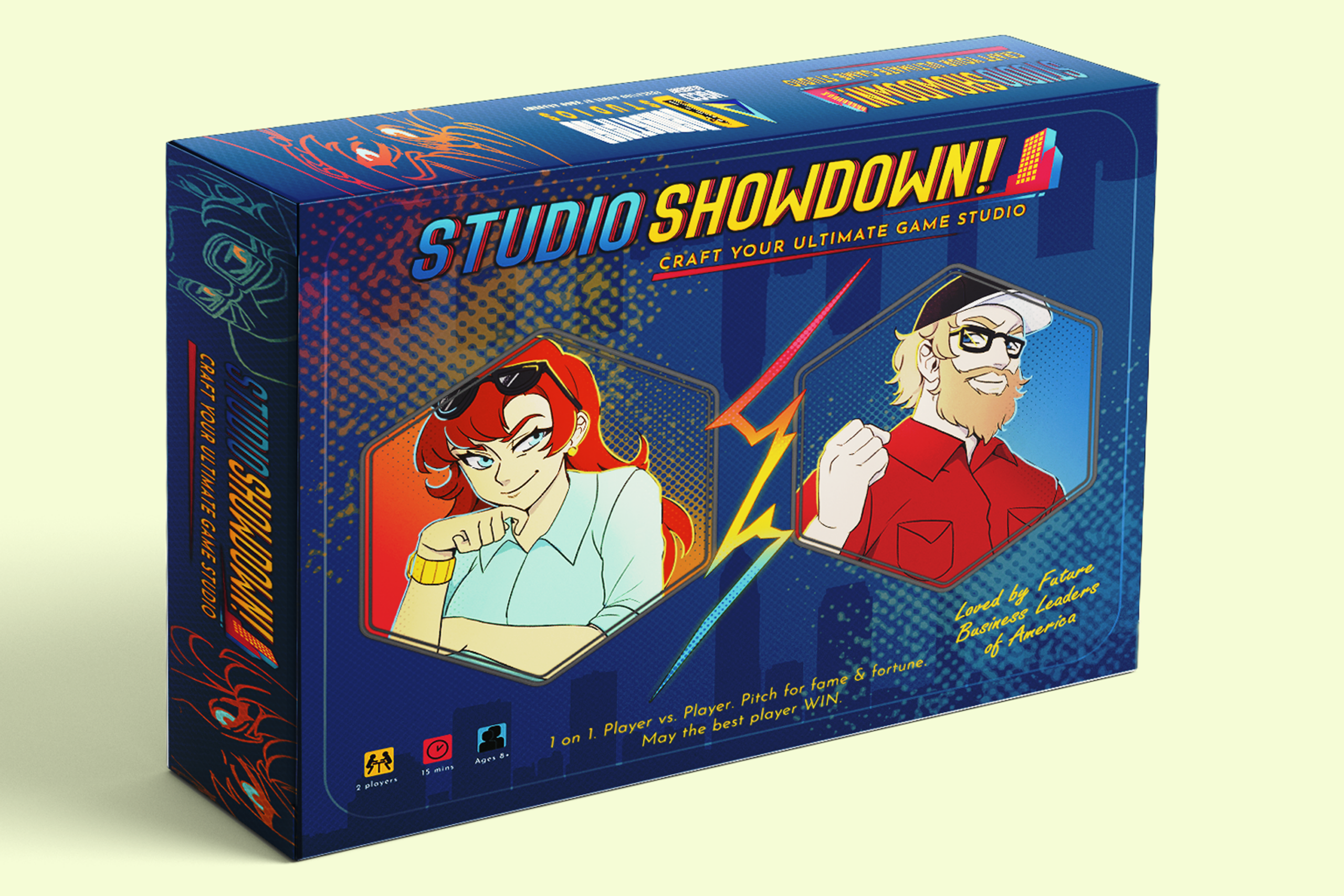
Level Up Your Studio with the Studio Showdown Board Game
Reading dry business manuals won’t save your studio when a major release flops or a lead artist quits. Theoretical knowledge is a ghost. You need muscle memory. You need to experience the friction of the industry before you risk your first $1,000. Think of the game studio simulator board game as your tactical flight simulator. Pilots don’t start in the cockpit of a 747; they start in a simulation where a crash doesn’t cost lives. Your studio deserves the same safety net. This is where you fail, pivot, and evolve without burning through your actual capital.
Studio Showdown isn’t just a game. It’s a high-stakes arena for mastering the business of play. You’ll face the brutal reality of fundraising, the adrenaline of pitching, and the cutthroat nature of outmaneuvering rivals. Every turn forces a decision. Do you invest in marketing or polish? Do you hire a veteran or a rising star? These aren’t just mechanics; they’re the daily dilemmas of a CEO. By the time you reach the digital market, you’ve already faced these battles a dozen times on the table. You’ll enter the industry with a level of tactical awareness that most adult founders lack.
The Studio Showdown Experience
Launching a hit game is a chaotic sprint. You have to manage technical debt, community expectations, and team morale all at once. Using this game studio simulator board game allows you to train your squad in a low-risk environment. It builds a shared language of success. When your team understands how a launch works in a simulation, they’ll perform better when real stakes are on the line. It’s the bridge between a group of friends and a professional production house. Dive deeper into how this works in The Ultimate Business Board Game: Master Entrepreneurship in 2026.
From Tabletop to Tech Mogul
The victories you earn at the table translate directly into real-world confidence. You’ll stop guessing and start calculating. Educators and parents are already using Studio Showdown to build business literacy because it bypasses the boredom of a classroom. It turns complex economic principles into a competitive struggle for dominance. This is where you prove you have the grit to lead. Don’t wait for permission to be a founder. Build your skills, test your strategy, and prepare for the 2026 market. Get the Studio Showdown Board Game and start your founder journey today!
Build Your Legacy Starting Now
Your future as a founder doesn’t start with a line of code. It starts with a decision to lead. You’ve seen that the 2026 market demands more than technical skill; it demands strategic grit. You need to assemble a squad of specialists, master the high-stakes language of investors, and validate your mechanics through analog prototyping. Success belongs to those who treat their studio as a professional production from day one. Don’t just play the game; own the board.
The game studio simulator board game is your ultimate training ground. It’s the same tool used by VGCD Academy to prepare the next generation of industry leaders. This immersive experience significantly reduces the learning curve for complex business simulations. It’s a perfect fit for classroom environments and after-school programs looking to build real-world entrepreneurship skills. Don’t wait for a degree or a corporate invitation to start your journey. Practice the hard decisions now so you can dominate the market later.
Launch Your Career with the Studio Showdown Board Game
The industry is waiting for your vision. Go take it.
Frequently Asked Questions
Do I need to know how to code to start a game studio as a teen?
You don’t need to write a single line of code to lead a studio. While technical skills are helpful, the role of a founder is focused on vision, team management, and business strategy. Many successful studio heads act as producers; they ensure the project stays on schedule and within budget while specialists handle the engine. Your job is to orchestrate the talent and drive the brand’s identity forward in the market.
How can a minor legally own a game studio in the US?
Minors can’t sign binding contracts alone. To legally form an LLC or secure formal funding, you’ll need a parent or legal guardian to act as a custodian or co-signer. This allows your business to open bank accounts and sign distribution agreements with major platforms. It’s a partnership where you handle the creative and operational leadership while an adult provides the legal foundation required by state and federal laws in 2026.
Where can I find other teens to join my game development team?
Look where the creators gather. Discord communities dedicated to game jams are prime hunting grounds for fresh talent. School computer science clubs and art programs also house potential teammates who share your drive. When recruiting, don’t just look for skill; look for a shared work ethic. You can even use a game studio simulator board game during a meetup to test how well a group collaborates under simulated pressure.
What are the best free tools for starting an indie game studio in 2026?
Professionalism doesn’t require a massive budget. Use Trello for production tracking and Discord for team communication. For development, Godot remains a powerful open-source engine, while Blender is the industry standard for 3D modeling. These tools allow you to maintain high production standards without the overhead of expensive licenses. Focus on mastering the workflow first. The efficiency of your process is more important than the price tag of your software suite.
How much does it cost to start a game studio from scratch?
Starting an online service-based studio in 2026 typically requires an investment between $500 and $2,000. This covers LLC formation fees, which range from $35 to $500 depending on your state, plus basic website hosting and professional tools. While some indie projects start with less than $5,000, having a clear budget for marketing and legal filings is essential. Focus on lean operations during your first 12 months to maximize every dollar.
How do I protect my game idea from being stolen by other studios?
Ideas are cheap; execution is everything. You protect your studio by building a unique brand and documenting your development process carefully. While you can’t copyright a basic mechanic, your specific code, art, and story are protected by intellectual property laws once they’re created. Use non-disclosure agreements when discussing sensitive details with external partners. Most importantly, outpace the competition through superior strategy and a faster, more disciplined production cycle.
What is the best way to build a game dev portfolio for college?
Show your work, not just the result. Admissions officers look for evidence of your critical thinking and problem-solving skills. Include Game Design Documents, photos of your analog prototypes, and data from playtest sessions. Documenting how you pivoted after a failure proves you have a professional producer mindset. A portfolio that showcases business acumen alongside creative talent will always stand out over a simple collection of buggy, unfinished demos.
How does Studio Showdown help me become a better game developer?
Studio Showdown acts as a high-stakes flight simulator for your career. By playing this game studio simulator board game, you master the business mechanics that most developers ignore until it’s too late. You’ll practice fundraising, pitching, and resource management in a competitive environment. This builds the tactical awareness needed to navigate the actual industry. It turns abstract business theories into practical skills you can apply to your real-world studio immediately.