What if your brain isn’t actually exhausted by technology, but simply starved for high-stakes reality? You feel the mental fog. The notification overload. The hollow guilt of another hour sacrificed to the infinite scroll. It’s time to stop surviving the digital noise and start dominating your own attention. By integrating high-intensity screen-free educational activities into your routine, you don’t just step away from the glass; you step into a higher level of performance.
We all recognize the cost of a life lived through a lens. Real-world social connections fade, and professional focus becomes a rare commodity. This article promises a blueprint to reclaim your mental clarity and build genuine business acumen through analog competition. We’ll explore the 2026 strategy for peak focus, including the tactile power of the Studio Showdown Board Game. You’ll learn how to upgrade your downtime, sharpen your pitching skills, and replace digital fatigue with the raw adrenaline of face-to-face strategy.
Key Takeaways
- Understand why AI-driven feeds in 2026 make traditional digital detoxes fail. It’s about recognizing the high cognitive cost of constant context switching.
- Apply the “Void Theory” to rewire your brain for deep focus. You can’t just quit scrolling; you must replace it with an immediate, high-value analog habit.
- Discover high-performance screen-free educational activities that match the dopamine hit of gaming. Build real-world business acumen while protecting your mental clarity.
- Execute immediate focus-saving tactics like the “Phone Bed” strategy. Create physical boundaries that stop notification overload at the source.
- Master professional skills through the tactile strategy of the Studio Showdown Board Game. Learn fundraising and studio management without ever touching a monitor.
The Digital Fatigue of 2026: Why Scrolling is the New Stagnation
Digital fatigue is the heavy cognitive tax of constant context switching. It’s the mental friction of moving between tabs, apps, and alerts without ever reaching a state of flow. The Digital Fatigue of 2026 represents a state where your brain never truly lands on a single task. AI-driven feeds have evolved into predictive engines that keep you locked in a cycle of passive consumption. This erosion of focus is a crisis for anyone building a career. Entrepreneurship requires sharp, critical thinking. Scrolling requires none. Digital Minimalism is the elite professional’s secret weapon for protecting cognitive bandwidth in an age of total distraction.
The Dopamine Loop: Understanding Your Brain’s Reward System
Your phone is a slot machine. Notifications use intermittent reinforcement to keep you checking for the next hit. This is cheap dopamine. It feels good for a second, then leaves you hollow. True satisfaction comes from earned dopamine. This is the biological reward for solving a complex problem or winning a high-stakes negotiation. Your brain is wired for the hunt. It craves challenge and strategic friction. When you replace scrolling with screen-free educational activities, you feed that hunger for mastery. Passive feeds offer no resistance. Without resistance, there is no growth.
The Physical and Mental Toll of Excessive Screens
The body keeps score. High-refresh-rate displays in 2026 demand constant ocular micro-adjustments that wear down your focus. The impact is measurable and destructive:
- Vision: Constant near-field focus causes significant ocular strain and headaches.
- Sleep: Blue light suppresses melatonin, ruining restorative sleep cycles.
- Resilience: Digital bubbles reduce your ability to handle real-world conflict and social nuance.
Use the 20-20-20 rule to survive: every 20 minutes, look at something 20 feet away for 20 seconds. It’s simple; it works. Building real-world skills requires getting away from the glow. Engaging in screen-free educational activities restores your edge, sharpens your vision, and rebuilds the social grit that digital spaces have smoothed away. You become more than a consumer. You become a competitor.
The Science of Replacement: Why “Cold Turkey” Usually Fails
Quitting a digital habit isn’t a matter of willpower. It’s a matter of physics. The “Void Theory” suggests that every habit you remove leaves a cognitive vacuum. If you don’t fill that space with high-intensity screen-free educational activities, your brain will naturally gravitate back to the easiest source of stimulation: the screen. Most digital detoxes fail because they offer boredom as a cure for overstimulation. For a high-performance individual, a simple puzzle isn’t enough. You need the “Flow State,” that deep immersion where time disappears and your skills are pushed to their limit. You can’t find that in a mindless scroll, but you also won’t find it in a “boring” analog alternative.
Neuroplasticity is your greatest ally in this transition. Your brain is a dynamic system that rewires itself based on the tasks you prioritize. Digital feeds have trained your mind for shallow, rapid context switching. To regain deep focus, you must provide tasks that demand sustained strategic thinking. This isn’t just about “taking a break.” It’s about training your neural pathways to handle complex, multi-layered challenges without the crutch of a digital interface.
Tactile Learning vs. Digital Observation
Screens are two-dimensional. Reality is tactile. When you engage with physical objects like cards, tokens, or dice, you activate more regions of your brain than when you simply tap glass. Memory retention spikes when physical movement is tied to strategic decision-making. You aren’t just observing data; you’re manipulating it in physical space. This builds a unique kind of “muscle memory” for business logic. You learn to feel the weight of a decision when you physically commit a resource to a board. It’s a level of professional training that digital simulators simply cannot replicate.
Social Resilience: The Power of Face-to-Face Strategy
Digital lobbies are sterile environments. Real-world business, however, is built on nuance. You can’t learn to read a subtle “tell” or interpret shifting body language through a Discord chat or a Zoom call. Analog competition forces you to manage your own physical presence while analyzing others in real-time. You learn to project confidence, detect hesitation, and navigate high-stakes social friction. These are the skills that define leaders. If you’re ready to test your tactical grit in a real-world setting, the Studio Showdown Board Game offers the perfect arena to sharpen these instincts. Physical presence creates a psychological weight that digital play lacks, building social bonds through shared, high-stakes struggle rather than just shared pixels.
Strategy Over Scrolling: Analog Alternatives for the Gamer Brain
Passive hobbies like reading or walking are often suggested as the antidote to screen time. For the high-performance gamer or ambitious professional, these suggestions fall flat. They lack the competitive edge. They don’t provide the strategic friction your brain craves. To truly replace digital habits, you need an “Analog Upgrade.” This means choosing screen-free educational activities that match the intensity, complexity, and dopamine rewards of a high-end video game. A tabletop victory provides a more durable sense of achievement because it’s rooted in physical presence and social consequence. You aren’t just clicking a mouse; you’re outmaneuvering a living opponent in real-time.
Strategy board games serve as the ultimate bridge for digital natives. They offer the same deep systems and rewarding feedback loops found in top-tier simulations. If you’re looking to dive deeper into this world, check out our resource on Mastering the Board: The 2026 Guide to Strategy Board Games. By shifting your focus to high-fidelity tabletop experiences, you reclaim your attention without sacrificing the thrill of the win.
Immersion Without the Blue Light
Complex mechanics keep the mind fully engaged for hours. Unlike the shallow interaction of a mobile app, modern strategy games demand total focus. The “Thematic Hook” is critical here. Just as world-building draws you into a digital RPG, high-quality analog games use art, lore, and physical components to create a sense of place. You can choose a game that mimics your favorite digital genre. If you love resource management in an RTS, find a heavy “Eurogame.” If you prefer the narrative of an adventure game, look for a legacy campaign. The goal is to find screen-free educational activities that don’t feel like a downgrade, but a more tactile version of the games you already love.
The Entrepreneurial Edge: Skill-Based Tabletop Play
Game night is the perfect laboratory for professional growth. Strategy games allow you to practice negotiation, pitching, and aggressive resource allocation in a safe yet competitive environment. You learn the financial stakes of a studio founder through play. You manage risks. You pivot when a rival sabotages your plans. These games prepare players for real-world market dominance by rewarding the same traits that define successful entrepreneurs: foresight, adaptability, and the ability to read a room. It’s about building a professional portfolio of instincts while the screens are dark. Winning in the boardroom starts with winning at the table.
5 Practical Steps to Reclaim Your Focus and Reduce Screen Time
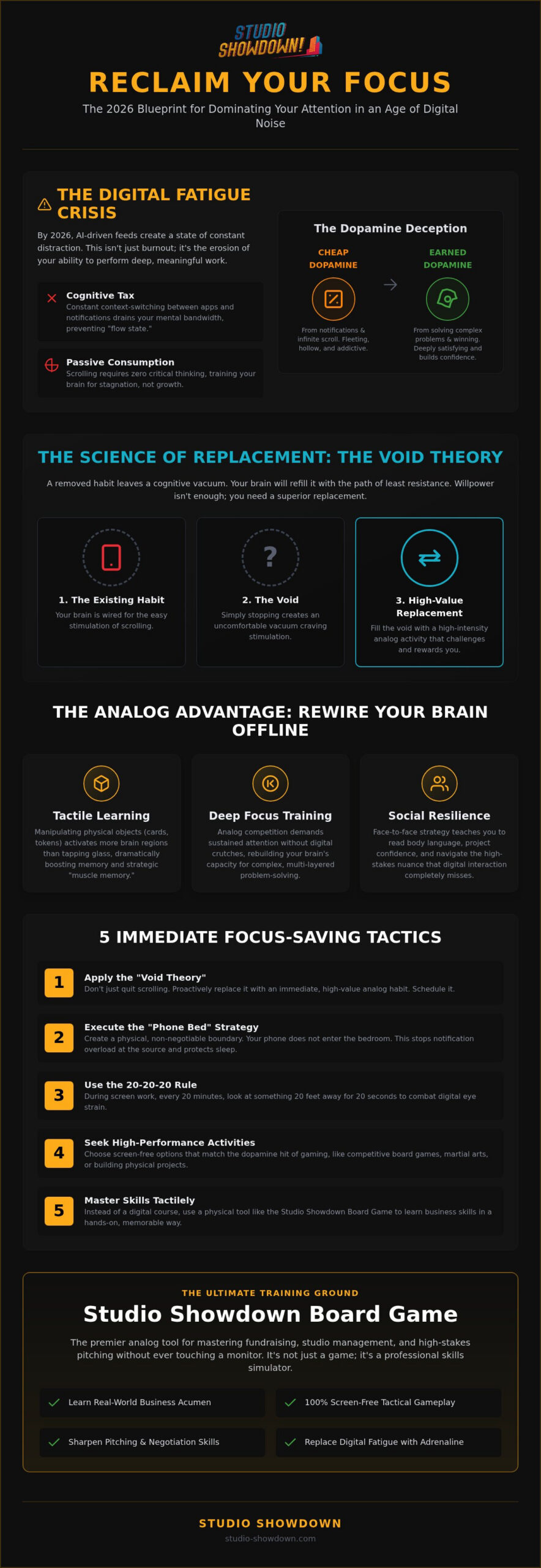
Reclaiming your attention isn’t a passive act. It’s a calculated strike against digital noise. You don’t need more willpower; you need a better environment. High-performance focus requires physical boundaries that protect your cognitive bandwidth from the infinite scroll. By implementing screen-free educational activities into a structured routine, you replace mindless consumption with strategic growth. These five steps are designed to move you from a state of digital fatigue to one of analog mastery.
- Step 1: The “Phone Bed.” Stop sleeping with your distractions. Create a physical charging zone outside the bedroom or living area. If your phone isn’t within reach, it can’t steal your focus.
- Step 2: Audit Your Dopamine. Identify the apps that offer zero strategic value. If a platform doesn’t sharpen your mind or build your professional acumen, it’s dead weight. Delete it.
- Step 3: Schedule “Analog Hours.” Block out non-negotiable time for deep work or strategy. Treat these hours with the same respect as a high-stakes board meeting.
- Step 4: The “Replacement Ritual.” Friction is the enemy of new habits. Keep your screen-free educational activities physically ready. Have your sketchbook open or your board game set up on the table.
- Step 5: Social Accountability. Strategy is better with an audience. Invite colleagues or family into your screen-free sessions. Competition breeds consistency.
Building Screen-Free Zones in Your Home
Design your space for victory. Establish a “No-Phone Table” where digital devices are strictly prohibited. This turns game time or dining into a sacred space for face-to-face connection. Your workspace should actively discourage distraction. Use physical cues to signal the end of the digital workday. Close the laptop. Clear the desk. When the screen goes dark, the analog environment should be ready to engage your brain in a new, tactile way.
Digital Boundaries for Students and Professionals
Professionals don’t live in their inboxes; they batch their notifications. Check your messages at set intervals rather than reacting to every buzz. Use “Focus Mode” to brick your phone during intense strategy sessions. This allows you to fully immerse yourself in The Ultimate Business Board Game: Master Entrepreneurship in 2026 without the constant pull of the cloud. Sharp boundaries create the mental room needed for market dominance. Ready to upgrade your strategy? Explore the Studio Showdown collection today.
Studio Showdown Board Game: Mastering Game Design Without a Screen
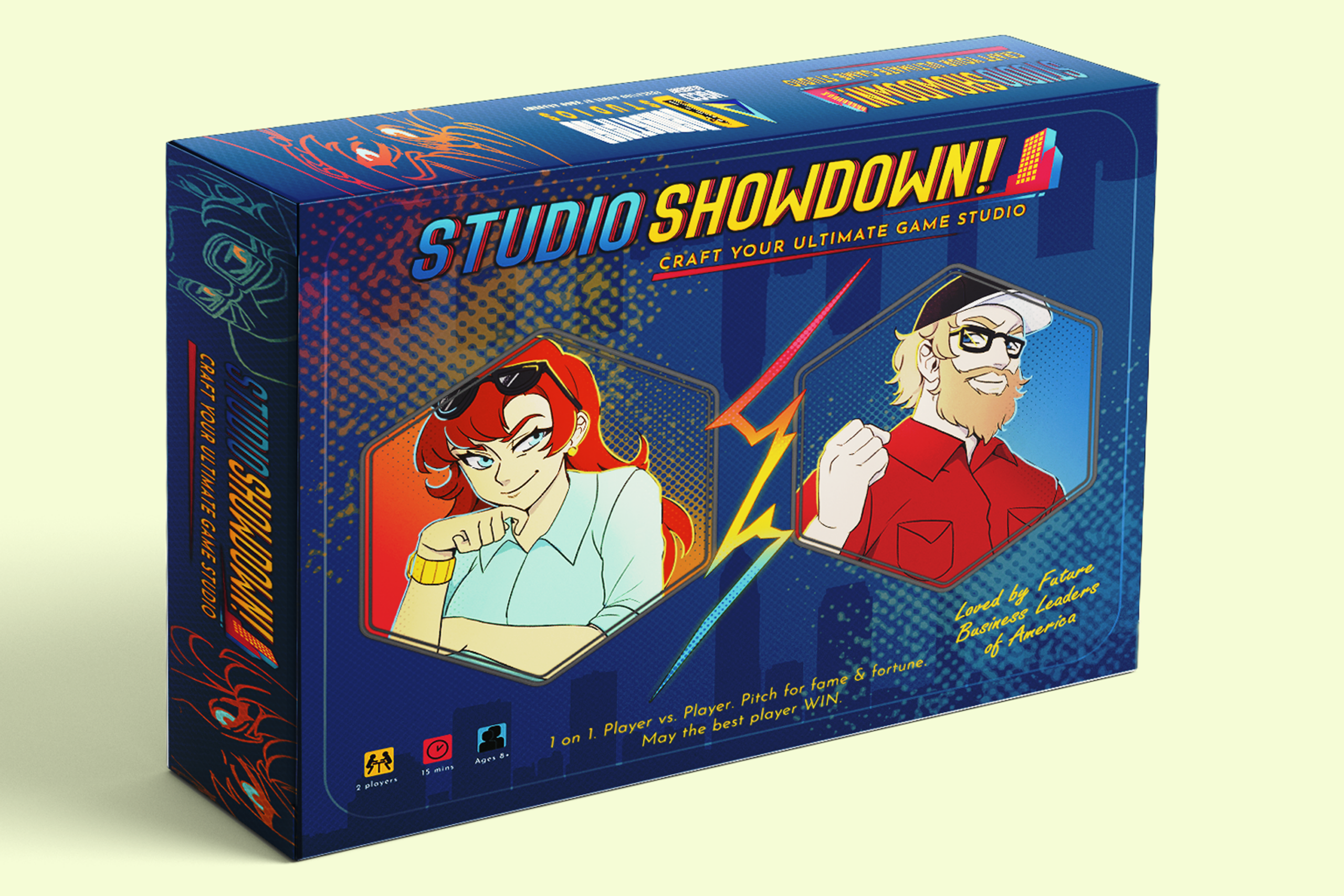
Pixels are cheap. Strategy is expensive. Most people assume that mastering game design requires a monitor and a keyboard. They’re wrong. The Studio Showdown Board Game turns the complex machinery of the industry into a high-stakes, tactile experience. It’s a business simulation where the glow of the screen is replaced by the heat of competition. Developed by VGCD Academy and DEMYSTIFIED Studios, this game bridges the gap between digital play and professional reality. You navigate the high-friction corridors of the Game Development Life Cycle through physical cards and resource management. It’s the industry grind, stripped of its digital distractions.
One of the most effective screen-free educational activities for aspiring creators is simulating the very ecosystem they want to join. This isn’t just a game; it’s a training ground for the next generation of founders. You don’t just build a product. You pitch it. You fundraise for it. You outmaneuver rivals face-to-face in a room where there’s no “mute” button. This social dynamic forces you to read body language and sell your vision with conviction. Educators use this tool to build professional portfolios because it requires players to articulate their strategy. It builds financial literacy by making every resource spent on development feel heavy and consequential.
From Founder to Market Leader: The Gameplay Experience
Launching a hit title isn’t just about the art. It’s about market timing and aggressive resource allocation. In Studio Showdown, you balance the books while pitching to investors. You manage the delicate tension between creativity and capital. The “Showdown” element brings competitive entrepreneurship to life. Rival studios will try to sabotage your launch. You’ll have to pivot, protect your assets, and strike back. It’s a lesson in resilience that no digital tutorial can replicate. You learn to survive the market before you ever write a line of code.
The Educator’s Secret Weapon for 2026
Classroom engagement is a battle for attention. The Studio Showdown: Educator Edition is the heavy artillery for teachers who want to win. It integrates seamlessly into STEM and business curricula by providing a concrete framework for abstract concepts. Students don’t just read about entrepreneurship; they live it at the table. They learn the stakes of fundraising and the grit required for studio management. To transform your teaching space into a high-performance lab, explore the Classroom Bundle for your school. It’s the ultimate tool for building real-world skills through screen-free educational activities that actually stick.
Dominate Your Attention: The Future is Analog
Digital fatigue is a choice. Focus is a high-performance skill. You now have the blueprint to move beyond the infinite scroll and reclaim your cognitive edge. True mastery requires replacing cheap dopamine with high-stakes reality. By integrating screen-free educational activities into your daily routine, you don’t just step away from the glare; you step into a higher level of strategic thinking. You’ve learned to build physical boundaries and audit your attention. Now, it’s time to put those skills to the test in the real world.
The Studio Showdown Board Game is the ultimate training ground for 2-6 players. Developed by industry experts at VGCD Academy and trusted in financial literacy curricula, it delivers a high-intensity business simulation without a single monitor. It’s time to sharpen your pitching, manage your resources, and outmaneuver your rivals face-to-face. Take the Showdown Offline: Get the Studio Showdown Board Game Today. Your attention is your most valuable asset. Stop spending it on feeds. Start investing it in victory.
Frequently Asked Questions
What are the most effective screen-free activities for teens in 2026?
High-stakes strategy games and collaborative physical prototyping are the most effective options. Teens need activities that mirror digital intensity but build tactile skills. Focus on screen-free educational activities that involve resource management, pitching, or creative problem-solving. This builds social resilience and financial literacy. It provides the dopamine hit they usually seek in video games while grounding them in reality and professional growth.
How much screen time is considered “too much” for an adult?
Screen time becomes excessive when it interferes with professional focus, sleep quality, or physical health. There’s no universal hourly limit, but “too much” is defined by the onset of digital fatigue and mental fog. If you can’t sustain 90 minutes of deep work without checking a device, your consumption has likely eroded your cognitive bandwidth. Your performance is the ultimate metric.
Can board games actually teach professional business skills?
Strategy-based board games act as analog business simulations. They force players to manage limited resources, negotiate with rivals, and adapt to market shifts in real-time. Unlike digital sims, tabletop games require face-to-face persuasion and reading body language. These are critical soft skills that directly translate to boardroom success, entrepreneurial grit, and market dominance. Winning at the table builds winning instincts.
How do I stop doomscrolling when I am bored?
Apply the Replacement Ritual by having a high-value analog alternative physically ready. Boredom is just a craving for stimulation. If you have a strategy game or a sketchbook open on your desk, you lower the friction for better habits. Don’t just try to stop; give your brain a more engaging, tactile challenge to solve. Friction is the enemy of focus.
What is the 20-20-20 rule for eye strain?
Every 20 minutes, you must look at something 20 feet away for at least 20 seconds. This simple practice resets your ocular focus. It reduces the strain caused by high-refresh-rate displays. It’s a non-negotiable habit for professionals who need to maintain visual clarity throughout a demanding workday. Protect your vision to protect your performance. Sharp eyes lead to sharp decisions.
Are there board games specifically designed for aspiring game developers?
The Studio Showdown Board Game is specifically designed to teach the game development life cycle. It moves players through fundraising, pitching, and studio management without a single monitor. Educators use it to build professional portfolios and financial literacy. It’s a premier example of screen-free educational activities that align with creative career goals. You learn the industry grind through tactile strategy.
How can I make my smartphone less addictive?
Turn off all non-human notifications and move your charging station out of the living area. Batching your alerts into set check-in times prevents the constant context switching that fuels addiction. You can also use Focus Mode to brick distracting apps during your analog strategy sessions or deep work blocks. Control the device so it doesn’t control your attention.
What are the benefits of Digital Minimalism for entrepreneurs?
Digital Minimalism provides a competitive advantage by reclaiming mental clarity and deep focus. Entrepreneurs who limit digital noise can make faster, more accurate decisions and sustain high-intensity social engagement. By removing the cheap dopamine of social feeds, you force your brain to seek satisfaction through real-world market wins and strategic growth. It’s about trading passive consumption for active domination.