The traditional business textbook is dead weight in a high-speed classroom. You’ve felt the silence. Students tune out during lectures on theory while you struggle to find hands-on tools that actually deliver. Turning play into measurable learning outcomes shouldn’t feel like a losing battle. We agree that engagement is the only currency that matters in education today. If the tools aren’t dynamic, the results won’t be either.
This guide transforms your approach by introducing high-impact classroom activities using Studio Showdown. We’ll show you how to turn a tabletop strategy game into a professional laboratory for game design and entrepreneurship. You’ll gain access to modular 45-60 minute blocks that align perfectly with STEM and business standards. We’ll preview specific strategies to move students from simple gameplay to creating portfolio-ready results. This isn’t just about playing a game; it’s about building a foundation for future studio founders and industry leaders. It’s time to cut the noise, ignore the fluff, and build a curriculum that wins.
Key Takeaways
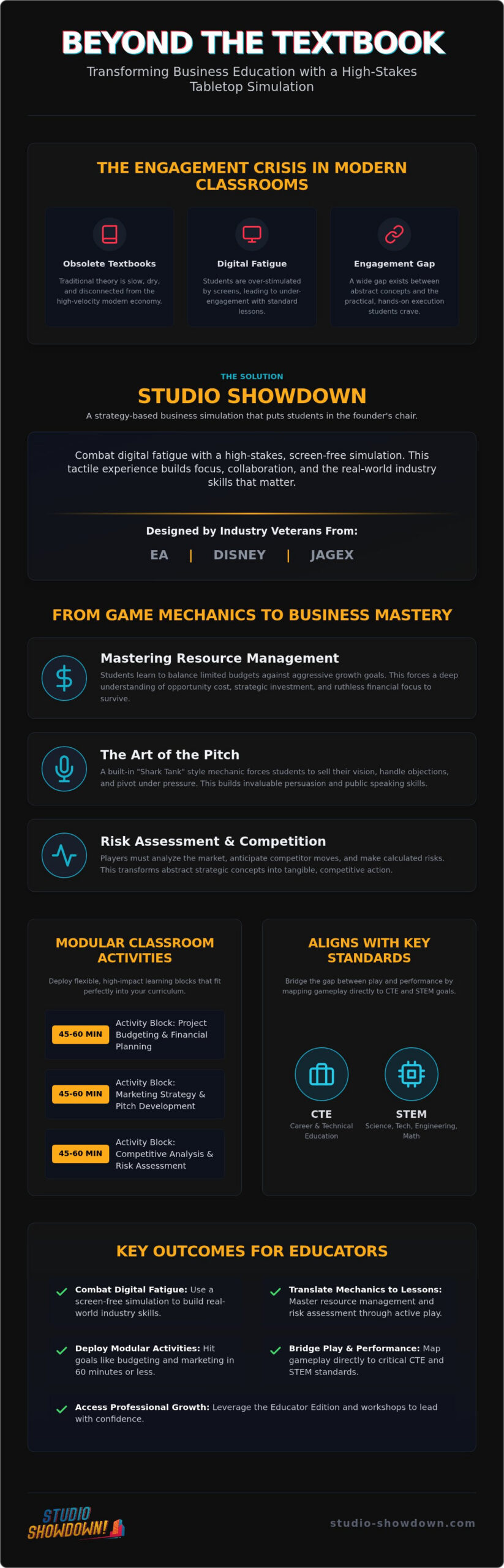
- Combat digital fatigue. Use a high-stakes, screen-free simulation to build real-world industry skills.
- Translate game mechanics into business lessons. Master resource management and risk assessment through active play.
- Deploy modular classroom activities using Studio Showdown to hit specific goals like budgeting and marketing in 60 minutes or less.
- Bridge the gap between play and performance. Map gameplay directly to CTE and STEM standards.
- Access professional growth. Leverage the Studio Showdown: Educator Edition and specialized workshops to lead with confidence.
The Engagement Crisis: Why Your Classroom Needs Studio Showdown
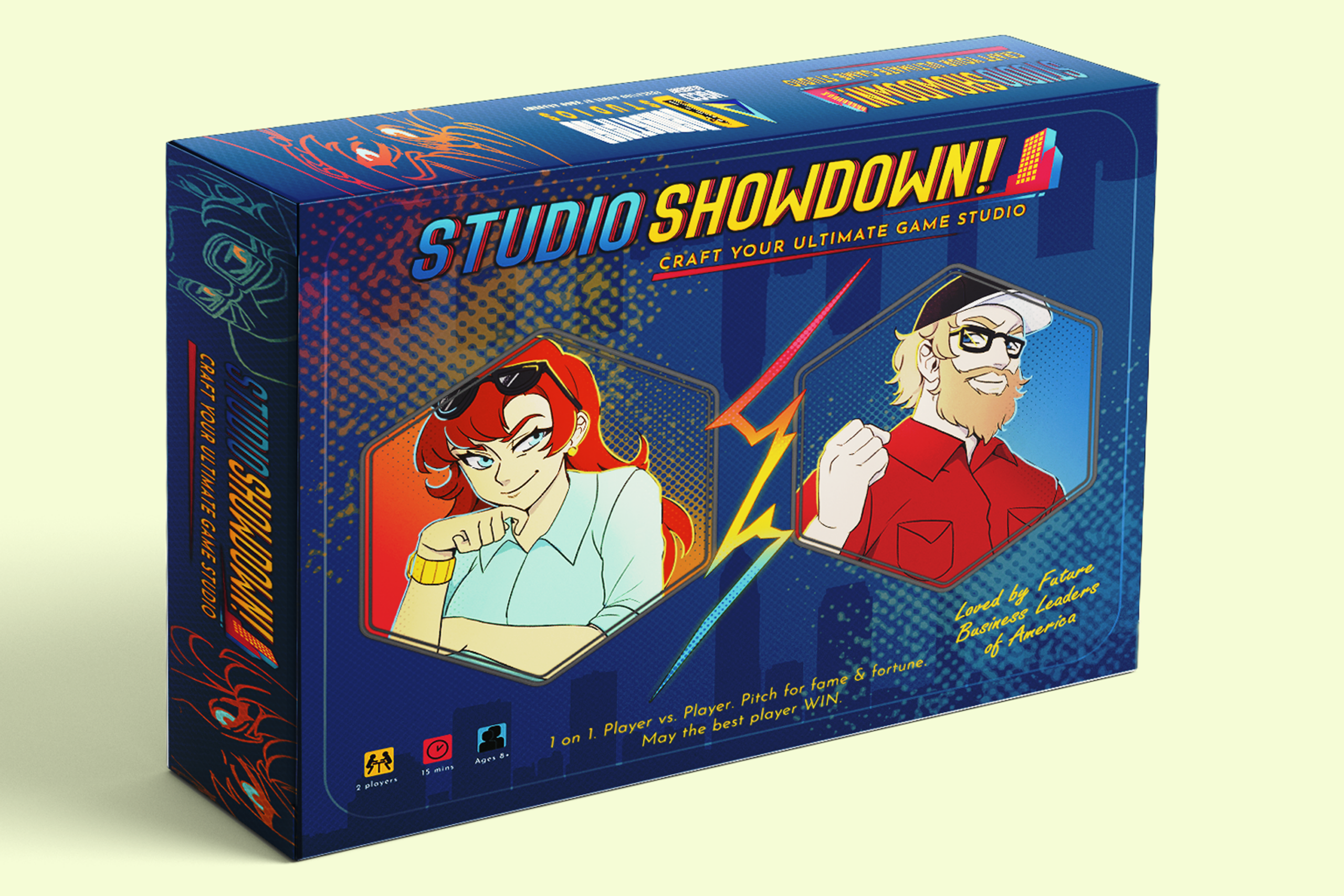
The traditional business textbook is a relic. It’s slow, dry, and disconnected from the high-velocity reality of the modern economy. Students today are over-stimulated by digital noise yet under-engaged by standard theory. They don’t want to read about entrepreneurship; they want to experience it. Studio Showdown isn’t just another board game. It’s a strategy-based business simulation designed to pull students out of the spectator seat and into the founder’s chair.
By integrating classroom activities using Studio Showdown, you bridge the gap between abstract concepts and professional execution. This tool maps directly to Career and Technical Education (CTE) goals. It transforms the classroom into a high-stakes environment where resource management and competitive analysis are the only ways to survive. It’s about results, not just participation.
Breaking the Digital Barrier
Digital fatigue is real. In a screen-saturated world, analog strategy provides a necessary reset. Tactile learning creates a level of focus that a monitor simply can’t match. When students handle physical components, they engage different cognitive pathways. They aren’t just clicking buttons; they are negotiating, reading body language, and collaborating in real time.
Game-based learning thrives in this analog space because it demands social presence. It builds the “soft skills” that industry leaders actually crave: communication, empathy, and quick-fire problem solving. This format resonates deeply with hard-to-reach students. It uses the familiar language of video games to teach the unfamiliar mechanics of business.
From Players to Studio Founders
We need to shift the narrative. Students shouldn’t be passive consumers of entertainment. They should be the architects of it. Classroom activities using Studio Showdown force this evolution. The game doesn’t ask them to play; it asks them to lead. They must navigate the brutal cycles of fundraising, master the art of the pitch, and execute strategic outmaneuvering to achieve market dominance.
This is where the “Founder’s Mindset” takes root. Students learn that every choice has a cost and every risk requires a calculation. They move beyond the “how” of a game and start questioning the “why” of a business. Ultimately, Studio Showdown functions as a professional bridge that converts raw competitive drive into sophisticated industry acumen.
The Studio Showdown Framework: Mechanics as Lessons
Studio Showdown isn’t just a game. It’s a high-fidelity simulation of the video game industry. Every turn forces a decision that mirrors real-world business pressure. The core loop revolves around resource management, risk assessment, and market competition. These aren’t just mechanics; they are the building blocks of a professional mindset. By integrating classroom activities using Studio Showdown, educators replace dry theory with visceral experience.
The design comes from veterans of EA, Disney, and Jagex. This pedigree ensures every challenge is grounded in reality. The Studio Showdown: Educator Edition provides the structure needed to deliver these lessons effectively, ensuring play always leads to performance. It’s a tool for teachers who demand more than passive participation.
Mastering Resource Management
Survival requires a ruthless focus on the bottom line. Students must balance limited budgets with aggressive growth. This is the ultimate lesson in opportunity cost. They choose which projects to fund and which to kill. It goes far beyond standard financial literacy board games by adding the layer of strategic competition. Budgeting. Risk. Growth. It’s all connected.
When students analyze these systems, they engage in deep logic. Research suggests these approaches Improve Student Achievement in STEM by making complex systems tangible. It’s about seeing the immediate impact of a financial decision on a studio’s survival. This is classroom activities using Studio Showdown at their most potent, turning numbers on a page into a fight for market dominance.
The Art of the Pitch
The most valuable skill in any industry is the ability to sell a vision. The pitching mechanics force students to refine their persuasion skills in a high-stakes environment. It’s a “Shark Tank” simulation without the financial ruin. They learn to handle objections, pivot under pressure, and articulate value.
These soft skills are gold for college and internship applications. They help students build a narrative of leadership. When a student explains how they secured funding through a perfect pitch, they aren’t just talking about a game. They are demonstrating professional acumen that sets them apart from the crowd. They aren’t just players; they are future studio founders.
5 Modular Classroom Activities Using Studio Showdown
Time is the one resource every educator lacks. You don’t always have a three-hour window for a full session. Studio Showdown isn’t a rigid, all-or-nothing experience. It’s a modular system. You can isolate specific mechanics to target high-value learning outcomes in tight 45-60 minute blocks. By using the Educator Edition, you can deploy these modules to hit specific curriculum goals without losing momentum. These classroom activities using Studio Showdown turn your room into a high-velocity business incubator.
Activity 1: The 15-Minute Pitch Challenge
Speed is a competitive advantage. In this module, students draw random game cards to generate an instant studio concept. They have five minutes to prep and two minutes to pitch their vision to the “board” of classmates. This exercise strips away the fluff and focuses entirely on persuasive communication and rapid ideation. Rapid ideation builds creative confidence by forcing students to trust their instincts over their fears.
Activity 2: The Budget Battle
Math feels different when your studio’s survival is on the line. In the Budget Battle, students receive a fixed pool of “funding” and three competing priorities: development, marketing, and talent. They must calculate the potential Return on Investment (ROI) for each choice based on game statistics. This math-heavy module positions Studio Showdown as a premier business board game pillar. It forces students to justify every dollar spent through logic and financial literacy.
Activity 3: Market Disruption Scenario
Stability is an illusion in the tech industry. This activity uses the game’s event cards to trigger a sudden crisis. A key developer quits; a competitor launches a clone; a platform goes bankrupt. Students must pivot their entire strategy mid-stream. This module focuses on adaptability and crisis management. It teaches them that a business plan is only useful if you can change it when the market breaks.
These focused modules prove that Gamification and Game-Based Learning work best when they are precise. You don’t need a full afternoon to teach a life-changing business lesson. Targeted classroom activities using Studio Showdown allow you to dissect complex ecosystems into digestible, high-impact sessions that fit your schedule.
Aligning Play with Standards: Business, Finance, and STEM
Educational standards shouldn’t be a cage for creativity. They should be the floor. Studio Showdown bridges the gap between having fun and hitting benchmarks by turning game mechanics into measurable data points. When you implement classroom activities using Studio Showdown, you aren’t just letting students play. You’re facilitating a deep dive into logic and systems thinking. This is where STEM meets the boardroom. Every mechanic aligns with Career and Technical Education (CTE) goals, ensuring your curriculum remains rigorous and relevant.
Financial Literacy and Economic Principles
Market dynamics are hard to teach from a whiteboard. In this simulation, supply and demand are felt, not just defined. Students navigate the financial risks of game development, learning that capital is a finite resource. This approach is a massive upgrade over the traditional easy money game found in most classrooms. Here, victory requires an understanding of ROI, burn rates, and competitive analysis. It’s finance with teeth. Students don’t just calculate interest; they manage an entire studio’s survival.
Building the College Portfolio
The real win happens after the board is packed away. Students can translate their in-game triumphs into high-impact resume bullets. Securing a virtual funding round or managing a multi-department studio is a legitimate demonstration of business acumen. These experiences serve as powerful fodder for college application essays, especially for elite programs like USC or Princeton. It gives them a narrative of leadership that most of their peers lack. They aren’t just applicants; they are proven strategists who have navigated complex industrial simulations. You can help them secure this edge by ordering the Studio Showdown: Educator Edition for your next semester.
The Grading Framework
Grading play is a common concern for administrators. We solve this through structured, professional-grade deliverables. Instead of a simple participation grade, ask students to produce a post-game “Studio Audit” or a “Market Analysis Report.” These artifacts turn their strategic choices into evidence of learning. You can grade the logic behind the risk, not just the outcome of the dice. By using these classroom activities using Studio Showdown, you create a trail of professional-grade work that proves mastery of complex systems.
- Reflection Journals: Students document their pivot points and the logic behind their biggest risks.
- ROI Reports: A math-focused breakdown of how they allocated resources versus their final market share.
- Pitch Decks: A visual and oral presentation of the studio they built during the session.
Implementing the Studio Showdown: Educator Edition
Logistics are only the beginning. Innovation requires a sustainable ecosystem. To scale your classroom activities using Studio Showdown, you need more than a single box on a shelf. You need a system that supports multiple teams, provides clear assessment data, and grows with your curriculum. We’ve built the Classroom Bundle to be that foundation. It’s a professional-grade toolkit for educators who refuse to settle for mediocre engagement.
This isn’t just another teaching aid. It’s a high-impact simulation that cuts through the digital noise of the modern school day. You aren’t just buying a game; you’re investing in a laboratory for future founders. The transition from theory to practice happens here. It’s fast, it’s competitive, and it’s grounded in the reality of the global tech market.
The Classroom Bundle Advantage
Efficiency matters in a crowded school budget. The Classroom Bundle delivers. You get multiple game sets, comprehensive educator guides, and assessment rubrics in one package. It’s a complete “lab in a box” designed for high-school business electives and after-school programs. This setup allows you to run simultaneous sessions without the bottleneck of limited resources. It’s the most cost-effective way to integrate the game into your strategy board games clubs or entrepreneurship tracks.
Professional Development for Educators
We don’t leave you to figure it out alone. Integration is a skill that requires precision. Through the VGCD Academy, we offer specialized workshops focused on game-based learning. You’ll learn how to manage the high-energy environment of a competitive classroom while maintaining a strict focus on STEM standards. These sessions aren’t dry lectures. They are creative deep dives led by industry veterans who understand the pressure of the classroom and the boardroom.
For the 2026 academic year, we are expanding our professional development workshops to support district-wide rollouts. We offer institutional bulk licensing to ensure every student has access to high-caliber entrepreneurship tools. You’ll join a network of innovative educators who are redefining what it means to teach business. This is your chance to lead the charge in your district.
Stop teaching theory in a vacuum. Start building a studio. Your students deserve a curriculum that matches their ambition. Transform your classroom with a tool that demands engagement and delivers portfolio-ready results. Order the Studio Showdown: Educator Edition today and turn your next lesson into a high-stakes showdown.
Lead the Next Generation of Studio Founders
Theory alone won’t prepare your students for the high-stakes world of the tech industry. You’ve seen how modular classroom activities using Studio Showdown bridge the gap between abstract concepts and professional execution. This isn’t just a game; it’s a proven laboratory for entrepreneurship. By mapping every session to CTE standards, you ensure that play leads to measurable academic and professional growth. Students aren’t just participating. They are building the business acumen required for top-tier applications at USC and Princeton.
The pedigree behind this tool is unmatched. Designed by industry veterans from EA and Disney, and recognized by the $100,000 Peter Thiel Foundation Fellowship, it delivers a level of realism textbooks can’t touch. You have the power to transform your classroom into a high-velocity business incubator where risk, reward, and strategy are the primary lessons. Don’t let your curriculum fall behind the visual noise of the digital age. It’s time to build something extraordinary with your students.
Equip your classroom with the Studio Showdown Educator Bundle today and start your first session next semester. Your students are ready for the challenge. Are you?
Frequently Asked Questions
How long does a typical session of Studio Showdown take in a classroom setting?
A session fits into a standard 45 to 60 minute instructional block when you use modular classroom activities using Studio Showdown. While a full game can take longer, the Educator Edition is designed to be broken down into high-impact segments. This allows you to teach specific concepts like pitching or budgeting without needing a half-day workshop. It’s built for the reality of your schedule.
What age group is Studio Showdown most appropriate for?
Studio Showdown is optimized for high school students and college undergraduates. The complexity of the strategy and the professional nature of the business simulation resonate best with learners aged 14 and up. It’s a sophisticated tool that avoids the childish feel of many educational games. This makes it ideal for Career and Technical Education programs where students want real-world relevance.
Does the Educator Edition come with lesson plans or grading rubrics?
Yes, the Studio Showdown: Educator Edition includes comprehensive lesson plans, assessment rubrics, and teaching guides. These resources help you map gameplay directly to STEM and business standards. You don’t have to invent the curriculum from scratch. We provide the professional framework needed to turn active play into measurable academic results. It’s about making your job easier while the students work harder.
Can Studio Showdown be used to teach coding or just business?
Studio Showdown focuses on the business and strategy side of the industry rather than technical coding. It teaches students how to manage a studio, secure funding, and navigate market competition. By focusing on the “how” and “why” of the industry, it provides the essential context that coding courses often miss. It builds a founder’s mindset that complements any technical skill set.
How many students can play Studio Showdown at once with a Classroom Bundle?
The Classroom Bundle is designed to support an entire class of 25 to 30 students simultaneously. By providing multiple game sets, it ensures that every student is actively engaged in a small-team environment. This setup prevents bottlenecks. It allows you to run several competing studios at once, maximizing the energy and competitive spirit in the room. Every student stays in the action.
Is there a digital version of Studio Showdown for remote learning?
No, Studio Showdown is strictly a physical, tabletop experience. We believe the analog format is essential for reducing digital fatigue and building visceral social skills like negotiation and body language reading. There is no digital version for remote learning. The tactile nature of the game is a core part of its educational value. It’s about real-world interaction in a physical space.
What specific financial skills do students learn while playing?
Students master critical financial skills including Return on Investment calculations, burn rate management, and strategic budgeting. They learn to allocate limited capital across development and marketing while reacting to market disruptions. These classroom activities using Studio Showdown replace dry spreadsheets with high-stakes financial decisions. Every choice has a visible consequence on their studio’s survival. Logic wins, and mistakes are the best teachers.
How does Studio Showdown help with college applications for game design programs?
Studio Showdown provides unique business acumen bullet points that help students stand out on resumes. Applicants for top-tier programs at USC and Princeton use their in-game leadership experiences as powerful essay prompts. It demonstrates a practical understanding of the industry that goes far beyond a standard hobby. It proves they have the drive and strategic thinking of a future studio founder. They aren’t just players; they are proven leaders.