What if the law of supply and demand wasn’t a static line on a graph, but a high-stakes battle for market survival? Most students check out the moment a textbook opens to a dusty equilibrium curve. It’s hard to blame them. Traditional lectures often fail to capture the pulse of a real economy. You’ve felt that frustration. You’ve seen the glazed eyes during a talk on price ceilings. You want a classroom that feels like a high-pressure boardroom. Finding the right interactive activities for teaching supply and demand is the difference between a forgotten lesson and a total classroom victory.
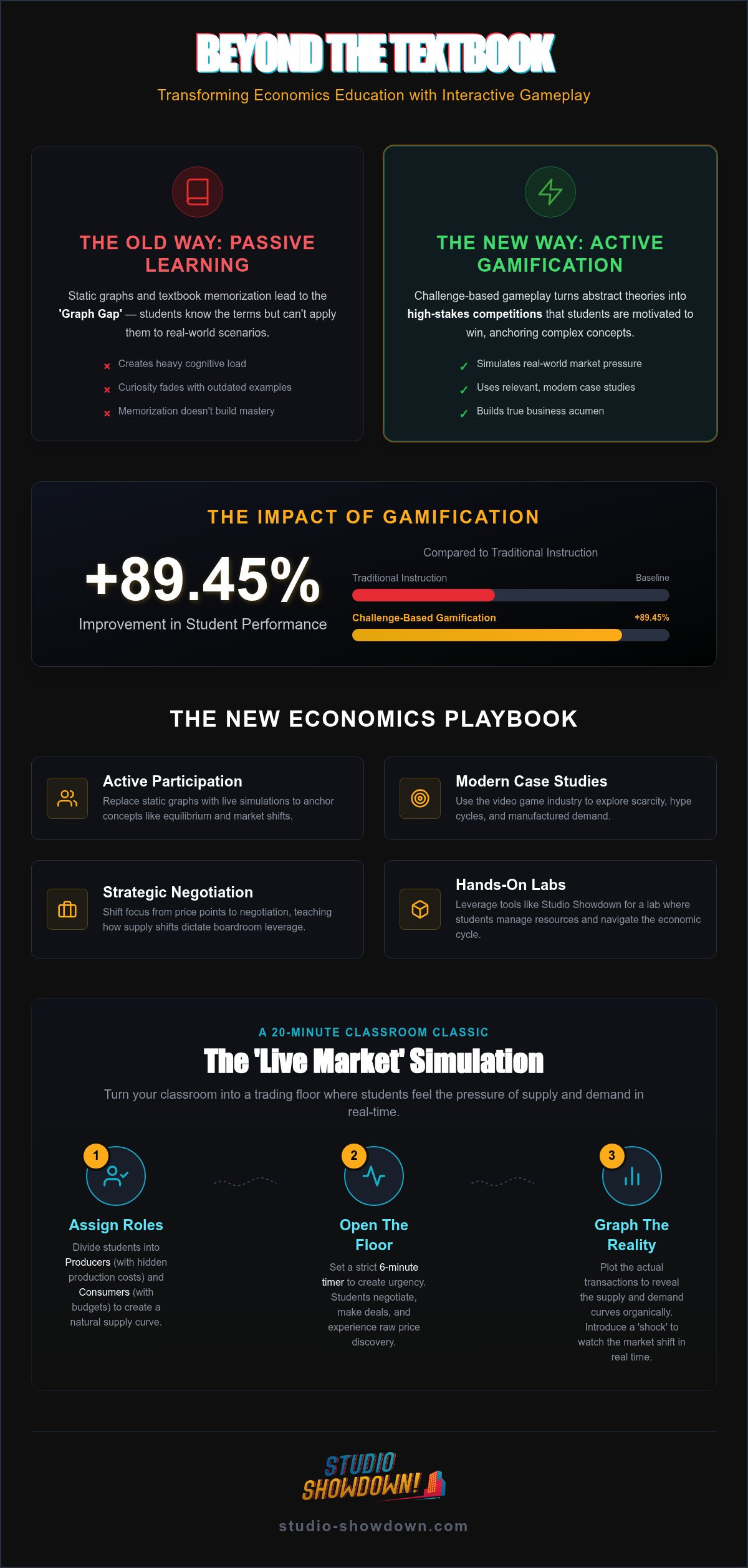
Data proves that challenge-based gamification improves student performance by 89.45% compared to traditional instruction. This guide shows you how to transform your curriculum into a strategic arena. You’ll discover high-energy, immersive activities that turn abstract theories into a competition your students actually want to win. We’ll explore digital escape rooms, live simulations, and the Studio Showdown board game to bridge the gap between definitions and the cutthroat reality of the gaming industry. It’s time to stop lecturing and start winning.
Key Takeaways
- Replace static graph memorization with active participation to anchor complex economic concepts like equilibrium and market shifts.
- Discover how to deploy interactive activities for teaching supply and demand that transform the classroom into a high-stakes, competitive market simulation.
- Use the video game industry as a modern case study to explore the mechanics of scarcity, the hype cycle, and manufactured demand.
- Shift the focus from simple price points to strategic negotiation, teaching students how supply shifts dictate boardroom leverage.
- Leverage professional tools like Studio Showdown to provide a hands-on lab where students manage resources and navigate the entire economic cycle.
Why Passive Learning Fails in Economics Education
Textbooks are often where curiosity goes to die. In many classrooms, economics is reduced to static lines on a whiteboard. Students memorize the core economic principles of supply and demand, but they struggle to apply them to the real world. This is the ‘Graph Gap’. It’s a failure of translation. A student might draw a perfect equilibrium point during a test while having zero clue why their favorite sneakers just doubled in price on a resale app. Memorization isn’t mastery. When the lesson stays on the page, it never reaches the brain’s decision-making center.
Passive learning creates a heavy cognitive load. When students just listen, their brains struggle to anchor abstract concepts. They need a hook. They need to be in the driver’s seat. Integrating interactive activities for teaching supply and demand changes the classroom chemistry instantly. It shifts the perspective from a passive consumer to a strategic creator. By 2026, students don’t want lectures; they expect immersive narratives where their choices actually matter. They want to see the immediate impact of a supply shock or a demand surge in an environment they control.
The Psychology of Competitive Learning
Competition is a powerful cognitive anchor. When a student enters a market simulation, their brain chemistry shifts. Healthy competition triggers dopamine, which locks in the lesson far more effectively than a slide deck. This isn’t just about winning a game; it’s about navigating a market. High stakes simulate real-world financial risk without the actual bankruptcy. It forces students to think three steps ahead. They’re no longer just following a law. They’re surviving an ecosystem. This proactive attitude is what builds true business acumen.
Breaking the ‘Lemonade Stand’ Stereotype
Traditional examples feel like relics. The ‘lemonade stand’ model is far too simple for today’s digital economy. Modern students understand digital assets, limited edition drops, and manufactured hype cycles. They see scarcity in their gaming skins and social media feeds every single day. Modern interactive activities for teaching supply and demand must reflect this complexity. We’re moving beyond simple bartering. We’re teaching complex strategic planning. It’s about understanding how supply shifts dictate leverage in a boardroom, not just at a sidewalk stand. When the examples match their reality, engagement skyrockets.
The ‘Live Market’ Simulation: A 20-Minute Classroom Classic
The market doesn’t wait for permission. It reacts. To move beyond the textbook, you need to turn your classroom into a living, breathing trading floor. This simulation is the gold standard for interactive activities for teaching supply and demand. It takes twenty minutes to run, but the lessons stick for a lifetime. You aren’t just showing them a graph; you’re letting them feel the pressure of a closing window and a shrinking margin. It’s fast, it’s loud, and it’s incredibly effective.
Step 1: Assigning Economic Roles
Divide the room. Half the students become Producers; the other half are Consumers. Supply diversity is the engine of this activity. Hand out resource cards to the Producers with hidden ‘Cost to Produce’ values. Some might produce for $5, while others face a $15 overhead. This creates a natural supply curve. Consumers receive ‘utility points’ and a maximum budget. They want the highest value for the lowest price. Use physical tokens or a digital tracker to keep the currency real. This setup mirrors the strategic depth of Studio Showdown, where resource management determines who survives the market.
Step 2: The Trading Floor Chaos
Open the floor. Set a strict timer for six minutes. Market pressure is non-negotiable. Without a deadline, the negotiation lacks urgency. Encourage students to find partners, shout their offers, and walk away from bad deals. This is price discovery in its rawest form. As the moderator, record every successful transaction on a shared board or digital sheet. You’ll see the prices start in a wide range and slowly gravitate toward a center. That’s the market finding its pulse through pure, unscripted interaction.
Step 3: Graphing the Reality
Once the timer hits zero, the real analysis begins. Plot the trades. The scattered points on your board will reveal the supply and demand curves better than any pre-drawn diagram. To push the lesson further, introduce a ‘shock’ like a sudden tax or a resource surplus. Watch as the curves shift in real time based on the students’ actual behavior. It makes the abstract tangible. Equilibrium is the final price where the quantity of goods sellers want to provide exactly equals the quantity buyers want to purchase.
Teaching Scarcity Through the Lens of Video Game Development
Video games aren’t just entertainment. They’re a masterclass in market manipulation. To find effective interactive activities for teaching supply and demand, you must look at how developers manufacture desire. Modern studios don’t wait for demand to appear; they build it from the ground up. This industry provides a visceral, relatable case study for students who already live in digital marketplaces. It’s the perfect arena to show how abstract curves translate into midnight launches and sold-out digital storefronts.
The ‘Hype Cycle’ is a strategic weapon. By controlling the flow of information, studios create a vacuum of anticipation. When a product finally drops, the demand curve is often nearly vertical. This is price inelasticity in its purest form. Students see this every time a new console or a high-profile expansion is announced. They understand the ‘Talent War’ too. They know that a shortage of elite developers leads to delays; a classic example of how supply constraints in the labor market dictate the pace of an entire industry.
The ‘Skin’ Economy: Digital Supply vs. Physical Constraints
Why does a player pay hundreds of dollars for a digital ‘skin’ that costs nothing to replicate? In the digital world, scarcity isn’t about physical limits. It’s about social capital and artificial restriction. This is a vital lesson in marginal cost versus perceived value. In this activity, students act as studio leads. They must design a ‘limited drop’ strategy for a fictional game. They have to decide exactly how many units to release to maximize profit without crashing the item’s long-term prestige. If everyone owns the ‘Legendary’ gear, its value hits zero.
Crowdfunding as a Demand Signal
Crowdfunding flips the traditional economic script. It uses demand as a green light for supply. Platforms like Kickstarter allow creators to prove a market exists before they ever touch a production line. It’s a risk-mitigation tool that uses pre-orders to justify the initial supply. However, there’s always a danger of oversupply. Flooding the market with clones or sequels can quickly dilute a brand’s power. This specific dynamic shows how business simulation games teach real-world skills by forcing students to manage the entire lifecycle of a product, from the first pitch to the final market saturation point.
The Negotiation Showdown: Strategic Equilibrium
Negotiation is where theory meets reality. It’s the ultimate test of economic literacy. Most interactive activities for teaching supply and demand stop at the transaction. They focus on the price of a single unit. But real-world business happens in the boardroom. Strategic equilibrium isn’t just about a number; it’s about the terms of the deal. It’s about royalties, market share, and distribution rights. When supply is low and demand is high, the power shifts. The creator holds the cards. The ‘Power Shift’ is a visceral lesson in leverage that no graph can replicate.
Handling market rejection is a vital part of this process. What do students do when demand is zero? In a textbook, the curve just stays there. In a simulation, they have to pivot. They have to redesign. They have to find a new niche. This is where true entrepreneurship begins. It’s about reading the signals and reacting before the capital runs out. This social-emotional component of face-to-face negotiation builds a level of confidence that digital-only platforms simply can’t match.
Pitching for Survival
The ‘Shark Tank’ model is a classroom favorite for a reason. Assign a small group of students as Venture Capitalists (VCs). Give them a limited pool of investment tokens. The rest of the class must pitch their game concepts to secure funding. This activity teaches that capital itself is subject to supply and demand. If ten studios are fighting for two investors, the ‘price’ of equity skyrockets. Students quickly learn that a unique value proposition is their only leverage. They must refine their pitches based on the demand signals they receive from the ‘sharks’.
Outmaneuvering Rivals
Supply isn’t just about what you produce. It’s about what your rivals produce. Launching a high-fantasy RPG into a market already saturated with them is a recipe for failure. Students must analyze the competitor supply before committing resources. Strategic timing is everything. Do they launch into a ‘dry’ market with zero competition, or do they try to steal market share from a titan? This layer of strategy is essential for Mastering the Board: The 2026 Guide to Strategy Board Games. It forces them to look beyond their own spreadsheets and see the entire ecosystem.
Ready to bring this level of strategic intensity to your classroom? Explore the Studio Showdown Educator Edition to start your first boardroom battle today.
Studio Showdown: The Ultimate Supply and Demand Lab
Theory is just the starting line. To win in the real world, students need a lab where they can fail safely, pivot quickly, and compete fiercely. The Studio Showdown Board Game gamifies the entire economic cycle. It isn’t just a game; it’s a high-stakes arena for interactive activities for teaching supply and demand. Students must balance the internal supply of creative talent with the external demand for a hit title. One wrong move in resource allocation can end a studio’s run. This analog experience forces a level of critical thinking that screen-based simulations often miss. It turns abstract curves into tangible, high-pressure decisions.
Managing resources in the gaming industry requires a ruthless focus on efficiency. In this lab, the ‘Talent War’ is real. Students learn that the supply of elite developers is finite. They must negotiate, outbid rivals, and manage their burn rate. This isn’t just about drawing a graph. It’s about feeling the scarcity of capital and the volatility of consumer interest. The Educator Edition provides specialized tools to integrate these finance concepts directly into STEM curricula. It bridges the gap between creative passion and the hard numbers of market survival.
Hands-On Entrepreneurship
Physicality matters in education. A physical board game builds social-emotional skills through face-to-face friction. You can’t hide behind an avatar when a rival outmaneuvers your launch window. Students navigate the chaos of the market in real time, making split-second decisions on production and marketing. It’s about reading the room, not just the data. For schools looking to scale this intensity, the Classroom Bundle provides a turnkey solution. It allows an entire grade level to compete simultaneously. This transforms a standard lesson into a school-wide event where every transaction counts toward a larger victory.
From Classroom to Career
We’re building more than just high scores. We’re building professional portfolios and business acumen. Studio Showdown prepares students for the actual mechanics of the corporate world. They master fundraising. They perfect their pitching. They learn that the market doesn’t care about their effort; it only cares about value. Through repeated, safe play, students develop a proactive attitude that carries over into their future careers. They stop being passive observers of the economy and start becoming its architects. It’s time to move beyond the textbook and into the showdown. Explore the Studio Showdown Educator Edition and transform your classroom into a powerhouse of economic strategy.
Master the Market: Your Classroom’s New Competitive Edge
Theory is a foundation, but competition is the master teacher. We’ve explored how moving from static graphs to live simulations and boardroom negotiations transforms student engagement. By integrating interactive activities for teaching supply and demand, you’re giving your students the tools to navigate real-world scarcity and value creation. They stop being passive observers and start becoming strategic architects of their own economic success. This isn’t just about a grade. It’s about building the business acumen they’ll need for a lifetime.
Ready to level up your curriculum? Studio Showdown was developed by industry experts at VGCD Academy specifically for educational environments. We make it easy to bring high-stakes strategy to your students with national shipping available across the United States. Don’t let your lessons stay trapped in a textbook. Order a Studio Showdown Classroom Bundle for your school today and turn your next economics unit into an unforgettable showdown. The market is waiting. Let’s see who wins.
Frequently Asked Questions
What are the best interactive activities for teaching supply and demand to high schoolers?
Market simulations, digital escape rooms, and strategy-based board games are the most effective tools. These interactive activities for teaching supply and demand force students to make real-time decisions under pressure. High schoolers respond best to high-stakes environments where they can compete for dominance. Using the video game industry as a backdrop makes abstract concepts like scarcity and hype cycles feel immediately relevant to their digital lives.
How can I explain the law of supply and demand without using a textbook?
Use live simulations and real-world case studies to demonstrate the mechanics of the market. Instead of reading about equilibrium, let students experience it through a trading floor activity. Show them how a limited edition sneaker drop or a viral video game release shifts the demand curve. When they see the results of their own choices, the law becomes a lived experience rather than a memorized definition.
Are there board games that teach supply and demand and economic principles?
Studio Showdown is a premier example of a strategy board game built specifically for this purpose. It gamifies the entire economic cycle by putting students in charge of a video game studio. They manage the supply of developers and pitch for investor capital. While games like Catan offer basic resource management, Studio Showdown provides a specialized lab for modern entrepreneurship and market strategy.
How do you simulate a market in a classroom setting?
Divide the class into producers and consumers and give them conflicting goals. Producers receive cards with varying production costs, while consumers have specific budgets and utility targets. Set a timer and let them negotiate freely. By recording every transaction, you can plot a real-time graph that shows exactly where the class reached equilibrium. It’s a fast, loud, and effective way to visualize price discovery.
What is the difference between active and passive learning in economics?
Passive learning relies on lectures and memorization, while active learning centers on participation and decision-making. In economics, passive learning often leads to a gap where students can draw a curve but can’t apply it. Active learning anchors abstract concepts through dopamine-driven competition. Gamified learning can increase knowledge retention by as much as 45% compared to traditional non-gamified programs, making the lesson stick longer.
Can video game development be used to teach financial literacy?
Yes, the business of game development is an excellent vehicle for financial literacy. It involves complex budgeting, fundraising, and market analysis. Students learn about return on investment, burn rates, and the risk of oversupply in a digital economy. Using interactive activities for teaching supply and demand within this industry helps students understand how capital flows through modern tech sectors. It prepares them for real-world business challenges.
How long does a typical classroom supply and demand simulation take?
A focused classroom simulation typically takes between 20 and 45 minutes to complete. The trading phase itself should be short, usually 5 to 7 minutes, to create artificial market pressure. The remaining time is used for setup and the essential post-market debrief. This structure allows you to fit a complete economic cycle into a single standard class period without losing student momentum.
What materials do I need for a classroom market activity?
You need resource cards, tokens for currency, and a method to track transaction data. For a DIY setup, index cards with production costs and max budgets work well. If you want a more professional experience, the Studio Showdown Classroom Bundle includes everything required for a large group. You’ll also need a whiteboard or shared digital sheet to visualize the transaction trends as they happen during the simulation.