Mastering how to teach project management to students in 2026 requires a shift from static lists to high-stakes strategy. With the demand for AI and technological literacy projected to jump 87% by 2030, students need more than just a calendar. They need a competitive edge. We’ll show you how to transform dry assignments into a dynamic, game-based experience that builds professional-grade portfolios. We’ll explore the latest PMP domain shifts, the rise of AI-driven resource management, and the power of “power skills” like collaborative leadership. You’ll learn how a strategic, “showdown” mindset turns classroom collaboration into a real-world win. It’s time to stop managing tasks and start producing results.
Key Takeaways
- Kill the engagement gap. Replace boring deadlines with a production-driven mindset that treats every project as a high-stakes creative mission.
- Master how to teach project management to students by framing classroom points as “funding” for their own “hit game” visions.
- Analog first. Discover why physical tools and board games build stronger strategic foundations than jumping straight into complex software.
- Pitch and roadmap. Learn a two-phase implementation guide that forces students to own their vision and defend their resource choices.
- Simulate success. Use game-based strategies to build professional portfolios through competitive fundraising and market-focused decision making.
Why Traditional Project Management Fails Students (And How to Fix It)
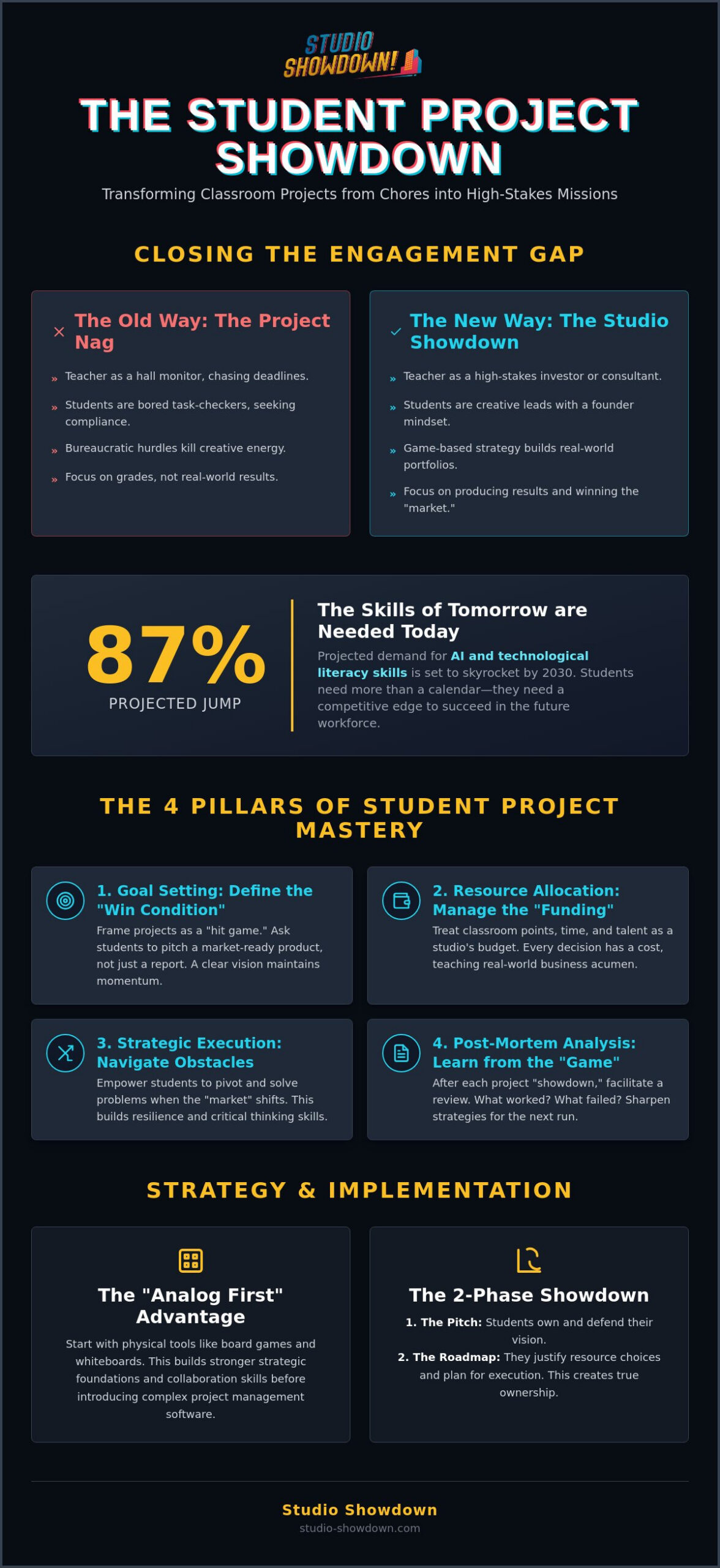
Traditional education treats project management like a chore. It’s often reduced to a checklist of dates on a whiteboard or a dry spreadsheet. This approach fails because it ignores the core truth: project management is the art of moving a vision from concept to completion. When students view deadlines as obstacles rather than milestones, you’ve lost the battle. This is the Engagement Gap. It turns the classroom into a factory rather than a studio. It makes the process feel like a series of bureaucratic hurdles instead of a creative journey.
Effective Project-based learning requires a total rebrand of the process. You aren’t just a teacher anymore. You’re a Senior Consultant or a high-stakes Investor. Your students aren’t just pupils; they are creative leads. If you want to master how to teach project management to students, you must introduce real-world business acumen. High-stakes simulation provides the friction necessary for growth. Without stakes, there’s no strategy. Without strategy, there’s no learning. You need to create an environment where every decision carries weight and every delay has a visible cost.
The ‘Nagging Teacher’ Trap
Micro-managing is the death of initiative. When you hover over every task, students stop thinking for themselves. They wait for your next instruction. This creates a cycle of dependency that kills creative momentum. It’s a trap that leads to burnout for you and apathy for them. Failed projects shouldn’t just result in a lower grade. They should reflect a missed market opportunity. Transitioning from rigid, top-down deadlines to goal-oriented milestones allows students to breathe. It gives them the space to pivot and solve problems. When they own the schedule, they own the outcome.
The Power of the Founder Mindset
Stop calling them students. Start calling them founders. This psychological shift changes everything. A founder doesn’t just “do homework.” A founder builds a legacy. This mindset is critical for developing video game development skills and professional creative habits. By connecting classroom tasks to a professional portfolio, you give the work a life beyond the gradebook. It becomes a tangible asset they can use in the real world.
Learning how to teach project management to students involves showing them that every choice has a cost. Every delay affects the “studio’s” reputation. When students see themselves as creators competing in a crowded market, their focus sharpens. They stop asking “is this done?” and start asking “is this good enough to win?” This is where true ownership begins.
The 4 Pillars of Student Project Mastery
Efficiency isn’t an accident. It’s the result of a solid foundation. In the world of high-end production—whether it’s software development or the complex classic car restoration taught at Restomod Academy—we don’t just “start” projects. We engineer them. When you are looking at how to teach project management to students, you need a framework that mimics the high-pressure world of creative studios. This isn’t about filling out forms. It’s about mastering the four pillars of mastery. These pillars turn a chaotic classroom into a focused production house.
The Project-Based Learning framework provides the structural backbone, but your strategy provides the soul. To move from theory to results, you must focus on four critical areas:
- Goal Setting: Define the “Hit Game.” What does total victory look like?
- Resource Allocation: Manage the burn rate of time, talent, and “funding” (classroom points).
- Strategic Execution: Choose the right path when the market shifts or obstacles appear.
- Post-Mortem Analysis: Review the “Showdown” to sharpen the next run.
Defining the Win Condition
Vague goals lead to vague results. Students need a “Win Condition” they actually care about. Use SMART goals, but wrap them in a narrative. Don’t just ask for a report. Ask for a market-ready product. Visualizing the final result maintains momentum when the work gets difficult. The pitch phase is crucial here. When students have to sell their vision to an investor, they stop being passive. They become owners. They aren’t just completing a task; they’re launching a brand.
Breaking Down the Chaos
Complex projects are overwhelming. They look like “Big Boss” battles with no clear strategy. Use the “Find the PARTS” method to deconstruct the vision into manageable levels. This involves identifying the Phases of production, Action items, Resource needs, Timeline milestones, and Stakeholder check-ins.
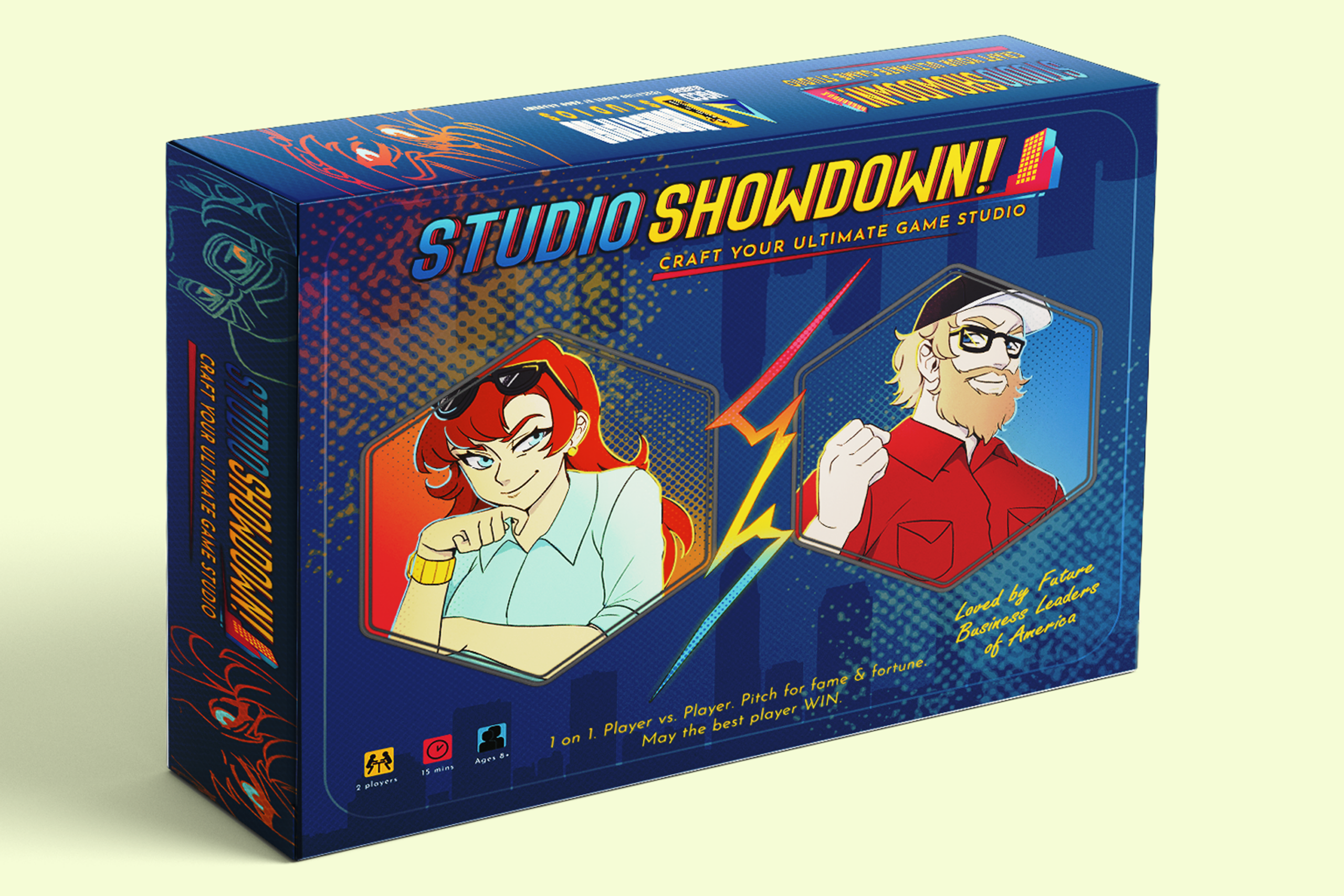
Creating a visual roadmap is non-negotiable. Whether it’s a kanban board or a physical wall chart, progress must be visible in real-time. This keeps group dynamics healthy. It makes individual accountability impossible to ignore. If one team member stalls, the whole roadmap shifts. That’s a real-world stake. To see these pillars in action, many educators use the Studio Showdown: Educator Edition to simulate these high-stakes decisions before the first assignment even starts. It turns the classroom into a laboratory for strategic execution, where every choice has a visible impact on the final “studio” success.
From Trello to Tabletop: Choosing Your Teaching Tools
Software is a trap. Most educators jump straight to Trello or Jira. They assume the tool teaches the skill. It doesn’t. Software often masks the logic behind project flow. It replaces critical thinking with button-clicking. If you want to master how to teach project management to students, start with the physical. Start with the tangible. Digital interfaces are secondary to the strategic mindset.
Analog tools like whiteboards and board games strip away the digital noise. They force students to look at the big picture. No notifications. No complex UI. No hidden menus. This Simulation First approach ensures students understand the mechanics of resource management before they ever touch a keyboard. Using business simulation games bridges the gap between abstract theory and gritty practice. It turns a lecture into a high-stakes showdown. It makes the stakes visible, tactile, and immediate.
The Analog Advantage
Tactile learning isn’t just for primary school. Moving physical tokens to represent talent, funding, time creates a mental map of project constraints. It makes the invisible visible. In a curriculum saturated with screens, the tabletop offers a necessary break. It reduces screen fatigue. More importantly, it forces face-to-face negotiation. You can’t hide behind an @mention in a board game. You have to look your investor in the eye. You have to defend your strategy in real-time. This builds the power skills that digital tools often neglect. It’s about presence, persuasion, and professional poise.
Scaling to Digital
Analog is the foundation. Digital is the destination. Once students grasp the logic of milestones and resource burn, introduce professional software. This transition should feel like a level-up. Use Trello for task tracking or spreadsheets for financial modeling only after the logic is mastered. This sequence ensures the tool serves the project. Not the other way around. This strategic progression is the most effective way to understand how to teach project management to students in a way that sticks beyond the classroom.
Teaching students to document their process is the final step. Digital tools are perfect for this. They allow students to export roadmaps, milestone charts, and budget sheets directly into their professional portfolios. This proves their ability to manage complex workflows. It shows they can move a creative vision from a messy whiteboard to a polished digital roadmap. By the time they graduate, they aren’t just users of software. They are masters of the process. They are ready to lead.
Running a Classroom ‘Showdown’: A Step-by-Step Implementation
Action beats theory every time. You’ve set the stage and chosen your tools. Now it’s time to execute. Running a classroom “Showdown” turns the semester into a high-stakes production cycle. This isn’t just about finishing an assignment. It’s about surviving the market. This is how to teach project management to students with real-world intensity. You’ll move through five distinct phases that mirror a professional studio’s workflow. It’s fast. It’s loud. It’s effective.
The Pitch and The Roadmap
Phase one is The Pitch. Students don’t just start building. They have to sell. They present their vision to you, the Investor. If the vision is blurry, the “funding” (your approval) is withheld. This forces clarity. It builds the persuasive power skills necessary for any creative career. Once the pitch is greenlit, they move to Phase two: The Roadmap. This is where they map out milestones and action items.
Planning for the unknown is a skill. To sharpen this, integrate strategy board games into your curriculum early. Games force students to practice decision-making under pressure. They learn to anticipate risks before they affect their actual project. A solid roadmap prevents the dreaded end-of-project crunch. It turns a massive, terrifying goal into a series of winnable battles. It gives them a path to victory.
Stand-ups and Showdowns
Phase three is The Development. This is the core work phase. Don’t let it become a black hole of productivity. Use five-minute daily “Stand-up” meetings. Each team reports three things: what they did, what they’re doing, and what’s blocking them. It’s brief. It’s punchy. It maintains total accountability. You aren’t nagging. You’re unblocking. This keeps the momentum high and the “visual noise” of classroom chaos low.
Phase four is The Showdown. This is the launch day. Forget traditional presentations. Make it an event. Invite other classes or local professionals. Students present their finished product and defend their strategic choices. Reward the “pivots” just as much as the final result. If a team hit a major obstacle and successfully rerouted their resources, that’s a win. Finally, move to Phase five: The Reflection. This “Post-Mortem” analysis is where the deepest learning happens. They analyze the burn rate of their resources and the accuracy of their initial roadmap.
Ready to bring this level of intensity to your next project? You can streamline this entire process by implementing the Studio Showdown: Educator Edition. It provides the framework you need to turn every lesson into a competitive, strategic victory. Stop managing tasks. Start leading founders.
Elevate Your Curriculum with Studio Showdown
Traditional methods are static. They are uninspiring. Studio Showdown is different. It’s the ultimate simulation for project management and entrepreneurship. Students don’t just learn; they compete. They pitch for funding. They fight for market dominance. They manage resources in a world where every choice has a price. This is the definitive answer for how to teach project management to students who are tired of dry spreadsheets and boring checklists. It’s about vision. It’s about execution. It’s about winning. It turns the classroom into a high-energy production house where the stakes are visible and the results are tangible.
The Studio Showdown: Educator Edition is more than a teaching aid. It’s a strategic engine. It forces students to navigate the same pressures faced by professional creative studios in 2026. They learn to balance quality against deadlines. They learn to negotiate with rivals. It turns abstract concepts into a physical showdown. This edition includes specific guides for teachers to facilitate high-stakes scenarios without the “nagging” trap. You become the investor. They become the founders. It’s a professional-grade experience designed for the next generation of creative leaders.
More Than Just a Game
This tool maps directly to modern STEM and business standards. It isn’t just “play time.” It’s rigorous professional training. Students develop critical soft skills: negotiation, risk assessment, collaborative leadership, strategic thinking. These are the “power skills” that the modern industry demands. Educators report a massive surge in engagement. One teacher noted that students who usually hide in the back were suddenly leading their teams to market victory. It builds the confidence needed for a real-world career. It proves they can handle the heat of a real production cycle before they ever step into an office.
Getting Started with Studio Showdown
Scaling this experience is simple. Choosing the right Classroom Bundle ensures every student has a seat at the table. Whether you’re running a small elective or a full-grade program, there’s a configuration for your needs. Bulk licensing is the most cost-effective way to scale. It brings the high-end production experience to your entire institution. We also offer professional development workshops. These sessions help you master the game mechanics so you can focus on being the “Investor” your students need. You’ll learn to trigger market shifts. You’ll learn to challenge their roadmap. You’ll learn how to teach project management to students by letting them fail safely and win spectacularly.
Secure your Classroom Bundle today and transform your teaching.
Master the Art of the Classroom Production Cycle
The era of the passive student is over. You’ve seen the roadmap. You know the pillars of mastery. Now, it’s time to execute. Shifting from a nagging facilitator to a strategic investor changes the entire classroom pulse. It turns every assignment into a high-stakes mission where students own their creative results. Mastering how to teach project management to students means embracing the friction of real-world simulation. It’s about building the “power skills” that the 2026 landscape demands.
Developed by VGCD Academy experts, our methodology is already transforming STEM and Business curricula nationwide. We focus on high-stakes game development simulation because it demands total commitment and professional-grade problem solving. It’s time to move beyond the dry spreadsheet. Give your students a platform where they can pitch, pivot, and prevail in a competitive market. This approach doesn’t just teach management; it builds founders.
Order the Studio Showdown Classroom Bundle today to secure the tools your future studio founders deserve. The creative world is waiting for new leaders. Your students are ready to step up. Let’s build something extraordinary together.
Frequently Asked Questions
What is the best age to start teaching project management to students?
Middle school is the ideal window to start. Students aged 11 to 13 begin transitioning from simple tasks to multi-stage assignments. This is the perfect time to instill the founder mindset. Starting early builds the neural pathways for strategic thinking before high school pressures mount. It prepares them for the professional world by making complex planning a second nature.
Can project management be taught without expensive software?
Absolutely. Analog tools like whiteboards, sticky notes, and physical milestone charts are often superior for beginners. They strip away UI complexity and focus on pure logic. You don’t need a subscription to teach resource burn or critical path analysis. Visual, tactile systems build a stronger foundation than clicking buttons in a freemium app. Focus on the strategy, not the software.
How do I grade a student’s project management skills?
Grade the process, not just the product. Use a rubric that weights milestone completion, strategic pivots, and resource management at 60% of the total score. The final launch is important, but the ability to document the journey and handle setbacks proves true mastery. This ensures students value the strategy as much as the final grade. It rewards the “how” as much as the “what.”
What are the most common mistakes students make in project management?
Underestimating the “buffer” is the most frequent error. Students often plan for a perfect world where nothing breaks. They fail to account for the 20% chaos factor inherent in any creative production. Another mistake is vague task definition. When a task is just “do research,” momentum dies. Every task must be a specific, actionable milestone with a clear owner.
How can board games help teach project management?
Board games provide a low-risk, high-stakes environment to practice how to teach project management to students. They simulate complex systems where every move has a cost. Unlike a textbook, a game provides immediate feedback. If a student mismanages their funding or talent in a simulation, they see the consequences instantly. It’s experiential learning at its most intense and engaging level.
What is the difference between project management and time management for students?
Time management is about the clock; project management is about the vision. Time management is a solo skill focused on personal efficiency. Project management involves resource allocation, stakeholder negotiation, and risk mitigation across a team. It’s the difference between managing your own calendar and leading a studio to a successful market launch. One is about survival, the other is about leadership.
How do I handle group projects where one student does all the work?
Use a transparent roadmap to kill the passenger effect. When every milestone is assigned to a specific department head, there’s nowhere to hide. Weekly stand-up meetings force accountability in real-time. If a task isn’t moving, the bottleneck is visible to the whole studio. This structure ensures ownership is distributed. It makes the work visible and the slackers undeniable.
Is project management relevant for students not interested in business?
Project management is a universal survival skill. Whether a student wants to be an artist, a scientist, or a community leader, they need to move ideas from concept to completion. Learning how to teach project management to students prepares them to lead any creative initiative. It’s about agency. It’s about having the tools to build whatever vision they imagine, regardless of the industry.