Your game’s artistic vision won’t get you a signed contract. In 2026, publishers aren’t looking for just another beautiful demo. They’re looking for a bulletproof investment. It’s a hard truth to swallow when you’ve poured your soul into every line of code. You’ve likely felt that cold knot of fear when thinking about how to pitch a game to publishers, worrying that a lack of business jargon or a professional network will leave your project dead on arrival.
We understand that the boardroom feels like a different world. It’s a space where creative passion must meet cold, hard strategy. This guide is your tactical manual for bridging that gap. We’ll show you how to build a pitch deck that commands attention. You’ll learn to handle the high-stakes negotiations that secure your funding. From mastering the 2026 market trends to refining your vertical slice, you’re about to gain the confidence to turn your indie dream into a signed publishing deal. Let’s move your project out of the shadows and into the spotlight.
Key Takeaways
- Transition from developer to studio founder. Publishers in 2026 invest in sustainable leaders who understand the business of play.
- Master the architecture of a high-stakes presentation. Learn how to pitch a game to publishers by building a deck that captures interest in ten seconds.
- Navigate the boardroom with total confidence. Turn intense negotiations and even project rejections into strategic networking victories.
- Escape the “Starving Artist” trap. Align your creative vision with the financial realities of the 2026 market to secure your studio’s future.
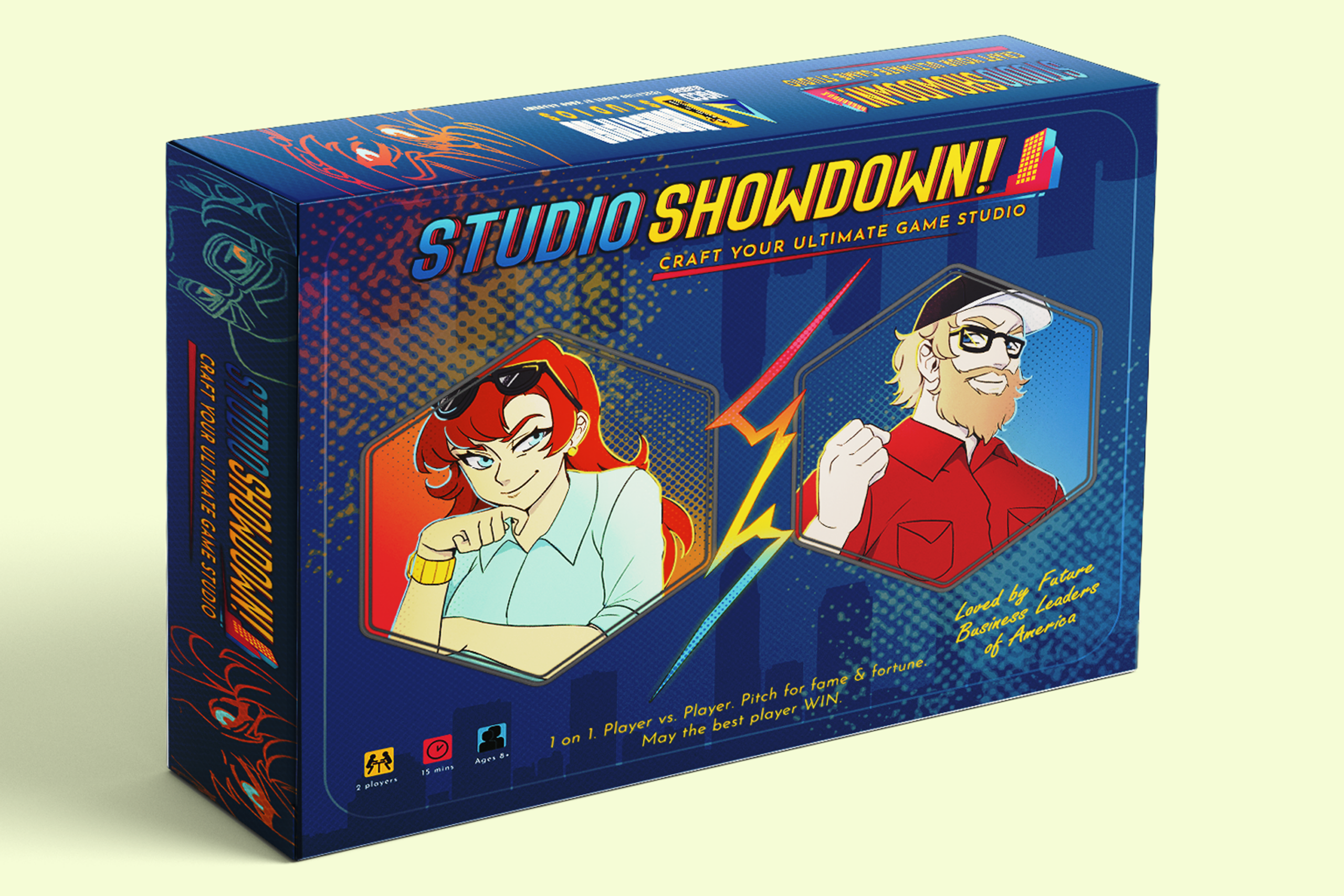
- Sharpen your competitive edge through analog simulation. Use Studio Showdown to practice the high-stakes art of the pitch in a risk-free environment.
What is a Game Pitch and Why Does It Matter?
A game pitch is more than a presentation. It is a strategic proposal designed to secure funding, marketing, and global distribution. It is your entry ticket to the high-stakes world of professional production. Without a sharp pitch, even the most innovative project remains a ghost on a hard drive. In 2026, the industry has shifted. Publishers no longer hunt for “game makers” who simply have a cool idea. They are hunting for “studio founders.” They want partners who understand What is a Video Game Publisher? and the financial machinery required to move a product through a crowded market.
If you have a world-class game but no strategy to sell it, you’ve already lost the battle for market dominance. Learning how to pitch a game to publishers requires you to see your project through their eyes. They aren’t just buying your art. They are buying your ability to execute, manage a budget, and hit milestones. You must distinguish between your pitch deck and the pitch meeting itself. The deck is your visual evidence; it’s the polished “vibe” and data. The meeting is your boardroom performance. It is where you prove you have the grit to lead a studio through a multi-year development cycle.
The Core Loop: The Heart of Your Pitch
Your pitch fails if you can’t define the “fun” in one sentence. This is your 30-second elevator pitch. It must be punchy. It must be undeniable. In 2026, publishers expect the core loop to be demonstrated through a vertical slice, not just described in a slide. Your mechanics must align with current demands. Whether it’s seamless cross-platform play or robust live service potential, your loop needs to show why players will keep coming back. Don’t hide behind lore. Show the gameplay loop that drives the revenue.
Researching Your Target Publisher
Precision is your greatest weapon. Identify publishers whose portfolio matches your genre and scope. Understand the nuances of different houses. A “Devolver Digital” pitch requires a different energy and aesthetic than a pitch to a “Raw Fury” or a “Big Tech” giant like Microsoft. Each has a specific “brand” of game they support. Shotgunning your pitch to every inbox in the industry is a recipe for failure. It shows a lack of focus. It signals desperation. Tailor your approach. Research their recent signings. Prove that your game isn’t just good, but that it’s the perfect missing piece in their specific collection.
Building the Perfect Pitch Deck: A 2026 Framework
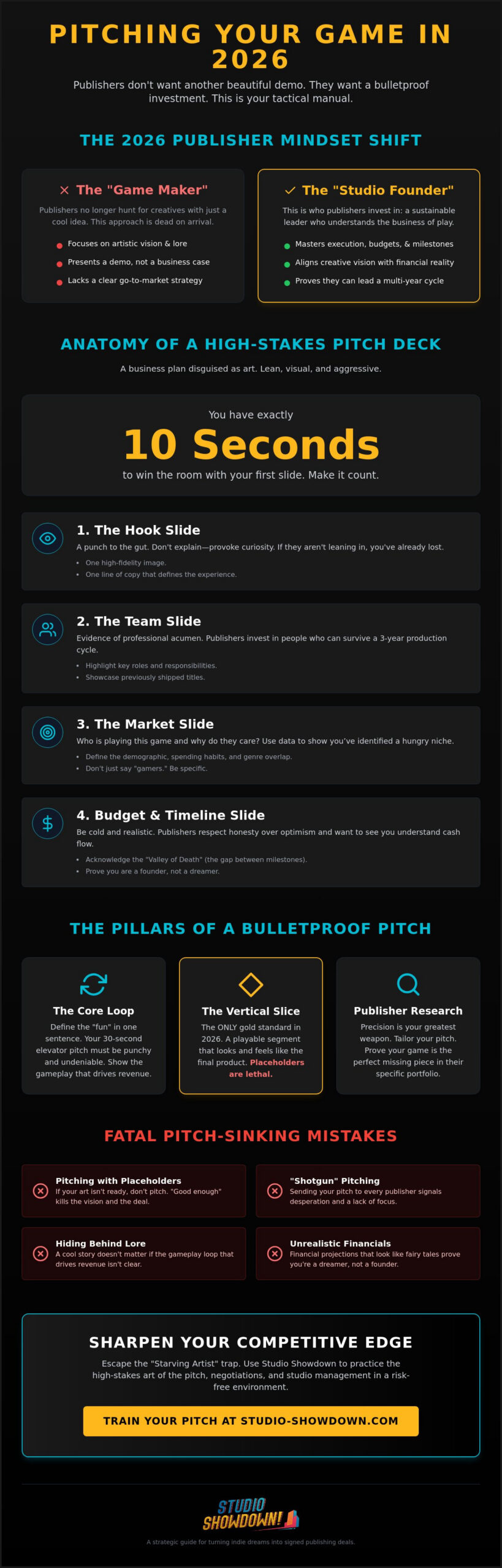
A deck isn’t a portfolio. It’s a business plan disguised as art. If you want to master how to pitch a game to publishers, your deck must be lean, visual, and aggressive. You have exactly ten seconds to win the room. Your “Hook” slide needs to be a punch to the gut. One high-fidelity image, perhaps crafted by a design studio like STUDIA LLC., and one line of copy that defines the experience. Don’t explain. Provoke curiosity. If they aren’t leaning in after the first slide, the rest of your data won’t save you.
The “Team” slide follows. This isn’t just a list of names. It’s evidence of professional acumen. Publishers invest in people who can survive a three-year production cycle. Show your roles. Highlight your shipped titles. Prove you won’t vanish when things get difficult. Then, hit them with the “Market” slide. Who is playing this? Why do they care? Use data to show you’ve identified a hungry niche in the 2026 ecosystem. Don’t just say “gamers.” Define the demographic, the spending habits, and the genre overlap.
Finally, address the money. Your “Budget and Timeline” slide must be cold and realistic. Acknowledge the “Valley of Death,” that dangerous gap between your first milestone and the game’s release. Publishers respect honesty over optimism. They want to see that you understand burn rates and cash flow management. Following these tips for a successful pitch will ensure your financial projections don’t look like fairy tales. It proves you’re a founder, not a dreamer.
Visuals vs. Mechanics: Finding the Balance
In 2026, the “vertical slice” is the only gold standard. A pitch deck alone is a ghost. You need a playable segment that looks and feels like the final product. Placeholders are lethal. If your art isn’t ready, don’t pitch. “Good enough” kills the vision. Craft a single sentence that defines your visual identity. Stick to it. Every pixel must serve the brand you’re building. If you’re struggling to balance these high-stakes decisions, practicing with an analog simulation like Studio Showdown can help you master the trade-offs before real capital is on the line.
The Secret Ingredient: The Business Strategy
Mastering the Pitch Meeting: Soft Skills and Negotiation
The boardroom is where code meets capital. Most guides tell you to “be yourself,” but that is dangerous advice. You need to be a founder. This means transitioning from a developer who loves their project to an entrepreneur who understands their asset. When you learn how to pitch a game to publishers, the meeting is where you prove you can handle the pressure of a multi-million dollar production. You aren’t there to defend your art; you’re there to demonstrate your professional maturity. It is a performance of competence.
Handling a “no” is your first real test of grit. In the 2026 market, a rejection is often just a “not right now.” Don’t burn the bridge. Turn that rejection into a networking win by asking for specific feedback on your vertical slice or your market projections. This builds a relationship for your next project. The art of the follow-up is equally critical. Stay on their radar with brief, quarterly updates on your milestones. Be a professional partner, not a nuisance. It shows you’re still building, still shipping, and still worth watching.
Negotiation is the final battle. You must understand what you can give away and what is non-negotiable. Revenue shares, IP ownership, and creative control are the levers you’ll pull. Know your walk-away point before you step into the room. If a deal compromises your studio’s long-term survival, it isn’t a deal worth signing. Publishers respect a founder who knows their value and isn’t afraid to say no to a bad contract. Confidence in the boardroom comes from knowing exactly where your line in the sand is drawn.
Handling Hard Questions from Investors
Prepare for the interrogation. If your project goes 20% over budget, do you have a contingency plan? Publishers will ask. They want to see that you’ve accounted for the “Valley of Death.” When scope creep threatens your timeline, prove you have the discipline to cut features to save the product. When they ask why your game is better than the current Steam chart-topper, don’t be defensive. Provide a data-driven comparison of your unique mechanics and your target audience’s spending habits. Facts beat feelings every time.
Practicing Rational Decision Making
Publishers value teams that can pivot. Demonstrating that you are “coachable” is a massive competitive advantage. It shows you can take industry feedback and apply it without losing your creative soul. This requires high-level tactical thinking. Many founders sharpen these skills by using strategy board games to simulate high-pressure choices and resource management. Mastering how to pitch a game to publishers is about showing you can make the right call when the stakes are at their peak. It proves you are a safe pair of hands for their investment.
Common Pitching Mistakes That Sink Indie Studios
Pitches don’t fail because the art is mediocre. They fail because the business logic is broken. Many indie developers fall into the “Starving Artist” trap. They believe raw passion justifies a lack of financial planning. Publishers aren’t patrons of the arts; they’re risk managers. If you ignore the financial reality of development, you aren’t pitching a project. You’re asking for a handout. This lack of professionalism is the fastest way to get shown the door.
Then there’s the “Clone” mistake. Pitching a game that already exists without a distinct hook is a waste of a boardroom meeting. In 2026, the market is too crowded for “another” survival crafter or deckbuilder. You need a mechanical edge that screams originality. Combine this with the “Silent Development” error, and you’re in trouble. If you have zero community buzz before the meeting, you have no proof of market demand. Publishers want to see that players already care about your world. They want evidence of traction before they commit capital.
Technical stability is the final hurdle. “Tech Debt” is a massive red flag. If your vertical slice is built on a house of cards, a publisher won’t touch it. They need to know the foundations can support a full release and future updates. Understanding how to pitch a game to publishers means proving your project is scalable, stable, and ready for the grind. Don’t let your code be the reason your vision dies.
Ignoring Post-Launch Realities
Publishers look at “Day 30” and beyond. The work doesn’t end at launch. You need a plan for live-ops, community management, and consistent bug fixes. Failing to account for localization and porting costs shows a lack of foresight. These aren’t afterthoughts; they’re core production expenses. If your pitch doesn’t address how you’ll sustain the game after the initial hype, you’re signaling that you aren’t ready for the big leagues.
The Passion vs. Profit Dilemma
Passion is the fuel, but data is the engine. Proving market viability requires numbers, not just “feel.” Show them the genre trends. Show them the competitor gaps. My game is a safe investment because it targets a high-retention niche with a pre-validated community and a lean, milestone-driven production budget. Passion alone won’t pay the bills, but a data-backed strategy will win the room. Don’t let these mistakes sink your studio before you’ve even started. Order Studio Showdown to stress-test your strategy and turn your team into founders who know how to win.
Mastering the Meta-Game: How Studio Showdown Trains Future Founders
Reading about boardroom tactics is one thing. Living them is another. Analog simulations provide a tactile arena where strategic mistakes don’t cost millions in venture capital. Studio Showdown creates a risk-free environment to fail, pivot, and master the pitch before you ever set foot in a publisher’s office. It transforms abstract business concepts into immediate, high-stakes decisions. This is where you build the muscle memory of a founder. You learn to balance creative ambition with the cold reality of resource management.
The gap between being a developer and an entrepreneur is wide. Studio Showdown bridges that divide by forcing you to see your project as a product. You aren’t just playing a game; you’re building a professional portfolio of strategic wins. It’s a training ground for the mental grit required to survive a multi-year production cycle. By the time you reach a real meeting, the pressure feels familiar. You’ve already fought these battles at the table. You’ve already learned how to protect your IP and manage your burn rate under fire.
Simulating the Competitive World of Dev
Success in the games industry is about more than just a good idea. It’s about outmaneuvering rival studios and capturing market share. This business board game prepares you for real-world industry challenges by simulating fundraising and pitching mechanics in a competitive setting. You learn to read the room. You learn when to push for a better deal and when to walk away. It’s a lesson in market dominance that no textbook can replicate. Tactical maturity is your greatest weapon in the fight for funding.
From Tabletop Strategy to Digital Success
The mechanics of a great board game translate directly into core video game development skills. Rational decision making, financial literacy, and scope control are universal. Learning how to pitch a game to publishers is a skill best honed through repetition and immediate feedback. Educators use the Studio Showdown: Educator Edition to teach these complex financial realities in a way that sticks. It turns students into founders who understand the bottom line. Don’t wait for a real rejection to learn these lessons. Get your copy of Studio Showdown and master the business of games!
Claim Your Place in the Boardroom
The era of the lucky break is over. Success in 2026 belongs to those who treat their studio like a business and their vision like a high-value asset. You now have the framework to build a bulletproof deck and the mindset to dominate the boardroom. Mastering how to pitch a game to publishers is no longer a mystery; it’s a tactical process. You understand the financial risks. You know the mistakes to avoid. Now, it’s time to sharpen your instincts before the real capital is on the line.
Studio Showdown was developed by VGCD Academy and DEMYSTIFIED Studios to bridge the gap between creative vision and market reality. It’s a high-stakes simulation used by educators to teach entrepreneurship and business acumen. This is where you master fundraising and strategic pitching without risking your own studio’s future. Don’t step into a meeting unprepared. Practice the meta-game, master the negotiation, and secure the funding your project deserves.
Master the business of game dev with Studio Showdown
Your studio’s future starts with the first move. Make it count. You have the tools. Now, go win the room.
Frequently Asked Questions
What is the most important part of a game pitch?
The most important part of a game pitch is the synergy between your unique hook and your team’s ability to execute. Publishers don’t just buy ideas; they buy the confidence that you can ship a high-quality product on time. Your first slide must prove why your game is undeniable. Your team slide must prove why you are the only ones who can build it.
How long should a game pitch deck be in 2026?
Keep your deck between 10 and 15 slides. In 2026, publishers have zero patience for fluff. Every slide must serve a specific purpose: hook, gameplay loop, market data, team expertise, and financial requirements. If you can’t explain how to pitch a game to publishers in under 15 slides, you haven’t refined your vision enough. Clarity is a sign of professional maturity.
Do I need a playable demo to pitch to a publisher?
A playable vertical slice is essential in the current market. Pitching with just a deck is a strategy from a decade ago. Publishers need to see that your core mechanics work and that your visual identity is established. A polished 10 to 15 minute demo proves you’ve solved the hardest technical challenges and understand the “fun” of your project.
What are publishers looking for in an indie game?
Publishers seek a combination of creative originality and market viability. They look for games that fill a specific gap in their portfolio while targeting a documented, hungry audience. They want to see a clear path to profitability. This includes a realistic understanding of user acquisition costs and post-launch support. They aren’t just looking for a game; they’re looking for a studio partner.
How do I protect my game idea during a pitch?
Focus on execution rather than secrecy. Most publishers won’t sign an NDA for an initial pitch because they see hundreds of similar ideas. Your protection lies in your unique art style, your proprietary code, and your team’s specific talent. A “stolen idea” is worthless without the talent to build it. Professionalism and a strong vertical slice are your best defense.
What is the “Valley of Death” in game development?
The “Valley of Death” is the high-risk production phase where your initial funding is spent but your game isn’t yet earning revenue. It’s the gap where many studios collapse due to poor cash flow management. Understanding how to pitch a game to publishers requires showing a budget that accounts for this period. You must prove you have the discipline to survive the grind.
How early should I start pitching my game?
Start pitching once you have a vertical slice that represents final quality. Don’t reach out during the concept phase. You only get one chance to make a first impression with a major publisher. Wait until your core loop is fun, your visuals are striking, and your business plan is bulletproof. Pitching too early signals a lack of production experience.
Can a board game really help me learn how to pitch video games?
Studio Showdown effectively simulates the entrepreneurial side of game development. It forces players to manage budgets, handle rival studios, and master the logic of a professional pitch. While the medium is analog, the strategic choices are identical to those in the digital industry. It’s a risk-free arena to sharpen your business acumen before you face a real boardroom.