The most successful student game creators aren’t just learning to code; they’re learning to lead. Most educators worry they need a master’s degree in computer science or a room full of high-end GPUs to get started. It’s a common fear. You’ve likely seen that initial spark of excitement fade when students hit the steep learning curve of a complex engine. Learning how to run a school game development club shouldn’t feel like a losing battle against technical debt. It’s about building a culture of creation, not just a lab for syntax. Success in 2026 requires a production mindset that values the artist and the entrepreneur as much as the programmer.
This guide delivers a battle-tested framework to turn your classroom into a high-octane production studio. You’ll discover how to balance technical skills with the business of gaming and creative vision. We’ll show you how to leverage modern tools and free engines to bypass hardware limitations. From building professional-grade portfolios to integrating STEM skills naturally, you’re about to build a sustainable club that students actually love. It’s time to move beyond the basics and start shipping games.
Key Takeaways
- Transform students from passive players into active producers by building a collaborative studio culture that mirrors the real industry.
- Master how to run a school game development club by prioritizing core mechanics and analog prototyping before writing a single line of code.
- Eliminate hardware bottlenecks by using tabletop game design to teach complex logic and rapid iterative testing.
- Bridge the gap between STEM and entrepreneurship by teaching students to manage budgets, resources, and the business of game creation.
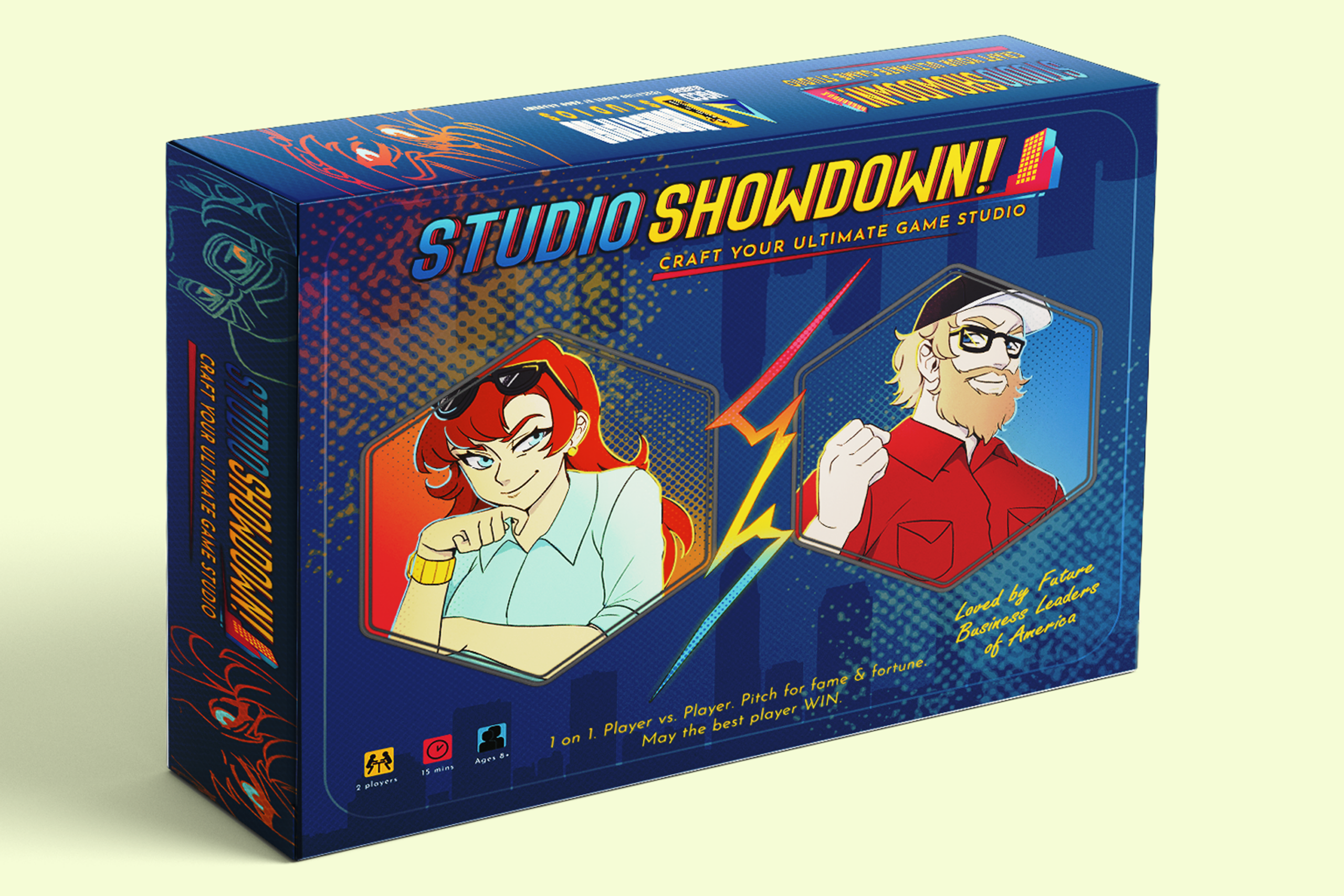
- Deploy the Studio Showdown Board Game as a high-impact simulator to guide students through the entire studio lifecycle.
Defining the Mission: What is a School Game Development Club?
A school game development club is a high-performance incubator. It isn’t a room where students simply play games or tinker with isolated code snippets. It’s a collaborative studio environment where the next generation of creators builds digital experiences. Learning how to run a school game development club requires a fundamental shift in perspective. You’re moving students from a “consumer” mindset to a “creator” mindset. In this space, they don’t just see a mechanic; they understand the logic behind it. They stop asking “is this fun?” and start asking “how do I make this fun?”
By 2026, the global creator economy demands more than technical proficiency. Success requires a blend of disciplines. Students must master the core principles of game design to move from playing to producing. This includes narrative arc, visual aesthetics, and mathematical logic. It also involves the business of gaming. A club that only focuses on coding misses the mark. You’re training studio founders, lead artists, and project managers. This interdisciplinary approach ensures students are ready for a market projected to exceed $200 billion this year. You aren’t just teaching a hobby; you’re building a career foundation.
Setting Clear Objectives for Your Club
Stop focusing on abstract exercises. Start building projects. Project-based learning is the heartbeat of a successful club. Your objectives should prioritize tangible outcomes over theoretical knowledge. Focus on these pillars:
- The Pitch: Can they sell an idea in sixty seconds?
- Team Management: How do they handle creative friction?
- The Launch: Set a hard deadline for a final showcase.
A final launch event drives motivation. It turns a hobby into a mission. When students know their work will be played by peers, the quality of their logic and art skyrockets. Soft skills like fundraising and resource allocation are just as vital as clean code.
Finding the Right Space and Resources
Building the Framework: A Step-by-Step Club Curriculum
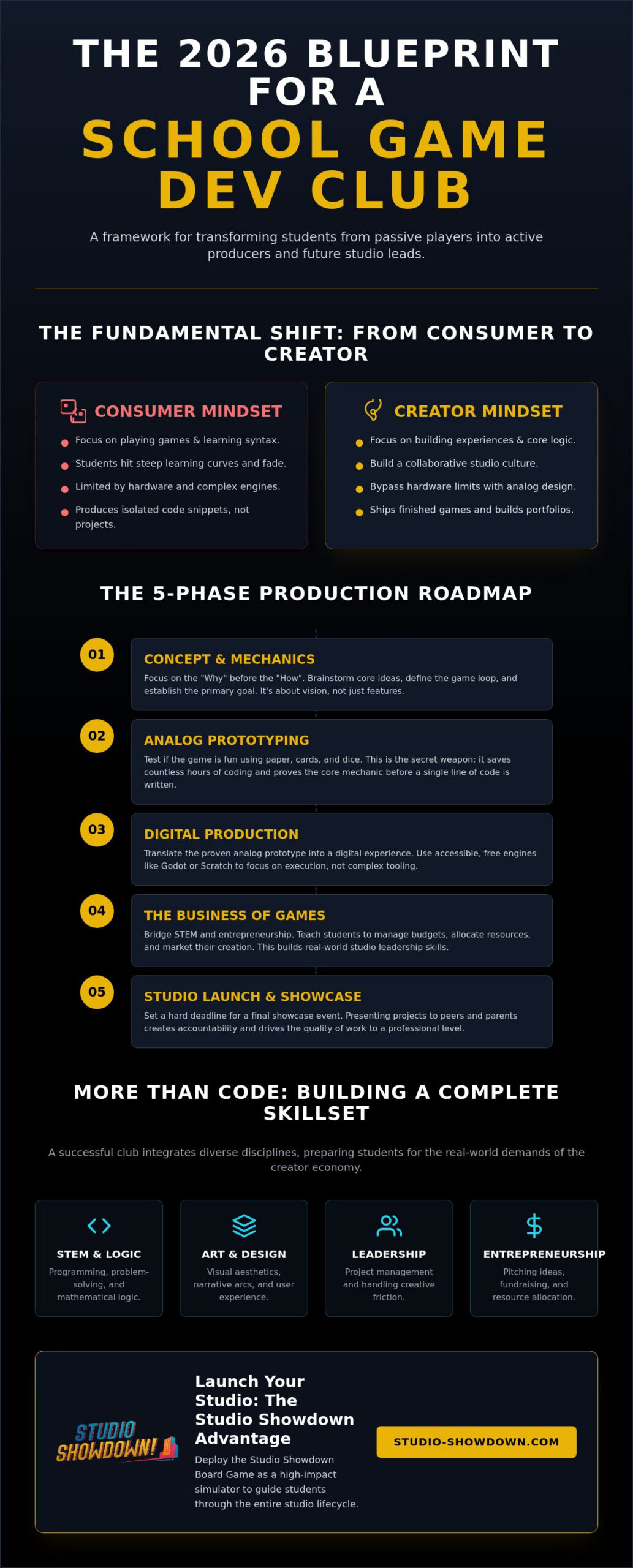
Stop guessing. A successful club needs a roadmap that mirrors the actual industry. When you master how to run a school game development club, you realize the curriculum is the backbone. It isn’t a random collection of tutorials. It’s a five-phase journey from a raw concept to a public launch. This structure ensures students stay engaged because they’re always moving toward a tangible goal. You’re building a studio, not just a classroom.
The 2026 standard for excellence involves five critical phases. First, Concept and Mechanics focus on the “Why” before the “How”. Second, Prototyping uses analog testing to prove the fun. Third, Digital Production introduces engines like Godot or Scratch. Fourth, the Business of Games covers marketing and pitching. Finally, the Studio Launch showcases projects to parents and peers. This progression mirrors structuring a university game design club, providing a professional pathway for younger creators.
Phase 1 & 2: Mastering the Mechanics
Don’t touch the keyboard yet. Teach the “Game Loop” through physical activities. If a game isn’t fun with paper and dice, code won’t save it. Use rapid prototyping to test if a mechanic actually works. Students should fail fast and iterate often. Introducing strategy board games is a brilliant way to demonstrate complex systems without a single line of syntax. It forces them to think about balance, player agency, and win conditions. This analog foundation is where real designers are born.
Phase 3 & 4: Digital Execution and Market Strategy
Select an engine that matches your team’s skill level. For younger groups, Scratch is a visual logic powerhouse. For older students, Godot offers a professional-grade environment. Once the build starts, pivot to the market. Teach students how to research their target audience. They need to “market” their game even within the school halls. Incorporate lessons on business simulation games to explain development costs and resource management. This ensures they understand that a game is a product, not just a project. If you want to jumpstart this process, the Studio Showdown: Educator Edition provides the perfect toolkit to simulate these high-stakes decisions.
Phase 5 is the payoff. The Studio Launch is a high-energy event where students pitch their final builds. This isn’t just a presentation; it’s a premiere. Invite parents, local developers, and peers. When students see others playing their creations, the cycle of how to run a school game development club completes itself. They aren’t just students anymore; they are developers ready to engage with the wider tech community through events like CityJS Athens.
Bridging the Gap: Why Analog Design is the Secret Weapon
Hardware is expensive. Skills are not. The most common excuse for stalling a new project is the lack of high-end PCs. It’s a myth. If you’re learning how to run a school game development club, your most powerful tools aren’t found in a computer lab. They’re in the supply closet. Paper, dice, and index cards are the true engines of innovation. Analog design allows students to strip away the visual noise of graphics and focus entirely on the core experience. If the game isn’t engaging on a tabletop, no amount of 4K textures will save it.
This approach directly addresses the entrepreneurial side of the gaming world by teaching students to value lean production. You don’t need a massive budget to find the fun. You need a ruleset that works. Integrating screen-free activities also prevents the inevitable burnout that comes from eight hours of digital saturation. It keeps the energy high. It keeps the focus sharp. It turns a potential technical bottleneck into a creative advantage.
The Power of Paper Prototyping
Paper prototyping is the fastest way to iterate. Give your students templates for card-based combat or board layouts. Encourage them to playtest with physical tokens before they write a single line of code. This phase reveals flaws in balance and fairness instantly. Is one character too powerful? Change the number on the card with a pencil. In a digital engine, that same fix might involve debugging three different scripts. Analog testing speeds up the development cycle. It builds confidence. It ensures that when students finally sit down at a screen, they’re building a proven concept.
Using Tabletop Games to Teach Logic
Logic isn’t exclusive to code. Turn-based games are living examples of conditional logic. If a player lands on this tile, then they must pay two gold. This is the same if/then structure found in every game engine. Use strategy board games to illustrate complex resource management and player agency. These games teach emergent gameplay, where simple rules create complex, unpredictable outcomes. Students learn to manage systems. They learn to balance economies. They learn that how to run a school game development club is less about mastering software and more about mastering the architecture of play. It’s about the logic, the math, and the thrill of a balanced challenge.
The Business of Creation: Teaching Entrepreneurship in Gaming
Code is only half the battle. A brilliant mechanic means nothing if nobody plays it. When you’re figuring out how to run a school game development club, you must treat your students like studio founders, not just technicians. This shift transforms a coding session into a business incubator. Students learn that every creative choice has a financial or temporal cost. They aren’t just making a game. They’re launching a brand. This mindset builds a portfolio that stands out in the 2026 job market by proving both technical skill and commercial acumen.
Introducing the “Game Studio” concept as a business entity changes the stakes. It forces students to think about fundraising, project budgets, and resource allocation. They must decide whether to spend their “talent” on high-end art or complex networking code. This mirrors the real-world trade-offs faced by every major studio. By the end of the year, your students shouldn’t just have a file on a hard drive. They should have a professional pitch deck and a clear understanding of how their project fits into the global market. It’s about moving from a student project to a professional product.
Mastering the Pitch
A great game dies in silence without a market. Run “Shark Tank” style sessions where students must pitch their concepts to a panel. This isn’t about being mean. It’s about being prepared. Teach them to identify their “Unique Selling Proposition” (USP). What makes their game different from the 14,000 titles released on Steam every year? Focus on communication skills and public speaking. If they can’t explain why their game is fun in sixty seconds, they don’t have a product yet. They have a hobby.
Financial Literacy for Future Developers
Development is a war for resources. Explain the real costs: time, tools, and talent. Discuss different monetization models like premium, freemium, or ad-supported builds. Students need to understand how a studio stays afloat while building the next big hit. Use business board games to simulate market competition and resource management. This allows them to see the consequences of their decisions without the risk of a real-world bankruptcy. They learn to pivot when a strategy fails and double down when a mechanic finds its audience. To give your students a head start on these high-stakes decisions, equip your club with the Studio Showdown: Educator Edition and watch them master the business of games.
Learning how to run a school game development club means teaching students that their creativity has value. When they understand the business side, they stop being just coders. They become creators who know how to survive and thrive in a competitive industry. You’re giving them the tools to build a career, not just a game.
Launching Your Studio: The Studio Showdown Advantage
You’ve defined the mission. You’ve mapped the curriculum. Now you need the engine to drive it all home. The Studio Showdown Board Game is the ultimate starter kit for anyone figuring out how to run a school game development club with professional results. It isn’t just a diversion; it’s a high-fidelity simulation of the entire industry. Students step into the shoes of studio founders, managing the chaotic lifecycle of a game from the first concept to global dominance. This isn’t just about playing. It’s about winning in the creator economy.
The game mirrors the production phases discussed earlier. It forces players to balance creative vision with market reality. By using the Studio Showdown: Educator Edition, club leads get a structured way to facilitate these high-stakes lessons. You aren’t just supervising play; you’re directing a masterclass in production. For schools looking to scale, the Classroom Bundle offers a cost-effective path to equip multiple teams simultaneously. It’s the most efficient way to turn a room of students into a network of competing studios without a massive investment in silicon.
Integrating Studio Showdown into Your Curriculum
Don’t treat the game as an after-thought. Make it the centerpiece of your studio culture. Use it to teach the cutthroat world of fundraising and market dominance strategies. Students learn that a great game can still fail if the timing is wrong or the budget runs dry. This competitive environment builds social skills and a healthy rivalry that keeps engagement high through the long development cycle. It bridges the gap between abstract game mechanics and the hard reality of entrepreneurship effortlessly. They’ll see how a single decision in the boardroom affects the final product on the shelf.
Why Educators Choose Studio Showdown
The biggest hurdle in how to run a school game development club is often the instructor’s own technical anxiety. Studio Showdown removes that barrier. You don’t need to be a senior developer or a math wizard to lead this club. The game provides the structure. Students are instantly hooked because they’re acting as founders in a high-stakes world where their choices matter. Plus, educators get access to professional development training on integrating the game into broader STEM programs. It’s a turnkey solution for a complex industry. You provide the space; we provide the strategy. It’s time to launch your studio.
Build Your Future Studio Today
Success in the 2026 creator economy isn’t an accident. It’s a deliberate production. You’ve seen how a shift from consumer to creator changes everything for your students. You’ve discovered why paper prototypes are the secret to faster builds, better logic, and zero technical debt. Most importantly, you now understand that every great game is a business. Mastering how to run a school game development club is about more than syntax. It’s about vision, strategy, and the courage to ship a professional product.
Don’t let technical barriers or screen fatigue stall your progress. Our tools are developed by VGCD Academy experts to bridge the gap between STEM and entrepreneurship. They are already powering Business and STEM curricula nationwide, delivering professional skills without the hardware headache. High-stakes learning starts now. Order a Studio Showdown Classroom Bundle for your school club today! It’s the most effective way to teach professional production while keeping student engagement at an all-time high. Your students are ready to move beyond the keyboard. Give them the studio they deserve and watch them conquer the industry.
Frequently Asked Questions
Do I need to be a programmer to run a game development club?
No, you don’t need to be a coder to lead a high-performance studio. Think of your role as a Creative Director or Executive Producer. You facilitate the production pipeline, manage team dynamics, and guide the creative vision. Your students will handle the syntax while you focus on logic, narrative, and the business of gaming. Many successful leads prioritize the “why” of a game rather than the “how” of the code.
What is the best age group for a school game development club?
Middle and high school students, typically ages 11 to 18, are the ideal demographic for this framework. At this stage, they possess the logical foundation to grasp complex systems and the creative drive to build unique worlds. While younger students can thrive with visual logic tools, older students benefit most from the entrepreneurship and portfolio-building aspects. The key is matching the engine’s complexity to the students’ maturity level.
How much does it cost to start a game dev club with limited hardware?
You can launch with a near-zero budget by leveraging free, open-source software and analog prototyping. Tools like Godot and Blender are free for educational use, and Unity 6.5 offers robust free plans for schools. If hardware is scarce, focus on the design phases using paper and dice. This reduces the need for expensive workstations. Your primary investment should be in a solid curriculum that bridges the digital gap effectively.
Can we run a game development club without using computers?
Absolutely, analog game design is a professional standard for testing mechanics and logic. You can teach balance, player agency, and resource management entirely through board and card games. This is a vital strategy for how to run a school game development club without technical bottlenecks. It strips away distractions. Students build the logic on paper first, ensuring the game is actually fun before they ever write a single line of code.
How do I keep students motivated when their code doesn’t work?
Shift the focus from “fixing bugs” to “iterative production.” When code fails, treat it as a standard studio obstacle rather than a personal defeat. Encourage students to document their troubleshooting process as part of their professional portfolio. Use peer-review sessions where teammates collaborate on debugging. By normalizing technical hurdles, you build resilience. Remind them that even AAA studios spend months in the debugging phase. It’s just part of the craft.
What software should we use for a beginner game dev club in 2026?
The 2026 standard for beginners includes Unity 6.5, Unreal Engine 5.8, and Godot. For younger groups, Scratch remains a powerhouse for teaching visual logic. Unity and Unreal offer free education plans that provide pro-level features to students. If your hardware is aging, Godot is a lightweight, open-source alternative that runs efficiently on modest machines. For assets, Blender and Audacity are the industry-standard free tools for 3D modeling and audio.
How can I involve parents and the local community in the club?
Host a “Launch Night” premiere where students pitch and demo their final builds to a live audience. Invite local developers to act as mentors or guest judges for “Shark Tank” style sessions. This provides real-world validation for the students’ work and builds professional connections. Parents can contribute by sponsoring events or attending showcases. When the community sees the STEM and business skills in action, they become the club’s most passionate advocates.