Most tech gifts are just polished distractions. They turn bright minds into passive consumers rather than active creators. If you are hunting for educational gifts for teens interested in tech, you’ve likely seen the same repetitive kits that end up gathering dust. It’s time to stop buying gadgets and start investing in a professional mindset.
You know your teen has the talent to code or create, but they’re missing the bigger picture of how the industry actually works. It’s frustrating to see them master a tool without understanding the strategy behind the product. You want something that challenges them to think like a producer, not just a player.
This guide will show you how to choose gifts that bridge the gap between a hobby and a career. You’ll discover how to move them from the bedroom to the boardroom by fostering strategic, screen-free thinking. We’ll explore high-end creator tools like the $1,999 xTool F1, hands-on Arduino kits, and the competitive industry logic of the Studio Showdown Board Game.
Key Takeaways
- Shift the focus from passive consumption to production by choosing gifts that teach entrepreneurship, pitching, and creator economy essentials.
- Navigate the spectrum of educational gifts for teens interested in tech by comparing the ROI of traditional hardware kits against strategic simulations.
- Unlock the screen-free advantage where analog play builds the focus and tactical depth required for high-level software development.
- Evaluate every potential gift based on professional scalability and the ability to adapt to diverse classroom environments or solo projects.
- Learn how the Studio Showdown Board Game bridges the gap between a coding hobby and a professional mindset by simulating the real-world tech industry.
Beyond Coding: Why 2026 Tech Gifts Focus on the Creator Economy
Coding is no longer a superpower; it’s a baseline. The real shift in 2026 is the transition from tech consumption to tech entrepreneurship. We don’t just want teens who can write a loop. We want teens who can build a studio. When searching for educational gifts for teens interested in tech, the focus must shift toward the creator economy. This path recognizes the “Teen Founder” as a legitimate educational goal. It’s about understanding the entire ecosystem of production. It’s about moving from “How does this work?” to “How do I scale this?”.
The Problem with Passive Tech Gifts
Most gadgets are abandoned after one use. They “do the work for you.” A robot that only follows a pre-programmed line teaches nothing about the friction of the real world. Real learning happens in the struggle. You need gifts that encourage long-term engagement through variable outcomes. If the gift doesn’t allow for failure, it doesn’t allow for growth. This is the primary flaw in traditional STEM toys. They treat education as a finished product rather than a continuous process of discovery and tactical adjustment. This distinction is vital for understanding educational technology in a modern context. It isn’t just about the hardware; it’s about the cognitive process the tool triggers.
The Skills That Actually Matter in the Tech Industry
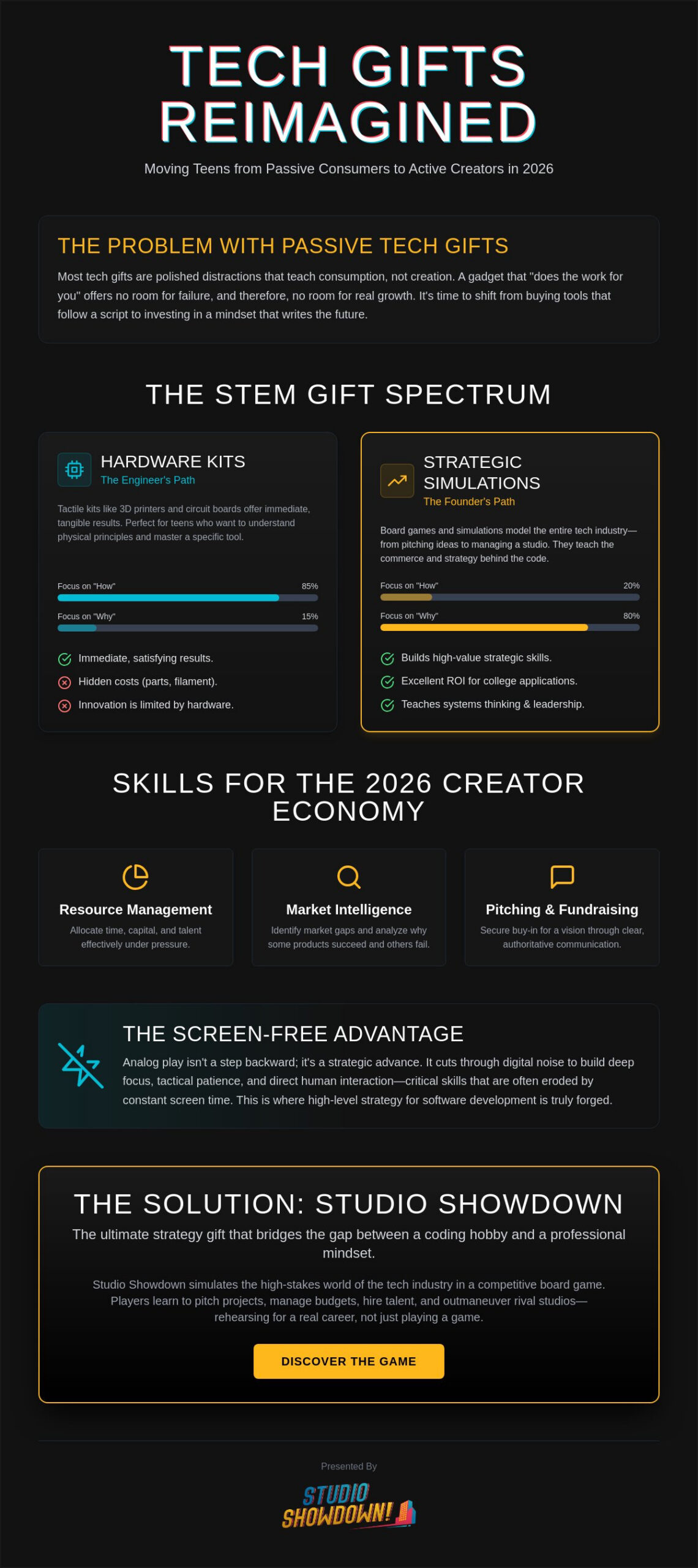
Syntax is easy to Google. Strategy is hard to master. The tech industry now prioritizes “soft” skills that are actually incredibly complex to execute. Pitching an idea, managing limited resources, and analyzing rival studio dynamics are the new essentials. With the strategy game market projected to reach $23.45 billion in 2026, the ability to manage a production cycle is a high-value asset. These skills move a teen from hobbyist to professional.
- Resource Management: Learning to allocate time, capital, and talent effectively under pressure.
- Market Intelligence: Identifying gaps in the market and understanding why certain products fail.
- Pitching and Fundraising: The ability to secure buy-in for a vision through clear, authoritative communication.
Gifts that simulate these high-stakes environments prepare them for the 2026 economy. They build a professional mindset through game-based learning. They learn to navigate the visual noise of a crowded market. This isn’t just play. It’s a rehearsal for a career. It’s about developing the artistic courage to lead a project from concept to launch. High-impact educational gifts for teens interested in tech should bridge the gap between a simple hobby and a scalable career path.
The STEM Gift Spectrum: Hardware Kits vs. Strategic Simulations
Choosing the right path is a tactical decision. Hardware and strategy represent two sides of the same coin. Both align with the goals of national STEM initiatives, but their outcomes differ wildly. Hardware builds the machine. Strategy builds the empire. When selecting educational gifts for teens interested in tech, you must decide if you’re training an operator or a founder. One masters the tool; the other masters the industry. The best gifts don’t just teach a skill; they provide a roadmap for professional success.
Physical Hardware: For Aspiring Engineers
Strategic Simulations: For Aspiring Founders
The tech industry isn’t just code. It’s commerce. This is where strategic simulations outperform traditional kits. By engaging with business simulation games, teens learn the financial risks of development. They discover that a brilliant project can still fail without proper resource management. It’s a high-stakes environment where every move matters. These games provide a massive ROI for college applications because they demonstrate systems thinking and leadership. They move the teen beyond simple logic puzzles and into the world of market mechanics.
Resilience is the ultimate professional skill. In hardware, a mistake might mean a fried circuit board or a jammed printer head. In a strategic simulation, a mistake means losing market share to a rival studio. One costs money; the other builds character. Simulations teach teens to pivot under pressure and manage the visual noise of a competitive market. It’s about developing the artistic courage to lead a project from concept to launch despite the obstacles. If you want a gift that encourages this level of tactical depth, look for tools that simulate the real-world studio experience. You can find a perfect example of this in the Studio Showdown Board Game, which turns development into a high-stakes competition. Balancing hands-on building with high-level strategy is the secret to creating 2026’s tech leaders. High-impact educational gifts for teens interested in tech should always push them beyond the simple logic of a manual.
The Screen-Free Advantage: Why Analog Beats Digital for Tech Mastery
The most advanced training for a digital career often happens away from the screen. It’s a paradox. You want to teach video game development, but you reach for a box of cards and tokens. This is the screen-free advantage. When looking for educational gifts for teens interested in tech, don’t overlook the power of the physical board. Digital environments are full of visual noise and notifications. Analog spaces demand total focus. They strip away the distractions and leave only the pure logic of the system.
Analog play removes the “coding wall.” In a digital environment, a missing semicolon breaks everything. The teen gets frustrated. They quit. In an analog simulation, the logic is transparent. They can see the mechanics moving. They learn the “if-then” structures of game design without the friction of syntax errors. It’s about mastering the architecture before you ever touch the bricks. This clarity is why analog tools are becoming essential for building a professional mindset in 2026.
Tactical Depth in a Physical Format
Physical pieces create a unique cognitive anchor. You can touch the resources. You can see the board state in three dimensions. This is why strategy board games remain the preferred training tool for modern CEOs. They force players to internalize complex systems. In a digital-first generation, building “Analog Literacy” is a competitive edge. It develops the ability to visualize abstract problems without needing a screen to render them. It’s about mental rendering. It’s about tactical depth.
Social Engineering and Negotiation
Tech isn’t a solo sport. Every major studio launch requires massive collaboration. Multiplayer board games simulate this better than any AI. They force teens to engage in social engineering. They have to read their opponents. They have to negotiate for resources. High-impact screen-free activities foster these essential human connections. They teach the art of the deal in a way a screen never can.
The “Pitch” mechanic is a perfect example. A teen might have a great technical idea, but can they sell it? Can they convince a rival to form an alliance? This develops emotional intelligence alongside technical acumen. It prepares them for the real-world competition of the industry. You aren’t just buying a game. You’re buying a boardroom rehearsal. This approach ensures educational gifts for teens interested in tech deliver long-term professional value. It builds the artistic courage needed to lead a project to victory.
Criteria for Choosing High-Impact Gifts for Future Tech Leaders
Stop sorting by “Best Sellers.” Amazon’s algorithms favor sales volume over actual educational value. For educational gifts for teens interested in tech, you need a framework that measures skill acquisition. A high-impact gift isn’t just about the first hour of play. It’s about the fiftieth. It must bridge the gap between a simple hobby and a professional portfolio. If a gift doesn’t force a teen to make difficult decisions, it isn’t teaching them leadership.
Replayability is your first metric. If a kit has a single “correct” solution, it’s a puzzle, not a strategy. You want tools that change every time the teen engages with them. Scalability is equally vital. A gift that works for a single teen but can also dominate classroom environments offers the best return on investment. It prepares them for the group dynamics they’ll face in the professional world. Collaborative potential isn’t just a bonus; it’s a requirement for modern tech mastery.
The “Founder Mindset” Checklist
Evaluating Long-Term Educational Value
Avoid the “One-and-Done” trap. Simple kits that build a single object are often abandoned once the assembly is finished. You need systems that grow with the teen’s knowledge level. Look for games or kits that offer advanced modules. “Expert Editions” are essential for older teens who have already mastered basic logic. They provide the tactical depth required to keep a bright mind engaged for months rather than minutes.
Real-world application means using the same terminology found in industry reports. If a gift doesn’t mention fundraising, market dominance, or production cycles, it’s just a toy. You want your teen to speak the language of a studio head. You want them to understand the stakes of a global launch. Don’t settle for mediocre solutions that offer no professional growth. Build their future today by choosing the Studio Showdown Board Game to master the business of tech. This is how you move them from passive consumption to strategic industry leadership.
Studio Showdown: The Ultimate Strategy Gift for Aspiring Developers
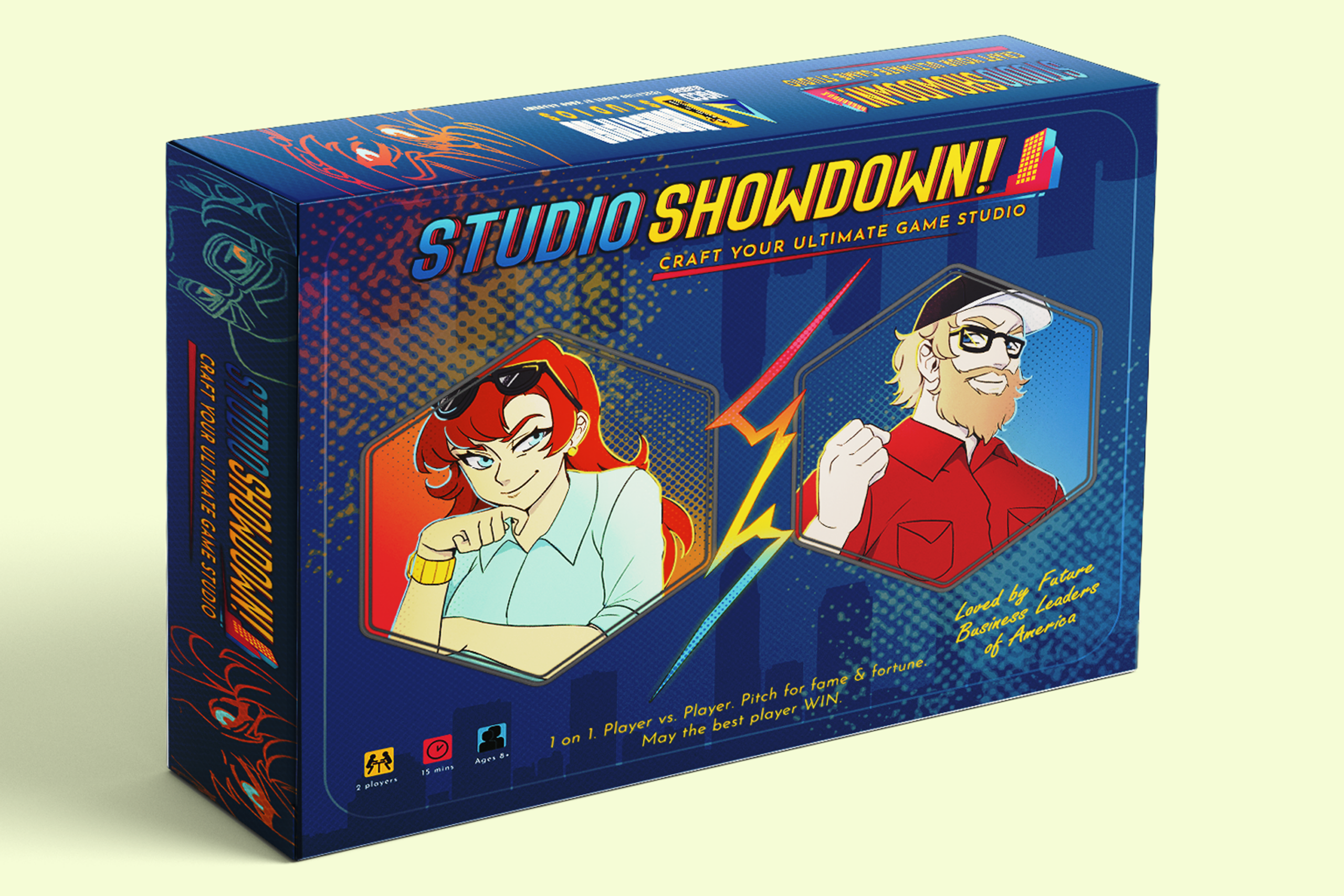
Most educational gifts for teens interested in tech stop at the surface. They teach a specific tool but ignore the industry. Studio Showdown is different. It’s the culmination of everything we’ve discussed: the creator economy, the shift to entrepreneurship, and the power of screen-free tactical depth. This isn’t just a game. It’s a high-stakes simulation that turns players into studio founders. It forces teens to step out of the code and into the boardroom. They don’t just build games; they launch empires.
Parents and educators choose this experience because it builds a professional portfolio. It’s a rehearsal for the real world. In 2026, the tech industry demands more than just technical acumen. It requires the artistic courage to lead and the tactical intelligence to survive. Studio Showdown provides the competitive edge needed to outmaneuver rivals and achieve market dominance. It’s the ultimate bridge between a bedroom hobby and a career in the global gaming market.
From Player to Entrepreneur
The game simulates the brutal reality of launching a hit title. It moves beyond simple logic puzzles. Players must master fundraising, pitching, and resource allocation. If they fail to manage their budget, their project stalls. If they don’t pitch effectively, they lose investors. These are the “soft” skills that define modern tech leaders. Studio Showdown makes these complex concepts tangible. It’s a hands-on learning experience that rewards strategic foresight and punishes hesitation. Every session is a new battle for market share. It’s pörgős, intense, and deeply rewarding.
The Studio Showdown Ecosystem
Choosing the right version depends on your specific goals. For individual learners and families, the standard Studio Showdown Board Game offers endless replayability. It’s the perfect entry point for a teen founder. However, for those looking to integrate these lessons into a formal curriculum, the Studio Showdown: Educator Edition provides additional layers of depth and instruction. It turns any room into a production hub.
- Studio Showdown Board Game: The core experience for aspiring developers and strategy enthusiasts.
- Studio Showdown: Educator Edition: Enhanced tools for mentors who want to guide the next generation of founders.
- Classroom Bundle: The complete solution for institutions looking to foster collaborative tech mastery on a larger scale.
Join a community of students and developers who are already mastering the business of play. Don’t just give them another gadget that will gather dust. Give them the skills to navigate the visual noise of the industry. Give them the ability to turn a vision into a success. This is the new standard for educational gifts for teens interested in tech. Start the showdown. Build the future.
Launch the Next Generation of Tech Founders
The 2026 tech landscape doesn’t reward those who simply follow manuals. It rewards the visionaries. You’ve seen why the creator economy demands skills like fundraising and pitching. You’ve discovered that screen-free strategy offers a tactical depth that digital tools often lack. Finding the right educational gifts for teens interested in tech is about more than just entertainment. It’s about professional scalability and building a mindset that survives the visual noise of the industry.
Don’t settle for kits that gather dust after a single use. Developed by VGCD Academy and DEMYSTIFIED Studios, Studio Showdown is the definitive tool for building a professional mindset. Educators use it to teach real-world business acumen because it focuses on portfolio building through competitive play. It’s time to move your teen from the bedroom to the boardroom. Master the business of gaming with Studio Showdown today. Their journey from passive player to strategic producer starts with the first move. Build the future now.
Frequently Asked Questions
What are the best educational gifts for teens who already know how to code?
Focus on industry management and product strategy rather than more syntax tools. Teens who code already have the technical foundation; they now need to understand how to turn those skills into a viable product. Business simulations or advanced maker tools like laser engravers provide the next level of professional challenge.
How do board games help with a career in tech or game design?
Board games strip away the distractions of syntax and focus purely on system logic and player psychology. You learn to balance complex mechanics and limited resources without the friction of software bugs. This builds the foundational architecture needed for high-level software design and systems thinking.
Are there screen-free gifts that still feel “techy” for teenagers?
Look for analog tools that simulate complex physical or digital systems. Smart motor kits, modular electronics, and industry-focused board games satisfy the technical itch without adding more screen time. These are excellent educational gifts for teens interested in tech because they foster deep focus and tactical depth.
What is the best way to teach entrepreneurship to a tech-focused student?
Place the student in a high-stakes simulation where their decisions have immediate, visible consequences. They need to manage budgets, pitch to imaginary investors, and outmaneuver rivals in a competitive market. Active participation in a simulated business ecosystem is far more effective than passive reading.
Can playing a board game really help a teen build a professional portfolio?
Yes, because it provides documented evidence of strategic mastery and systems understanding. Teens can reference their ability to navigate production cycles and manage risk in interviews or college applications. It proves they understand the business logic and market dynamics behind the technology they create.
How does Studio Showdown compare to traditional STEM kits?
Traditional STEM kits often focus on a single assembly task with one pre-determined outcome. Studio Showdown is a dynamic simulation of the entire video game industry. It teaches scalability, competition, and leadership rather than just simple mechanical assembly or following a manual.
What skills do teens learn from business simulation games?
They master resource management, market analysis, and the high-pressure art of the pitch. These games force players to handle financial risks and production bottlenecks in real-time. It’s a boardroom rehearsal for the actual pressure of a global studio launch.
Are there educational games designed specifically for aspiring game developers?
Studio Showdown is specifically engineered to teach the professional side of game development. It covers the entire lifecycle from initial fundraising to final market dominance. It’s one of the few educational gifts for teens interested in tech that focuses on the reality of the creator economy.